Caribbean · Colombia
Santa Marta & Tayrona
Cold upwelling makes Colombia's Caribbean coast unexpectedly productive
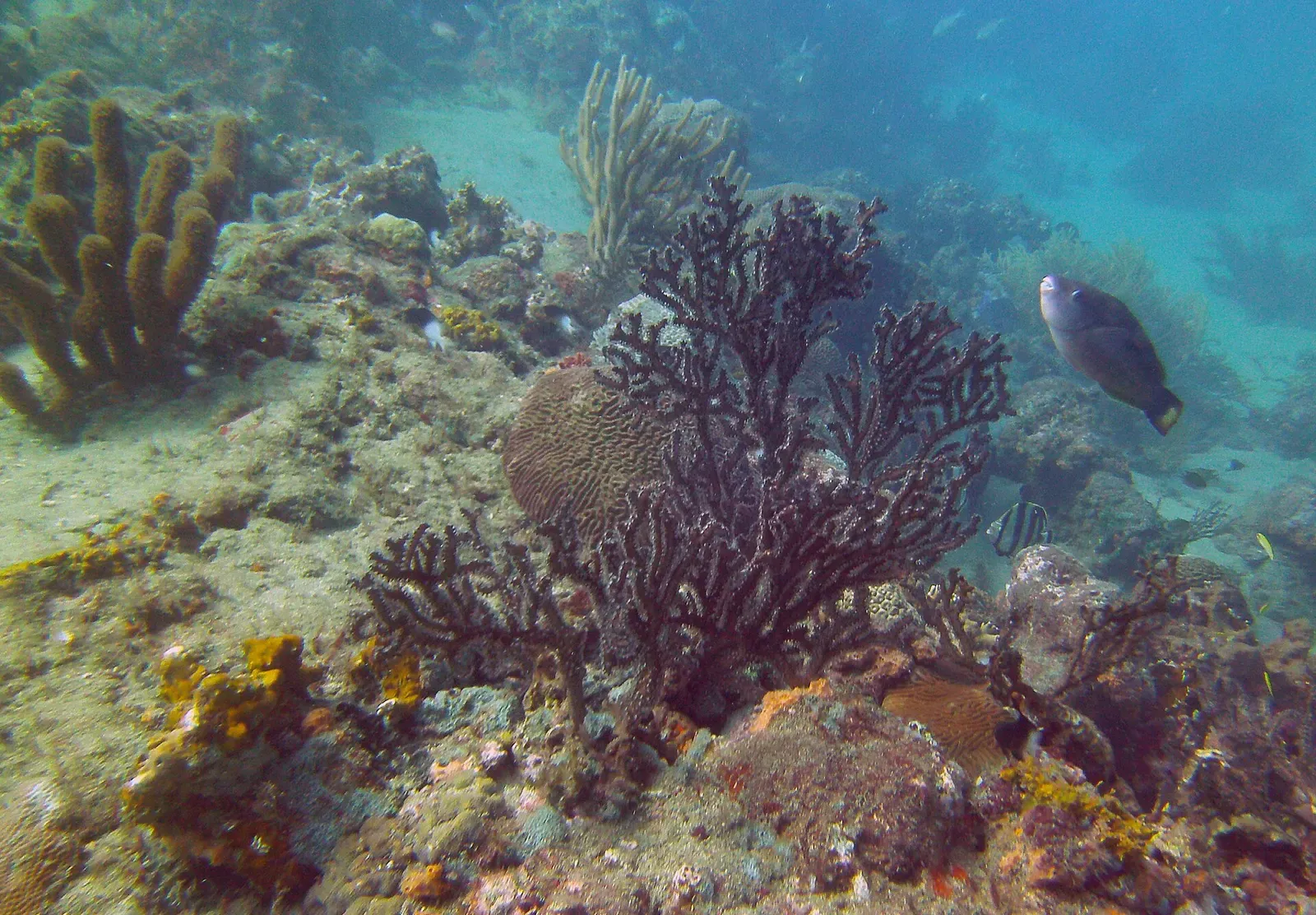
Photo: Tisquesusa · CC BY-SA 4.0
The fishing village of Taganga, outside Santa Marta, is where a large share of South America backpacks its way through an Open Water course, and the diving reflects that: shallow, cheap, busy and better than its reputation. Rocky reefs run along the Tayrona national park coast with unusually high invertebrate diversity, driven by a seasonal upwelling that drops the water to 20°C and turns it green between December and April — the same upwelling that makes the coast productive.
About diving in Santa Marta & Tayrona
A day here starts on Taganga's beach, where open boats load straight off the sand and run a few minutes around the headland. Operators usually put two tanks in before lunch, take the surface interval in a cove, then give the afternoon over to course dives, which is why the same handful of bays fill and empty on a rhythm. Sites are close and shallow enough that a night dive is an add-on rather than an expedition, and a couple of the beaches can be walked into.
The Sierra Nevada drops straight into the sea here and the diving follows that geology: boulders stacked into ledges and swim-throughs, rock faces running onto sand, sponge and gorgonian cover rather than hard-coral framework. Corals grow, but in patches on rock. Sites differ mainly by exposure. The outer points catch current and hold schooling fish, while the enclosed bays stay calm and a little silty, and that is where the small subjects live. A few sunken vessels add another texture.
The water changes character twice a year and the diving changes with it. Through the middle of the year it is warm and settled, open enough for wide-angle work on the points and for longer profiles at the deeper headlands. From December into April the cold, nutrient-heavy water pushes in: dives get shorter, 3 mm stops being enough neoprene, and a torch earns its place even at midday, but invertebrate life is at its most active. Anyone who enjoys hunting small subjects gets more from this coast than anyone chasing visibility.
Best time to dive Santa Marta & Tayrona
| Jan | Feb | Mar | Apr | May | Jun | Jul | Aug | Sep | Oct | Nov | Dec | |
|---|---|---|---|---|---|---|---|---|---|---|---|---|
| Season | Fair | Fair | Fair | Good | Good | Prime | Prime | Prime | Prime | Good | Good | Fair |
| Sea surface | 26°C79°F | 25°C77°F | 25°C77°F | 26°C79°F | 28°C82°F | 28°C82°F | 27°C81°F | 28°C82°F | 29°C84°F | 29°C84°F | 29°C84°F | 27°C81°F |
| Daytime high | 28°C82°F | 28°C82°F | 28°C82°F | 29°C84°F | 29°C84°F | 30°C86°F | 29°C84°F | 30°C86°F | 30°C86°F | 30°C86°F | 29°C84°F | 29°C84°F |
| Rain | 8 mm0.3 in | 12 mm0.5 in | 10 mm0.4 in | 42 mm1.7 in | 247 mm9.7 in | 134 mm5.3 in | 92 mm3.6 in | 141 mm5.6 in | 206 mm8.1 in | 268 mm10.6 in | 135 mm5.3 in | 25 mm1.0 in |
| Jan | Feb | Mar | Apr | May | Jun |
|---|---|---|---|---|---|
| Fair | Fair | Fair | Good | Good | Prime |
| Sea surface | |||||
| 26°C79°F | 25°C77°F | 25°C77°F | 26°C79°F | 28°C82°F | 28°C82°F |
| Daytime high | |||||
| 28°C82°F | 28°C82°F | 28°C82°F | 29°C84°F | 29°C84°F | 30°C86°F |
| Rain | |||||
| 8 mm0.3 in | 12 mm0.5 in | 10 mm0.4 in | 42 mm1.7 in | 247 mm9.7 in | 134 mm5.3 in |
| Jul | Aug | Sep | Oct | Nov | Dec |
|---|---|---|---|---|---|
| Prime | Prime | Prime | Good | Good | Fair |
| Sea surface | |||||
| 27°C81°F | 28°C82°F | 29°C84°F | 29°C84°F | 29°C84°F | 27°C81°F |
| Daytime high | |||||
| 29°C84°F | 30°C86°F | 30°C86°F | 30°C86°F | 29°C84°F | 29°C84°F |
| Rain | |||||
| 92 mm3.6 in | 141 mm5.6 in | 206 mm8.1 in | 268 mm10.6 in | 135 mm5.3 in | 25 mm1.0 in |
2011–2025 averages. Sea surface: NOAA Coral Reef Watch, measured at the surface, so deeper water can run colder. Daytime high and rain: NASA POWER.
Jun–Oct is warmest and clearest; the Dec–Apr upwelling brings 20°C green water, good for life but poor for visibility.
Best months: June, July, August, September
Santa Marta water temperature and weather by month
The sea surface runs from 25 °C (77 °F) in February to 29 °C (84 °F) in October. Most rain falls from August to November, peaking at about 270 mm (11 in) in October; it stays largely dry from December to April. Daytime highs sit around 29 °C (84 °F) all year. Below the surface the water can drop to about 20 °C (68 °F), so pack a 5 mm suit.
Dive types & marine life
Octopus, nudibranchs and other macro subjects are the constant, and they are busiest in the cold green water from December to April. Turtles, stingrays on the sand, grouper under the ledges and barracuda over the points read better through the warm settled months of June to October, when visibility opens up enough for wide-angle work.
- Reef
- Wall
- Wreck
- Muck & macro
- Night
- Sea turtles
- Octopus & cuttlefish
- Nudibranchs
- Macro critters
- Reef fish swarms
- Groupers
- Stingrays
- Barracuda
Best dive sites in Santa Marta & Tayrona
Wall
A coral wall with a small cave and a submerged statue, popular for night dives
Reef
Taganga's main training ground, with a deeper wall close by
Morro Grande
Headland dropping to 30 m, the area's deepest and least crowded site.
Punta Venado
Tayrona park point with rock ledges and good macro on the sand.
Bahía Concha
Sheltered park bay used for training and easy second dives.
How to get to Santa Marta & Tayrona
Fly into Santa Marta from Bogotá or Medellín, or come overland from Cartagena in roughly four hours. Taganga is a short taxi ride over the hill from the city, shops line the bay and boats load off the beach, so there is no marina transfer. Stay in Taganga to be next to the boats, or in Santa Marta or Rodadero for more rooms and places to eat.
Photos from Santa Marta & Tayrona
Jorge Láscar · CC BY 2.0
Ben Bowes · CC BY 2.0
Ben Bowes · CC BY 2.0
Ben Bowes · CC BY 2.0
Jorge Láscar · CC BY 2.0
Dive videos
¿CÓMO es Bucear en El Parque Tayrona? || Scuba Diving in Parque Tayrona || Taganga · edwin.everywhere on YouTube
Photo credits
- Sea fans, sponges and a reef fish at Isla Aguja in Tayrona National Park, Colombia by Tisquesusa, CC BY-SA 4.0, via Wikimedia Commons
- Turquoise bay at Cabo San Juan de la Guía, the iconic Tayrona National Park cove near Santa Marta by Jorge Láscar, CC BY 2.0, via Wikimedia Commons
- Rocky point and sandy beach at Arrecifes in Tayrona National Park near Santa Marta by Ben Bowes, CC BY 2.0, via Wikimedia Commons
- Granite boulders and turquoise water along the Tayrona National Park coastline near Santa Marta by Ben Bowes, CC BY 2.0, via Wikimedia Commons
- A fishing boat anchored beside a giant rounded boulder at La Piscina cove in Tayrona National Park by Ben Bowes, CC BY 2.0, via Wikimedia Commons
- Boulder-strewn shoreline and a moored boat along the Tayrona park coast near Cabo San Juan by Jorge Láscar, CC BY 2.0, via Wikimedia Commons
Embed
Run a dive centre, club or blog? Embed this map of 2 dive sites near Santa Marta on your own page.
In The Logbook
- Cheapest places to scuba dive, and the catchTrip planning · 15 min read
Similar destinations

Swim off a beach onto a wall that drops past 900 metres

Lava flows, old wreck sites and night turtles in a marine park
Caribbean
Tobago — Crown Point & Mount Irvine
Trinidad and Tobago
A critter wall on the calm Caribbean side and drift dives at the Atlantic south end


.jpg)


.jpg)
A Soviet frigate lies broken in two between 15 and 30 m