Durban · South Africa · Wreck
Coopers Light Wreck
A nameless 76 m steamship whose origin and sinking remain a mystery.
Area photo: Peter Southwood · CC BY-SA 4.0
An iron steamship of unknown name sitting upright on sand in 30 m off the Coopers lighthouse on the Bluff. Nobody has recorded how she sank, and the whole ship can be seen in one dive. It is Durban's most interesting wreck within recreational range, and it is where the endemic harlequin goldie was first found.
Also known as Coopers Light, Cooper's Light wreck.
Where it is and how deep
29.9579° S, 31.0137° EApproximate position — the dashed circle shows where the site lies; your operator's briefing has the mooring.
The dive
The skipper hooks the wreck with an anchor tied to a buoy, and divers go down the shot line onto the hull. She is 76 m long and 10.5 m wide and sits upright on the sand, perpendicular to the shore, in 30 m of water. The iron hull still shows its boilers and a single propeller, with a chip taken out of one blade by salvors testing whether it was brass.
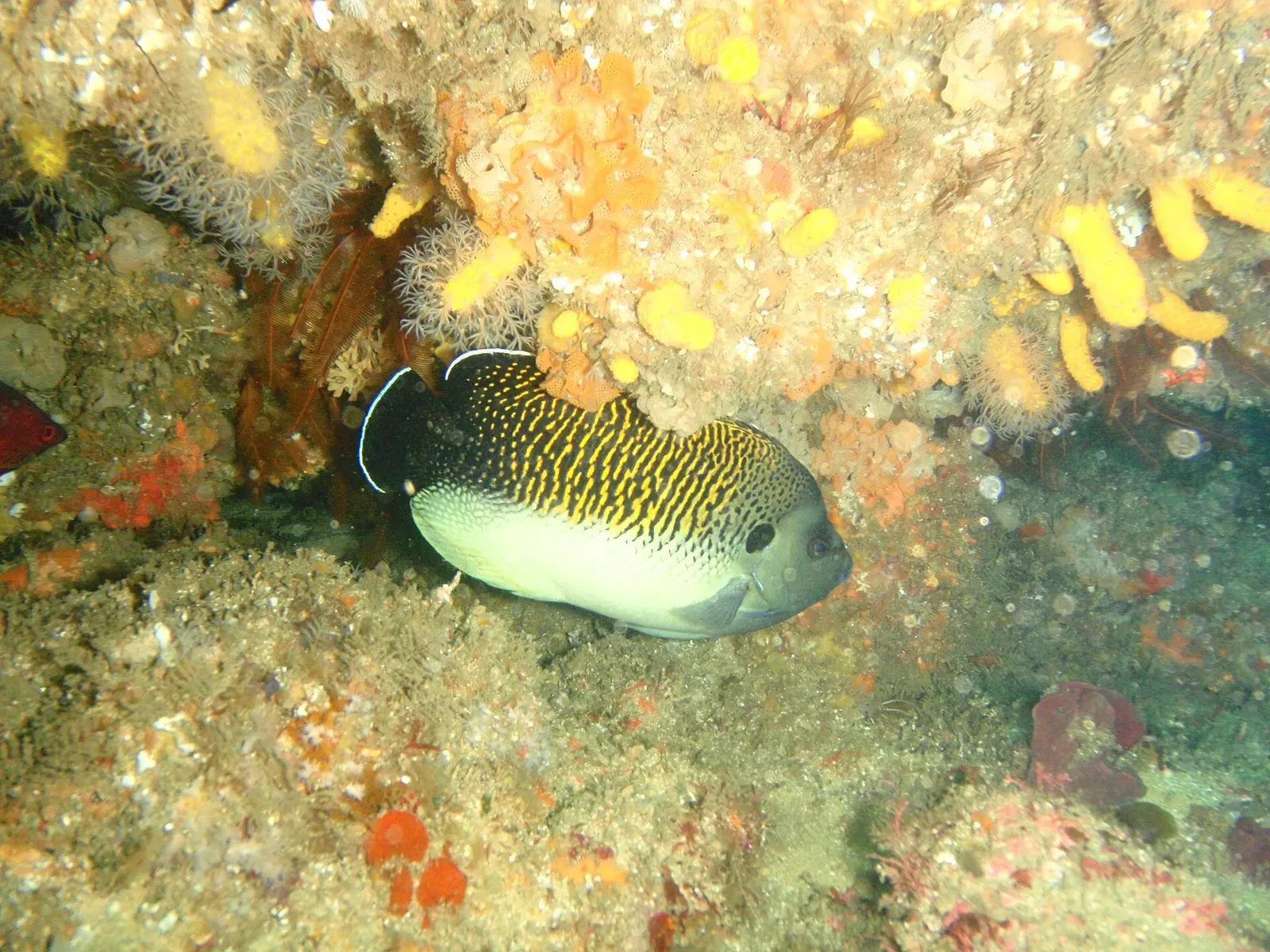
The size of the wreck makes it possible to cover the whole ship in one dive. The prop, the rudder and the bow are the wide-angle subjects. A structure at the stern resembles a harpoon gun, and bollards at bow and stern have led to talk that she served with the whaling fleet. Juvenile angelfish and butterflyfish, scorpionfish, paperfish, lionfish, eels and coral banded shrimps live on the hull, along with the harlequin goldie, a species endemic to KwaZulu-Natal.
There are two ways to end the dive. Divers either return to the shot line at 125 bar, judging the current and visibility so they reach it with air to spare, or the divemaster sends up a deploy buoy and the group ascends on it from anywhere on the wreck at 50 bar. Air and decompression are the limits that set the length of the dive.
The wreck
- Vessel
- Unidentified (Coopers Light Wreck)
- Type
- Iron single-propeller steamship
- Length
- 76 m (249 ft)
- Cause
- No record of her sinking; most likely scuttled after decommissioning
- Lies
- Upright on sand at 30 m, perpendicular to the shore
The wreck was found by ski-boat fishermen who first took it for a reef, and it was first dived in 1974 by Darroll Smith. Fishermen took Navy, Police and club divers out to recover the anchors lost on it, a collaboration that opened boat diving in KwaZulu-Natal. Her name, origin and how she came to be on the seabed are still unknown: archive vessels of similar size all had twin propellers. On 29 July 1979 Dr Allen Connel dived her and discovered the harlequin goldie.
Marine life and season
The sources we used don't single out particular species here.
| Jan | Feb | Mar | Apr | May | Jun | Jul | Aug | Sep | Oct | Nov | Dec |
|---|---|---|---|---|---|---|---|---|---|---|---|
| Good | Good | Prime | Prime | Prime | Prime | Prime | Good | Fair | Fair | Fair | Fair |
Season follows Durban: March to July is best: low rainfall and south-westerlies bring clear water. Spring rain (September to December) clouds the water near the harbour and Umlaas canal mouths.
Know before you go
- Running out of air and straying into decompression are the main risks; plan the turn at 125 bar for the shot line.
- Current and visibility vary, so assess both before leaving the shot line or ascend on a deploy buoy instead.
Questions divers ask
How deep is the Coopers Light Wreck?+
The wreck sits upright on sand in 30 m of water, and dives on it run from 25 to 30 m.
Where is the Coopers Light Wreck?+
Off the Bluff, south-east of the Coopers lighthouse, between the Umlaas cutting and Brighton Beach. It is reached by boat from Vetch's Pier.
Sources
- Durban Dive Sites – Wrecks — Durban Undersea Club
- Diving in Durban — Wikivoyage
More dive sites in Durban
Reef
Sandstone ledges and caves where raggies rest on migration.
Wreck
A 34.5 m prawn trawler wrapped in shoals of bait fish.
Reef
One of the few places to see the endemic harlequin goldie.
Reef
A shallow ledge reef reached by a swim across the sand from Vetch's.
Reef
Durban's deep offshore reef, with caves used by migrating raggies.
Wreck
The boilers of a 1940 sugar ship, reached from Addington Beach.
Artificial reef
A 48-compartment concrete barge with a steel gantry at the T junction.
Wreck
Boilers, mast, bow and stern all visible from the surface.
Similar dives elsewhere
Wreck
Alpha Funguo Wreck
Diani Beach · Kenya
A purpose-sunk trawler carrying frogfish, nudibranchs and batfish
Wreck
MV Dania
Mombasa, Nyali & Bamburi · Kenya
A former livestock carrier sitting upright on the sand, ringed by barracuda


A 176-metre molasses carrier broken across the sand at 32 metres.
The propeller and boiler are still identifiable in the broken stern.