Durban · South Africa · Reef
Harlequin Reef
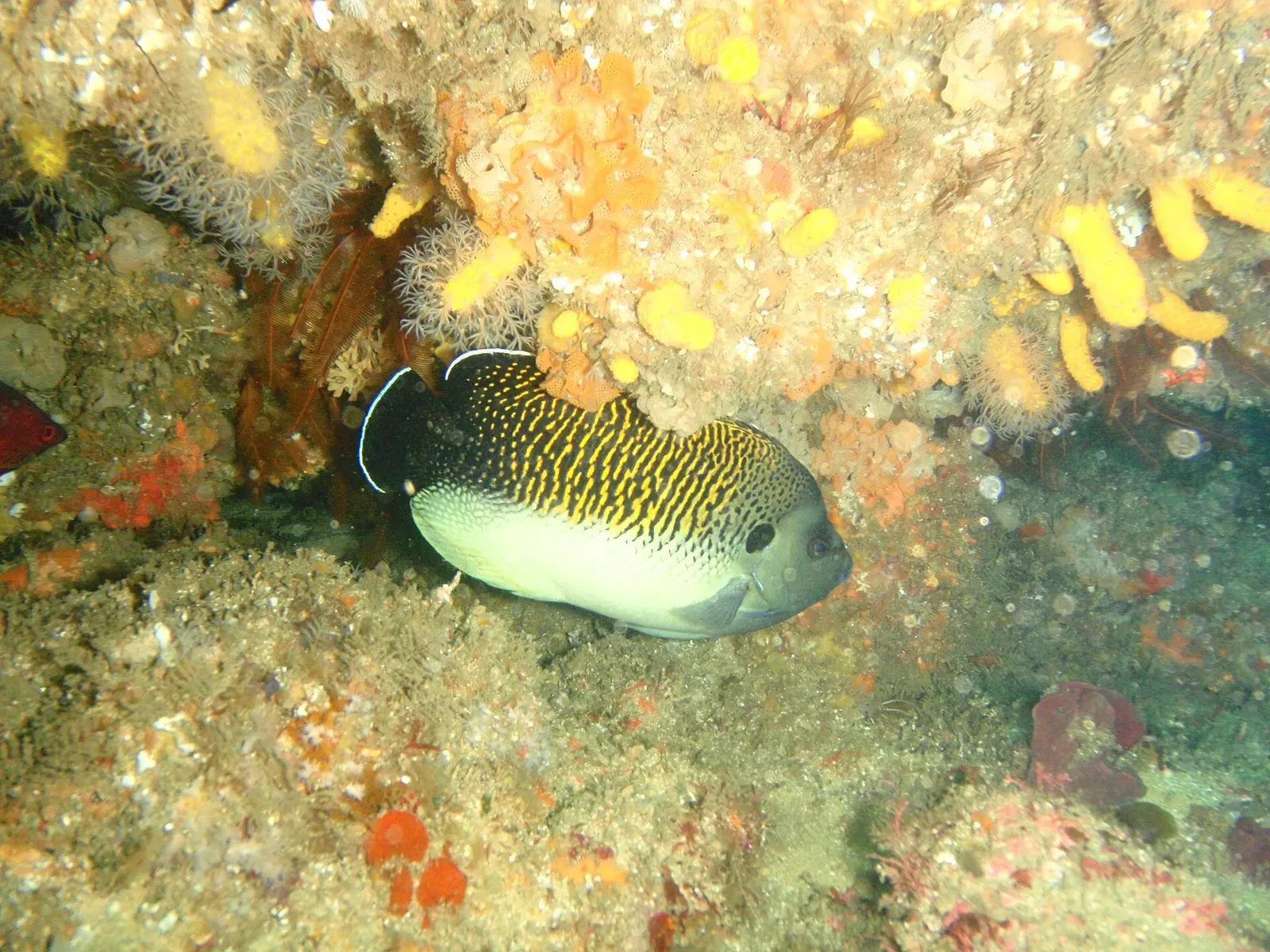
One of the few places to see the endemic harlequin goldie.
Area photo: Peter Southwood · CC BY-SA 4.0
A deep reef off the Bluff, between 30 and 35 m, shaped like a bread loaf on the sand and possibly an old concrete barge. It is named for the harlequin goldie, a fish endemic to KwaZulu-Natal, and is dived only in perfect conditions by experienced divers.
Where it is and how deep
No published position for this site — the map shows Durban and its other sites; operators know the mooring.
The dive
Harlequin Reef lies between 30 and 35 m and looks like a bread loaf sitting on the sand. It may in fact be a wreck, possibly an old concrete barge. A large anchor and chain lie on the site. The dive is attempted only in perfect conditions: good visibility and no current are prerequisites.
The reef is named after the harlequin goldie that lives on it. This uncommon goldie, endemic to the KwaZulu-Natal coast, was once thought to live only on wrecks, but it has been found here, on No.1 Reef and on a few isolated reefs in the Phumula and Rocky Bay area of the South Coast. The depth calls for redundancy: H-valve cylinders and bailout cylinders.
Marine life and season
The sources we used don't single out particular species here.
| Jan | Feb | Mar | Apr | May | Jun | Jul | Aug | Sep | Oct | Nov | Dec |
|---|---|---|---|---|---|---|---|---|---|---|---|
| Good | Good | Prime | Prime | Prime | Prime | Prime | Good | Fair | Fair | Fair | Fair |
Season follows Durban: March to July is best: low rainfall and south-westerlies bring clear water. Spring rain (September to December) clouds the water near the harbour and Umlaas canal mouths.
Know before you go
- At 30 to 35 m, gas and decompression limits are tight; carry redundant gas with H-valves and a bailout cylinder.
- Dive only in good visibility with no current; any current rules the site out.
Questions divers ask
Where can the harlequin goldie be seen near Durban?+
Harlequin Reef off the Bluff is one of the few sites with the harlequin goldie, an endemic KwaZulu-Natal fish also found on No.1 Reef.
Sources
- Durban Dive Sites – Reefs — Durban Undersea Club
- Diving in Durban — Wikivoyage
More dive sites in Durban
Reef
Sandstone ledges and caves where raggies rest on migration.
Wreck
A nameless 76 m steamship whose origin and sinking remain a mystery.
Wreck
A 34.5 m prawn trawler wrapped in shoals of bait fish.
Reef
A shallow ledge reef reached by a swim across the sand from Vetch's.
Reef
Durban's deep offshore reef, with caves used by migrating raggies.
Wreck
The boilers of a 1940 sugar ship, reached from Addington Beach.
Artificial reef
A 48-compartment concrete barge with a steel gantry at the T junction.
Wreck
Boilers, mast, bow and stern all visible from the surface.
Similar dives elsewhere

Black coral and metre-wide basket sponges at 30 to 40 m

Deeper outer system of branching, table and plate corals
One of two launch points for the Pondoland reefs, 12 to 40 metres


Eight park islets, minutes from the only dive base on Mohéli