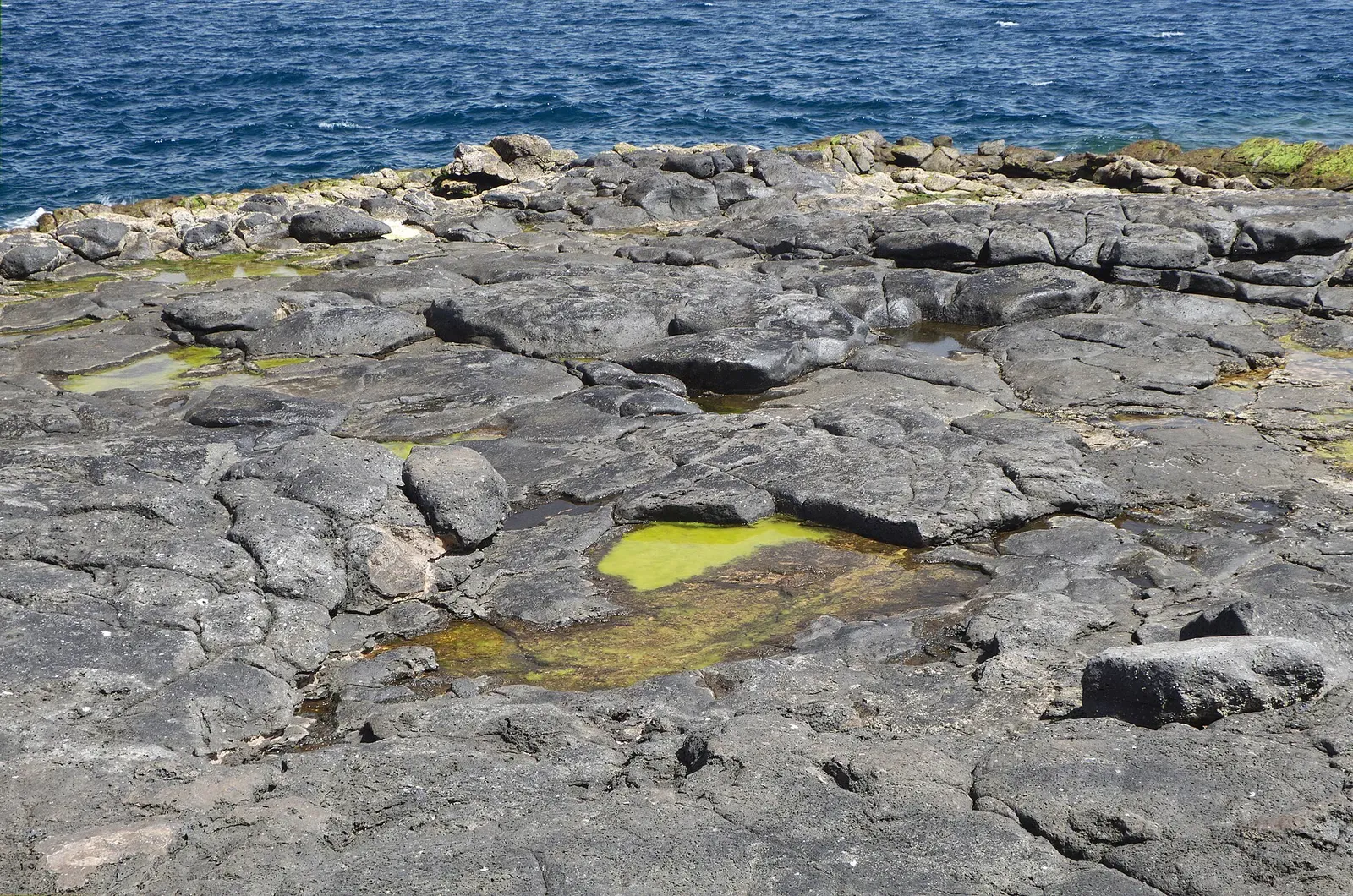
Fuerteventura · Spain · Wall
Anchors
Huge ancient anchors on a wall running from 18 m to 27 m
Area photo: H. Zell · CC BY-SA 3.0
A classic wall off Lobos. You descend to 18 metres to reach the drop, and from there the rock keeps falling to between 25 and 27, followed in either direction on a west-to-east line. The huge, ancient anchors that give the site its name lie on the way west. Groupers, breams and banks of sardines are constant company.
Also known as Anchors Canary.
Where it is and how deep
28.7579° N, 13.8478° WPublished position for this site.
The dive
The dive begins with a descent to 18 metres, which is where the drop starts. From that lip the wall keeps falling to between 25 and 27 metres, and it can be followed on either side along a west-to-east line, so the direction is chosen on the boat with the conditions rather than dictated by the rock.
Going west is what gives the site its name: huge, ancient anchors lie on the way, and they are the landmark the dive is built around. Groupers, breams and banks of sardines run with the group throughout, and tuna and amberjacks come through from time to time. Down in the rocks there are rays, lobsters and moray eels to be picked out of the cracks.
Depth is what sets the level. With the drop at 18 metres and the foot of the wall at 25 to 27, no-decompression time is short and the dive is planned to end on it rather than on the terrain. Groups work back up the face to the top of the drop and hold the stop there, in the shallower water above the wall.
Background
The site is called Anchors because of the huge and ancient anchors that lie on the ground as the wall is followed towards the west. They are the reason divers pick that direction rather than the other. The source gives no date for them and does not say which ships they came from or how they ended up on this piece of wall, so they are counted as the site's landmark rather than as an identified archaeological find.
Marine life and season
- Groupers
- Sardine baitballs
- Tuna
- Trevally & jacks
- Reef fish swarms
- Macro critters
| Jan | Feb | Mar | Apr | May | Jun | Jul | Aug | Sep | Oct | Nov | Dec |
|---|---|---|---|---|---|---|---|---|---|---|---|
| Good | Good | Good | Good | Good | Prime | Prime | Prime | Prime | Prime | Good | Good |
Season follows Fuerteventura: Divable in every month; water runs 18–23°C, coolest in late winter and warmest from August into October, and the desert climate keeps conditions mild.
Questions divers ask
Why is the site called Anchors?+
Because of the huge, ancient anchors found along the wall towards the west. Neither their age nor the ships they came from is recorded by the source.
How deep is the Anchors dive?+
You descend to 18 metres to reach the drop and the wall continues down to between 25 and 27 metres, which puts the dive in Advanced and deep territory.
Sources
- Anchors dive site — Scubago
More dive sites in Fuerteventura
Reef
A false ceiling right around a 10 m shoal off Corralejo
Wall
A vertical drop from a 12 m platform to 22 m off Lobos
Anchors, masts and a sunken buoy on an 8 m harbour bottom
Cave & cavern
A narrow gorge from 23 m to a portal in the reef at 32 m
Reef
A reef edge at 7 m that steps down to past 40 m
Reef
A diveable breakthrough in an 18 m rock wall at 32 m
Reef
A volcanic plateau at 24 m dropping to sand at 35 m
Reef
Wreckage and coal at 12 m under a reef that crests at 1.5 m
Similar dives elsewhere
A 15 m to 33 m wall, run only when the current allows
A gorgonian field at 30 m, with one fan over 2 m across

Wall of blue and purple gorgonians to 32 m on the outer islets
Wall
Ilhéu de Vila Franca
Azores · Portugal
Passages in the wall of a protected volcanic islet