Africa · South Africa
Gansbaai
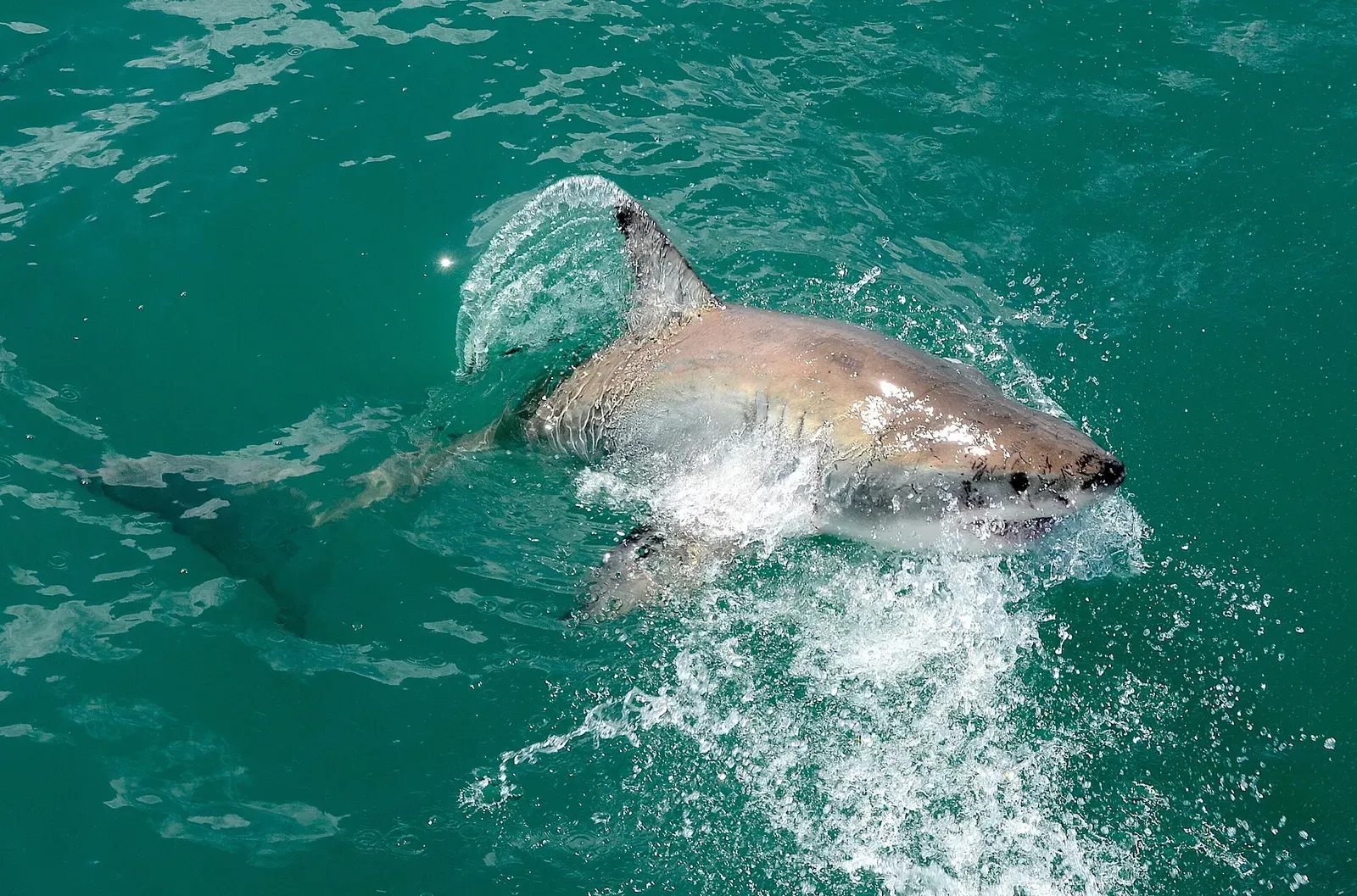
Cage-dive Shark Alley, once the world's surest great white ground, now an open question.
Photo: Olga Ernst · CC BY-SA 4.0
Gansbaai is a fishing town on South Africa's Western Cape coast that became, from around 1995, the world's best-known great white shark cage-diving base: boats leave the slipway at Kleinbaai for Shark Alley, the shallow channel between Dyer Island's penguin colony and the roughly 60,000 Cape fur seals hauled out on Geyser Rock. Since 2015 two orcas nicknamed Port and Starboard have hunted white sharks along this coast for their livers, and sightings here have collapsed for long stretches; the same boats now run largely for bronze whaler and sevengill sharks instead.
About diving in Gansbaai
Cage diving became Gansbaai's main trade in about 1995, and the town was soon routinely billed as the great white shark capital of the world. Boats run out of Kleinbaai, a small harbour minutes from Gansbaai, for the roughly 8 km crossing to Dyer Island and Geyser Rock, where operators such as Marine Dynamics work Shark Alley, the channel between the two islands, from a surface cage fed by air piped from a compressor, so no diving qualification is needed to get in. What draws sharks to the channel is Geyser Rock's Cape fur seal colony, some 60,000 animals strong; Dyer Island's penguins and bottlenose dolphins work the same water, but neither island can be landed on.
From around 2015 the picture changed. Two male orcas with distinctive collapsed dorsal fins, nicknamed Port and Starboard, began hunting white sharks along this coast, flipping them into a paralysed state and eating only the liver; carcasses started washing up with nothing else touched, and a 4.9 m female known as Khaleesi was found this way in 2017. Sightings at Gansbaai and neighbouring False Bay fell toward zero for long periods, and several operators have since closed.
Whether the sharks relocated east to Algoa Bay and KwaZulu-Natal or the population genuinely declined is disputed in the scientific literature: a 2023 study argues for stable numbers and eastward redistribution, while a 2024 rebuttal points to falling KwaZulu-Natal catch rates as evidence against a clean relocation story. Operators still running increasingly market bronze whaler (copper) sharks and broadnose sevengill cowsharks, which keep showing up in the same water, as much as the white sharks they were built around.
The activity has a real safety record worth knowing rather than guessing at. In 2005 a great white bit through the bars of a cage off this coast, and the diver was pulled out unharmed as the crew fought the shark off; in 2008 a cage boat anchored over the nearby Geldsteen reef in rising swell was capsized by a large wave, throwing all 19 aboard into the water and killing three; a 2014 court found the skipper and operators negligent for anchoring over a shallow reef in worsening conditions rather than the shark encounter itself. No diver at Gansbaai is documented as having been bitten inside an intact cage.
When to dive Gansbaai
| Jan | Feb | Mar | Apr | May | Jun | Jul | Aug | Sep | Oct | Nov | Dec |
|---|---|---|---|---|---|---|---|---|---|---|---|
| Good | Good | Good | Good | Fair | Fair | Fair | Fair | Fair | Good | Good | Good |
Ratings track Cape winter swell on the Kleinbaai crossing, not shark odds; cold fronts between May and September most often cancel trips.
Best months: January, February, March, April, October, November, December
Dive types & marine life
Trip listings once named April to September as the prime white-shark window here; that calendar no longer holds. Since 2015 the orcas Port and Starboard have hunted white sharks along this coast, and in any given month a trip may see none at all. Bronze whaler and sevengill sharks are now the steadier draw, and Cape fur seals are on Geyser Rock year-round regardless.
- Pelagic & blue water
- Wreck
- Great whites
- Seals & sea lions
- Penguins
- Dolphins
Notable dive sites in Gansbaai
Pelagic & blue water
A surface cage in the channel where 60,000 seals once reliably drew great whites
Dyer Island
Nature reserve with a declining African penguin colony; closed to the public.
Geyser Rock
Home to roughly 60,000 Cape fur seals, the reason sharks hunted here at all.
HMS Birkenhead wreck
1852 troopship wreck off Danger Point at 24-28 m, source of 'women and children first'.
Getting there
Kleinbaai, the boat departure point, is a little over two hours' drive from Cape Town on the N2 and R43, past Hermanus. Gansbaai itself is a working fishing town of around 11,600 people rather than a resort, and most operators collect divers from accommodation in town or nearby Kleinbaai on the morning of the trip.
Photos from Gansbaai
Winfried Bruenken (Amrum) · CC BY 3.0
Bernard DUPONT · CC BY-SA 2.0
Photo credits
- A great white shark breaks the surface off Gansbaai, dorsal fin cutting through green water by Olga Ernst, CC BY-SA 4.0, via Wikimedia Commons
- A diver crouches inside a steel shark cage lowered off the stern of a boat at Gansbaai by Winfried Bruenken (Amrum), CC BY 3.0, via Wikimedia Commons
- Low buildings on rocky Dyer Island seen from choppy blue water, seabirds circling above by Bernard DUPONT, CC BY-SA 2.0, via Wikimedia Commons
In The Logbook
- Tiger, bull and white: the big shark divesBig animals · 14 min read
Similar destinations

Ragged-tooth sharks hang in mid-water over the offshore reefs each summer

Equatorial volcanic pinnacles almost nobody has dived

Ragged-tooth sharks pack Cathedral cave through the southern winter.

.jpg)


East Africa's last viable dugong population, in a 1971 national park