The dive every old listicle still recommends is gone
For two decades the question “where do you cage-dive with great whites?” had three headline answers: Gansbaai in South Africa, the Neptune Islands in South Australia, and Isla Guadalupe off Mexico’s Pacific coast. Guadalupe was arguably the best of them — clear blue Pacific water, big animals, a fleet that grew from a single boat in 2005 to as many as eight operators by 2019.
It no longer exists as a dive. In May 2022 Mexico suspended shark tourism at the island to evaluate its impact; on 10 January 2023 CONANP, the country’s protected-areas commission, made the closure permanent through a new management plan for the Guadalupe Island Biosphere Reserve. The plan’s wording, as reported at the time, is categorical: “White shark observation may not be carried out in the Reserve for tourist purposes, to avoid altering their habitat, behavior, and feeding sites.” The ban covers all tourism in the reserve — film crews and liveaboards included — and the decision followed reports of safety violations, including divers swimming outside cages and improper chum handling, along with two incidents in which sharks were harmed after becoming caught between cage bars. Operators do not expect it back: one of the displaced companies drew the parallel with Cedros Island, closed more than 25 years ago and never reopened.
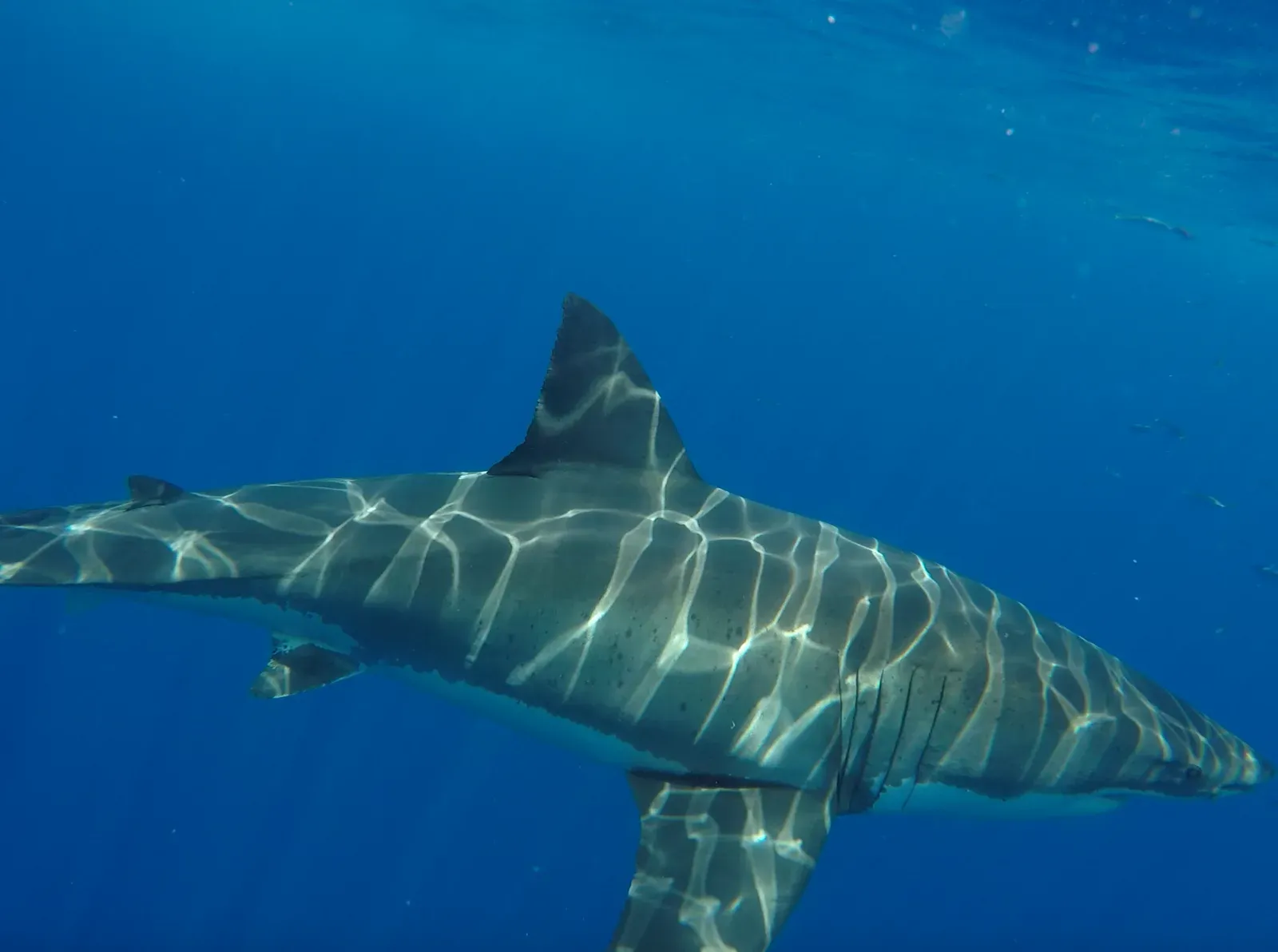
Three years on, most of the internet has not caught up, and Guadalupe still tops lists of “best shark dives” that were stale before they were published. That is the reason this guide exists. The big three species — tiger, bull and great white — are still very much diveable, but the map has moved, the law has moved, and the science has moved. Across our dataset, tiger sharks are tagged at twenty sites and bull sharks at sixteen; great whites are down to five sites in three places on earth. What follows is the honest version.
Baited, provisioned, natural — three different dives
The phrase “shark feeding” gets used for everything, and it shouldn’t be, because the science below answers different questions for each practice.
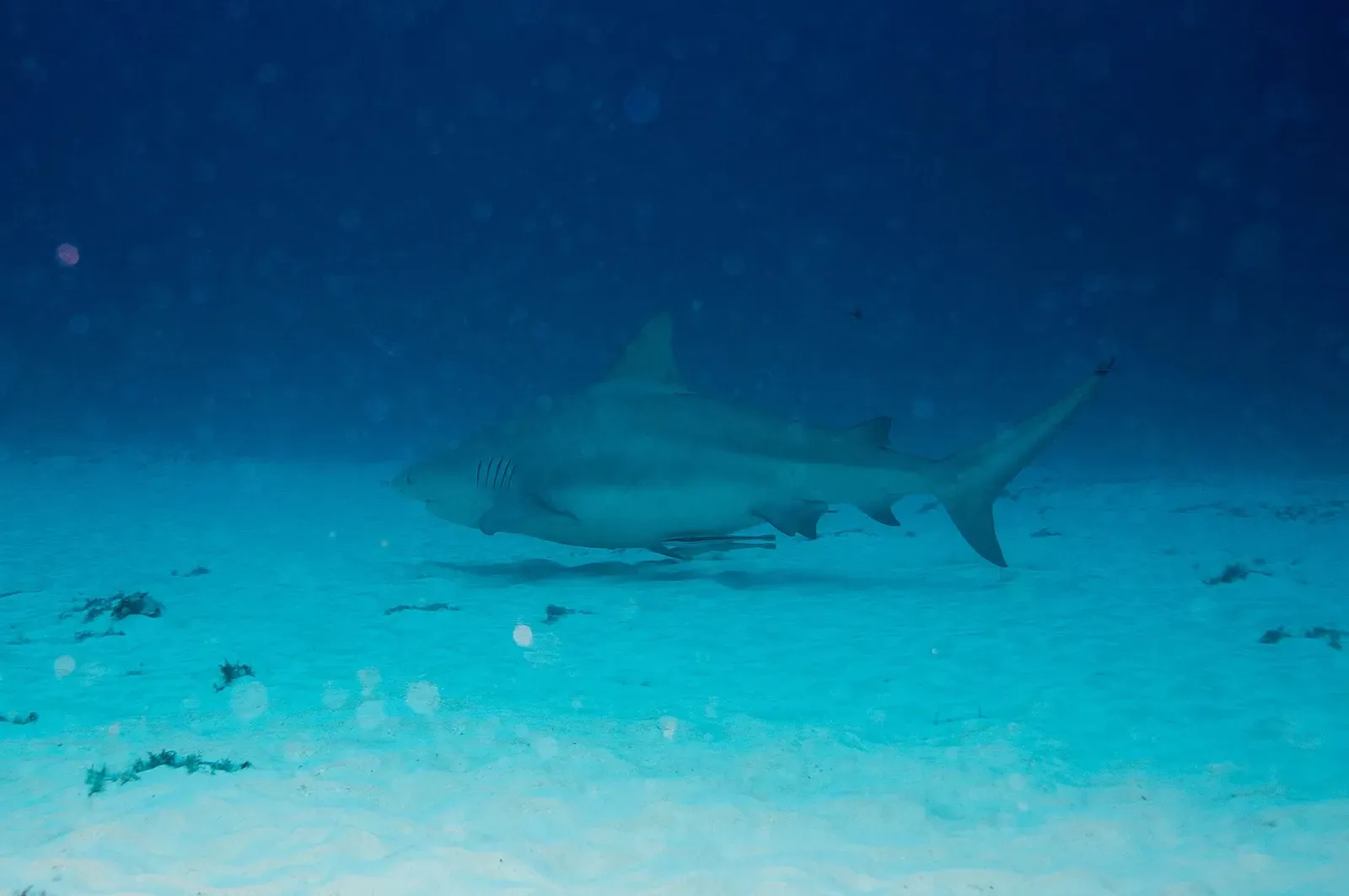
Baited dives use an attractant that the sharks do not, by design, get to eat: a berley trail behind a Neptune Islands cage boat, the sealed bait drum drifting off Aliwal Shoal. Provisioned dives actually feed the animals — the tuna heads at Fuvahmulah, the hand-fed wall of bull sharks at Beqa Lagoon. Natural encounters use no attractant at all: the bull sharks that arrive at Cabo Pulmo with the warm water, the unbaited winter drift at Jupiter, the blue-water hangs at Pinnacles off Ponta do Ouro.
The distinction changes what you are buying. A provisioned dive is close to guaranteed and tightly choreographed; a natural one is a probability, not a promise. It also changes the briefing. At Tiger Beach the operator’s language is that divers “will be overweighted and kneeling on the bottom” so all attention stays on the sharks, in black wetsuits and gloves because bright skin-to-suit contrast “might spark unwanted investigation”. Nobody says that before an unbaited drift at Cabo Pulmo, because nothing there is being invited in.
Tiger sharks: a sand flat, a harbour mouth and a naming trap
Tiger Beach off Grand Bahama is the template baited big-shark dive: a bright sand bank in eight to ten metres on the Little Bahama Bank, no reef, divers kneeling in a line on the bottom while tiger sharks circle within arm’s reach. The backdrop matters — the Bahamas banned longline fishing in the early 1990s and declared its entire EEZ a shark sanctuary in 2011, which is a large part of why the sharks are there in numbers. The same patch of sand reliably holds lemon and Caribbean reef sharks, with great hammerheads through winter; the operator’s line is that six shark species on one dive is not unusual.
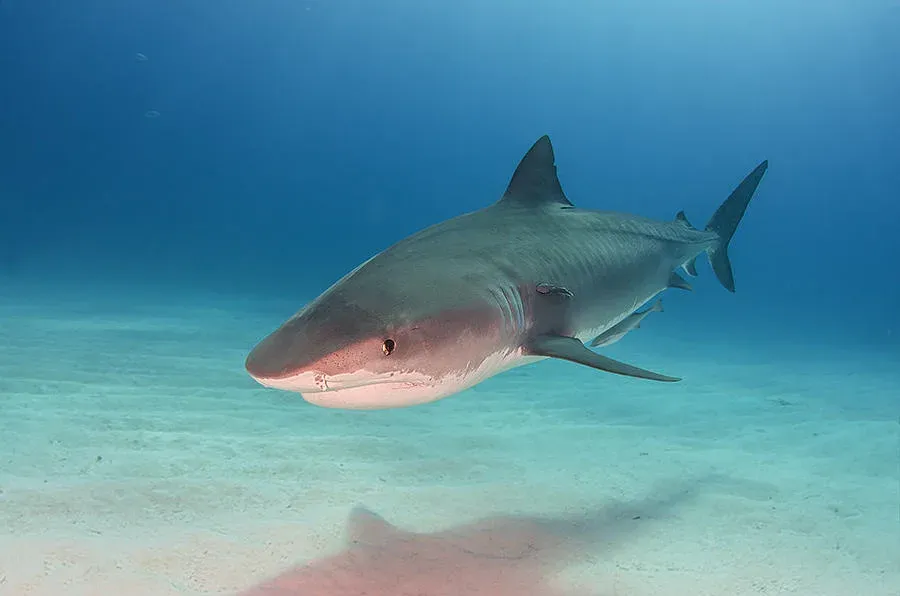
Its most famous animal is a roughly 4.5-metre female named Emma, estimated at around 40 years old and seen at the site for more than 20 of them. What she demonstrates is habituation, in the plain sense. As one photographer put it to Newsweek, “Emma has seen humans many times so there’s less of a sense of trepidation than what would normally exist with a shark seeing a human for the first time” — while sharks new to the site tend to stay on the periphery until they are comfortable. A more elaborate origin story, involving a hook removed in 2001 and a bond with one particular diver, circulates in tabloid retellings; we could not verify it, and the verifiable version is remarkable enough.
The Ultimate Tiger Beach Video - Plus Shark ID · Steve Colligan UK on YouTube
Tiger Harbour at Fuvahmulah in the far southern Maldives is the provisioned counterpart, and it now carries the best science of any shark dive anywhere. A 2024 study in Scientific Reports identified 239 individual tiger sharks over six to seven years at this one shallow plateau — the largest documented aggregation of the species in the world, against 69 identified in Hawai’i over sixteen years. The aggregation is 84.5 per cent female, adult females return year after year with modelled residencies of about 61 days per visit, and the authors argue the island’s warm water may serve as a gestation ground on a biennial breeding cycle. They are equally clear about the cause: fish waste from the tuna fishery has likely been discarded here for generations, but provisioning for tourism began in 2017, the aggregation is a consequence of human activity, and the sharks studied “likely present a skewed picture of natural tiger shark population dynamics”. Then the sentence that should give every visitor pause: in the Maldives there are currently “no laws or guidelines regulating provisioned shark dives”, with codes of conduct voluntary and dive-centre specific. The paper points to Fiji’s locally managed marine reserve as the framework Fuvahmulah lacks. The dive itself is disarmingly simple — a settled group on sandy rubble at 8 to 12 m (40 ft) outside the harbour wall, watching a feeding hierarchy the local guides run to their own schedule, with hand feeding prohibited.
South Africa rounds out the tiger map, with a trap in the vocabulary. On the KwaZulu-Natal coast, operators run baited open-water dives off Aliwal Shoal — The Bull Ring, a drum-baited drift at 15 to 30 m whose exact position is set by the current on the day — where bull sharks are the staple and tiger sharks are a genuine November-to-April possibility, as they are in summer at Protea Banks. But the famous “raggie” dives of the same coast, like Raggie’s Cave, are a different animal altogether: the ragged-tooth shark, known elsewhere as the sand tiger or grey nurse — Carcharias taurus, a snaggle-toothed, slow-moving winter aggregator that has nothing to do with Galeocerdo cuvier, the tiger shark of this guide. Booking a “tiger” trip in June on the strength of the raggie season is a real and common mistake; the tigers come with the warm water, the raggies with the cold.
Bull sharks: a levy, a nursery and a drift of lemons
The Shark Reef Marine Reserve off Fiji’s Pacific Harbour is the provisioned bull shark dive the rest of the world gets measured against, and the interesting part is the governance. Every diver pays a marine-reserve levy that is disbursed to villages holding traditional fishing rights over the reef — Galoa and Kuku are the ones named. Published figures for the levy disagree with each other, so we won’t print one; the structure is the point, and it is the structure the Fuvahmulah researchers held up as the model. The dive runs cage-free to a fixed weekly schedule all year, on a slope where the deeper of the two feeds starts at 30 m, and eight shark species attend — bulls in the lead role, with tigers turning up too irregularly to book around.
It is also the site of the most reassuring feeding study yet done. Tracking bull sharks from 2004 to 2011 — 48 identified visually, 82 carrying acoustic tags — Brunnschweiler and Barnett found the animals are not tethered to the handout: site fidelity was actually lower during the morning feeding window than at other times of day, the sharks ranged widely across the reserve and neighbouring reefs, and individuals routinely vanished for weeks to months, especially around the year’s end, before returning. One species at one site, as the authors would caution — but a direct, data-backed answer to “doesn’t feeding trap them there?”. For what it buys Fiji, a US$42 million figure for shark tourism circulates, though even Wikipedia flags the basis of that number as unclear — treat it as an order of magnitude, not an audit.
Diving with the Largest Bull Sharks in the World: Fiji’s Shark Reef Marine Reserve · Luke Duggan on YouTube
Mexico’s Caribbean coast offers the seasonal version. At Shark Point, five minutes off Playa del Carmen’s beach, pregnant female bull sharks gather over the sand from November to March, believed connected to winter pupping in the nearby lagoons. Two formats run on the same ground and the choice is yours: a baited encounter at about 24 m, kneeling while a feeder draws the sharks in, or an unbaited 45-minute drift at about 18 m watching the same animals behave like animals. Outside the window sightings are rare, which is the clearest possible demonstration that this is a wild seasonal event with a commercial layer on top, not a resident colony.
Florida adds a shark the colour of the sand. Off Jupiter Inlet, Lemon Drop stages one of the US East Coast’s most reliable big-shark events: migratory lemon sharks packing onto a reef ledge at 21 to 30 m each January and February, in groups historically reported at 30 to 40 animals. The dive is a Gulf Stream drift, not a feed — Florida law is blunt that “feeding fish, sharks or other marine species while diving or snorkeling is prohibited” in state waters, which extend three nautical miles off the Atlantic coast. The baited shark trips that do run from Florida ports run beyond that line into federal water; a bill that would close the loophole across all US waters, the Safe Seas Act, has passed the House and awaits the Senate as of this writing. Jupiter’s shops are equally blunt that the lemons are never guaranteed — advanced certification and nitrox are the standard asks.
The natural end of the bull shark spectrum belongs to the eastern Pacific. At Los Morros in Cabo Pulmo, bulls arrive with the June-to-November warm water inside a no-take park protected since 1995, whose recovered fish biomass is the whole attraction; nothing is baited, and the sharks share the site with mobula schools. Costa Rica’s Big Scare runs on the same honest terms: big animals from May to early November with a July-August peak, strong unpredictable current, and a December-to-April off-season when the Papagayo upwelling cools the water and the sharks leave.
Great whites: the map has been redrawn
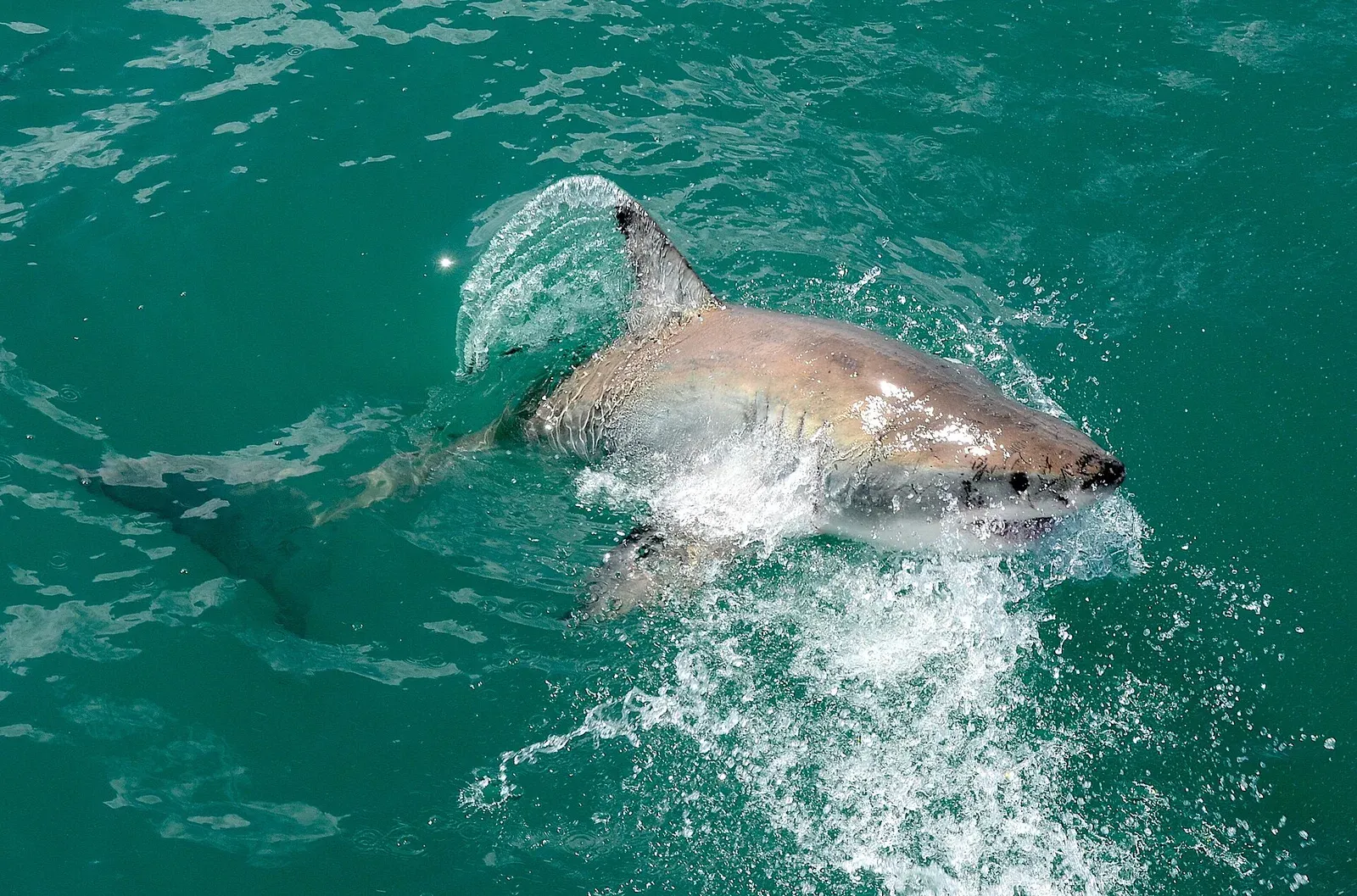
What is left for the great white after Guadalupe is a short list, and the most famous entry on it is the most changed. Shark Alley — the channel between Dyer Island and Geyser Rock, 8 km off Gansbaai — was the most reliable white shark ground on earth for twenty years. Then two orcas with bent dorsal fins, nicknamed Port and Starboard, began killing white sharks along the Western Cape from around 2015, flipping them into tonic immobility and eating the liver alone. By 2017 — the year a well-known 4.9 m female called Khaleesi washed up liverless — the sightings at Gansbaai and False Bay had collapsed; a 2022 paper by Towner and colleagues carried the story in its title, “Fear at the Top: Killer Whale Predation Drives White Shark Absence at South Africa’s Largest Aggregation Site”. Many cage operators closed. The survivors pivoted — bronze whalers and broadnose sevengills now front the trips the white shark built, alongside kelp-forest dives riding the interest My Octopus Teacher created.
Where the sharks went is genuinely unresolved, and you should distrust anyone who tells it as settled. One camp, led by a 2023 analysis, argues South Africa’s white shark population has been stable since 1991 and simply redistributed eastward, appearing in unprecedented numbers at Algoa Bay and along KwaZulu-Natal. A direct 2024 rebuttal in the same journal counters that KZN catch rates have declined since 2010, which sits awkwardly under the “they just moved east” story. Both papers cannot be entirely right. Until that argument resolves, a Gansbaai cage trip is a good wildlife day with a real chance of a white shark, not the certainty the brochures remember.
That leaves the Neptune Islands as the world’s remaining stable cage operation. Everything about it is deliberate. It has been the only place in Australia where the activity is legal since 2002; the cage design itself descends from work Rodney Fox — who survived a 1963 attack and went on to found the pioneering operation that still runs — helped develop in the late 1960s. Surface cages work on air piped from the boat; a bottom cage is winched to the seabed at about 18 m. And it is the one place where regulation has a measured result: after 2012 rules capped licensed operators and their days on site, a 2023 study found shark numbers at the islands recovered. South Australia’s government calls it one of the state’s iconic nature-based tourism experiences, supporting 70 jobs and over $11 million for the economy. Sharks are sighted around the islands in every month, though the site records rate May to October best, followed by the November-to-February seal breeding season; what winter changes most is the crossing.
Shark Cage Diving - 28th May 2016 - North Neptune Islands · alpacabackpack on YouTube
New Zealand’s version survived a different predator: litigation. The cage boat that works Edwards Island and the Tītī Islands in Foveaux Strait — surface cage, surface-supplied air, a 55-minute crossing from Bluff, roughly mid-November to June — spent years in court against PauaMAC5, the association of Stewart Island pāua divers, who argued that berleying for whites endangered them and amounted to unlawfully hunting a protected species. The Court of Appeal agreed, ruling that attracting sharks with bait constituted “pursuing” them under the Wildlife Act and made the practice an offence. In October 2019 the Supreme Court reversed it, finding “the Court of Appeal erred in issuing a declaration that shark cage diving is an offence under the Wildlife Act”, and the trips resumed openly under Department of Conservation permits. Both halves of that arc matter: the practice was ruled unlawful, and then it wasn’t, and local unease — the Tītī Islands are Rakiura Māori muttonbird-harvest grounds — has not gone anywhere.
The Farallon Islands off San Francisco complete the map as the control case: white sharks protected in California waters since 1994, and since 2019 a state ban on any bait, chum or decoy used to lure them. Trips run with no attractant at all, and the reported sighting rates show what that honesty costs.
What the feeding actually does
Put the studies side by side and the picture is more specific than either the industry or its critics tend to say.
For white sharks, reviews cited in the standard literature find no strong evidence that chumming conditions them to associate humans with food. That is not the same as no effect: at the Neptunes, cage operations measurably alter shark movement and behaviour, and a 2018 study found encounters raise individual activity and energy expenditure — while judging the population-level impact negligible if no individual shark meets the boats too often, which is precisely what South Australia’s operator caps exist to ensure. For bull sharks at Beqa, the tracking data above shows provisioned animals dispersing freely rather than camping at the feed. The strongest statement in the other direction concerns the tigers of Fuvahmulah, where the authors describe the world’s largest aggregation of the species as a consequence of human activity — provisioning does not seem to break individual sharks, but it demonstrably reshapes where a population spends its time, in a country with no rules governing the practice.
The incident record deserves the same precision. In 2005 an 18-foot white bit through a cage off South Africa with a British tourist inside; in 2007 a Guadalupe cage was torn apart by a shark that became entangled and fought to free itself; in 2016 a shark lunging for bait broke into a cage off Mexico and the diver surfaced unhurt. The one fatal accident in this history killed three tourists off Gansbaai in April 2008 — and it was not a shark. The anchored boat was capsized by a large wave over a shallow reef, and in 2014 a court found the skipper and operator negligent for anchoring there in worsening swell. Across everything this research turned up, no diver inside an intact cage has been seriously injured by a shark reaching them; the documented dangers of this industry are seamanship, weather and judgement — the same dangers as any small-boat diving, concentrated in dramatic surroundings.
Booking it honestly
Season first, and with a warning about how to read our own charts. For baited and provisioned sites, the monthly ratings below describe diving conditions — sea state, swell, visibility — not animal presence, because the managed encounters run whenever the boats can. Where the two calendars differ, the text above wins: Fuvahmulah’s tigers are resident in every month, Beqa’s feed runs to its fixed weekly schedule all year, and Jupiter’s lemons stage in January and February inside an area whose conditions rate well year-round.
| Site | Jan | Feb | Mar | Apr | May | Jun | Jul | Aug | Sep | Oct | Nov | Dec |
|---|---|---|---|---|---|---|---|---|---|---|---|---|
| Tiger BeachTiger Beach | Prime | Prime | Prime | Good | Good | Fair | Fair | Fair | Off-season | Good | Good | Good |
| Tiger HarbourFuvahmulah | Prime | Prime | Prime | Prime | Good | Good | Good | Good | Good | Fair | Fair | Prime |
| The Bull RingAliwal Shoal | Good | Good | Good | Good | Fair | Prime | Prime | Prime | Prime | Good | Good | Good |
| Southern PinnacleProtea Banks | Good | Prime | Prime | Prime | Good | Good | Prime | Prime | Prime | Good | Fair | Fair |
| Shark Reef Marine ReserveBeqa Lagoon | Fair | Fair | Fair | Good | Good | Prime | Prime | Prime | Prime | Prime | Good | Fair |
| Shark PointPlaya del Carmen | Prime | Prime | Good | Off-season | Off-season | Off-season | Off-season | Off-season | Off-season | Fair | Prime | Prime |
| Lemon DropPalm Beach & Jupiter | Prime | Prime | Prime | Good | Good | Good | Good | Prime | Prime | Good | Good | Good |
| Los MorrosCabo Pulmo | Fair | Fair | Fair | Good | Good | Prime | Prime | Prime | Prime | Prime | Good | Fair |
| Big ScareBat Islands | Fair | Fair | Fair | Fair | Good | Good | Prime | Prime | Good | Good | Fair | Fair |
| North Neptune IslandsNeptune Islands | Good | Good | Fair | Fair | Prime | Prime | Prime | Prime | Prime | Prime | Good | Good |
| Shark AlleyGansbaai | Good | Good | Good | Good | Fair | Fair | Fair | Fair | Fair | Good | Good | Good |
| Edwards IslandStewart Island | Prime | Prime | Prime | Good | Good | Fair | Off-season | Off-season | Off-season | Off-season | Fair | Prime |
The certification asks split cleanly. Gansbaai’s cages take complete non-divers, the Neptune Islands surface cage runs on air piped from the boat, and the Foveaux Strait operator asks for a dive certificate or its own training session — which is why cage trips anchor so many first shark encounters. The open-water baited dives sit at the other end: The Bull Ring and Jupiter’s drifts are booked as advanced dives, Beqa’s deeper feed starts at 30 m, and Playa del Carmen expects current-and-depth comfort. Tiger Beach and Tiger Harbour are shallow but behavioural: the skill being examined is staying put, keeping hands in, and doing what the feeder’s briefing says for an hour at a time.
| Site | Depth | Current | Level | Best months |
|---|---|---|---|---|
| Tiger Beach Tiger Beach · Bahamas | 5–10 m | Moderate | Intermediate | Jan–Mar |
| Tiger Harbour Fuvahmulah · Maldives | to 12 m | Mild | Intermediate | Dec–Apr |
| The Bull Ring Aliwal Shoal · South Africa | 15–30 m | Strong | Advanced | Jun–Sep |
| Southern Pinnacle Protea Banks · South Africa | 26–30 m | Strong | Advanced | Feb–Apr |
| Pinnacles Ponta do Ouro · Mozambique | 28–42 m | Strong | Advanced | Jul–Oct |
| Shark Reef Marine Reserve Beqa Lagoon · Fiji | 5–30 m | None | Intermediate | Jun–Oct |
| Shark Point Playa del Carmen · Mexico | 18–24 m | Moderate | Advanced | Nov–Feb |
| Lemon Drop Palm Beach & Jupiter · United States | 21–27 m | Strong | Advanced | Jan–Mar |
| Los Morros Cabo Pulmo · Mexico | 9–17 m | Strong | Advanced | Jun–Oct |
| Big Scare Bat Islands · Costa Rica | to 30 m | Strong | Advanced | Jul–Aug |
| North Neptune Islands Neptune Islands · Australia | 2–18 m | Moderate | Intermediate | May–Oct |
| South Neptune Islands Neptune Islands · Australia | 2–18 m | Moderate | Intermediate | May–Oct |
| Shark Alley Gansbaai · South Africa | to 5 m | Moderate | Intermediate | Oct–Apr |
| Edwards Island Stewart Island · New Zealand | to 3 m | Strong | Intermediate | Dec–Mar |
| Tītī / Muttonbird Islands Stewart Island · New Zealand | 18–46 m | Strong | Advanced | Dec–Mar |
Where this sits in the Logbook
The great hammerhead — the third giant of the baited-sand-flat world — is deliberately missing from this guide, because it has its own: the winter aggregation at Bimini, plus every scalloped-hammerhead seamount worth a negative descent, is covered in our month-by-month hammerhead guide. Several of this guide’s sites appear there too — Protea Banks and Ponta do Ouro run hammerheads and the sharks of this guide over the same pinnacles in different months.
The open-ocean equivalent of these encounters — a pelagic shark that comes to the diver, and the briefing discipline that goes with it — is the subject of our oceanic whitetip guide, which is also where the case against loose bait in open water is made at length. And if what draws you is big animals rather than teeth, the same honest-calendar treatment is applied to gentler company in our whale shark guide.
Wherever you take this list, apply its one repeatable lesson: the operators worth your money are the ones who tell you what is not guaranteed. Guadalupe’s closure order, Gansbaai’s empty seasons and Fuvahmulah’s unregulated boom all argue the same thing from different directions — that the future of big-shark diving belongs to the places that wrote rules before they needed them.