Gansbaai · South Africa · Pelagic & blue water · Channel & pass
Shark Alley
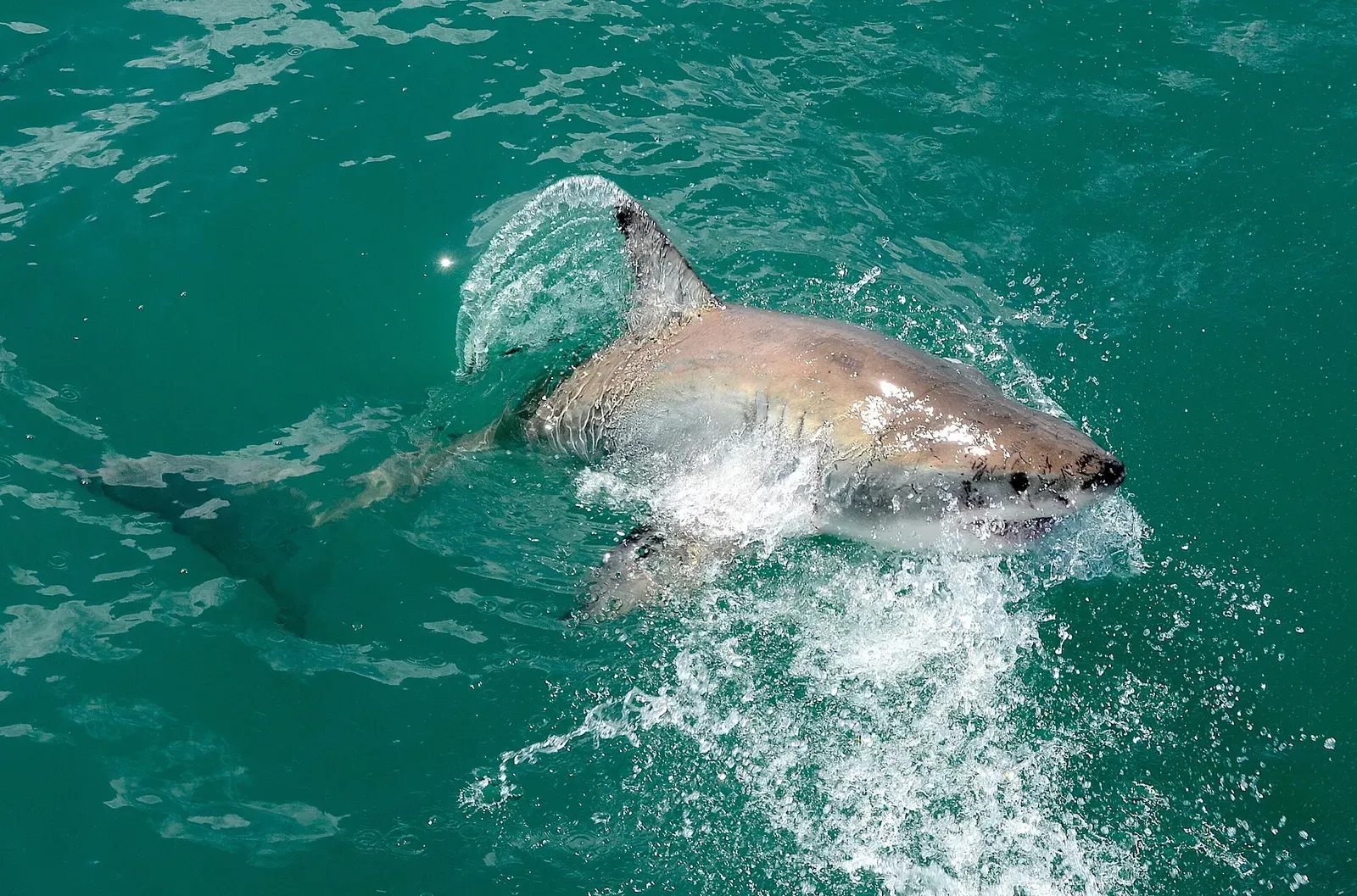
A surface cage in the channel where 60,000 seals once reliably drew great whites
Area photo: Olga Ernst · CC BY-SA 4.0
Shark Alley is the shallow channel between Dyer Island and Geyser Rock, 8 km off Gansbaai, worked by surface shark cages tethered alongside the boat rather than by a swum dive. It was the world's most reliable great white shark ground for two decades; since 2015 orca predation has made sightings unpredictable, and operators now show bronze whaler and broadnose sevengill sharks as often as the white sharks the site was built around.
Where it is and how deep
34.6829° S, 19.4203° EApproximate position — the dashed circle shows where the site lies; your operator's briefing has the mooring.
The dive
The day starts at the Kleinbaai slipway, where operators such as Marine Dynamics and White Shark Projects load gear and run the roughly 8 km crossing to Dyer Island and Geyser Rock. Once on site the cage is lowered alongside the boat rather than dropped to the bottom, tethered so it floats with its top bars at the surface; a crew member works a bait line to draw sharks past the bars while divers breathe through a hose piped down from a surface compressor, or simply snorkel. Nobody needs a certification, a logbook, or prior diving experience — getting in the cage is closer to an aquarium exhibit worked in reverse than to a normal dive.
The channel itself sits between two small islands that nobody is allowed to land on. Dyer Island carries a declining African penguin colony, and Geyser Rock holds around 60,000 Cape fur seals, which is the reason the water here concentrated so many white sharks for so long: an ambush ground beside a standing food source. Indo-Pacific bottlenose dolphins work the same channel, and the crossing itself, not the cage, is usually the roughest part of the day.
What changed is well documented rather than guessed at. From around 2015, two male orcas with distinctive collapsed dorsal fins, nicknamed Port and Starboard for which side each fin folds toward, began hunting white sharks along this stretch of coast, flipping them belly-up to trigger a paralysed state and eating only the liver before leaving the rest of the carcass to wash ashore. A well-known 4.9 m female called Khaleesi turned up this way in 2017, and white sharks began evacuating the area for weeks at a time whenever the pair were around, sometimes for much longer.
A trip booked today is honestly a different product from one booked in 2010. Some operators have closed; the ones still running lean harder on bronze whaler (copper) sharks and broadnose sevengill cowsharks, both of which keep showing up in the channel, and treat a great white sighting as a bonus rather than a certainty. Researchers are still arguing over whether the white sharks relocated east to Algoa Bay and KwaZulu-Natal or the regional population genuinely fell — worth knowing before you book on the strength of an old dive-magazine season chart.
Background
Cage diving turned Gansbaai into a tourist destination from around 1995, and within a couple of decades the town was routinely marketed as the great white shark capital of the world. That changed after 2015, when Port and Starboard, a pair of orcas identifiable by their collapsed dorsal fins, began preying on white sharks in the channel and along the wider coast, eating only the liver and leaving the rest of the carcass. Sightings at Shark Alley fell sharply and unpredictably through the following years, and by the 2020s several operators had closed while the survivors rebuilt their trips around bronze whaler and sevengill sharks rather than a guaranteed great white.
Marine life and season
- Great whites
- Seals & sea lions
- Dolphins
- Penguins
| Jan | Feb | Mar | Apr | May | Jun | Jul | Aug | Sep | Oct | Nov | Dec |
|---|---|---|---|---|---|---|---|---|---|---|---|
| Good | Good | Good | Good | Fair | Fair | Fair | Fair | Fair | Good | Good | Good |
This tracks the Kleinbaai boat crossing, not shark odds: cold-front swell between May and September most often cancels trips, and which months bring sharks has become unpredictable since 2015.
Know before you go
- The one fatal cage-diving incident here was a 2008 boat capsize on the nearby Geldsteen reef in rising swell while at anchor — a seamanship failure, not a shark bite.
- In 2005 a great white bit through the bars of a cage off this coast; keep hands, cameras and gear inside the bars at all times.
- Cold Cape water calls for a full wetsuit even in summer; cold-water fatigue is a more likely problem on any given trip than the sharks are.
Questions divers ask
Do you need a diving certification to cage dive at Shark Alley?+
No. The cage runs on air piped from the boat, or as a snorkel activity, so no prior diving training or experience is required — just the ability to get in the water and handle a boat crossing.
Will I actually see a great white shark?+
It isn't guaranteed. Since 2015 the orcas Port and Starboard have hunted white sharks along this coast, and Gansbaai sightings have become unpredictable for weeks or months at a time. Most operators now also show bronze whaler and broadnose sevengill sharks.
What happened to Gansbaai's great white sharks?+
From around 2015, two orcas nicknamed Port and Starboard began killing white sharks here for their livers, and sightings collapsed. Whether the sharks relocated east or the population genuinely declined is disputed among researchers, with studies from 2023 and 2024 reaching different conclusions.
Is shark cage diving at Gansbaai safe?+
The one fatality was a 2008 boat capsize caused by anchoring over a reef in rising swell, not a shark incident, and a court found the operator negligent for the anchoring decision. No diver here is documented as bitten inside an intact cage.
Sources
- Gansbaai — Wikipedia
- Dyer Island Nature Reserve Complex — Wikipedia
- Port and Starboard (orcas) — Wikipedia
- Shark cage diving — Wikipedia
- Great white shark — Wikipedia
- Where Did South Africa's Missing Sharks Go? — Smithsonian Magazine
- Diving in South Africa — Wikivoyage
- Marine Dynamics shark tours — Marine Dynamics
In The Logbook
- Tiger, bull and white: the big shark divesBig animals · 14 min read
Similar dives elsewhere
Bait balls 10-20 m across, worked from the surface to 10 metres
A massive shoal was reported off the bay during the 2011 run

.jpg)
Muttonbird islets in a cold, tidal, shark-cage strait
Great whites from a surface cage off a Tītī group islet