
South America · Brazil
Ilha Grande & Angra dos Reis
Pinguino wreck, Jorge Grego crevice and rocky islands
Photo: Feliperogeriobr · CC BY-SA 4.0
Ilha Grande and the islands around Angra dos Reis offer rock-and-crevice diving on Brazil's Costa Verde, with sites for first-timers and experienced divers alike. The Pinguino wreck in Sítio Forte cove, the Jorge Grego crevice, the Jaconema rocky shore and the sheltered Ilha dos Meros give a mix of wreck, drift and night dives, with rays, turtles, octopus and nudibranchs among the residents.
About diving in Ilha Grande & Angra dos Reis
Local dive shops and marinas in Angra dos Reis run quick boat trips to the dive sites, including those around Ilha Grande, and a day for certified divers can be two dives at different points so that guests see more of the island. Sites lie all the way around the island, and which coast is dived depends on the weather: the north side faces the mainland and stays available whatever the sea is doing, while the south side faces open water and needs good weather and sea conditions.
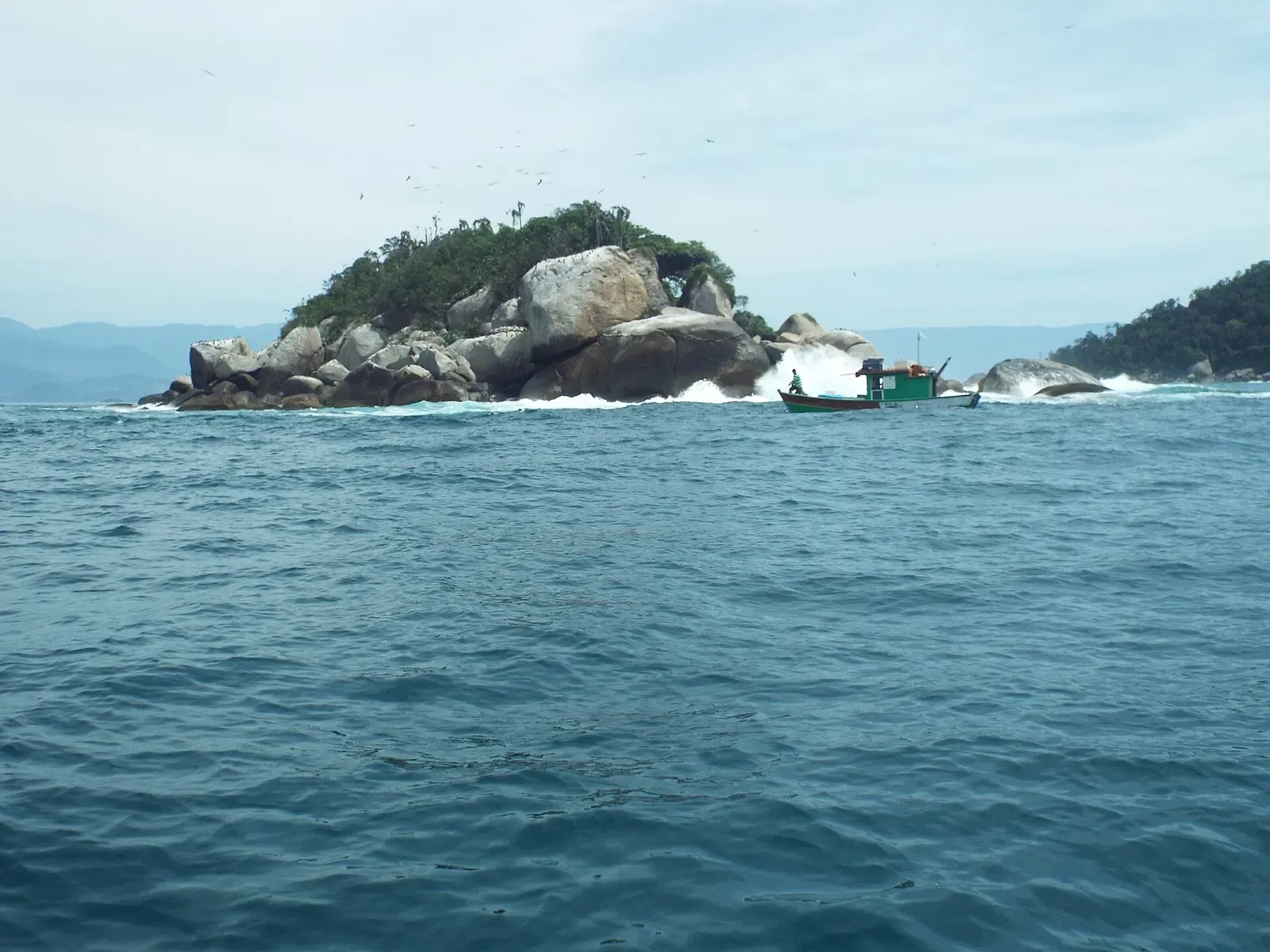
Hefty rock formations rise at every dive site around Ilha Grande, and their crevices hide a multitude of marine life. Ilha Josefa is a rocky-shore dive with a great amount of sponges, corals and small multicoloured fish, and schools of mullet and other fish are easily seen around the Pinguino wreck. At Ilha dos Meros, overfishing has cut the diversity and size of the marine life, though shoals, rays and turtles are still seen.
Newer divers have several options: the Pinguino wreck, the Jaconema rocky shore and the sheltered Ilha dos Meros, where many divers made their first dives. Experienced divers have the open sea outside the island, where the Jorge Grego crevice is dived from a drift boat, and the south face, which opens only when the weather and sea allow. The coast is not tropical, so the dives run over rock and crevices rather than vast colourful coral reefs.
Best time to dive Ilha Grande & Angra dos Reis
| Jan | Feb | Mar | Apr | May | Jun | Jul | Aug | Sep | Oct | Nov | Dec | |
|---|---|---|---|---|---|---|---|---|---|---|---|---|
| Season | Prime | Prime | Prime | Prime | Good | Good | Good | Good | Good | Prime | Prime | Prime |
| Sea surface | 27°C81°F | 27°C81°F | 27°C81°F | 26°C79°F | 24°C75°F | 23°C73°F | 22°C72°F | 22°C72°F | 22°C72°F | 23°C73°F | 23°C73°F | 25°C77°F |
| Daytime high | 32°C90°F | 31°C88°F | 31°C88°F | 29°C84°F | 29°C84°F | 28°C82°F | 28°C82°F | 31°C88°F | 34°C93°F | 33°C91°F | 32°C90°F | 32°C90°F |
| Rain | 223 mm8.8 in | 178 mm7.0 in | 176 mm6.9 in | 94 mm3.7 in | 49 mm1.9 in | 44 mm1.7 in | 27 mm1.1 in | 38 mm1.5 in | 55 mm2.2 in | 113 mm4.4 in | 166 mm6.5 in | 176 mm6.9 in |
| Jan | Feb | Mar | Apr | May | Jun |
|---|---|---|---|---|---|
| Prime | Prime | Prime | Prime | Good | Good |
| Sea surface | |||||
| 27°C81°F | 27°C81°F | 27°C81°F | 26°C79°F | 24°C75°F | 23°C73°F |
| Daytime high | |||||
| 32°C90°F | 31°C88°F | 31°C88°F | 29°C84°F | 29°C84°F | 28°C82°F |
| Rain | |||||
| 223 mm8.8 in | 178 mm7.0 in | 176 mm6.9 in | 94 mm3.7 in | 49 mm1.9 in | 44 mm1.7 in |
| Jul | Aug | Sep | Oct | Nov | Dec |
|---|---|---|---|---|---|
| Good | Good | Good | Prime | Prime | Prime |
| Sea surface | |||||
| 22°C72°F | 22°C72°F | 22°C72°F | 23°C73°F | 23°C73°F | 25°C77°F |
| Daytime high | |||||
| 28°C82°F | 31°C88°F | 34°C93°F | 33°C91°F | 32°C90°F | 32°C90°F |
| Rain | |||||
| 27 mm1.1 in | 38 mm1.5 in | 55 mm2.2 in | 113 mm4.4 in | 166 mm6.5 in | 176 mm6.9 in |
2011–2025 averages. Sea surface: NOAA Coral Reef Watch, measured at the surface, so deeper water can run colder. Daytime high and rain: NASA POWER.
October to April brings warmer water and the best visibility; the mainland-facing north coast is diveable all year.
Best months: January, February, March, April, October, November, December
Ilha Grande water temperature and weather by month
The sea surface runs from 22 °C (72 °F) in August to 27 °C (81 °F) in February. It is 24 °C (75 °F) or warmer from December to May. Most rain falls from October to March, peaking at about 220 mm (8.7 in) in January; it stays largely dry from May to September. Daytime highs reach 34 °C (93 °F) in September and drop to 28 °C (82 °F) in June. Below the surface the water can drop to about 18 °C (64 °F), so pack a 5 mm suit.
Dive types & marine life
Stingrays, butterflyfish and even eagle rays are common at Parcel do Coronel, and octopus, squid, rays and turtles are common sightings on the Jaconema rocks. Nudibranchs are very common on the walls of the Jorge Grego crevice.
- Reef
- Wreck
- Drift
- Night
- Sea turtles
- Octopus & cuttlefish
- Nudibranchs
- Macro critters
- Reef fish swarms
- Stingrays
Best dive sites in Ilha Grande & Angra dos Reis
- 1
Naufrágio Pinguino
Best-preserved wreck on the Costa Verde, at 18 m in the middle of Sítio Forte cove; suited to beginners.
- 2
Fenda Jorge Grego
Crevice almost 4 m wide and 15 m deep in the open sea outside Ilha Grande; a drift dive for experienced divers.
- 3
Costão da Jaconema
Rocky shore from 4 to 15 m for beginners or advanced divers, and an excellent night dive.
- 4
Ilha dos Meros
Sheltered, quiet site in Paraty to 13 m with no current, where many divers made their first dives.
- 5
Ilha Josefa
Rocky-shore dive from 0 to 8 m with many sponges, corals and small multicoloured fish.
Site guides
Rocky coastline between 4 and 15 m, dived by day and by night
13 m, sheltered and currentless: the region's first-dive island
Cave & cavern
A crack almost 4 m wide and 15 m deep, dived off a drifting boat
Artificial reef
The best-preserved wreck on the Costa Verde, at 18 m
200 m of submerged reef running down to 26 m
How to get to Ilha Grande & Angra dos Reis
The closest major airport is Rio de Janeiro's Galeão (GIG), a 3 to 4-hour drive from Angra dos Reis along the BR-101 coastal highway. Boats from local marinas then run out to Ilha Grande and its dive sites.
Photos from Ilha Grande & Angra dos Reis
Feliperogeriobr · CC BY-SA 4.0
Misstetei · CC BY-SA 3.0
Marcio Ranauro · CC BY-SA 3.0
CARLAJOAO · CC BY 4.0
Dive videos
Mergulho no Naufrágio Pinguino de Sidemount · Getulio on YouTube
Mergulho Naufrágio Pinguíno - Ilha Grande - Angra dos Reis-RJ - 23.09.2018 · Anderson De Cadeirante Monstro on YouTube
Questions divers ask
Can the Pinguino wreck be penetrated?+
No. Penetration is not allowed, so the wreck is dived from the outside only.
Can Ilha Grande be dived all year?+
Yes, on the north side, which faces the mainland: Lagoa Verde, Sítio Forte, Bananal and Lagoa Azul can be dived whatever the sea is doing. The south side faces open water and needs good weather and sea.
Are there coral reefs at Ilha Grande?+
Not vast colourful ones. The coast of Rio de Janeiro is not tropical; the dives run over hefty rock formations whose crevices shelter abundant marine life.
Sources
- Mergulho Diurno | Dive & Cia — Dive & Cia
- Ilha dos Meros - Paraty — SSI MyDiveGuide
- Fenda Jorge Grego — Scubago (SSI MyDiveGuide)
- Naufrágio Pinguino — Scubago (SSI MyDiveGuide)
- Costão da Jaconema - Deck Pous Nautilus — Scubago (SSI MyDiveGuide)
- Ilha Josefa — Scubago (SSI MyDiveGuide)
- Parcel do Coronel — Scubago (SSI MyDiveGuide)
- Angra dos Reis Average Sea Temperatures — SeaTemperature.org
- Diving Angra dos Reis — PADI
- Brazil's Ilha Grande — X-Ray Mag
Photo credits
- A turquoise, boulder-lined cove framed by rainforest on Ilha Grande, Brazil by Feliperogeriobr, CC BY-SA 4.0, via Wikimedia Commons
- Emerald-green lagoon bordered by dense Atlantic rainforest on Ilha Grande by Feliperogeriobr, CC BY-SA 4.0, via Wikimedia Commons
- Sandy cove with a small pier and forested hills on Ilha Grande, Brazil by Misstetei, CC BY-SA 3.0, via Wikimedia Commons
- Hazy view over Ilha Grande's bay and its scattered islands from a hilltop by Marcio Ranauro, CC BY-SA 3.0, via Wikimedia Commons
- Sunrise over the water at Praia do Perequê on Ilha Grande, Brazil by CARLAJOAO, CC BY 4.0, via Wikimedia Commons
Embed
Run a dive centre, club or blog? Embed this map of 5 dive sites near Ilha Grande on your own page.
Similar destinations

Granite reefs where tropical and temperate species overlap

Dozens of wrecks on flat sand, including the 1887 steamer Pirapama
Cold upwelling packs granite walls with fish an hour from Rio


Submerged statues of Christ and Neptune among calm bay islands