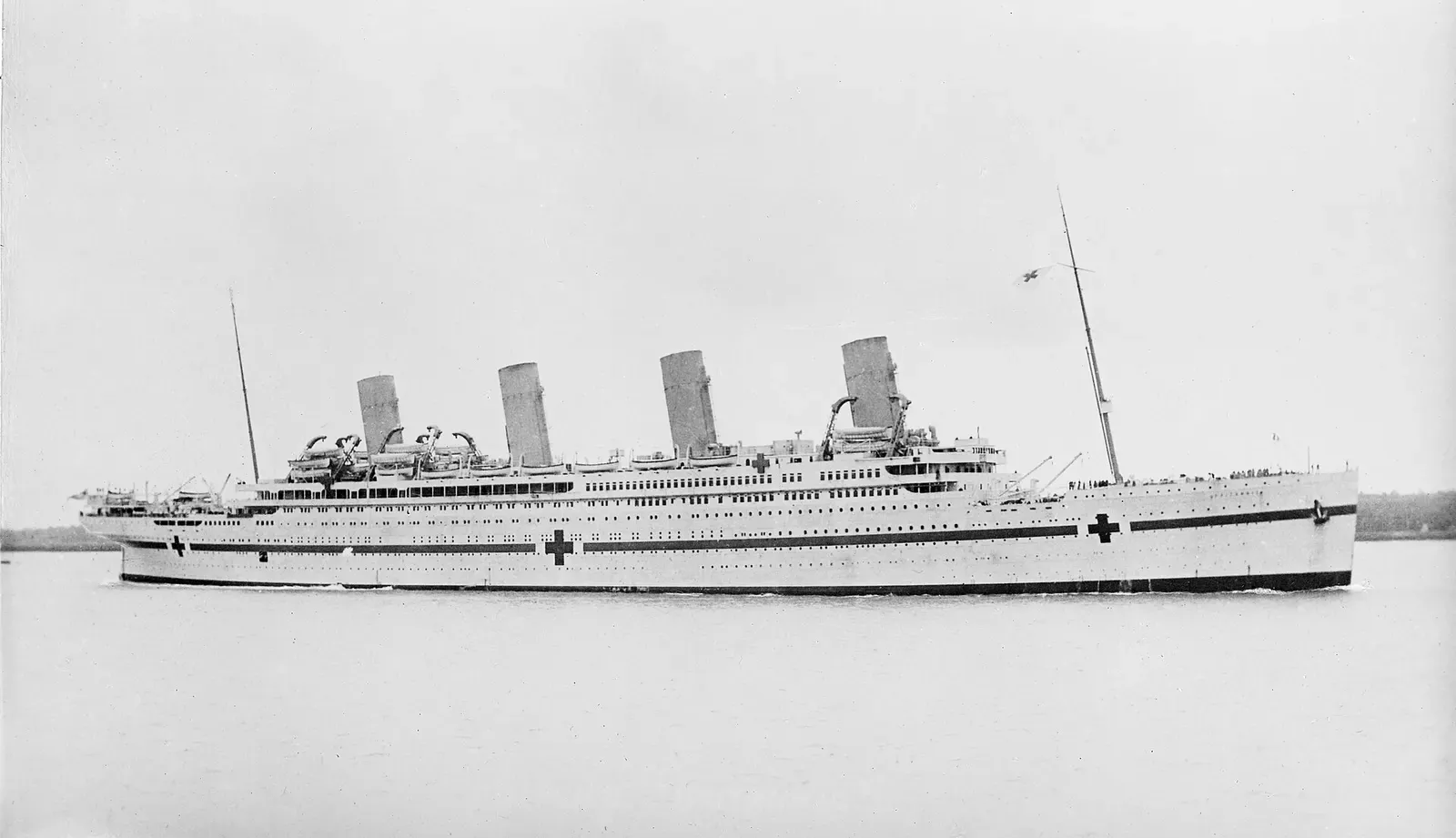
Kea Channel · Greece · Wreck
HMHS Britannic
Largest intact passenger shipwreck on any seabed, found by Jacques Cousteau in 1975
Area photo: Allan C. Green · Public domain
The third and largest of the White Star Line's Olympic-class liners, sister ship to Titanic and Olympic, converted to a hospital ship and sunk by a German mine in the Kea Channel on 21 November 1916. She is the largest ship lost in the First World War and the largest intact passenger wreck on any seabed, lying on her starboard side between about 80 and 122 m. Diving her is expedition-level closed-circuit trimix work, permitted case by case by Greece and the wreck's private owner.
Where it is and how deep
37.7014° N, 24.2839° EPublished position for this site.
The dive
Britannic was launched in February 1914, the third and safest-designed of the Olympic-class sisters after lessons drawn from the Titanic disaster, and was requisitioned as a hospital ship before she ever carried a fare-paying passenger. At 269 m she is enormous even among deep technical wrecks, and also the least accessible: Cousteau found her by sonar in November 1975 and dived her the next year, Robert Ballard surveyed her with ROVs in 1995, the first open-circuit trimix team reached her in 1997, GUE divers led the first major penetration expedition in 1999, and an all-closed-circuit team in 2003 located mine anchors confirming a single mine, not a torpedo, brought her down.
The mine hit her starboard side between holds two and three on the morning of 21 November 1916, and the flooding that followed was worse than it should have been: nurses had opened portholes along the lower decks to air the wards, against orders, and as the ship listed those portholes went under and let water into compartments that would otherwise have held. Two lifeboats were launched without orders while the propellers were still turning and were drawn into them, killing the 30 people aboard; all but those 30 of the 1,066 people on the ship survived. She rolled onto her side and sank 55 minutes after the explosion, the largest ship lost in the whole of the First World War.
Every organised dive on her since has run on the same footing: closed-circuit rebreathers, staged decompression, and a shot dropped onto one section of the wreck for that day's team rather than any attempt to see her end to end. Reported depths vary by expedition and by which part of the hull is measured — Cousteau put the shallowest point at 80 m in 1976, the 1997 team closer to 90 m, and the deepest point of the hull is consistently given as around 120 m.
On 29 September 2019 English technical diver Tim Saville, a TDI-rated rebreather diver on what he had called a bucket-list dive, died during a 120 m dive on the wreck; the cause was not established at the time. In May 2025 an 11-member closed-circuit team, organised by Mills under a Greek Ministry of Culture permit, recovered the ship's bell, a navigation lamp, cabin fittings and other artefacts for conservation and eventual display in Piraeus's new National Museum of Underwater Antiquities.
The wreck
- Vessel
- HMHS Britannic
- Type
- Olympic-class ocean liner, hospital ship
- Length
- 269.1 m (883 ft)
- Built
- 1914
- Sunk
- 1916
- Cause
- Struck a German naval mine laid by the submarine U-73 in the Kea Channel
- Lies
- Largely intact on her starboard side in the Kea Channel, between about 80 and 122 m; a war grave
Britannic was the third and final Olympic-class liner, launched by Harland & Wolff in Belfast in February 1914 as the younger sister of Olympic and Titanic. She never entered commercial service: the Admiralty requisitioned her as a hospital ship in November 1915, and she carried the sick and wounded of the Middle Eastern theatre for five voyages before striking a German mine in the Kea Channel on 21 November 1916 and sinking within the hour. Cousteau located the wreck in 1975 and first dived it in 1976; historian Simon Mills bought her in 1996 and has organised or authorised every expedition since, including the 2025 artefact recovery now held by Greece's Ephorate of Underwater Antiquities.
Marine life and season
The sources we used don't single out particular species here.
| Jan | Feb | Mar | Apr | May | Jun | Jul | Aug | Sep | Oct | Nov | Dec |
|---|---|---|---|---|---|---|---|---|---|---|---|
| Off-season | Off-season | Off-season | Fair | Good | Prime | Good | Good | Prime | Good | Fair | Off-season |
Season follows Kea Channel: Expeditions run roughly May–October; the Aegean meltemi blows hardest in July–August and the strait closes over winter.
Know before you go
- Extreme depth: the shallowest reported point is around 80 m and the hull runs to about 120 m, putting every dive on closed-circuit rebreathers with mandatory staged decompression and no direct ascent.
- A technical diver died on the wreck in September 2019; this is expedition-grade diving with a documented fatality, not an extension of ordinary recreational trimix.
- Diving requires prior permission from both the Ephorate of Underwater Antiquities and the wreck's private owner; unauthorised dives, and removing anything, are offences under Greek law.
- The wreck is a war grave and a protected antiquity: it is dived look-only outside the licensed archaeological recoveries Greece has authorised.
Questions divers ask
How deep is the HMHS Britannic wreck?+
Reports vary by expedition: the shallowest point of the hull has been put at 80 to 90 m and the deepest at around 120 m (Wikipedia's cited figure is about 122 m). Either way this is closed-circuit trimix diving with staged decompression, not a recreational-plus dive.
Can a recreational or ordinary technical diver dive the Britannic?+
No. Dives are organised expedition by expedition with closed-circuit rebreathers, require permission from Greece's Ephorate of Underwater Antiquities and from the wreck's owner, and have included at least one fatality (2019). There is no walk-up commercial trip to this site.
Who owns the Britannic wreck?+
British maritime historian Simon Mills bought the wreck in 1996 and now runs it through the Britannic Foundation; his agreement, alongside a Greek antiquities permit, is required for any expedition.
Sources
- HMHS Britannic — Wikipedia
- HMHS Britannic Expedition Summary 1976–1999 — Simon Mills, via Wayback Machine
- A little good comes from Brit wreck diver's death — X-Ray Magazine, via Wayback Machine
- Artefacts recovered from Titanic's sunk sister ship — BBC News
- Ephorate of Underwater Antiquities — Wikipedia
- WWI sinkings of Burdigala and Britannic commemorated on Kea — eKathimerini
In The Logbook
- How a rebreather works, and what it buys youGear & kit · 6 min read
- How deep can you actually dive?Body & health · 13 min read
More dive sites in Kea Channel
Wreck
A scattered cargo wreck on a reef running from 2 m to 35 m
The canyon exit opens onto a wall that falls to 45 m
Wreck
An 1868 paddle steamer, broken in two with a paddle wheel still in place
Wreck
An intact light aircraft on the bottom between 16 and 22 m
Wreck
Sunk by the same minefield as HMHS Britannic, seven days before her
Similar dives elsewhere
A shot-down jet fighter scattered over 50 by 50 m at 19 m
A 95 m WWII escort cut in two by a torpedo, mast top at 25 m, bow at 50 m
The Ghost Ship: an intact 20 m motor-sailboat on sand at 38 m

An unidentified wreck at 32 m, reached down a slope from 10 m