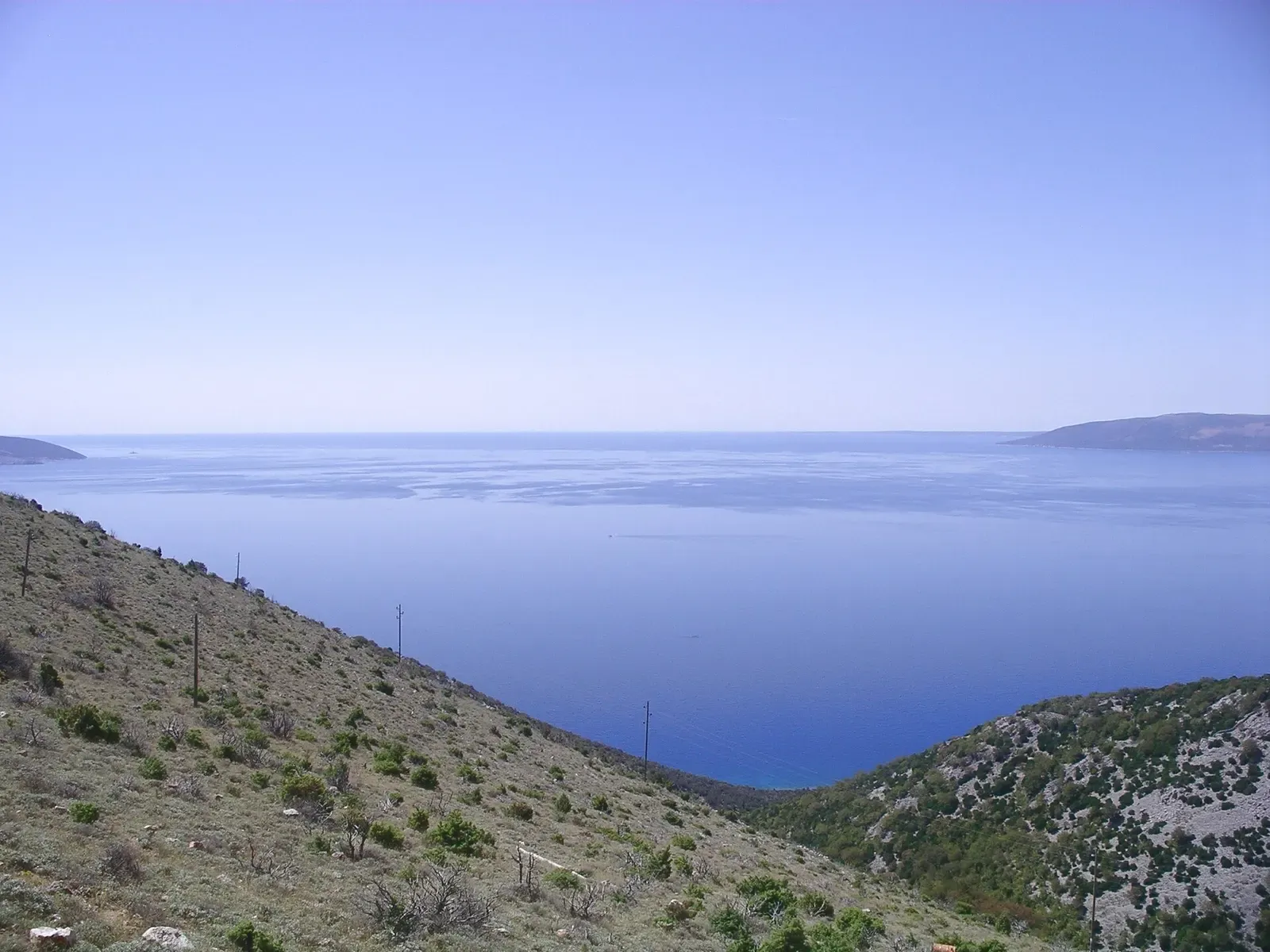
Kvarner · Croatia · Wall · Reef
Susak — secca Margarina
Wall from 5 to 40 m on Susak's south side, with Roman columns nearby
Area photo: Nem80 · CC BY-SA 3.0
A reef edge on the south side of Susak that breaks at 5 m and falls to 40 m, forming a wall thick with growth fed by nutrient-bearing currents. Roman marble columns and roof tiles lie nearby on the seabed. It is dived by boat from Mali Lošinj and covers a wide depth range, from a shallow top to a deep foot.
Also known as Susak-secca Margarina.
Where it is and how deep
44.4972° N, 14.3086° EPublished position for this site.
The dive
The site sits on the southern side of Susak. Drop onto the top of the reef in about 5 m, where the large reef edge breaks, and move to the lip. From there the rock falls as a wall to 40 m, so the dive is a matter of choosing a depth on the face and following it along rather than trying to see all of it.
The wall is where the life is. Strong nutrient-bearing currents feed it, and the growth is described as abundant in both flora and fauna, so go slowly and look at the rock rather than swimming past it. Keep an eye on your depth, since the face runs well below a comfortable recreational limit and the bottom at 40 m is not the aim of the dive.
Nearby are archaeological remains: Roman marble columns and roof tiles on the seabed. Ask the boat crew where they lie relative to the wall before you descend so you can include them without a long swim. Finish by working back up the face to the 5 m reef top, which gives a natural shallow stop before you surface to the boat.
Marine life and season
The sources we used don't single out particular species here.
| Jan | Feb | Mar | Apr | May | Jun | Jul | Aug | Sep | Oct | Nov | Dec |
|---|---|---|---|---|---|---|---|---|---|---|---|
| Off-season | Off-season | Fair | Fair | Good | Prime | Prime | Prime | Prime | Good | Fair | Off-season |
Season follows Kvarner: Peak season is May to September and conditions hold into October; from winter into early spring the bora churns the water and brings current, with the sea at 12–14 °C.
Know before you go
- Currents: the operator describes strong nutrient-bearing currents on the wall. Plan the dive with the boat crew and stay close to the rock.
- Depth: the wall runs to 40 m from a lip at 5 m. Set a floor before dropping over the edge.
Sources
- Susak-secca Margarina — Scubago — Scubago
More dive sites in Kvarner
Reef
Two reefs: yellow gorgonians to 25 m, endemic sponges to 35 m
Wreck
Upright, intact wreck with anti-aircraft guns at bow and stern, 42 to 51 m
Wall
Overgrown wall from 20 to 40 m, scorpionfish and frequent octopus
Reef
Two parallel sponge-covered rock ridges from 8 to 28 m, five minutes from Rab
Wreck
Near-vertical stone-cargo wreck, propeller at 75 m, trimix only
Wreck
Greek cargo ship lost in 1968, sponge-covered in 12 to 32 m off Krk
Wall
Near-vertical wall to 40 m on Krk's east side, dived one way
Wall
Fields of blue gorgonians from 30 m on a wall dropping to 45 m
Similar dives elsewhere
The park's best-known walls, and a cave with an air pocket
Two dives in one: an easier south side to 35 m, a deep north side past 40 m
A sea-cut bowl in the Peñón to 35 m where amberjack and barracuda gather

Basalt platform dropping steeply to 40 m under the lighthouse