Lembeh Strait · Indonesia · Muck & macro · Sand slope · Wall
Nudi Falls
Sea fans on the mini-wall hold pygmy seahorses
Photo: Bernard DUPONT from FRANCE · CC BY-SA 2.0
Nudibranchs are the point here, and the short mini-wall they feed on is what separates the site from the strait's open sand. Its face is packed with ascidians and sponges, the sea fans on it hold pygmy seahorses, and the rubble at its foot is where the gurnards, frogfish and mantis shrimps turn up. The bay is sheltered enough that the boat ties to trees on the bank.
Where it is and how deep
1.4610° N, 125.2266° EApproximate position — the dashed circle shows where the site lies; your operator's briefing has the mooring.
The dive
You roll off the side into water that is normally a degree or two cooler than at Bunaken. The descent is slow and unhurried, down a dark sandy slope to about 25 m where the bottom turns to soft corals like a bed of cauliflower. This upper stretch is search time rather than scenery: ribbon eels and shrimp-and-goby partnerships are the things to watch for as you work your way down it.
The slope ends at the mini-wall that is the site's main feature. Its face carries a heavy growth of ascidians and sponges, which is what the nudibranchs are here for, and the count runs high enough to justify the name. Your guide will spend a good part of the dive scouring a fan on the wall for pygmy seahorses. The floor and the rocky base of the wall is where most of the action is, with flying gurnards, frogfish, mantis shrimps and pipefish all likely to be around.
The dive finishes in the shallows by the wall near the boat, close enough that there is no swim to speak of at the end. Poking around here turns up lionfish, banded pipefish and more nudibranchs, and it is usually where the tally for the dive climbs fastest. Because the bay is sheltered and the boat is tied within sight, the last stretch can be spent on one small patch of bottom rather than on navigation.
Marine life and season
- Nudibranchs
- Pygmy seahorses
- Frogfish
- Macro critters
| Jan | Feb | Mar | Apr | May | Jun | Jul | Aug | Sep | Oct | Nov | Dec |
|---|---|---|---|---|---|---|---|---|---|---|---|
| Good | Good | Good | Good | Good | Good | Prime | Prime | Prime | Prime | Prime | Good |
Season follows Lembeh Strait: Diveable all year; July and August bring the most critters, October to December the clearest water, and January and February the roughest seas.
Photos from Nudi Falls
Bernard DUPONT from FRANCE · CC BY-SA 2.0
Dan Schofield · CC BY 4.0
Bernard DUPONT from FRANCE · CC BY-SA 2.0
Dive videos
Muck diving at Nudi Falls in the Lembeh Strait, Indonesia · Scubabeat on YouTube
Muck diving Nudi Falls in Lembeh, Indonesia - Invertebrates Special · Scubabeat on YouTube
Questions divers ask
How deep is Nudi Falls?+
The sandy slope runs down to about 25 m, where soft corals cover the bottom and the mini-wall begins. Most of the dive is spent between the base of the wall and the shallows beside it, so the deep part is the start rather than the bulk of the dive.
What is there to see at Nudi Falls?+
Nudibranchs above all, feeding on the ascidians and sponges of the mini-wall, plus pygmy seahorses on the sea fans. The sand and rock at the wall's base holds flying gurnards, frogfish, mantis shrimps and pipefish, with ribbon eels and shrimp-and-goby pairs on the slope above.
Sources
- Nudi Falls dive site — PADI
- Lembeh Strait Diving Sites — Dive The World
Photo credits
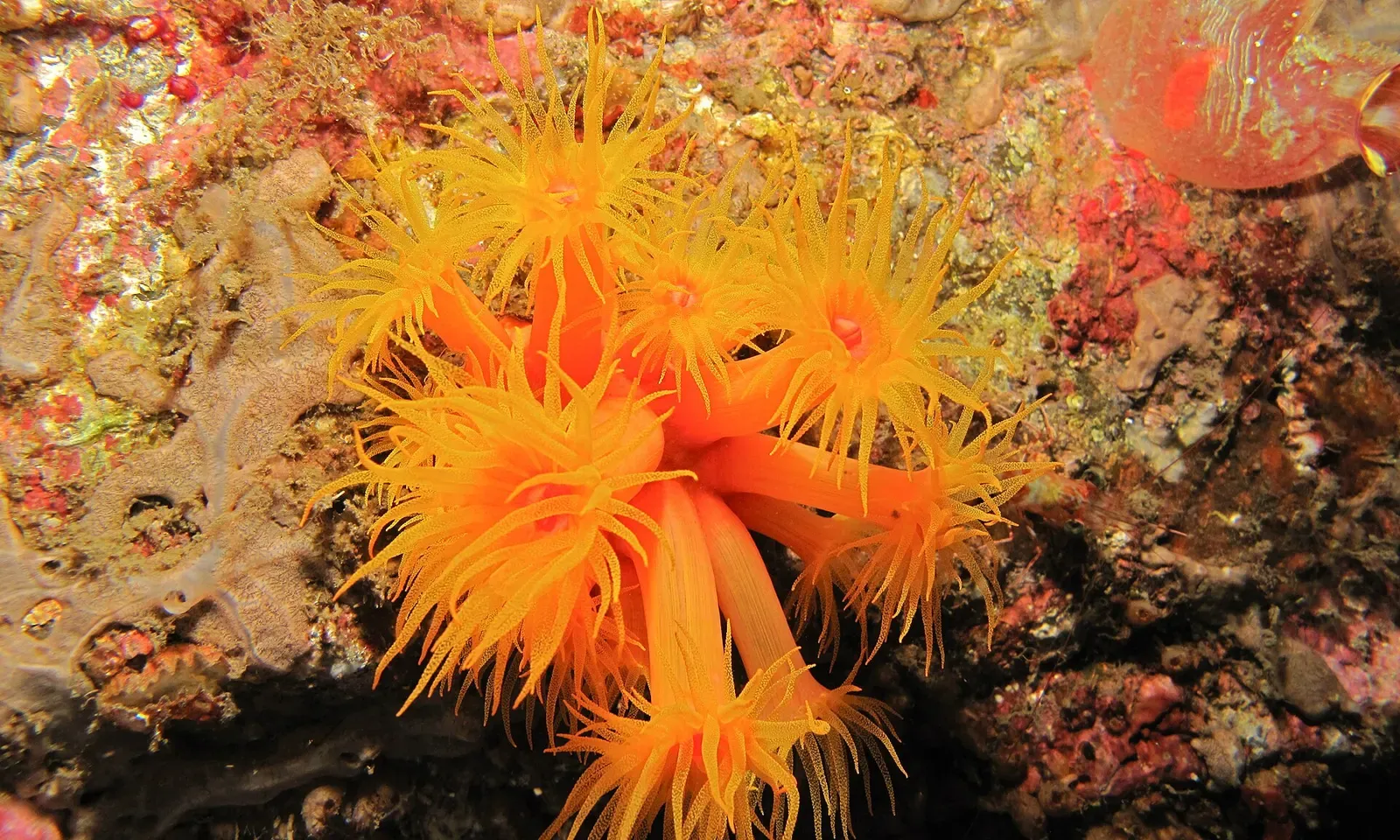
- A cluster of bright orange sun coral polyps open on a wall. by Bernard DUPONT from FRANCE, CC BY-SA 2.0, via Wikimedia Commons
- A decorator crab camouflaged with debris sits on the sandy slope. by Bernard DUPONT from FRANCE, CC BY-SA 2.0, via Wikimedia Commons
- A black-margined nudibranch with white and yellow ruffled edges on the reef. by Dan Schofield, CC BY 4.0, via Wikimedia Commons
- A red and white banded boxer shrimp perches on the reef with long antennae. by Bernard DUPONT from FRANCE, CC BY-SA 2.0, via Wikimedia Commons
In The Logbook
- Nudibranchs: species, habits and where to diveMacro & muck · 13 min read
- The best muck diving in the worldMacro & muck · 6 min read
More dive sites in Lembeh Strait
Pinnacle
A swim-through at 22 to 25 m lined with crinoids
Muck & macro
Sand, rubble and algae on a point that pulls in nutrient-rich water
Muck & macro
Zebra crabs sheltering in the spines of purple heart urchins
Wreck
A 60 m wartime cargo hull on its side under crinoids
Reef
A shallow coral bowl between two soft-coral mini walls
Muck & macro
The strait's only white-sand muck site, with coral in the shallows
Muck & macro
Banggai cardinalfish in the hundreds under a night torch
Muck & macro
Blue-ringed, coconut and mimic octopus on one black sand slope
Similar dives elsewhere

Fine sand and rock past 30 metres, dived for the small stuff

Black sand to 27 metres, at its best after dark
Two jetties over a steep sand slope to 30 metres
_(6082720640).jpg)
_(8457976853).jpg)

_(6080400754).jpg)
A sloping wall onto muck at 25 m, dived for nudibranchs