
Coral Triangle · Indonesia
Lembeh Strait
Slow scans over black sand reveal mimic octopus and hairy frogfish.
Photo: Bernard DUPONT · CC BY-SA 2.0
Lembeh Strait, between the tip of North Sulawesi and Lembeh Island, is built almost entirely around muck diving over black volcanic sand. Dive guides work slow, methodical scans of the seabed to turn up hairy frogfish, mimic octopus, mandarinfish, and flamboyant cuttlefish, species that draw underwater photographers from around the world. Visibility is often modest and currents mild, since the appeal is what's on the bottom rather than reef structure or big schooling fish.
About diving in Lembeh Strait
A day in the strait runs on a short leash. Resorts sit on both shores, and more than 30 sites lie within 6 or 7 km of them across water calm enough to feel like a lake, so the boat is back at the jetty a few minutes after the safety stop. The pattern is three or four dives spread across the day with long surface intervals for downloading images and changing lenses. Groups are small, and the working method is that a guide marks a find and then holds position while each diver in turn settles, frames and shoots it. Briefings deal less with navigation than with a target list.
The seabed does all the work here, and the differences between sites are matters of texture rather than scenery. Some are open black volcanic sand where the interest is whatever has buried itself. Some are rubble and debris, sunken logs and half-buried coconut shells that shelter frogfish, juvenile fish and octopus. Some carry patches of coral and a short drop, like the mini-wall at Nudi Falls, with gorgonians that hold pygmy seahorses. Jetty pilings and the shallows under moored boats form a category of their own, since fixed structure in a sand channel collects what open bottom does not.
Night diving is where the strait made its name. Slopes that look bare by day fill after dark with stargazers buried to the eyes, bobbit worms, decorator crabs, Spanish dancers and hunting cuttlefish. Police Pier, over grey silt, is dived almost only at night for snake eels, flamboyant cuttlefish and swarms of Banggai cardinalfish, a species native to islands some 400 km to the south that aquarium traders introduced here in 2000. For a change of scene, Angel's Window is a soft-coral pinnacle with a swim-through at 22 to 25 m, and the Mawali, a 60 m Japanese cargo ship from the Second World War, lies on its side between 15 and 30 m.
The skill that matters is buoyancy rather than fitness or nerve: holding position just off the sand without stirring it into the frame is most of the job, and a full tank can go on a few square metres of bottom. That makes the strait a destination for photographers and for divers who have seen plenty of reef and now want the rare animals. Newer divers usually get more from the walls and coral gardens of Bunaken, on the other side of the same road transfer from Manado, and many trips split a week between the two.
Best time to dive Lembeh Strait
| Jan | Feb | Mar | Apr | May | Jun | Jul | Aug | Sep | Oct | Nov | Dec | |
|---|---|---|---|---|---|---|---|---|---|---|---|---|
| Season | Good | Good | Good | Good | Good | Good | Prime | Prime | Prime | Prime | Prime | Good |
| Sea surface | 29°C84°F | 29°C84°F | 29°C84°F | 29°C84°F | 29°C84°F | 29°C84°F | 29°C84°F | 28°C82°F | 28°C82°F | 29°C84°F | 29°C84°F | 29°C84°F |
| Daytime high | 29°C84°F | 29°C84°F | 29°C84°F | 30°C86°F | 30°C86°F | 29°C84°F | 29°C84°F | 29°C84°F | 30°C86°F | 30°C86°F | 30°C86°F | 29°C84°F |
| Rain | 259 mm10.2 in | 200 mm7.9 in | 198 mm7.8 in | 195 mm7.7 in | 191 mm7.5 in | 191 mm7.5 in | 158 mm6.2 in | 105 mm4.1 in | 110 mm4.3 in | 144 mm5.7 in | 184 mm7.2 in | 215 mm8.5 in |
| Jan | Feb | Mar | Apr | May | Jun |
|---|---|---|---|---|---|
| Good | Good | Good | Good | Good | Good |
| Sea surface | |||||
| 29°C84°F | 29°C84°F | 29°C84°F | 29°C84°F | 29°C84°F | 29°C84°F |
| Daytime high | |||||
| 29°C84°F | 29°C84°F | 29°C84°F | 30°C86°F | 30°C86°F | 29°C84°F |
| Rain | |||||
| 259 mm10.2 in | 200 mm7.9 in | 198 mm7.8 in | 195 mm7.7 in | 191 mm7.5 in | 191 mm7.5 in |
| Jul | Aug | Sep | Oct | Nov | Dec |
|---|---|---|---|---|---|
| Prime | Prime | Prime | Prime | Prime | Good |
| Sea surface | |||||
| 29°C84°F | 28°C82°F | 28°C82°F | 29°C84°F | 29°C84°F | 29°C84°F |
| Daytime high | |||||
| 29°C84°F | 29°C84°F | 30°C86°F | 30°C86°F | 30°C86°F | 29°C84°F |
| Rain | |||||
| 158 mm6.2 in | 105 mm4.1 in | 110 mm4.3 in | 144 mm5.7 in | 184 mm7.2 in | 215 mm8.5 in |
2011–2025 averages. Sea surface: NOAA Coral Reef Watch, measured at the surface, so deeper water can run colder. Daytime high and rain: NASA POWER.
The strait is sheltered enough to dive in every month, and the animals it is known for are resident, so the choice is between critter numbers and water clarity. July and August bring the most critters, with the water at its coolest, about 25 to 26 °C, and visibility often poor; they are also the busiest months at the resorts. September to November keeps good numbers while the water clears, and October to December has the best visibility of the year. From October to March the water sits at 28 to 29 °C. January and February are the wettest months, with the lowest visibility and rough seas that can put the exposed sites at the northern end of the strait out of bounds. From June to September the south-east monsoon can make the surface choppy. The ratings here follow the critters rather than the water, so July and August rate prime and a clearer December only good.
Best months: July, August, September, October, November
Lembeh Strait water temperature and weather by month
The sea surface stays between 28 and 29 °C (82–84 °F) all year. Rain falls through the year, about 180 mm (7.1 in) a month on average, with January the wettest. Daytime highs sit around 29 °C (84 °F) all year. Below the surface the water can drop to about 25 °C (77 °F), so pack a 3 mm full suit.
Dive types & marine life
Frogfish, mimic and blue-ringed octopus, flamboyant cuttlefish, mandarinfish, pygmy seahorses and the introduced Banggai cardinalfish are resident, so sightings follow breeding cycles rather than migrations. July and August bring the greatest number of critters. Night dives add stargazers, bobbit worms and hunting cuttlefish.
- Muck & macro
- Night
- Frogfish
- Mandarinfish
- Octopus & cuttlefish
- Nudibranchs
- Pygmy seahorses
- Macro critters
- Squid
Best dive sites in Lembeh Strait
- 1
Hairball
Black-sand slope often called the strait's best, with frogfish of every colour, seahorses and octopus.
- 2
Nudi Falls
Mini-wall and sand slope packed with nudibranchs, with pygmy seahorses on the fans.
- 3
Jahir
Black sand among heart urchins to 30 m, known for mimic octopus, hairy frogfish and night dives.
- 4
Teluk Kambahu
Village bay, called TK1, of sand and rubble to 25 m with mandarinfish, frogfish and many nudibranchs.
- 5
Police Pier
Pier over grey silt, dived at night for snake eels, flamboyant cuttlefish and Banggai cardinalfish.
- 6
Tanjung Paudean
Black-sand slope to 25 m on the east shore; the site for blue-ringed, coconut and mimic octopus.
- 7
Angel's Window
Soft-coral pinnacle off Lembeh Island with a swim-through at 22 to 25 m and pygmy seahorses.
- 8
Mawali Wreck
Japanese WWII cargo ship, 60 m long, on its side at 15 to 30 m and crusted in black coral.
Site guides
Pinnacle
A swim-through at 22 to 25 m lined with crinoids
Muck & macro
Sand, rubble and algae on a point that pulls in nutrient-rich water
Muck & macro
Zebra crabs sheltering in the spines of purple heart urchins
Wreck
A 60 m wartime cargo hull on its side under crinoids
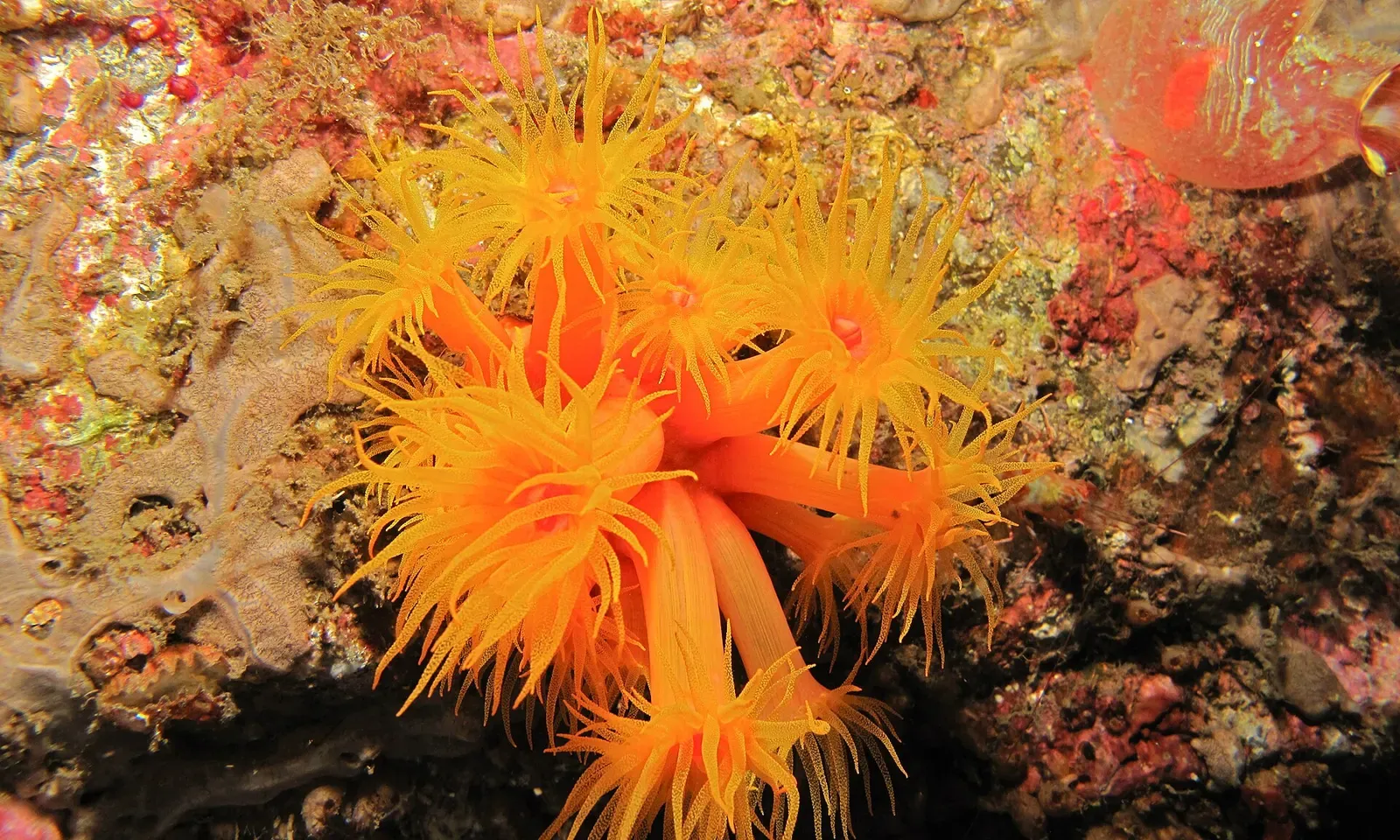
Sea fans on the mini-wall hold pygmy seahorses
Reef
A shallow coral bowl between two soft-coral mini walls
Muck & macro
The strait's only white-sand muck site, with coral in the shallows
Muck & macro
Banggai cardinalfish in the hundreds under a night torch
Muck & macro
Blue-ringed, coconut and mimic octopus on one black sand slope
Muck & macro
Village-bay sand and rubble with mandarinfish and cardinalfish
How to get to Lembeh Strait
Fly into Sam Ratulangi International Airport at Manado, then drive about 35 km east to Bitung on the strait, a transfer shortened by the Manado–Bitung toll road that opened in 2022. Resorts on the Lembeh Island side add a short boat crossing. Diving is from resort day boats, and North Sulawesi liveaboards also stop in the strait.
Photos from Lembeh Strait
Bernard DUPONT · CC BY-SA 2.0
Bernard DUPONT · CC BY-SA 2.0
Bernard DUPONT · CC BY-SA 2.0
desertnaturalist · CC BY 4.0
Justin Philbois · CC0
Justin Philbois · CC0
Dive videos
Mucky Secrets (full) - The Marine Creatures of the Lembeh Strait · Bubble Vision on YouTube
Diving the Lembeh Strait · Bubble Vision on YouTube
Questions divers ask
What certification is needed to dive the Lembeh Strait?+
Open Water is enough for almost all of it. Most sites sit between 5 and 25 m with little or no current, and the demand is buoyancy control close to silty sand rather than depth. Divers straight out of a course often find muck diving slow and build experience on reefs first.
What is the water temperature in Lembeh?+
It runs from about 25 to 26 °C in July and August up to 28 to 29 °C from October to March. The mid-year low coincides with the busiest critter season, and at sites such as Nudi Falls the water is usually a degree or two cooler than at Bunaken.
Is there a fee to dive in the Lembeh Strait?+
Yes. A dive permit introduced to tackle floating rubbish from the villages and the port town of Bitung is charged once per year per diver and paid on arrival. It is a small fee compared with the cost of the trip.
Can Lembeh be combined with Bunaken?+
Yes, and many trips do. Bunaken's walls and coral gardens lie off Manado, at the other end of the road transfer, and give the reef and snorkelling that the strait lacks. Liveaboards in North Sulawesi also link Lembeh with Bunaken and Bangka Island.
When is the best time to dive Lembeh?+
Any month works. July and August have the most critters, October to December the clearest water, and January and February the roughest seas and poorest visibility, with some northern sites closed on bad days.
Sources
- Lembeh Strait dive sites — Dive The World
- Diving Lembeh Strait — Divezone
- Lembeh Strait — Wikipedia
- Lembeh — Wikipedia
- Bitung — Wikipedia
- Bitung — Wikivoyage
- Banggai cardinalfish — Wikipedia
Photo credits
- Vivid pink soft coral colony rising from the black sand seabed in Lembeh Strait. by Bernard DUPONT, CC BY-SA 2.0, via Wikimedia Commons
- A coconut octopus curls its arms while resting on the sandy seabed of Lembeh Strait. by Bernard DUPONT, CC BY-SA 2.0, via Wikimedia Commons
- A cluster of dark sea squirts with pale golden siphons growing on a red sponge. by Bernard DUPONT, CC BY-SA 2.0, via Wikimedia Commons
- A bright orange spotfin frogfish camouflaged against a sponge in Lembeh Strait. by Bernard DUPONT, CC BY-SA 2.0, via Wikimedia Commons
- A translucent anemone shrimp perches among the pale tentacles of its host anemone. by desertnaturalist, CC BY 4.0, via Wikimedia Commons
- A mandarinfish swims side-on through dark coral rubble, its orange-lined blue and green pattern lit by a torch at dusk. by Justin Philbois, CC0, via iNaturalist
- A mandarinfish peers out from between pale branching coral, its blue face and orange-striped body half hidden. by Justin Philbois, CC0, via iNaturalist
Embed
Run a dive centre, club or blog? Embed this map of 12 dive sites near Lembeh Strait on your own page.
In The Logbook
- Nudibranchs: species, habits and where to diveMacro & muck · 13 min read
- Frogfish: species, behaviour and where to diveMacro & muck · 12 min read
- Bioluminescence: why the sea glows at nightNight diving · 7 min read
- Night diving: the best night dives in the worldNight diving · 12 min read
- Why is the sea blue? Water filters out redOcean science · 7 min read
- Why your ears hurt diving, and how to stop itBody & health · 8 min read
- The best muck diving in the worldMacro & muck · 6 min read
Similar destinations

Soft coral grows so thick on Sahaung's pinnacles the rock disappears

The endemic psychedelic frogfish lives on Ambon's harbour slopes

New species are described from these slopes with unusual regularity
_(6073606116).jpg)
_(8468811738).jpg)
.jpg)
_(8468807412).jpg)

A limestone wall the length of the coast, dived by almost nobody