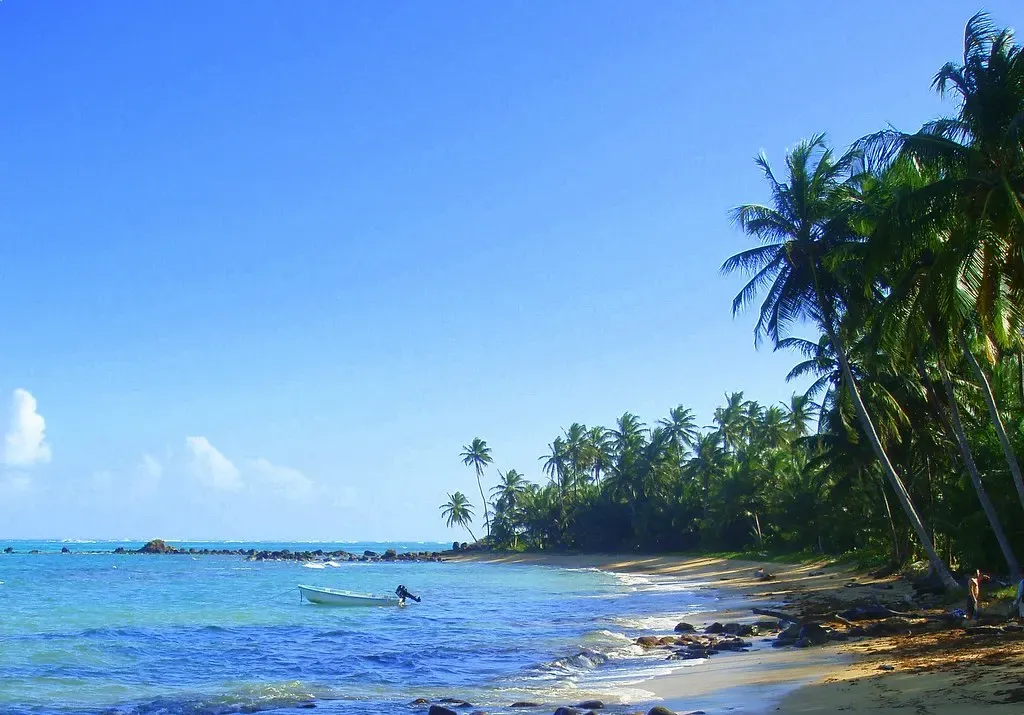
Little Corn Island, one of Nicaragua's Corn Islands in the Caribbean, is surrounded by coral reef. About 20 dive sites lie close to the island: coral slopes, sand channels, overhangs and swim-throughs, many of them no deeper than 12 m. The standout is Blowing Rock, an islet 26 km (16 miles) offshore where reef sharks, eagle rays and huge schools of barracuda and jacks gather when the sea is calm enough to reach it.
About diving in Little Corn Island & the Corn Islands
Diving runs from boats that leave the shop for single-tank dives, typically at 9am, 11.30am and 2.30pm, and return to the shop between them. Most sites lie close to the island. Blowing Rock is the exception: the boat leaves at 8am for the longer run, and the two dives are made with the surface interval spent aboard. Wind decides the menu. Sheltered sites inside the outer reef work on windier days, while the east side and Blowing Rock need consistently calm weather, with winds of about 16 km/h (10 mph) or less.
The reef around the island is a mix of coral slopes, sand channels, overhangs and swim-throughs. On the east side a series of overhangs and caves shelters schools of reef fish and, at times, a resident goliath grouper about 1.5 m (5 ft) long. Inside the outer reef a gentle drift follows a slope down and back up, and after dark midnight parrotfish wedge into holes in the reef in large numbers. Further out, two big reef mounds run from 18 m down to 26 m.
The shallow inner sites suit newer divers, and guided fun dives take divers of all levels. A training site in front of the dive shop hides eels, toadfish, small shrimps and crabs. Divers chasing sharks and big schools should plan around the calm months, since Blowing Rock and the exposed east-side sites cannot be promised outside them. Experienced divers can ask for deeper sites such as Dave's Place, west of the island, with reef heads and corals to 26 m.
Best time to dive Little Corn Island & the Corn Islands
| Jan | Feb | Mar | Apr | May | Jun | Jul | Aug | Sep | Oct | Nov | Dec |
|---|---|---|---|---|---|---|---|---|---|---|---|
| Fair | Fair | Fair | Prime | Prime | Fair | Fair | Good | Prime | Good | Fair | Fair |
January to March is the dry season but a windy one, and the east side and Blowing Rock are generally out of reach. April and May bring the calm spell that opens every site, and the rainy season starts in May. June and July turn windy again. From mid August to mid October the wind drops once more and the offshore trip runs, though the rain continues until November. November is both wet and windy, and December stays windy as the dry season begins. Tropical storms and hurricanes reach the islands occasionally.
Dive types & marine life
Nurse sharks and eagle rays are most reliable at White Holes, and Caribbean reef sharks are often seen at Tunnels. Blowing Rock adds stingrays, moray eels and huge schools of barracuda and jacks, but only in the calm windows. Green sea turtles turn up around the islands.
- Reef
- Drift
- Cave & cavern
- Night
- Reef sharks
- Eagle rays
- Barracuda
- Trevally & jacks
- Stingrays
- Hammerheads
- Sea turtles
- Groupers
- Octopus & cuttlefish
Best dive sites in Little Corn Island & the Corn Islands
- 1
Blowing Rock
Rocky islet breaking the surface in open sea, 45 to 60 minutes by boat depending on weather
- 2
White Holes
Shallow site of three sand patches ringed by staghorn and elkhorn coral, 10 minutes north
- 3
Tunnels
Swim-through tunnels lit by sunlight from above, opening onto reef
- 4
Tarpon Channel
Dived for one reason: the chance of one of the few native great hammerheads, never a sure thing
- 5
Yellowtail
Maze of sandy channels and small archways between coral, 5 minutes by boat from the dive shop
- 6
Turtle Rock
Sheltered inside the outer reef, the windy-day fallback and a night dive for lobster and octopus
- 7
Kev's Place
Sloping reef out to the north-west, starting at 12 m and running to just over 20 m
Site guides
Pinnacle
Caribbean reef sharks around a lone rock breaking the surface far offshore
Channel & pass
The island's one realistic chance of a great hammerhead
Reef
Lobster and octopus out feeding on a sheltered night reef
Reef
Nurse sharks and eagle rays over sand patches ringed by elkhorn coral
Reef
A maze of sandy channels and small coral archways
How to get to Little Corn Island & the Corn Islands
Daily flights run to Big Corn from Managua and Bluefields. From Big Corn, small open pangas make the crossing to Little Corn in around 30 minutes, and the dive centres are on Little Corn itself.
Questions divers ask
When is the best time to dive Blowing Rock?+
April and May, and mid August to mid October. Blowing Rock and the east-side sites need winds of about 16 km/h (10 mph) or less, and November to March and June to July are usually too windy.
How do divers get to Little Corn Island?+
Daily flights from Managua or Bluefields land on Big Corn, and small open pangas cross to Little Corn in around 30 minutes.
Can hammerheads be seen at the Corn Islands?+
Yes, though never reliably. Tarpon Channel is dived specifically for the few native great hammerheads, and only when conditions are calm enough.
Is there diving when the wind is up?+
Yes. Sites inside the outer reef such as Turtle Rock and Stanley Reef stay sheltered on windier days, while the east side and Blowing Rock wait for calm weather.
Sources
- Dive Sites – Dolphin Dive Little Corn — Dolphin Dive Little Corn
- How to get here – Dolphin Dive Little Corn — Dolphin Dive Little Corn
- Las Palmeras Dive Center | Little Corn Island — Las Palmeras Dive Center
- Corn Islands — Wikipedia
- Corn Island Average Sea Temperatures — seatemperature.org
Photo credits
Embed
Run a dive centre, club or blog? Embed this map of 2 dive sites near Little Corn Island & the Corn Islands on your own page.
Similar destinations
Caribbean
Deep wall drifts and a shark-feeding site off Cape Eleuthera

Descend into Angelfish Blue Hole, a vertical shaft opening onto a coral-rimmed cavern

Two dozen reef sharks circle a baited arena in 12 m of water

Atoll walls at Lighthouse Reef and Turneffe, and the Great Blue Hole