Long Island, Bahamas · Bahamas · Blue hole · Cave & cavern
Dean's Blue Hole
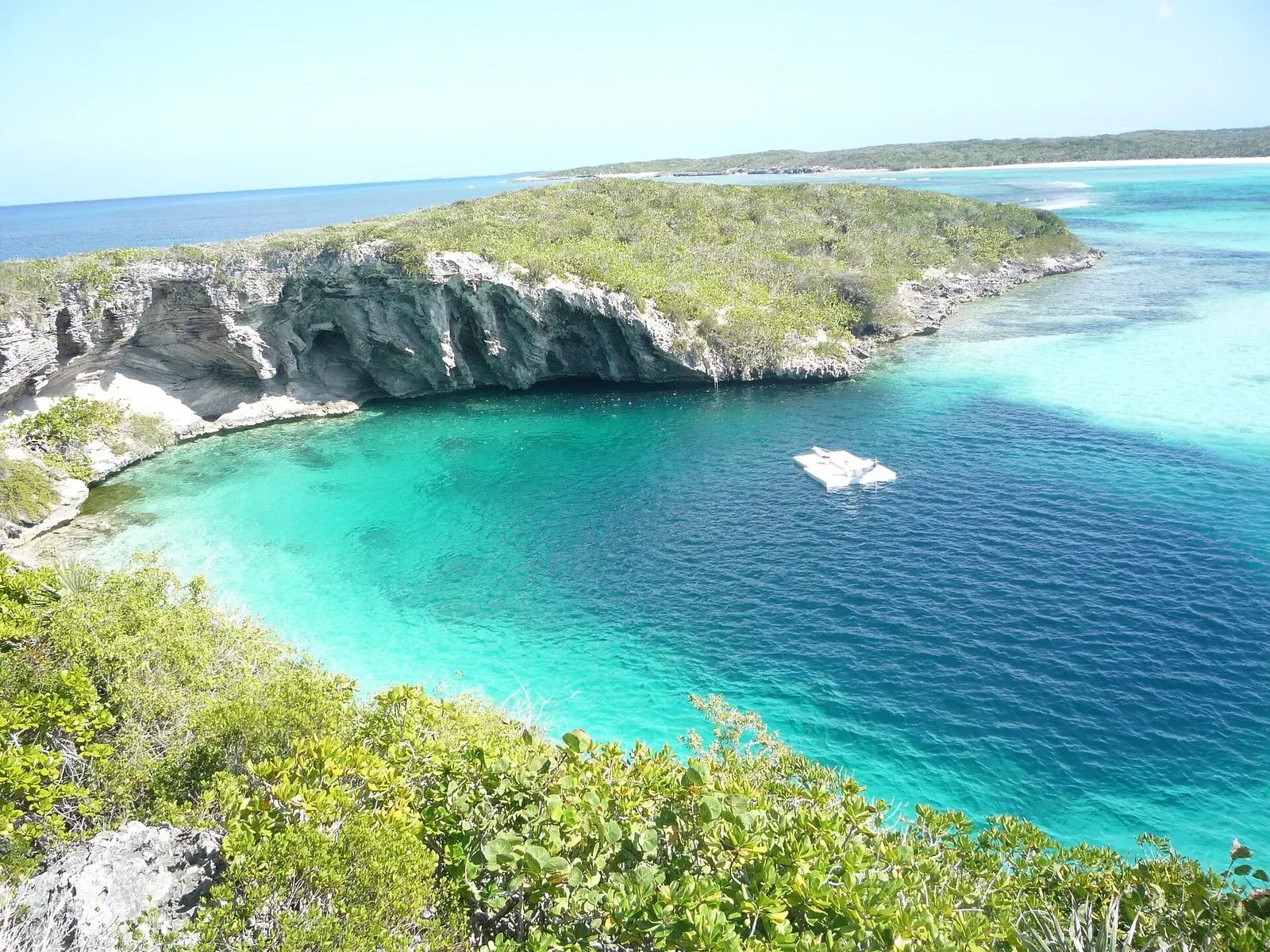
A 202 m blue hole entered from the beach, home of the Vertical Blue freediving competition
Area photo: Ton Engwirda · CC BY-SA 3.0
A flooded karst sinkhole in a bay west of Clarence Town, 202 m deep and the world's third-deepest known blue hole. A narrow 25–35 m mouth flares at around 20 m into a bell-shaped chamber over 100 m across, which is what makes it freediving's premier venue rather than a technical shaft dive. It is entered straight off a sheltered beach — free for anyone to swim or snorkel over, and dived by advanced scuba divers to a recreational limit of about 40 m.
Where it is and how deep
23.1064° N, 75.0086° WPublished position for this site.
The dive
Dean's Blue Hole sits in a bay on Long Island's Atlantic shore, its mouth a modest 25 to 35 m across at the surface. The shaft narrows on the way down, then flares out at around 20 m into a cavern at least 100 m wide — a bell-shaped chamber rather than a straight-sided shaft, which is why a diver descending the line drops through open water without ever brushing a wall. The hole reaches 202 m at its true bottom, the third-deepest known blue hole on Earth, behind the barely explored Taam Ja' in Mexico and Dragon Hole in the South China Sea.
That bell shape is exactly what has made the hole the world's foremost freediving venue. William Trubridge has run the invitational Vertical Blue competition here with AIDA International since April 2008, when its first edition drew competitors from nine countries and produced 23 national and 3 world records; Trubridge himself set a no-fins world record of 92 m here in April 2010, and Tunisia's Walid Boudhiaf reached 118 m at Vertical Blue 2025. The sport's worst tragedy happened here too: American freediver Nicholas Mevoli died on 17 November 2013 after attempting a national record during the competition.
Scuba divers come here as well, though as a single advanced dive rather than a multi-tank trip: local operators out of the island's resorts take guests down into the chamber to the recreational limit of about 40 m, well short of the true floor. Sunlight through the entrance breaks into shafts across the walls, tarpon shoal in the shadows at the edge of visibility, and turtles, reef sharks and the occasional dolphin pass through the shallower water near the rim.
Most visitors never put on a tank at all. A short walk from the road puts you on a sheltered, sandy beach, and swimming or snorkelling straight out over the shaft costs nothing and needs no booking. It is also, by a wide margin, the most dangerous water on Long Island: most of the deaths recorded here are freedivers who pushed past their training rather than divers on scuba, since the body grows denser with depth and the swim back up gets harder exactly when a diver is most likely to misjudge it. Underwater overhangs sit just beneath the cliffs at the surface and again around 18 m down, so the standard advice is to always surface with one hand raised overhead.
Marine life and season
- Sea turtles
- Dolphins
- Reef sharks
- Reef fish swarms
| Jan | Feb | Mar | Apr | May | Jun | Jul | Aug | Sep | Oct | Nov | Dec |
|---|---|---|---|---|---|---|---|---|---|---|---|
| Good | Good | Prime | Prime | Good | Fair | Fair | Fair | Off-season | Fair | Good | Good |
Season follows Long Island, Bahamas: Atlantic hurricane season runs June–November, peaking late Aug–Sep; Dec–Apr is calmer for the boat-based reef and wall dives. Dean's Blue Hole itself is sheltered and diveable year-round.
Know before you go
- Untrained freedivers pushing past their limits account for most of the deaths recorded here; body density increases with depth, making the swim back up harder than expected.
- Underwater overhangs sit just beneath the cliffs at the surface and again around 18 m down; always surface with one hand raised overhead.
- American freediver Nicholas Mevoli died here on 17 November 2013 attempting a national record during the Vertical Blue competition.
- Scuba dives are capped at the recreational limit of about 40 m; the shaft itself continues to 202 m with no floor in sight below that depth.
Questions divers ask
How deep is Dean's Blue Hole?+
202 m (663 ft) to the true bottom, making it the world's third-deepest known blue hole after Taam Ja' in Mexico and Dragon Hole in the South China Sea. The mouth is 25 to 35 m wide and flares into a chamber over 100 m wide at around 20 m down.
Can you scuba dive Dean's Blue Hole?+
Yes, but as a single advanced dive arranged through Long Island's resort dive operators, not a walk-up trip. Divers descend into the chamber to the recreational limit of about 40 m; the shaft below that has no floor in sight and is well outside recreational range.
Is Dean's Blue Hole dangerous?+
For untrained freedivers, yes — most of the recorded deaths here involve people diving beyond their training, including American freediver Nicholas Mevoli, who died during the Vertical Blue competition on 17 November 2013. Snorkelling at the surface and guided scuba dives are considered safe.
What is Vertical Blue?+
An invitation-only freediving competition William Trubridge has run here with AIDA International since April 2008. It is the sport's most prestigious event and has produced numerous national and world records, including Trubridge's own 92 m no-fins record set here in 2010.
Sources
- Dean's Blue Hole — Wikipedia
- Vertical Blue — Wikipedia
- Long Island — Wikivoyage
- Long Island — Bahamas Ministry of Tourism
- Top Three Blue Hole Dive Sites — Scuba Diver Life
- Clarence Town Sea Temperature — Sea Temperature
In The Logbook
- How deep can you actually dive?Body & health · 13 min read
- Blue holes: what's actually down thereCaves & caverns · 13 min read
Similar dives elsewhere
Stalactites that grew in open air, now hanging in a 124-metre shaft

A vertical shaft with side caverns at its 18 m base

A 30 m-wide hole rimmed with coral at 12 m, dropping to 60 m


A vertical chimney through the reef with a cave exit