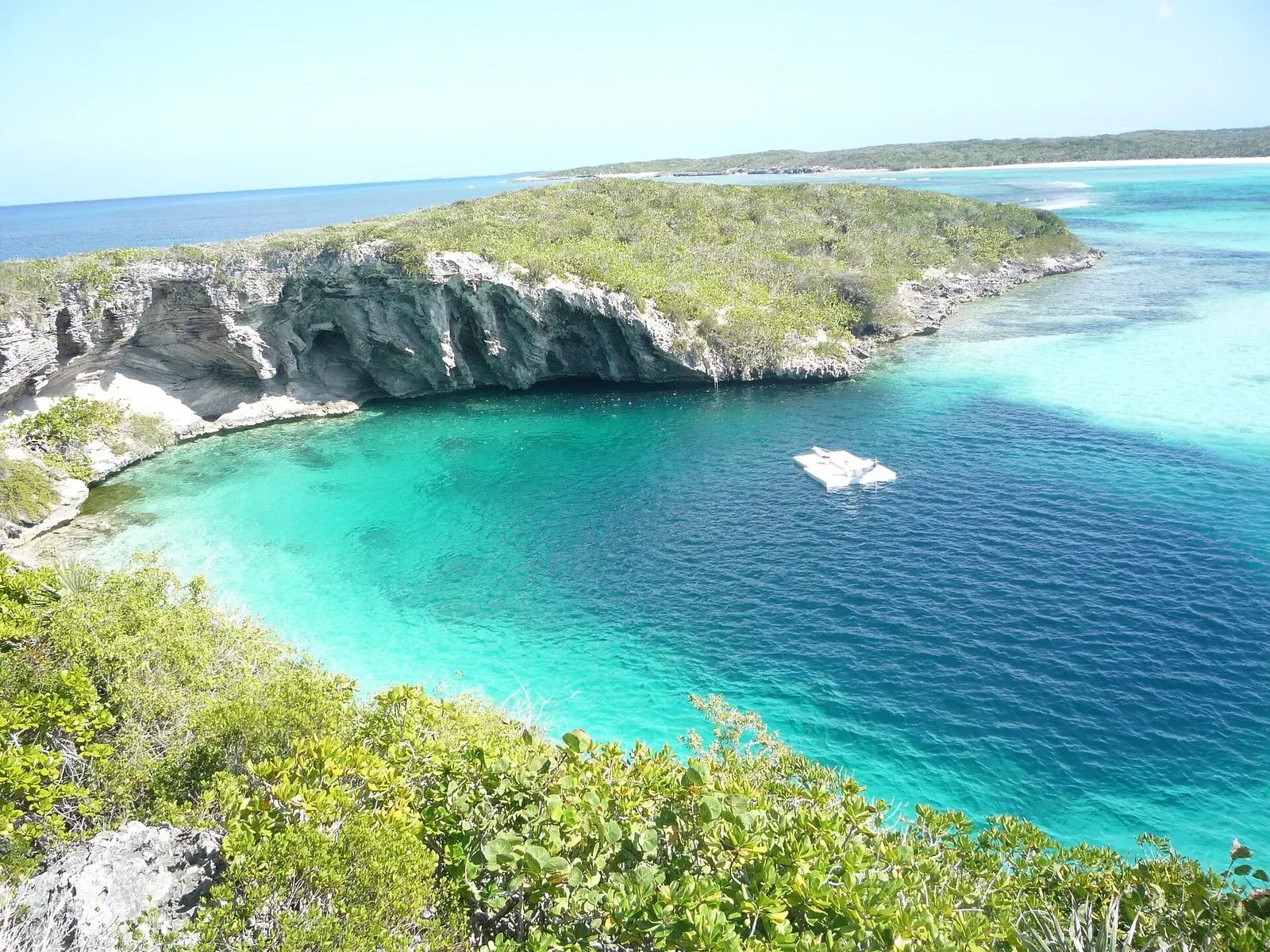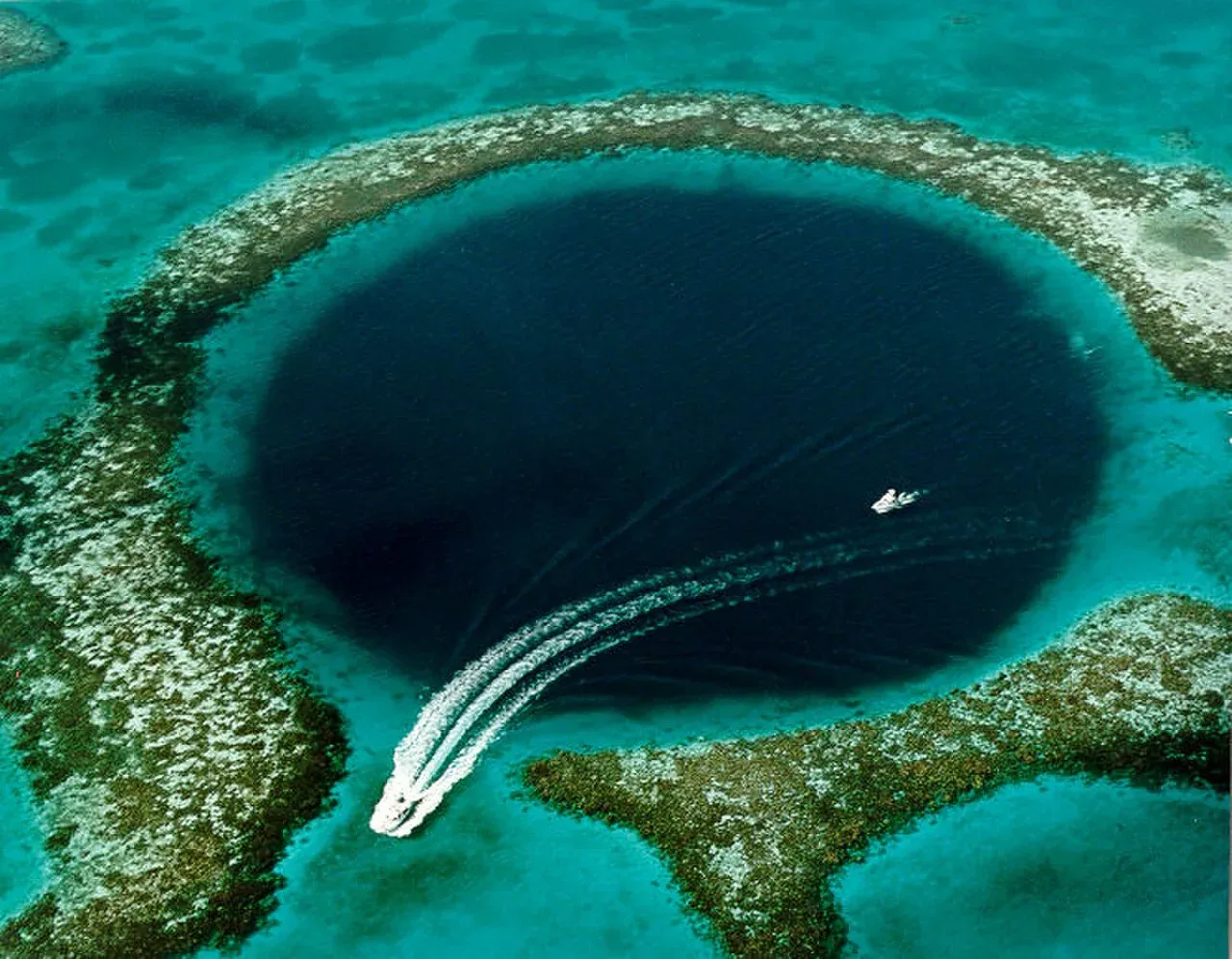
Every blue hole is a drowned cave
At the coldest points of the last ice ages, the sea stood 100 to 120 metres lower than it does today. The limestone platforms that are now the Bahama banks, Lighthouse Reef and the Yucatán shelf stood in open air, and rain did to them what rain does to limestone everywhere: it picked up carbon dioxide, turned faintly acidic, and dissolved the rock along every crack it could find. Over hundreds of thousands of years the water table carved out caverns, shafts and galleries — ordinary dry karst caves, with stalactites growing from their ceilings. Then the ice melted, the sea came up through the Holocene, and the caves flooded from below. A blue hole is what is left: a cave with the sea in it and its entrance pointing at the sky.
The Great Blue Hole carries the proof inside it. Stalactites only grow in air, and analysis of the ones recovered from its walls dates their formation to 153,000, 66,000, 60,000 and 15,000 years ago — four separate spells when the shaft stood dry and dripping. The ledges that ring the shaft at 21, 49 and 91 metres mark pauses in the same story, and it was the 1971 Calypso expedition, analysing the stalactites Cousteau’s team recovered, that confirmed the hole formed as karst limestone in at least four stages before the sea rose. A diver dropping down the southern wall to the formations at around 30 metres (100 feet) is descending a tide gauge of the last four ice ages.
Not every blue hole took exactly this route. Some are collapse features: Toriike on Shimoji-jima began as a sea cave that waves enlarged until the roof fell in, and Gozo’s Blue Hole is a collapsed sea cave along a fault. And one entry in this guide is a genuine exception — Little Blue Lake in South Australia was dissolved not by rain from above but by carbon-dioxide-charged groundwater rising during volcanic activity at Mount Schank, and it filled as the water table rose about 8,000 years ago. The family resemblance between all of them is the colour, not always the birth.
The colour is geometry, not chemistry
Water is a red filter: it absorbs the red end of the spectrum roughly 140 times more strongly than the blue, which is the whole subject of our guide to why the sea is blue. A blue hole stages that physics as a graphic. Inside the rim is a column of water deep enough that only blue light survives the round trip back to your eye; around the rim is a ring of shallow, sunlit carbonate sand and coral scattering the full spectrum back up. Deep navy circle, bright turquoise surround, and a boundary between them as sharp as the rim itself — every aerial photograph of Belize or Dean’s is the same optics diagram taken twice.
Below the halocline, the water stops behaving
The signature science of blue holes happens where fresh water sits on salt. Inland and near-shore holes catch rainfall, and that lighter fresh water floats as a lens on the denser seawater underneath, sealing it off from the air. With the oxygen gone, bacteria in the boundary layer switch to respiring dissolved sulphate and excrete hydrogen sulphide — the faintly cloudy, rotten-egg layer that divers meet as a visible surface hanging in open water. At Angelita in Mexico that cloud sits at about 27 metres; in Sawmill Sink on Abaco it starts around 9 metres; in the Great Blue Hole it lies below about 91 metres. The halocline itself is chemically corrosive where the two waters react, which is why blue holes so often widen sideways at that level — Sawmill Sink’s horizontal passages run past 600 metres.
Below the sulphide layer there is no oxygen, no scavengers and effectively no decay, which cuts both ways. It is why the Bahamian holes hold intact fossils thousands of years old, and it is why the bottom of a blue hole keeps whatever reaches it. In December 2018 two submersibles sonar-scanned the Great Blue Hole and produced a near-complete three-dimensional map of the shaft. The same expedition found the remains of two of the three divers known to have gone missing in the hole. That fact belongs in this guide as plainly as the stalactite dates: the Great Blue Hole is dived on ordinary recreational profiles, and it is not risk-free.
Seven you can dive without a headline
The famous holes have famous problems, covered below. These seven mostly do not, and six of them get far less attention than they deserve.
The walk-in is Gozo’s Blue Hole at Dwejra: five minutes on foot over the old quarry, down carved steps, into a collapsed sea cave whose archway opens to the sea between about 6 and 15 metres. Since the Azure Window fell on 8 March 2017 its blocks have lain outside between 5 and 16 metres, and the wall beyond runs to published depths of 35 to 60 metres. It is rated a summer site, but visibility here can exceed 30 metres even in winter.
The Bahamas has two boat dives in this class. Angelfish Blue Hole off Stocking Island is a shaft to a sand base at 18 metres with small caverns leading off it, dived on a rising tide only — on a falling tide the current through the tunnel below can hold a diver down, and eagle rays are often working the entrance as you arrive. Nassau’s Lost Blue Hole is a 30 metre-wide crater whose coral-packed rim sits at 12 metres over a 60 metre shaft, and it holds the one real animal calendar in this whole genre: blacknose sharks gather to mate here from May to early August.
The Philippines’ only recorded blue hole is at Tablas — a chimney about 8 metres across, entered at 5 to 7 metres and left through a large opening onto the reef at 27 to 32 metres, its cracks packed with Durban dancing shrimp. Guam’s Blue Hole reads as a heart shape from above the Orote cliffs: rim at 18 metres, a window through the wall at about 40, and a shaft that keeps going past 90 — the window is the dive, and the exit is an open-water pickup on a surface marker.
Toriike deserves its blue-hole reading rather than its swim-through one. It is a pair of collapsed sinkholes, 75 and 55 metres across, joined underground and connected to the sea by a cave whose ceiling sits at 20 metres. What makes it singular is the water itself: as the passage runs inland, the sea’s blue gives way to the green of the pond through a shimmering, layered gradient where temperature and salinity change with depth — a chemocline you swim through rather than look at — until you surface inside a ring of limestone cliff. It only runs on calm days, and operators ask for experienced divers.
And Little Blue Lake is the exception that proves the karst rule: a 50 metre-wide volcanic-CO2 sinkhole whose shallowest point is already 25 metres, with 12 °C water, normally poor visibility and a 1966 Morris 1100 on the silt at the bottom. Diving it requires membership of the Cave Divers Association of Australia; swimming across the top requires nothing at all.
| Site | Depth | Level | Best months |
|---|---|---|---|
| Blue Hole & Inland Sea Malta & Gozo · Malta | 10–30 m | Intermediate | Jun–Sep |
| Angelfish Blue Hole Exuma Cays · Bahamas | to 18 m | Advanced | Jan–Mar |
| Lost Blue Hole Nassau & New Providence · Bahamas | 12–12 m | Advanced | Nov–May |
| Blue Hole Romblon · Philippines | 5–30 m | Advanced | Nov–Apr |
| Blue Hole Guam · Guam | 18–40 m | Advanced | Dec–May |
| Toriike Miyako-jima · Japan | 20–35 m | Advanced | Apr–Jun |
| Little Blue Lake Mount Gambier · Australia | 25–42 m | Advanced | May–Aug |
| Site | Jan | Feb | Mar | Apr | May | Jun | Jul | Aug | Sep | Oct | Nov | Dec |
|---|---|---|---|---|---|---|---|---|---|---|---|---|
| Blue Hole & Inland SeaMalta & Gozo | Fair | Fair | Fair | Good | Good | Prime | Prime | Prime | Prime | Good | Good | Fair |
| Angelfish Blue HoleExuma Cays | Prime | Prime | Prime | Good | Good | Fair | Fair | Fair | Fair | Fair | Good | Good |
| Lost Blue HoleNassau & New Providence | Prime | Prime | Prime | Prime | Prime | Good | Good | Fair | Fair | Good | Prime | Prime |
| Blue HoleRomblon | Prime | Prime | Prime | Prime | Good | Good | Fair | Fair | Fair | Good | Prime | Prime |
| Blue HoleGuam | Prime | Prime | Prime | Prime | Prime | Good | Fair | Fair | Fair | Fair | Good | Prime |
| ToriikeMiyako-jima | Fair | Fair | Good | Prime | Prime | Prime | Good | Good | Fair | Prime | Good | Fair |
| Little Blue LakeMount Gambier | Good | Good | Good | Good | Prime | Prime | Prime | Prime | Fair | Fair | Fair | Good |
| Great Blue HoleBelize Barrier Reef | Good | Good | Prime | Prime | Prime | Prime | Good | Fair | Off-season | Off-season | Fair | Good |
| Blue HoleDahab | Good | Good | Good | Prime | Prime | Good | Good | Good | Prime | Prime | Good | Good |
| Dean's Blue HoleLong Island, Bahamas | Good | Good | Prime | Prime | Good | Fair | Fair | Fair | Off-season | Fair | Good | Good |
Belize and Dahab, stated plainly
The two most famous holes in diving are covered as cavern-adjacent dives in our cenotes and caverns guide, and nothing here changes that guide’s advice: the Great Blue Hole is a deep, short, dark dive planned to the metre, and Dahab’s Arch is a technical dive. What this guide can add is the texture around those verdicts.
A Belize day is a long one — boats run out to Lighthouse Reef from San Pedro, Caye Caulker, Hopkins and Placencia, the monument is open 08:00 to 16:30, and non-nationals pay a BZD 60 entry fee. The dive itself is a straight descent past the rim at 5 metres to the stalactites from about 30 metres on the southern wall, a few minutes with the limestone, and a slow climb back up the same face, often with reef sharks coming up out of the blue to meet you. Jacques Cousteau brought the Calypso here in 1971 and rated the site among the best in the world; the geology is why.
DIVING THE GREAT BLUE HOLE - Belize · UNDERWATER EXPLORATIONS on YouTube
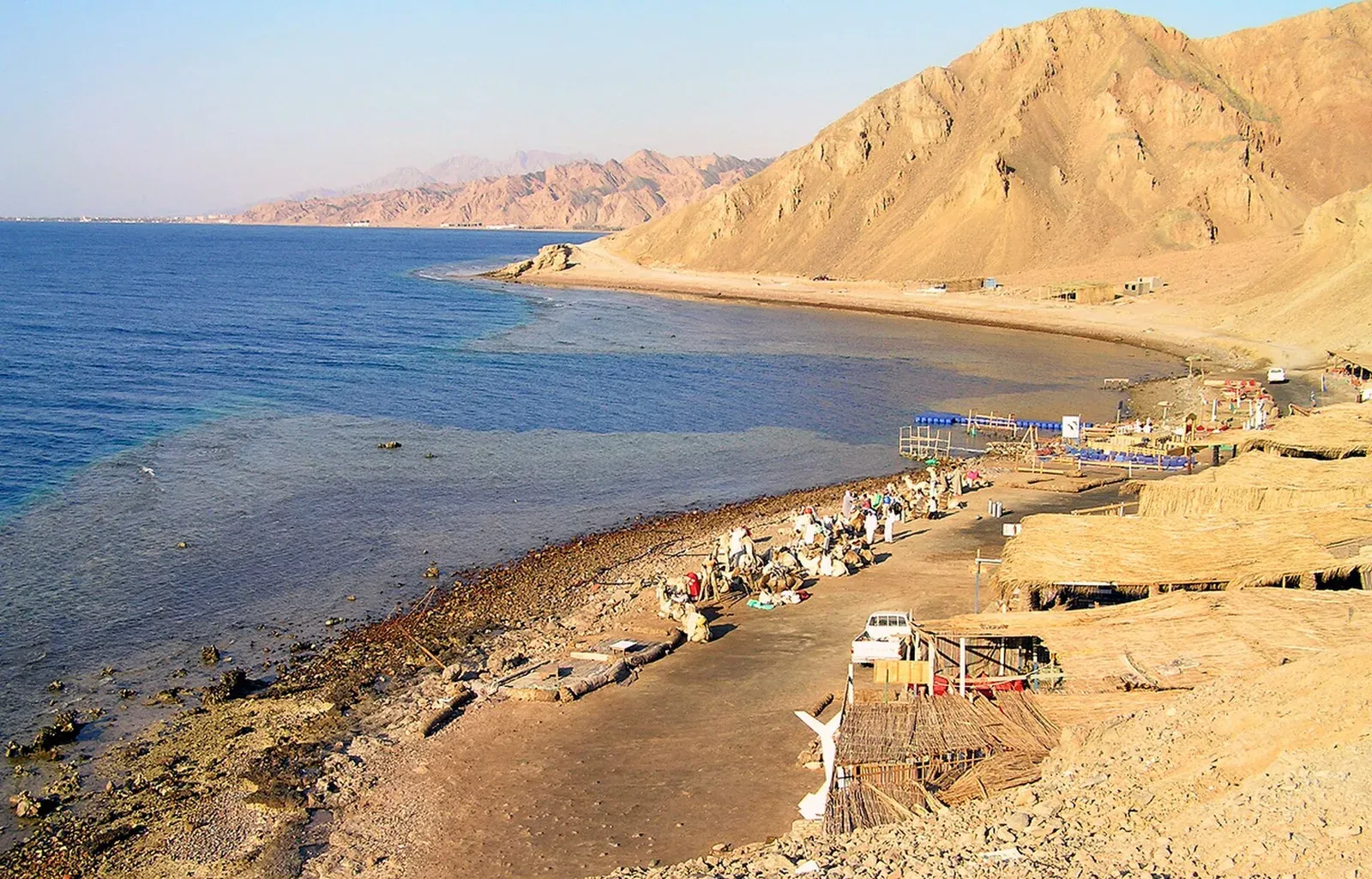
Dahab’s Blue Hole demands more honesty than any site in this guide. The safe version is genuinely lovely: an easy shore entry inside the hole, a swim across the 6 metre saddle to the reef outside, or the El Bells entry along the cliff — a chimney descent local centres run to 30 metres for advanced divers, drifting the wall back to the hole. The lethal version is the Arch, a 26 metre tunnel through to open sea with its ceiling at 55 metres. Part of what kills people is perceptual: divers report the tunnel looks less than 10 metres long against its measured 26 — clear water, light at the far end, nothing to scale it by — and narcosis at that depth on air is exactly the wrong state in which to reassess it. The commonly quoted death toll — 130 to 200 — deserves its own asterisk. The 130 figure traces to Dahab technical diver Tarek Omar’s 2012 statement that more than 130 divers had died in the preceding 15 years; the 200 figure is unattributed, Wikipedia flags the accuracy of all these numbers as poor, and the total conflates snorkelling deaths at the surface with scuba deaths at the Arch. What is beyond dispute is the memorial: plaques for the dead, left on the rock at the rim by families and friends. Entry now runs past a police post — the Egyptian Chamber for Diving and Watersports stations an officer at the site to check divers are with a certified guide — and local centres require Tech 60 certification, or enrolment in that course, before anyone approaches the Arch. Why 55 metres on air is a trap in itself is the subject of our gas density and narcosis guide.
Dean’s Blue Hole belongs to the freedivers
Start by retiring a claim you will read everywhere: Dean’s Blue Hole is not the deepest blue hole in the world. At 202 metres it ranks third, behind Taam Ja’ and the Dragon Hole below — the older claim was true only before those two were measured. What Dean’s actually is may be better: the deepest blue hole anyone actually swims in, and the spiritual home of competitive freediving.
The shape explains the sport. The mouth, off a sheltered beach west of Clarence Town on Long Island, is a modest 25 to 35 metres across — then at about 20 metres down the shaft flares into a bell-shaped chamber more than 100 metres wide. A freediver on the rope drops through still, dark, open water without a wall in sight, which is as close to a laboratory as depth sport gets. William Trubridge has run the Vertical Blue competition here with AIDA International since April 2008, when the first edition drew athletes from nine nations and produced 23 national and 3 world records; Trubridge set his 92 metre no-fins world record here in April 2010, and Walid Boudhiaf’s Tunisian record of 118 metres came at Vertical Blue 2025. The sport’s most painful loss happened on the same rope: American freediver Nicholas Mevoli died on 17 November 2013 after attempting a national record during the competition.
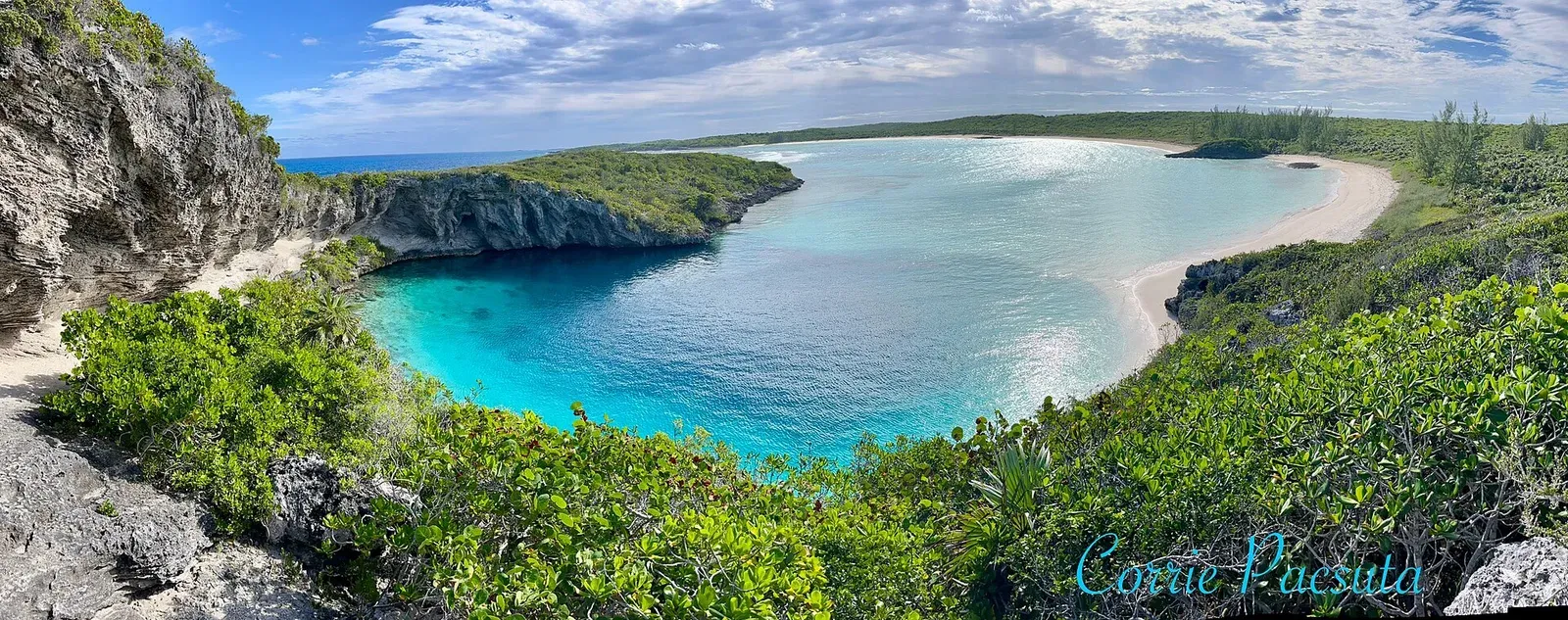
For everyone else the hole is disarmingly casual. The beach is free, unfenced and a short walk from the road; snorkelling over the void needs no booking. Scuba divers can go down into the chamber as a single advanced dive arranged through the island’s resort operators, capped at the recreational limit of about 40 metres — the bell keeps opening below you, and the floor stays 160 metres out of sight. The deaths recorded here are overwhelmingly untrained freedivers pushing past their limits: a breath-hold diver’s body grows denser with depth, so the swim back up gets harder exactly when judgement is most compromised. Overhangs sit under the cliffs at the surface and again around 18 metres, and the local rule is to surface with one hand raised overhead.
The records nobody dives
The top of the depth table is not a dive list at all. Taam Ja’, in Chetumal Bay on Mexico’s Caribbean coast, was known to a local diver, Jesús Artemio Poot-Vill, from about 2003 — he found it following a grouper — and was first surveyed in 2016 at an estimated 275 metres. A December 2023 expedition re-measured it, and results published in peer-reviewed research in 2024 put its depth at more than 420 metres, with the bottom still not found. Every number there is provisional: the measurements are echo soundings, a method the researchers themselves flag as unreliable in complex cave geometry, and whether the hole connects to the open sea is an open question. Dragon Hole, in the Paracel Islands of the South China Sea, held the record from 2016 until Taam Ja’ displaced it: 300.89 metres, up to 130 metres wide, surveyed entirely by a sonar-equipped ROV. No human has dived it. Local fishermen call it the eye of the South China Sea, and regional legend holds it is where the Monkey King found his golden cudgel.
Below those two, Dean’s 202 metres is where the list starts meaning something to people in the water — and one famous name does not belong on it at all. Boesmansgat, the South African sinkhole where depth-record technical diving has written some of its darkest chapters, is a landlocked dolomite feature nearly 300 metres deep with no marine history; it is often listed among the blue holes, and it is a different phenomenon.
The fossil vaults of Abaco
If the records explain why the public cares about blue holes, the Bahamas’ inland holes explain why scientists do. Andros alone has 178 blue holes on land and at least 50 in the sea — the world’s largest collection — and Jacques Cousteau filmed three of them in 1970; local legend stocks them with the Lusca, a half-octopus, half-shark that swallows boats. But the site that changed the science is Sawmill Sink on Abaco, where cave diver Brian Kakuk began recovering the remains of crocodiles and giant tortoises in 2005 — species extinct on the island, lying in the anoxic water below the hydrogen sulphide layer, where nothing decays. National Geographic’s account of the research describes complete skeletons with soft tissue still on tortoise shells, and leaves thousands of years old that keep their structure and pigment. One of the species named from these bones, Chelonoidis alburyorum, survived on Middle Caicos until roughly 1400 CE — the last of the West Indian giant tortoises, gone barely a century before European contact. The research programme that followed ran around 150 dives spanning geology, palaeontology and archaeology, plus one genuinely surprising discipline: astrobiology, because a stratified, anoxic blue hole is one of the closest things Earth offers to the chemistry of alien water.
The diving end of this science is Dan's Cave and Ralph's Cave, and it should be framed as plainly as Dahab’s Arch: full-cave certification, guided only, through a single operator, most of it in sidemount. The reward for that gatekeeping is the most decorated cave diving anywhere — Dan’s Cave runs from the Cascade Room at 24 metres into more than 18 kilometres of combined surveyed passage shared with Ralph’s, through chambers like Fangorn Forest, dense with soda straws and nine-metre columns, and the stadium-sized Airplane Hangar; Ralph’s carries formations dated from 13,000 to 350,000 years old, including helictites that grow in defiance of gravity. The area finally gained formal protection as the South Abaco Blue Holes Conservation Area in 2019 — the same year Hurricane Dorian destroyed the newly built museum housing the fossil finds.
| Site | Depth | Level | Best months |
|---|---|---|---|
| Great Blue Hole Belize Barrier Reef · Belize | 5–40 m | Advanced | Mar–Jun |
| Blue Hole Dahab · Egypt | 6–40 m | Advanced | Apr–May |
| Dean's Blue Hole Long Island, Bahamas · Bahamas | 20–40 m | Advanced | Mar–Apr |
| Dan's Cave South Abaco Blue Holes · Bahamas | 23–46 m | Advanced | Jan–Apr |
| Ralph's Cave South Abaco Blue Holes · Bahamas | 23–47 m | Advanced | Jan–Apr |
Where this connects
Blue holes sit at the meeting point of three other Logbook guides. The diver’s-eye version of the famous three — what a recreational profile at Belize, Dahab or Gozo actually looks like, and where the look-do-not-enter line runs — is in our cenotes and caverns guide, alongside the cenotes where the same karst story plays out in fresh water at Riviera Maya Cenotes. The optics that make the circle blue are worked through in why the sea is blue, and the physiology that makes 55 metres on air the real villain of the Dahab story is in gas density and narcosis. On the map, start with Dahab, Belize Barrier Reef and Malta & Gozo for the famous names, Long Island, Bahamas and South Abaco Blue Holes for the Bahamas’ two very different superlatives, and Miyako-jima for the strangest surfacing in diving.