Mediterranean · Italy
Ponza & the Pontine Islands
A WWII landing ship in two sections at 19 and 30 m off a cave-cut volcanic island
Ponza is the largest of the Pontine Islands, a volcanic group 33 km south of Cape Circeo in the Tyrrhenian Sea, and the archipelago's only dive base: both centres are in Ponza town and every site is a dinghy or boat ride out. The coast is cut into cliffs, sea stacks and caves, the US Navy landing ship LST 349 lies upright in two sections at 19 m and 30 m, and offshore shoals such as Secca di Punta Papa top out at 32 m and run on to technical depths. Palmarola, Zannone and Gavi are day-boat extensions, Palmarola's four Cattedrali caves among them.
About diving in Ponza & the Pontine Islands
Everything runs out of Ponza port. The island's dive centres, Odissey Diving Ponza and Ponza Diving Center, are both in the town around the harbour, and sites are reached by dinghy: the LST 349 off the west coast, the Le Formiche and Punta Papa shoals, the Faraglioni di Punta della Madonna with wall and cave diving from 4 m, the sheltered wall behind Punta Madonna used for courses, and the Guardia lighthouses on the southern tip, where current runs along the walls. Palmarola, Zannone and Gavi have no dive infrastructure of their own and are day-boat runs from Ponza; Gavi lies 120 m off the island and Scoglio Grosso sits between Ponza and Zannone.
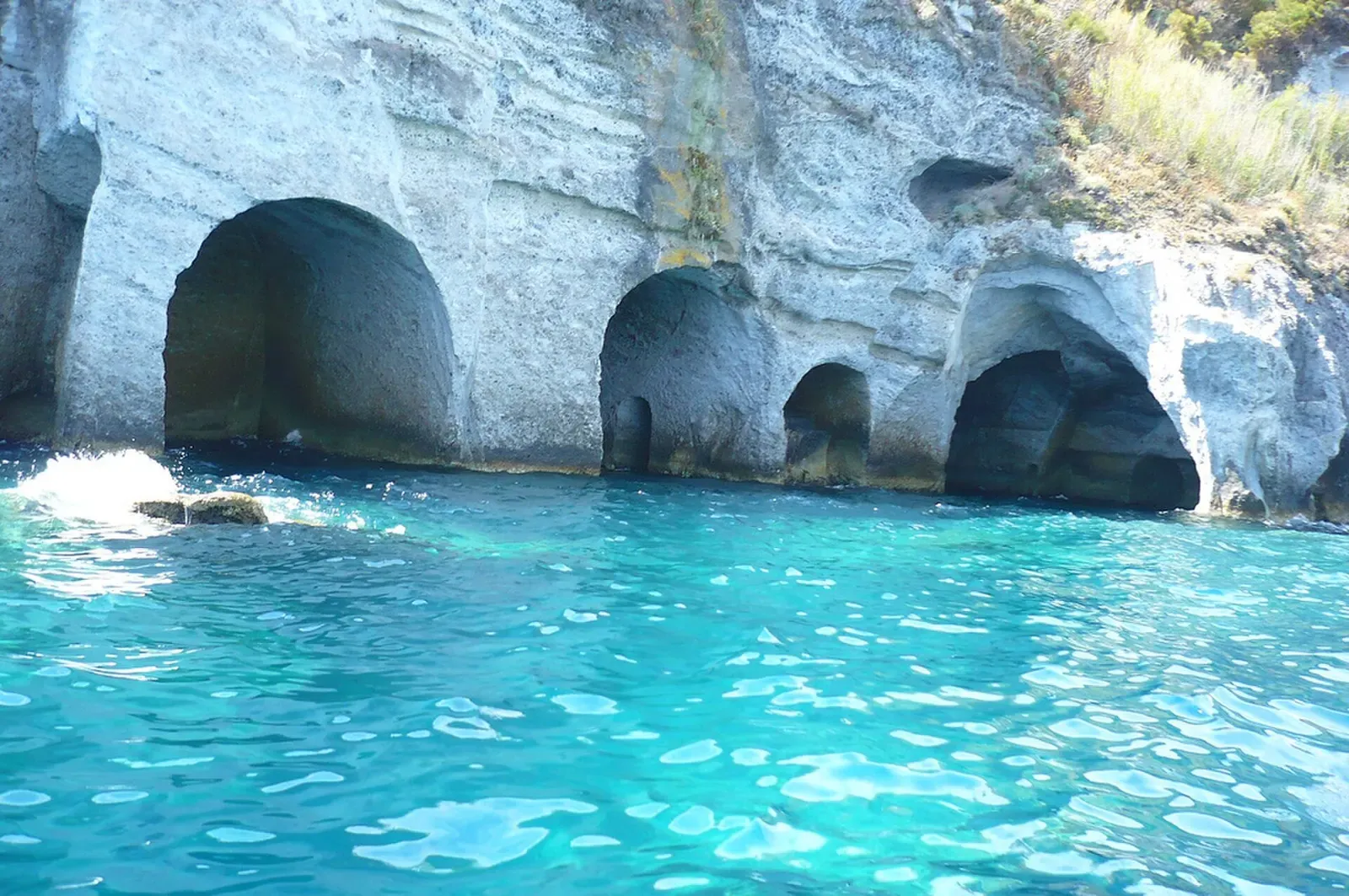
The rock is volcanic and the coast is cut into cliffs, sea stacks and caves. The caves at Maga Circe and Capo Bianco are shallow enough for mask and fins, the Gavi cave starts at 3 m and runs about 50 m into the rock to a dark chamber, and Palmarola's Cattedrali are four caves in a row that go back until the light goes. Offshore the secche rise as shoals from deep bottoms: Secca di Silverio from 90 m of mud to a 50 m top, Secca di Gioia from 90 m to 58 m, Secca di Tramontana past 80 m on its northwest face. Groupers hold behind the boulders, morays and lobster fill the cracks in the walls, scorpionfish sit on the wrecks, and the Punta Papa wall is known for its gorgonians.
The place suits divers with range, and the technical crowd in particular. The outer secche are marketed to experienced open-circuit and CCR divers: Punta Papa tops out at 32 m, Vricci runs from 27 m to 62 m in strong current, Mezzogiorno from a 42 m cap to 85 m, and wrecks below 80 m are rebreather-only. Open Water divers still have real dives, the LST 349 stern at 19 m, the Kastell Luanda wreck at 6 m and the Faraglioni from 4 m among them, but the island's signature ground starts at 30 m. An Abruzzo dive club runs organised diving weekends on the island into early November. Divers after a reserve with tame grouper on every dive should look to Ustica instead.
Protection here is specific rather than blanket. Zannone has been inside Circeo National Park since 1979, with free landing but no overnight stays for the general public; the seabed around Palmarola is a 1,929 ha marine Site of Community Importance, separate from the smaller land-and-shore site covering Palmarola and Zannone themselves; and Capo Bianco on Ponza's west coast is a National Natural Monument. No marine-reserve status was found for Ponza's own waters or the Gavi islet. The Roman amphorae and Bourbon anchor at Secca dei Mattoni remain on the bottom.
When to dive Ponza & the Pontine Islands
| Jan | Feb | Mar | Apr | May | Jun | Jul | Aug | Sep | Oct | Nov | Dec |
|---|---|---|---|---|---|---|---|---|---|---|---|
| Off-season | Off-season | Fair | Fair | Good | Prime | Prime | Prime | Prime | Good | Fair | Off-season |
Diving runs April to early November and all but stops December–February; water peaks at 23–24°C in August–September and is down to 14–15°C in March–April. Naples ferries are summer-only.
Dive types & marine life
Groupers hold behind the boulders and morays and Mediterranean lobster fill the cracks on the walls, with scorpionfish on the wrecks and rocky outcrops. Octopus are logged most from April to July and nudibranchs from March to May; barracuda schools turn up with some luck rather than on schedule. Blue shark, thresher and tuna are recorded in the wider waters but are not typical dive encounters.
- Wreck
- Wall
- Cave & cavern
- Seamount
- Reef
- Groupers
- Octopus & cuttlefish
- Nudibranchs
- Barracuda
- Macro critters
Notable dive sites in Ponza & the Pontine Islands
A wall of dens rising from 40 m to a 5 m plateau, dived multilevel
Sea stacks five minutes from port: a wall from 4 m to 20 m, an arch and a swim-through
Wall
Gullies at 30 m over a ledge past 50 m, with a cave entered by a siphon at 18 m
A sheltered 17 m wall behind Punta Madonna used as a natural pool for courses
A 6 m wreck with propeller and rudder on show, snorkelled as often as dived
A WWII landing ship's stern, in navigation trim and partly penetrable at 19 m
The split bow of a WWII landing ship at the foot of a wall at 30 m
Seamount
A meadow of red gorgonians on a current-swept shoal from 27 to 62 m
Seamount
A bank capping at 33 m and dropping to 58 m, with red gorgonians and a Roman anchor stock
Seamount
A 50 m shoal-top rising from 90 m of mud, its east wall in red coral and gorgonians
Seamount
A 60 m cap dropping past 80 m, with the outer ledge at 110 m by scooter
Relitto LST 349
US Navy landing ship grounded in 1944, upright in two sections: stern at 19 m, bow at 30 m, both partly penetrable.
Secca dei Mattoni
Shoal where a Roman ship sank; amphorae, Roman-era finds and a Bourbon anchor still lie on the bottom.
Le Cattedrali, Palmarola
Four caves in a row under Palmarola's dark cliffs, running back until the light is lost; a day-boat trip from Ponza.
Getting there
Hydrofoils and ferries reach Ponza port from Terracina (50 min by catamaran), Anzio and Formia (about 70 min by hydrofoil, longer by ferry) and San Felice Circeo (1 h); Naples sails in summer only. From Rome the usual route is a train from Termini to Formia. Crossings are cancelled in severe weather, so leave slack around flights. The dive centres are at the port; the satellite islands have none.
Photos from Ponza & the Pontine Islands
Ita01 · CC BY-SA 3.0
Ita01 · CC BY-SA 3.0
Photo credits
- Sea arches and caves cut into pale volcanic cliffs at Ponza, with turquoise shallows below by Seba Sofariu from Dublin, Ireland, CC BY 2.0, via Wikimedia Commons
- Silhouette of Palmarola island at sunset, seen across the water from Ponza by Ita01, CC BY-SA 3.0, via Wikimedia Commons
- Fishing boats moored along the pastel waterfront buildings of Ponza's harbour by Ita01, CC BY-SA 3.0, via Wikimedia Commons
Similar destinations
A zoned 2016 marine reserve, a sunk minesweeper and a 3 km hypogenic cave
Long limestone caves and the 110 m Malakoff wreck off one Balearic island
Giant groupers in volcanic caves along Andalusia's largest coastal protected area


Granite seamounts rising to the surface off Sardinia's south-east corner