
Brockville · Canada · Wreck · Freshwater · Drift
Daryaw
Twin propellers at the shot line, then the length of an upturned keel
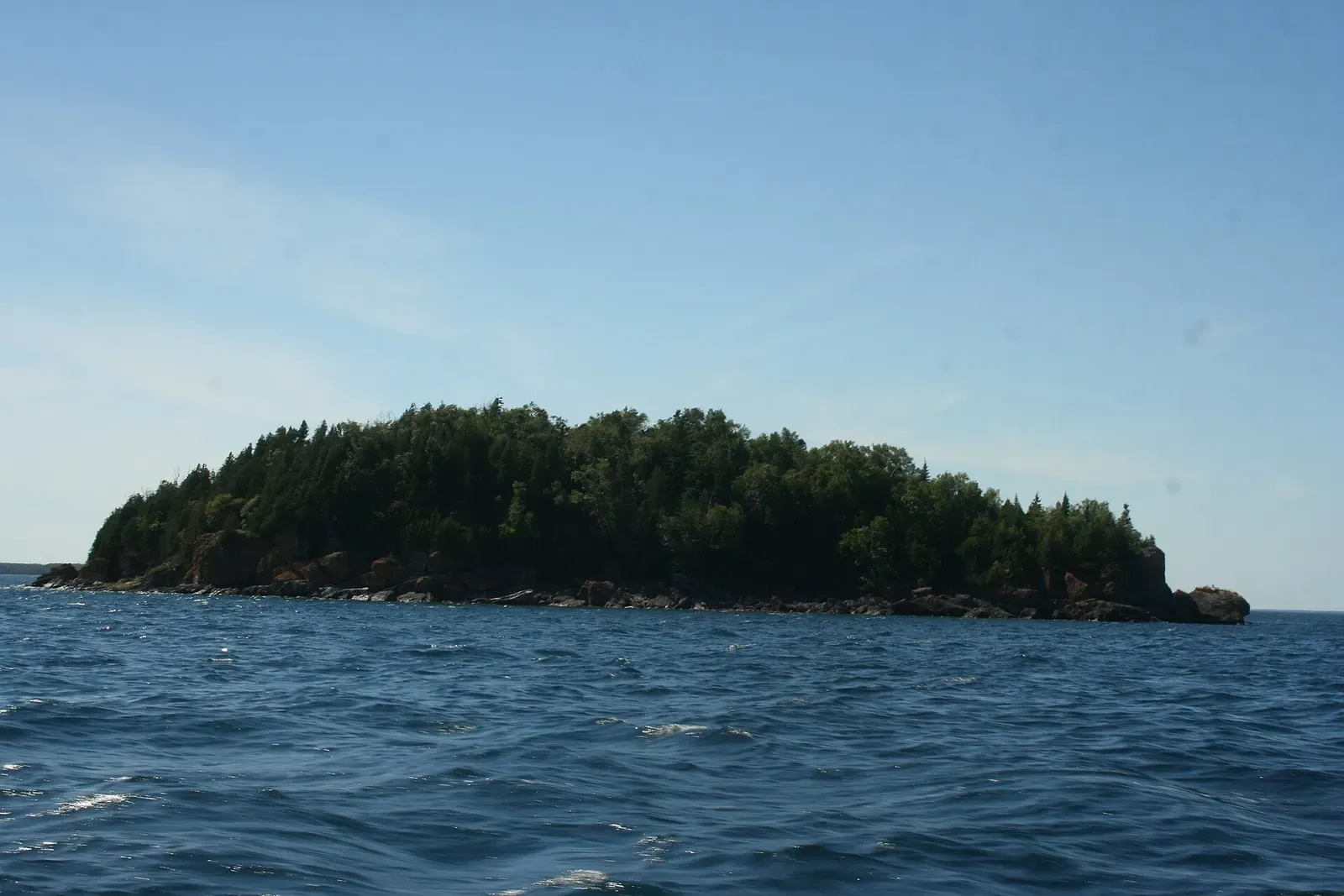
Area photo: Tutku Çetinel · CC BY 3.0
The Henry C. Daryaw tore her side open crossing a shoal near Crossover Island in 1941, slipped off it during salvage and settled completely upside down in 27 m with her bow into the current. Divers descend the mooring line onto her twin propellers, work forward along the inverted hull, then climb the keel and come back down the other side to the gash that sank her.
Also known as Henry C. Daryaw, Oakbay.
Where it is and how deep
44.5265° N, 75.7636° WApproximate position — the dashed circle shows where the site lies; your operator's briefing has the mooring.
The dive
The mooring line drops onto the stern, and the first thing you meet is her large twin propellers. A second rope leads around the starboard side, and from there, looking up under the wreck, you can pick out the ladder that once led to the wheelhouse, the cargo holds and assorted deck fittings — all of it above you, because the ship is completely inverted and you are swimming under her.
At the bow many divers climb over the keel and drift back down the far side of the wreck, where the gash she tore crossing the shoal is still open in her starboard plating. The interior is starting to decay and fall in, so penetration is strongly discouraged; the dive is a circuit of the outside of the hull, with the keel as the high ground and the bottom at 27 m.
The site also runs as the Daryaw Drift. Descend the mooring line, take a quick look at the propellers, then let go with your buddy and travel with the river rather than fighting it. The surface current is quick, 2 to 3 knots, and eases once you reach the bottom, which is why the descent is made on the line and the boat picks up wherever the drift ends.
The wreck
- Vessel
- Henry C. Daryaw
- Type
- Steel freighter
- Length
- 67 m (220 ft)
- Built
- 1919
- Sunk
- 1941
- Cause
- Tore a large gash in her starboard side crossing a shoal
- Lies
- Completely upside down at the foot of the shoal in 27 m, bow facing upstream
The Daryaw was a steel freighter built in France in 1919, 67 m long and rated at 1,265 gross tons. Crossing a shoal around Crossover Island on 21 November 1941 she tore a large gash in her starboard side; the crew were able to row ashore and only the ship's mechanic was lost. Salvors tried repeatedly to pull her more firmly onto the shoal, running cables to steam tractors on the cliff above, but the cables broke and she slipped upside down to the bottom of the shoal in 27 m with her bow facing upstream, where she has stayed since.
Marine life and season
The sources we used don't single out particular species here.
| Jan | Feb | Mar | Apr | May | Jun | Jul | Aug | Sep | Oct | Nov | Dec |
|---|---|---|---|---|---|---|---|---|---|---|---|
| Off-season | Off-season | Off-season | Off-season | Fair | Good | Prime | Prime | Prime | Good | Off-season | Off-season |
Season follows Brockville: May–Oct is the season, with the clearest water in late autumn; the river ices over and charters stop entirely in winter.
Know before you go
- Penetration is strongly discouraged: the interior is decaying and falling in, and the hull is fully inverted, so there is no simple way up and out of it.
- The surface current runs at 2 to 3 knots and only eases near the bottom. Descend on the mooring line and expect to be moved before you reach the shelter of the hull.
Dive videos
Henry C Daryaw Shipwreck, 1000 Islands, St. Lawrence River - Drexler Diving Systems · Drexler Diving Systems on YouTube
Henry C Daryaw (2019-08-30) · Mandarion on YouTube
Questions divers ask
How strong is the current on the Daryaw?+
The operator gives 2 to 3 knots at the surface, easing once you reach the bottom. Descents are made on the mooring line, and the site is often run as a drift, letting go after a look at the propellers.
Can you penetrate the Daryaw?+
No. The interior is starting to decay and fall in, and penetration is strongly discouraged. The dive is worked around the outside of the inverted hull, along the keel and back down to the gash in her starboard side.
Sources
- Henry C. Daryaw — Dive Brockville — Dive Brockville Adventure Centre
- Diving in Canada — Wikivoyage
- Keystorm — Dive Brockville — Dive Brockville Adventure Centre
In The Logbook
- Freshwater diving: lakes, springs and quarriesFreshwater · 15 min read
- WWII wrecks you can dive, by theatreWrecks · 7 min read
More dive sites in Brockville
Wreck
Blown apart by lightning in 1930, at 24 m off Cockburn Island
Wreck
A 78 m steamer on her side, bow at 6 m and stern at 35 m
Wreck
An upturned schooner on the bank, then a drift along the island wall
Wreck
A tug broken in two by her own fuel tanks, at 29 m off Brockville
Wreck
An 1889 salvage barge with her lifting pulleys still aboard
Similar dives elsewhere
Bowsprit still extending from an 1852 hull at 32 m
Three moorings: bow, stern and amidships at the crack in the hull
A split 1867 hull down a slope from 8 m to 28 m


A 1926 patrol yacht scuttled here in 1968, dived on the current