What changes when the salt goes
Fresh water is about two and a half per cent less dense than the sea, and that small number runs through everything else. The same diver in the same suit needs less lead, usually a couple of kilograms less, and a rig weighted for the ocean sinks like a stone in a lake. Most freshwater dives also happen above sea level, and once a site sits a few hundred metres up, the surface pressure is lower, the tables and computers need telling, and the ascent wants to be slower than it does at the coast: Lake Malawi is near 470 m, the Verzasca’s pools above 500 m, Lake Tahoe close to 1,900 m. None of it is hard. It is just different from the habits most of us learned in salt.
The water itself behaves differently too. There are no tides and, outside rivers, no current; what moves a plan is wind, snowmelt and rain. Lakes stratify, so a warm surface layer can sit over water ten degrees colder, and the thermocline is a line you fall through rather than a gradient. Clarity comes from geology: water that has spent years filtering through limestone or porous lava arrives with almost nothing suspended in it, which is why the springs of Florida, the cenotes of the Yucatán and the fissure at Silfra are among the clearest dives anywhere, and why a farmed, silty lowland lake is not. And the life is different. There are no corals and no big animals, so the reasons to dive fresh water are rock, light, wrecks and, in a few places, fish found nowhere else on earth.
Springs and cenotes
Warm springs are the easy entry. North Florida’s limestone pumps out water at a constant 21 to 22 °C in every month, the visibility can exceed 30 m, and there are no boats: you drive to the spring, pay at the gate and carry kit to the water. Ginnie Springs is the famous one, three dives on a single property on the Santa Fe River: the Ginnie Ballroom cavern, closed at its far end by an iron grate, the river itself, and the Devil’s Spring System, where only certified cavern and cave divers may carry lights. Devil's Den is a karst window, a chamber about 120 feet across whose roof fell in and let the daylight down onto a basin of more than 20 m. Blue Grotto goes to 30 m (100 ft) and is worked hard by courses, and Troy Springs pairs a 21 m spring bowl with the remains of the Madison, a Confederate paddle steamer scuttled in the run in 1863. Peacock Springs shows where the sport goes next: Orange Grove basin is open to any certified diver, and behind it lie more than 10 km of surveyed cave, 7,408 m mapped by 2008 and another 3,000 m connected in 2010, that only the fully trained may enter.
Rainbow River is Florida’s other freshwater idea, a 9.2 km spring-fed river at a constant 22 °C. A water taxi runs divers upstream from KP Hole Park and they drift back over sand and eelgrass in 2 to 7 m, past small caverns and boiling sand springs, in visibility the operators quote at over 100 feet. It is as gentle as diving gets, and the only skills it asks for are staying off the bottom and staying with the flag.
Mexico’s cenotes are the same limestone story with the roof left on. Dos Ojos opens onto the shallow end of a system with 82 km of surveyed passage, dived on guided cavern circuits at 5 to 7 m in 25 °C water; Gran Cenote is the shallow, decorated cavern most divers on the coast are taken to first; and Angelita is a single shaft with a hydrogen-sulphide cloud hanging across it at about 27 m, dived as a controlled descent to the layer and back out. All of them are shore entries, the first two paid for in cash at a gate, all of them stay in the daylight zone, and all of them sit on the edge of full cave diving, which is a different sport with a fatality record.
Brazil has the strangest springs of all. Around Bonito in Mato Grosso do Sul, rain filters through the limestone of the Serra da Bodoquena and surfaces in rivers so clear the town sells float-snorkelling as its main attraction. Nascente Azul is a spring and river float in 24 °C water, 7 m at its deepest. The two scuba dives are odder: Abismo Anhumas is a cave lake reached by a 72 m rope descent through a hole in the ground, dived to 18 m over submerged stalagmites, and Lagoa Misteriosa is a flooded sinkhole where a 1998 dive reached 220 m without seeing the floor; recreational divers are guided to 40 m with visibility past 50 m.
| Site | Depth | Level | Best months |
|---|---|---|---|
| Ginnie Springs North Florida Springs · United States | to 12 m | Intermediate | Nov–Apr |
| Devil's Den North Florida Springs · United States | to 20 m | Intermediate | Nov–Apr |
| Blue Grotto North Florida Springs · United States | to 30 m | Intermediate | Nov–Apr |
| Troy Springs North Florida Springs · United States | to 21 m | Beginner | Nov–Apr |
| Peacock Springs North Florida Springs · United States | 6–20 m | Advanced | Nov–Apr |
| Rainbow River Crystal River · United States | 2–7 m | Beginner | Nov–Feb |
| Dos Ojos Riviera Maya Cenotes · Mexico | 5–7 m | Intermediate | Nov–Apr |
| Gran Cenote Riviera Maya Cenotes · Mexico | to 10 m | Intermediate | Nov–Apr |
| Angelita Riviera Maya Cenotes · Mexico | to 27 m | Advanced | Nov–Apr |
| Nascente Azul Bonito · Brazil | to 7 m | Beginner | Apr–Aug |
| Abismo Anhumas Bonito · Brazil | to 18 m | Intermediate | Apr–Aug |
| Lagoa Misteriosa Bonito · Brazil | to 40 m | Advanced | Apr–Aug |
Cold, clear lakes
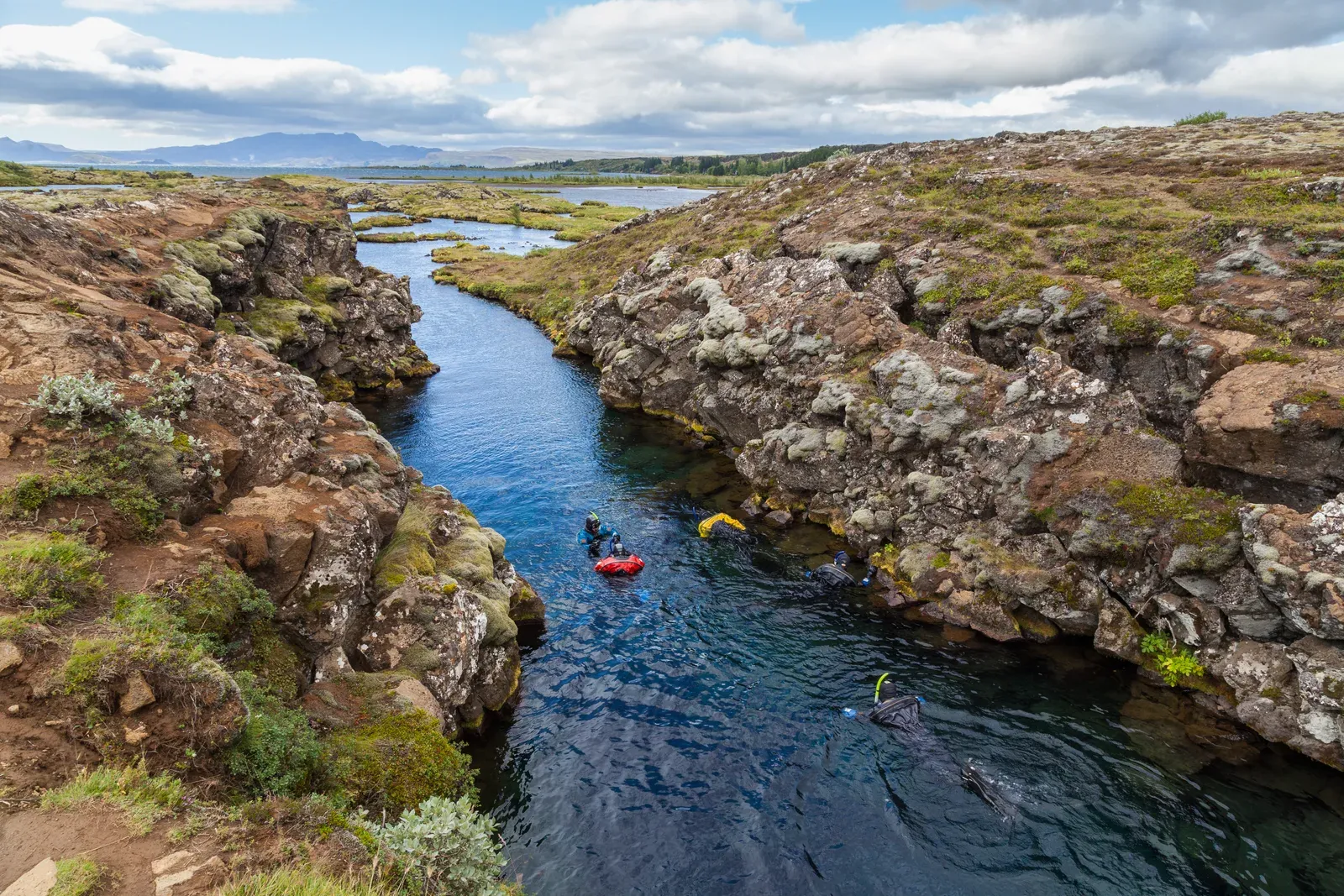
Iceland’s Silfra is the freshwater dive everyone has heard of: a fissure in Þingvellir National Park where the North American and Eurasian plates pull apart, filled with meltwater that has spent decades filtering through lava from the Langjökull ice cap. The water is 2 to 4 °C in every month and the visibility runs 40 to 80 m, past 100 m in the Cathedral. The dive is a one-way shore route with a park permit and a drysuit requirement, and it has sections: Silfra Big Crack at the entry, where both walls are within reach at once; Silfra Hall where the fissure opens into a room floored with boulders half the size of cars; and Silfra Cathedral, about 100 m long and some 20 m deep, where you can see the far end from the entrance. The whole route is capped at 18 m, and the cave systems that lead off it to 45 m are closed to tour divers. There is almost nothing alive in it, and it does not matter.
Diving at Silfra, Iceland · gramsmose on YouTube
The alpine lakes are where freshwater diving is a weekend habit rather than a pilgrimage. Austria’s Attersee is the best-known of them in the German-speaking world: the largest lake in the Salzkammergut, 169 m deep on the official maps, sitting at 469 m above sea level with more than twenty marked shore entries maintained by an association of the local dive centres. The water is clearest in winter, near 30 m, and murkiest in the August bathing season; below the thermocline it holds between 4.6 and 4.9 °C all year, so a drysuit is the practical minimum. Unterwasserwald is a stand of trees pushed into the lake by a landslide in September 1959, trunks up to 20 m long lying in 20 to 30 m of water and found by compass; Dixi at Weyregg is a sandy training slope with a boat at 12 m, a sailboat wreck at 22 m and a model pile-dwelling that becomes an underwater nativity scene every Advent; Kohlbauernaufsatz pairs shallow meadows with a wall from 18 to 32 m. Schwarze Brücke is the one to respect: a limestone wall at Steinbach dropping in stages past 100 m, capped at 40 m by the centre that coordinates it, with crosses at the entry for the thirteen divers recovered dead there between 1971 and 2009.
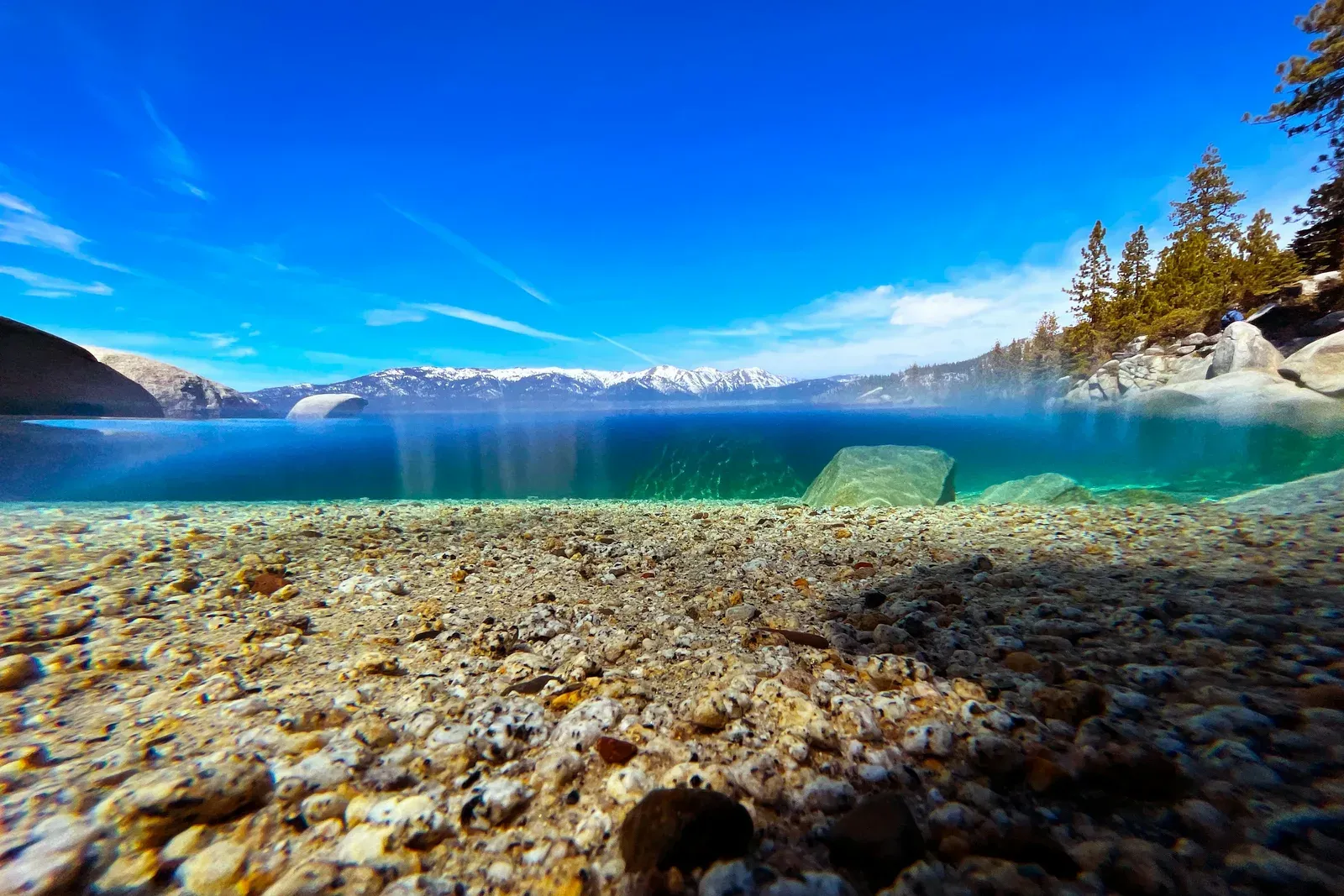
North America’s answer is Lake Tahoe, a subalpine lake on the California–Nevada line at 1,897 m, 501 m deep, where every dive is an altitude dive and the water a few metres down stays near 4 °C through midsummer. California made Emerald Bay one of its first underwater state parks in 1994 to protect a fleet of resort-era boats scuttled there, and the Emerald Bay Maritime Heritage Trail now links two cordwood barges, a 1915 passenger launch and two smaller boats between 3 and 18 m with interpretive panels; it is reached by boat or a long carry, and it is the one place on the lake where visibility runs worse than the rest. Rubicon Wall is a sheer granite face at D.L. Bliss State Park, a 270 m surface swim from Calawee Cove, that keeps dropping long past the 27 m recreational divers hold to, with brown trout on the rock and visibility of 20 to 30 m. Sand Harbor on the Nevada shore is the easy one, boulder swim-throughs at 9 m off a beach, and Sugar Pine Point follows old boathouse rails off the sand to a drop-off that slopes to 30 m. The season is July to September; the nearest chamber is in Reno.
| Site | Depth | Level | Best months |
|---|---|---|---|
| Silfra Big Crack Silfra · Iceland | 0.5–18 m | Intermediate | May–Sep |
| Silfra Hall Silfra · Iceland | to 10 m | Intermediate | May–Sep |
| Silfra Cathedral Silfra · Iceland | to 18 m | Intermediate | May–Sep |
| Unterwasserwald Attersee · Austria | 20–30 m | Intermediate | Dec–Feb |
| Dixi Attersee · Austria | to 22 m | Intermediate | Dec–Feb |
| Kohlbauernaufsatz Attersee · Austria | to 32 m | Intermediate | Dec–Feb |
| Schwarze Brücke Attersee · Austria | to 40 m | Advanced | Dec–Feb |
| Emerald Bay Maritime Heritage Trail Lake Tahoe · United States | 3–18 m | Intermediate | Jul–Sep |
| Rubicon Wall Lake Tahoe · United States | to 27 m | Advanced | Jul–Sep |
| Sand Harbor Lake Tahoe · United States | 9–15 m | Beginner | Jul–Sep |
| Sugar Pine Point Lake Tahoe · United States | to 30 m | Intermediate | Jul–Sep |
Rivers
Rivers are the one place fresh water moves, and the dives are shaped by the flow. Switzerland’s Verzasca is the European rite of passage: snowmelt off the Ticino Alps running over granite the glaciers polished, so clear that divers look up from the pool and see the trees. The classic dive is the pools under the double-arched bridge at Lavertezzo, nowhere deeper than 10 m and averaging 7 to 10 °C, so immersions are short and the intervals are spent warming up on the rock. It is also a genuinely dangerous river: 35 people died in it between 1990 and 2000, flow rather than depth is the limit, and rising water is the signal to get out. The season is June to September, once the melt has dropped.
Canada’s St. Lawrence is the other kind of river dive, cold and fast enough that the wrecks are dived as drifts. At Brockville — St. Lawrence divers descend a line onto a hull, cross it once with the current and let go. Lillie Parsons is an 1868 schooner upside down against Sparrow Island, bow at 21 m and stern at 6 m, finished with a drift along the island wall; Robert Gaskin is the gentle one, an 1889 salvage barge upright at 18 to 21 m in mild current. Keystorm lies on her side from 6 m to 35 m and can be dived as a shallow swim or a deep one, and Daryaw is fully inverted at 27 m with 2 to 3 knots running over her, a line descent onto the propellers and no way inside. Visibility here improves the colder it gets, and the clearest water is late autumn.
| Site | Depth | Level | Best months |
|---|---|---|---|
| Ponte dei Salti Verzasca Valley · Switzerland | to 10 m | Intermediate | Jun–Aug |
| Robert Gaskin Brockville · Canada | 18–21 m | Intermediate | Jul–Sep |
| Lillie Parsons Brockville · Canada | 6–21 m | Intermediate | Jul–Sep |
| Keystorm Brockville · Canada | 6–36 m | Advanced | Jul–Sep |
| Daryaw Brockville · Canada | to 27 m | Advanced | Jul–Sep |
The Great Lakes’ wrecks
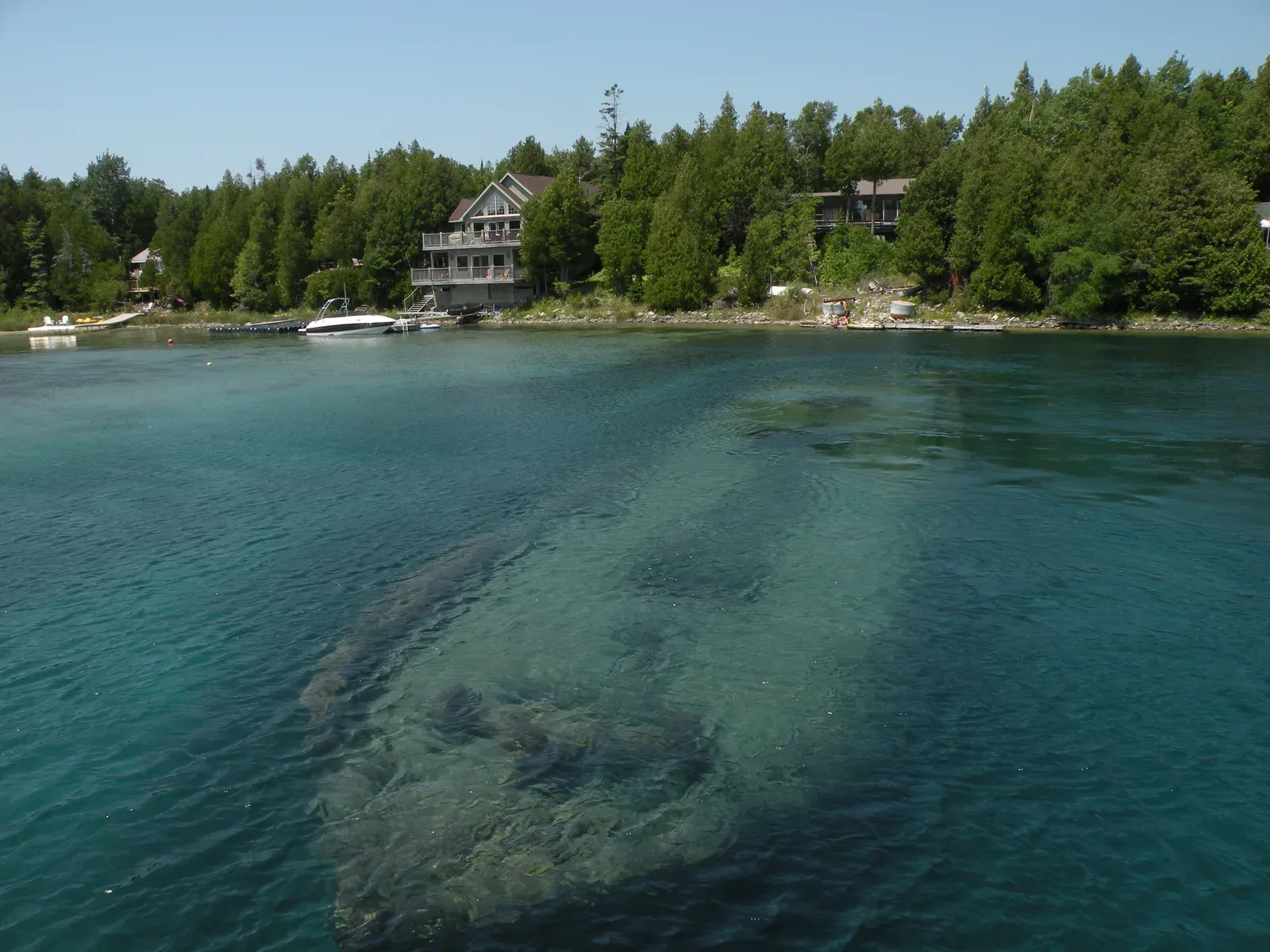
Cold fresh water preserves wood. Salt-water wrecks rust, break and grow over; a nineteenth-century schooner in Lake Huron keeps her masts, her deck fittings and her paint. Tobermory — Fathom Five in Georgian Bay is the best place to see it. Sweepstakes is an 1867 schooner lying almost completely intact in 6 m in Big Tub Harbour, so fragile that the park has repaired her deck to keep it from collapsing, and so shallow that snorkellers follow most of her from the surface. W.L. Wetmore is a 65 m freighter spread across 9 m of water on Russel Reef, and Caroline Rose a 1940 Lunenburg schooner scuttled for divers at 17 m. Arabia is the deep prize: an 1852 sailing ship at 32 m with her bowsprit still reaching out ahead of her, run as an advanced dive with the current and the cold in mind.
Across Lake Huron, Thunder Bay — Alpena protects a stretch of water sailors called Shipwreck Alley, and the wrecks run from snorkel depth to technical. Monohansett is a steam barge that burned in 1907 and lies in 5.5 m with boilers and propeller readable from a paddleboard; Nordmeer is a 144 m freighter broken across a shoal in 12 m. Montana keeps a three-storey steam engine standing in 20 m, and Grecian is a 90 m steel freighter upright with her stern deck at 23 m and the bottom at 31. The season on both lakes is late May to early October, the water is near freezing for much of the year, and a drysuit is the sensible default even in August.
| Site | Depth | Level | Best months |
|---|---|---|---|
| Sweepstakes Tobermory · Canada | to 6 m | Beginner | Jul–Sep |
| W.L. Wetmore Tobermory · Canada | to 9 m | Beginner | Jul–Sep |
| Caroline Rose Tobermory · Canada | to 17 m | Intermediate | Jul–Sep |
| Arabia Tobermory · Canada | to 32 m | Advanced | Jul–Sep |
| Monohansett Thunder Bay · United States | to 5.5 m | Beginner | Jul–Sep |
| Nordmeer Thunder Bay · United States | to 12 m | Beginner | Jul–Sep |
| Montana Thunder Bay · United States | to 20 m | Intermediate | Jul–Sep |
| Grecian Thunder Bay · United States | 23–31 m | Advanced | Jul–Sep |
Flooded quarries and dive parks
Most British and German divers learned in a hole in the ground, and the best of those holes have become destinations. Stoney Cove in Leicestershire is the UK’s National Diving Centre: a granite quarry whose pumps stopped in 1958, run for divers since 1978, open 362 days a year, and arranged on three shelves at roughly 7, 22 and 36 m. The shallow shelf holds the Viscount Aircraft Cockpit, an airliner nose placed there around 1967, and the The Nautilus, a 10 m steel tribute to Jules Verne’s submarine; the 22 m terrace has the The Wessex Helicopter against the northern cliff and the Stanegarth, a 1910 steam tug scuttled in June 2000 and called the largest inland wreck in Britain, with her wheelhouse and engine room open to the trained. The water is 4 °C in March and 18 °C in August, clearest from late October through winter, and pike and perch patrol the wrecks. Capernwray in Lancashire, Vobster Quay in Somerset and, until it closed in 2022, the 80 m NDAC at Chepstow followed the same pattern.
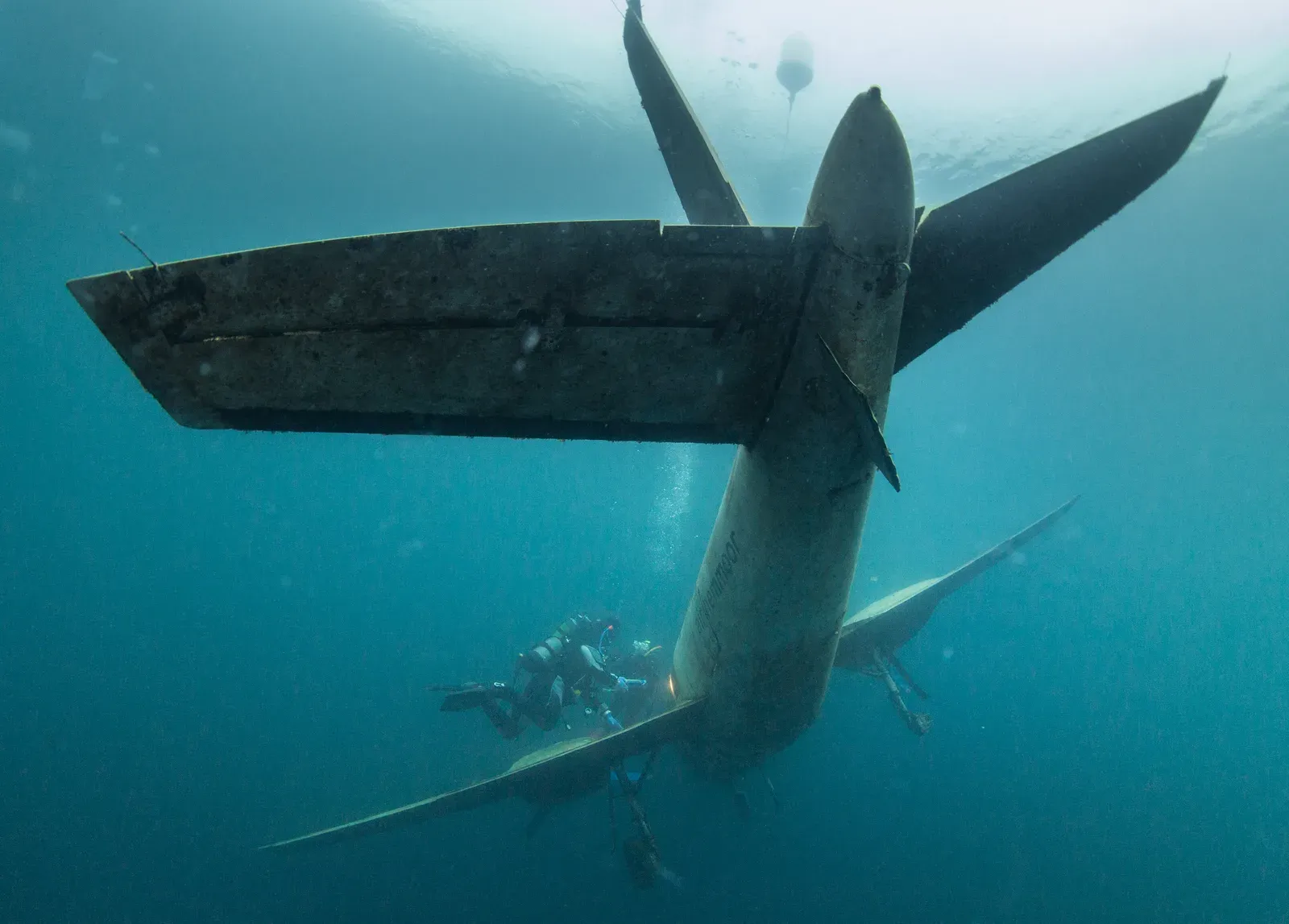
Germany’s equivalent is chalk rather than granite. Kreidesee Hemmoor near the Elbe estuary was quarried for chalk from 1862, feeding a cement works from 1882 until extraction stopped in 1976; it filled with groundwater by 1982, and was found by sport divers in 1984 before there was a single step down to the water; the base built there in the 1990s now runs shore diving from six numbered entries to a lake up to 60 m deep, the third-deepest body of water in northern Germany, with a chalk bed that keeps it unusually clear. A second regulator first stage and a doctor’s fitness note are compulsory for everyone. Der Flieger is a neon-yellow Piper light aircraft, once Alan Shepard’s, hung at 10 m with a skeleton at the controls; Der Steilhang is the old excavation face falling near-vertically to 35 m and on to 55 m; Der Wald is a stand of drowned trees on the slope below it, best seen from 25 m looking down on the canopy; and Der Rüttler is the ruined screening plant of the works, with its haul road and conveyor bridge at 20 to 35 m and its corridors sealed off behind grilles after repeated accidents.
| Site | Depth | Level | Best months |
|---|---|---|---|
| Viscount Aircraft Cockpit Stoney Cove · United Kingdom | to 7 m | Beginner | Oct–Jan |
| The Nautilus Stoney Cove · United Kingdom | to 7 m | Beginner | Oct–Jan |
| The Wessex Helicopter Stoney Cove · United Kingdom | to 22 m | Intermediate | Oct–Jan |
| Stanegarth Stoney Cove · United Kingdom | to 20 m | Intermediate | Oct–Jan |
| Der Flieger Kreidesee Hemmoor · Germany | to 10 m | Beginner | Apr–May |
| Der Rüttler Kreidesee Hemmoor · Germany | 20–35 m | Advanced | Apr–May |
| Der Steilhang Kreidesee Hemmoor · Germany | 1–55 m | Advanced | Apr–May |
| Der Wald Kreidesee Hemmoor · Germany | 25–55 m | Advanced | Apr–May |
Sinkholes and tropical lakes
Australia’s freshwater diving is a cluster of sinkholes around Mount Gambier — Limestone Coast on South Australia’s Limestone Coast, and it is run by rules rather than dive shops: Parks SA permits sold in one-hour slots, and for three of the four sites a current Cave Divers Association of Australia rating. Ewens Ponds is the exception and the place to start, three limestone dolines 9 to 13 m deep linked by shallow races, dived one way from the First Pond to the Third past plants visible 80 m away, on an ordinary Open Water card in a full wetsuit; it closes every year from September to November. Piccaninnie Ponds is the famous one, a Ramsar wetland whose First Pond, Cathedral and 100 m Chasm are dived by CDAA members at sinkhole grade with every dive capped at 36.5 m, and it has been closed to all water entry after an algae outbreak, so check before travelling. Kilsby Sinkhole is a shaft on a sheep farm with 30 to 60 m of visibility at a constant 14 to 17 °C, where approved operators guide Open Water divers to 20 m and Advanced divers to 40 m; and Little Blue Lake is a 50 m cenote whose shallowest point is already 25 m down, for CDAA members only.
| Site | Depth | Level | Best months |
|---|---|---|---|
| Ewens Ponds Mount Gambier · Australia | 9–13 m | Beginner | May–Aug |
| Kilsby Sinkhole Mount Gambier · Australia | 6–40 m | Intermediate | May–Aug |
| Piccaninnie Ponds Mount Gambier · Australia | 10–36.5 m | Intermediate | May–Aug |
| Little Blue Lake Mount Gambier · Australia | 25–42 m | Advanced | May–Aug |
Zimbabwe has southern Africa’s other freshwater dive, and it is a cave. The Chinhoyi Caves are a small national park of dolomite sinkholes about two hours north-west of Harare, and at the bottom of the collapsed Wonder Hole, 45 m below the surrounding ground, lies Chirorodziva, the Sleeping Pool: a cobalt-blue lake at a constant 22 to 24 °C with no thermocline and visibility of 30 to 50 m. A scree slope takes divers to about 20 m, which is the recreational dive; below it a near-vertical shaft has been followed past 100 m by technical teams since 1959 without the bottom being agreed on. Diving is arranged through Harare’s dive clubs rather than an on-site centre, and the site sits near 1,150 m, so it is an altitude dive as well as an overhead one. Bat Cave is a smaller guano-crusted pool at the north end, 13 m deep and linked to the main shaft by a passage that is cave-diving territory.
Lake Malawi is the freshwater dive that behaves most like a reef. The lake holds somewhere near a thousand species of cichlid, almost all of them endemic and many confined to a single stretch of shore, and the diving is over granite boulder slopes where males hold territories and display at reef-fish densities. Otter Point on the Cape Maclear shore runs rock down to a rock-sand transition at 15 m, with the Malawi butterfly cichlid among the fish that never cross the sand; Usipa Wreck is a ferry that sank in 1998 and lies at 30 m with kampango catfish on the sand around her. The water is 22 to 29 °C with no current and no tide, though bilharzia is present in the lake and worth a travel-clinic conversation; the lake sits near 470 m so altitude procedures apply, and September to December is the clear season before the rains.
The oddest freshwater dive in this guide is on a Philippine island. Barracuda Lake is a limestone-walled lake with 4 m of warm fresh water over salt, a thermocline and halocline stacked at 14 m that blur everything for a few metres, and water that heats to 38 °C at depth. It is dived for the water, not the life, and it is a useful reminder that not every lake is fresh: Palau’s Jellyfish Lake is a marine lake, and the Baltic’s brackish wrecks belong to another guide.
| Site | Depth | Level | Best months |
|---|---|---|---|
| Sleeping Pool Chinhoyi Caves · Zimbabwe | to 20 m | Advanced | Aug–Nov |
| Bat Cave Chinhoyi Caves · Zimbabwe | to 13 m | Advanced | Aug–Nov |
| Otter Point Lake Malawi · Malawi | to 16 m | Beginner | Sep–Nov |
| Usipa Wreck Lake Malawi · Malawi | to 30 m | Advanced | Sep–Nov |
| Barracuda Lake Coron · Philippines | to 30 m | Advanced | Year-round |
When the water is right
| Site | Jan | Feb | Mar | Apr | May | Jun | Jul | Aug | Sep | Oct | Nov | Dec |
|---|---|---|---|---|---|---|---|---|---|---|---|---|
| Ginnie SpringsNorth Florida Springs | Prime | Prime | Prime | Prime | Good | Good | Fair | Fair | Fair | Good | Prime | Prime |
| Dos OjosRiviera Maya Cenotes | Prime | Prime | Prime | Prime | Good | Good | Good | Good | Good | Good | Prime | Prime |
| Lagoa MisteriosaBonito | Fair | Fair | Good | Prime | Prime | Prime | Prime | Prime | Good | Good | Fair | Fair |
| Silfra CathedralSilfra | Fair | Fair | Good | Good | Prime | Prime | Prime | Prime | Prime | Good | Fair | Fair |
| Schwarze BrückeAttersee | Prime | Prime | Good | Good | Good | Good | Fair | Fair | Good | Good | Good | Prime |
| Rubicon WallLake Tahoe | Off-season | Off-season | Off-season | Off-season | Fair | Good | Prime | Prime | Prime | Fair | Off-season | Off-season |
| Ponte dei SaltiVerzasca Valley | Off-season | Off-season | Off-season | Off-season | Fair | Prime | Prime | Prime | Good | Fair | Off-season | Off-season |
| Lillie ParsonsBrockville | Off-season | Off-season | Off-season | Off-season | Fair | Good | Prime | Prime | Prime | Good | Off-season | Off-season |
| SweepstakesTobermory | Off-season | Off-season | Off-season | Off-season | Fair | Good | Prime | Prime | Prime | Fair | Off-season | Off-season |
| NordmeerThunder Bay | Off-season | Off-season | Off-season | Off-season | Fair | Good | Prime | Prime | Prime | Fair | Off-season | Off-season |
| StanegarthStoney Cove | Prime | Good | Fair | Good | Good | Fair | Fair | Fair | Good | Prime | Prime | Prime |
| Der SteilhangKreidesee Hemmoor | Fair | Fair | Fair | Prime | Prime | Good | Good | Good | Prime | Good | Fair | Fair |
| Ewens PondsMount Gambier | Good | Good | Good | Good | Prime | Prime | Prime | Prime | Fair | Fair | Fair | Good |
| Sleeping PoolChinhoyi Caves | Fair | Fair | Fair | Good | Good | Good | Good | Prime | Prime | Prime | Prime | Fair |
| Otter PointLake Malawi | Fair | Fair | Good | Good | Good | Good | Good | Good | Prime | Prime | Prime | Good |
The pattern in the matrix is the whole planning lesson. Springs and cenotes are fed by water that has spent years underground, so they hold the same temperature and much the same clarity in every month; Silfra’s ratings track daylight and road access, not the water. Lakes and rivers are the opposite. The Verzasca is undivable until the melt drops in early summer and after any big rain; the Great Lakes and the St. Lawrence run late May to early October, and the river is clearest in late autumn; alpine and quarry lakes are clearest in winter and early spring, before the algae, and warmest in late summer, when the visibility is worst. If clarity is the point, go cold.
How to dive fresh water
Weight for it. Drop a couple of kilograms from your salt-water weighting and check it at the surface with an empty BCD before the descent, not at 10 m. A drysuit and a thick undersuit change the sum again.
Plan for altitude. Anything above about 300 m needs altitude procedures: set the computer, use the right tables, ascend slowly, and remember that flying after diving and driving over a pass are the same problem. Verzasca and Lake Malawi are altitude dives; Lake Tahoe is very much one.
Respect the thermocline. A lake that reads 20 °C at the surface can be 6 °C at 15 m. Dress for the depth you will spend time at, and set a turn time by cold rather than gas.
Stay off the bottom. Lake and quarry floors are fine silt that hangs for an hour once kicked, and the divers behind you paid for the visibility too. Frog kick, stay horizontal, keep your fins up.
Rivers are about flow, not depth. Check the level before you kit up, dive the pools not the chutes, and treat rising water as the end of the day.
Pay the gate. Springs, quarries, cenotes and national parks all charge, several need permits or a registered operator, and a few, like Ginnie’s cave entrances and Silfra’s caves, are closed to anyone without the training. The rules are the reason the sites still exist.