
Thunder Bay · United States · Wreck · Freshwater
New Orleans
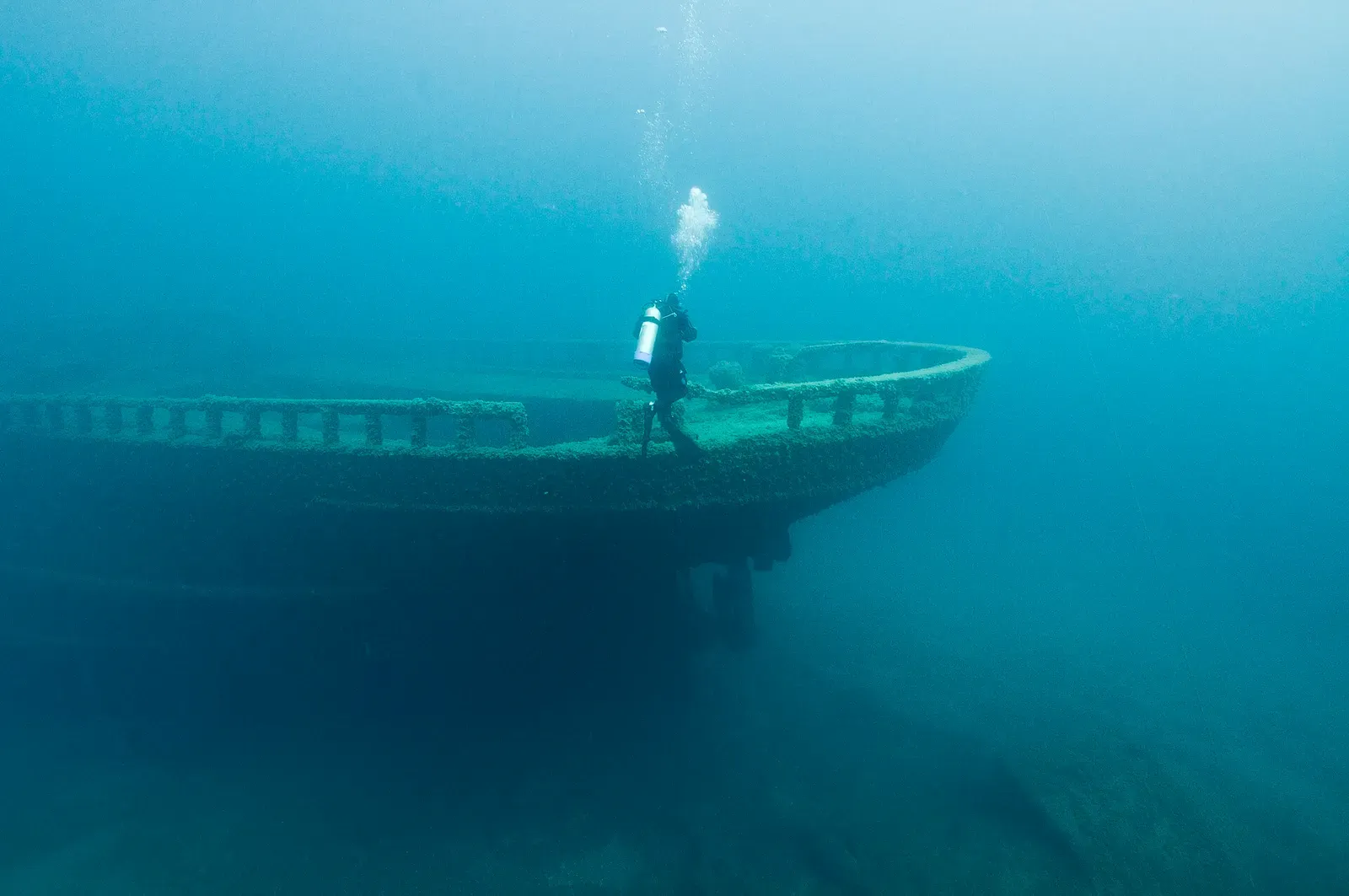
An 1885 freighter at 44 m, modelled in 3D by NOAA
Area photo: NOAA's National Ocean Service · CC BY 2.0
A 70-metre (231-foot) bulk freighter of 1885, sunk in fog after a collision with the steamer William R. Linn and now lying at 44 m in Lake Huron. Her crew all got off, rescued by the ship that hit them. The site carries one of the sanctuary's seasonal mooring buoys, and NOAA has published a 3D model of the wreck worth studying before a dive this short.
Also known as New Orleans (1885).
Where it is and how deep
45.1675° N, 83.2174° WPublished position for this site.
Site maps published elsewhere
The dive
The wreck sits at 44 m on the lake floor, a 70 m hull (231 ft) with a 12 m beam (38 ft) that is small enough to take in over a single dive if the gas plan is generous. Through the season a sanctuary mooring buoy marks the site, so the descent runs down a fixed line. Water this deep in Lake Huron is dark by the time you arrive, and the wreck comes to you in torchlight, section by section, rather than as a whole shape.
Divers work the deck and the bow, and the ship's winch is one of the features NOAA photographs on the site. Running the length of the hull and back to the line is the usual shape of the dive, and NOAA's published 3D model is worth studying beforehand so the time on the bottom is spent looking rather than orienting. Everything here is protected sanctuary property. Note also that this is the 1885 New Orleans, not the 1838-built ship of the same name that sank in 1849 and lies in 5 m (15 ft) of water elsewhere in the sanctuary.
The wreck
- Vessel
- New Orleans
- Type
- Bulk freighter
- Length
- 70 m (230 ft)
- Built
- 1885
- Sunk
- 1906
- Cause
- Collided with the steamer William R. Linn in fog; the crew were rescued by the colliding vessel
- Lies
- On the lake bottom at 44 m inside Thunder Bay National Marine Sanctuary
Marine life and season
The sources we used don't single out particular species here.
| Jan | Feb | Mar | Apr | May | Jun | Jul | Aug | Sep | Oct | Nov | Dec |
|---|---|---|---|---|---|---|---|---|---|---|---|
| Off-season | Off-season | Off-season | Off-season | Fair | Good | Prime | Prime | Prime | Fair | Off-season | Off-season |
Season follows Thunder Bay: The season runs late May to early October, with July and August warmest; the lake is unworkably cold and rough otherwise.
Know before you go
- Two sanctuary wrecks share the name New Orleans and the other lies in 5 m (15 ft) of water; confirm which site the charter is running before planning gas.
Sources
- New Orleans (1885) — NOAA Thunder Bay National Marine Sanctuary
- New Orleans (1838) — NOAA Thunder Bay National Marine Sanctuary
- Mooring Buoys — NOAA Thunder Bay National Marine Sanctuary
More dive sites in Thunder Bay
Wreck
Ghost schooner upright at 56 m, masts still standing
Wreck
Steering wheel and chained windlass on a broken schooner
Wreck
The sanctuary's largest wreck, 162 m and inverted
Wreck
An intact 1848 schooner on an even keel at 56 m
Wreck
Three masts still on deck at 63 m
Upright steel freighter with engine and boilers still in place
Wreck
A Great Lakes freighter lying inverted at 53 m
An 1862 schooner in 18 m on a mooring buoy
Similar dives elsewhere

A 78 m steamer on her side, bow at 6 m and stern at 35 m
Bowsprit still extending from an 1852 hull at 32 m

.jpg)
A 1940 Lunenburg schooner scuttled for divers at 17 m
Twin propellers at the shot line, then the length of an upturned keel