
Thunder Bay · United States · Wreck · Freshwater
Viator
A Norwegian ocean freighter upright at 57 m
Area photo: NOAA's National Ocean Service · CC BY 2.0
A Norwegian ocean-going freighter that came inland to the lakes and was rammed in heavy fog northeast of Thunder Bay Island in 1935 while carrying pickled herring. She sits upright and largely intact at 57 m, damaged only where the Ormidale went into her — an unusual saltwater ship on a freshwater bottom, and a technical dive well beyond recreational range.
Where it is and how deep
44.9913° N, 83.0371° WPublished position for this site.
The dive
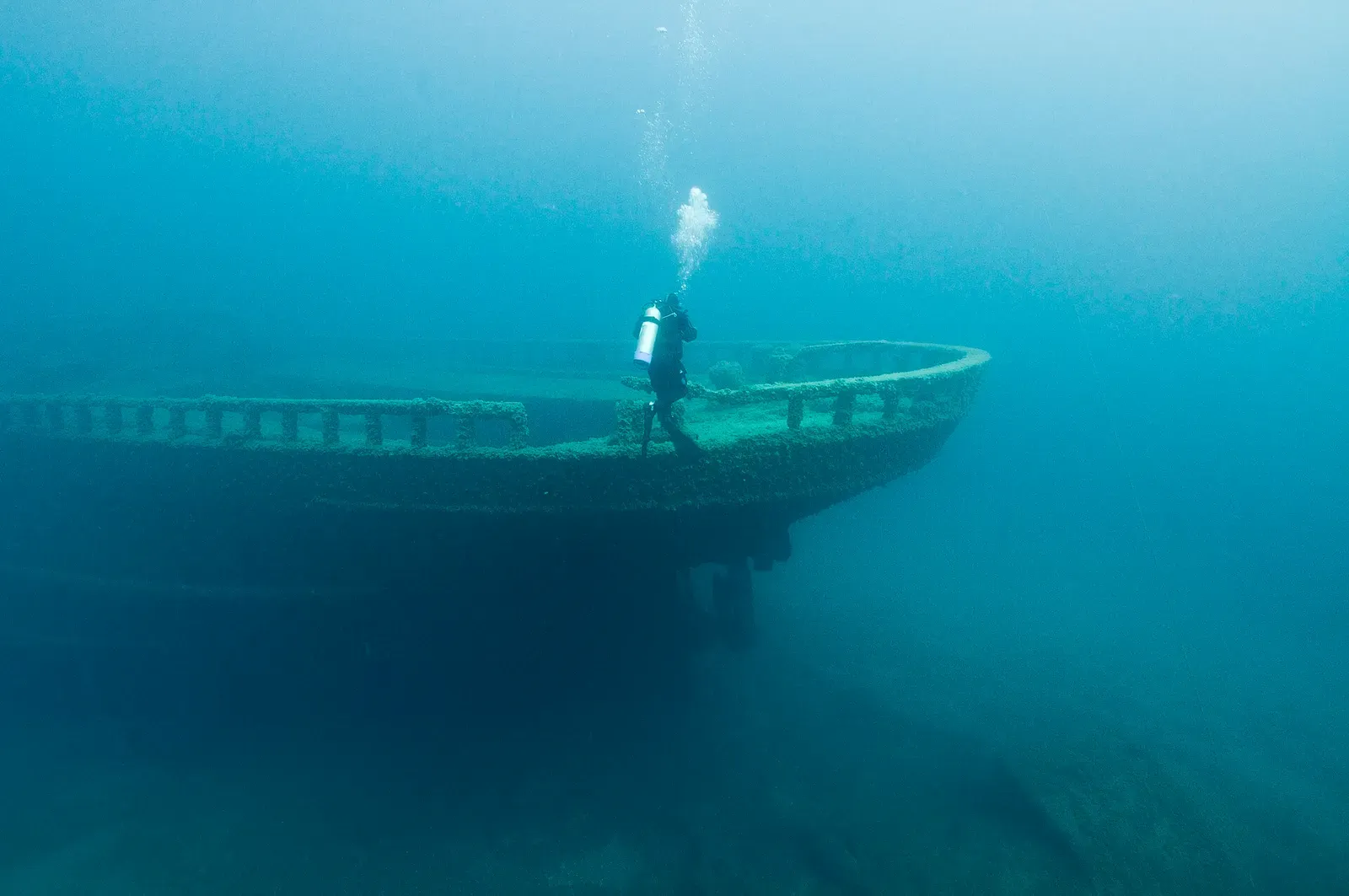
The Viator sits upright, so you arrive on a recognisable ship rather than a hull shape. At 57 m the water is dark and cold and the plan is short, so most teams pick a single stretch — the collision damage, the deck, or the bow — and work that rather than attempting the full 71 metres (232 feet). NOAA's own photographs of the site catch her looming out of the dark as a diver descends, which is exactly how the wreck reads at this depth.
Being an ocean vessel rather than a lake freighter, she is narrow for her length — 71 metres on a 10 m beam (232 feet on a 33-foot beam) — beside the Great Lakes ships around her, and that contrast is part of the interest. The wreck is otherwise largely intact, damaged only where Ormidale hit her, and preserved by water that stays cold all year at this depth. Ascents from 57 m are long and staged, and the sanctuary's protection means nothing leaves the bottom with you.
The wreck
- Vessel
- Viator
- Type
- Ocean-going freighter
- Length
- 71 m (233 ft)
- Built
- 1904
- Sunk
- 1935
- Cause
- Rammed by the freighter Ormidale in heavy fog while carrying pickled herring
- Lies
- Upright on the lake bottom, largely intact except for the collision damage
The Viator was built in 1904 by Stavanger, Stoberi and Dok at Stavanger, Norway — a 71 m ocean vessel (232 ft) of 983 gross tons on a 10 m beam (33 ft), unusual company for the lake freighters around her. On 31 October 1935 she was rammed by the freighter Ormidale during a heavy fog northeast of Thunder Bay Island while carrying a cargo of pickled herring, and went to the bottom in deep water inside what is now Thunder Bay National Marine Sanctuary. She came to rest upright and remains largely intact apart from the collision damage.
Marine life and season
The sources we used don't single out particular species here.
| Jan | Feb | Mar | Apr | May | Jun | Jul | Aug | Sep | Oct | Nov | Dec |
|---|---|---|---|---|---|---|---|---|---|---|---|
| Off-season | Off-season | Off-season | Off-season | Fair | Good | Prime | Prime | Prime | Fair | Off-season | Off-season |
Season follows Thunder Bay: The season runs late May to early October, with July and August warmest; the lake is unworkably cold and rough otherwise.
Know before you go
- At 57 m gas planning leaves no margin for a detour — fix the route and the turn pressure before you leave the boat and hold to both.
Questions divers ask
How deep is the Viator wreck?+
The Viator lies at 57 m — 188 feet — in Lake Huron, which makes her a technical dive requiring mixed gas and staged decompression.
Sources
- Viator — NOAA Thunder Bay National Marine Sanctuary
More dive sites in Thunder Bay
Wreck
Ghost schooner upright at 56 m, masts still standing
Wreck
Steering wheel and chained windlass on a broken schooner
Wreck
The sanctuary's largest wreck, 162 m and inverted
Wreck
An intact 1848 schooner on an even keel at 56 m
Wreck
Three masts still on deck at 63 m
Upright steel freighter with engine and boilers still in place
Wreck
A Great Lakes freighter lying inverted at 53 m
An 1862 schooner in 18 m on a mooring buoy
Similar dives elsewhere
Remains of the largest wooden steamer on the Great Lakes, in 5 m
Bowsprit still extending from an 1852 hull at 32 m
Wreck
Bermuda
Alger Underwater Preserve & Munising · United States
Upright 1870 schooner with open cargo hatches and schools of rock bass

.jpg)
A 1940 Lunenburg schooner scuttled for divers at 17 m