Utila · Honduras · Wreck · Artificial reef
Halliburton Wreck
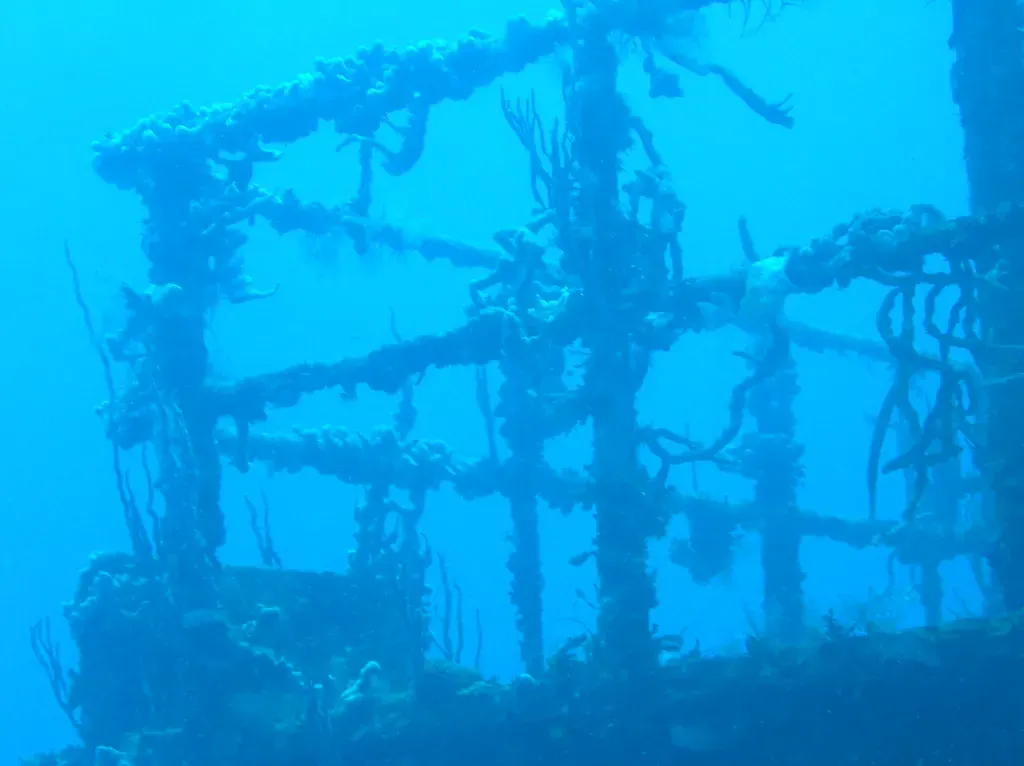
A 1998 artificial-reef wreck dived for its critters
Photo: Micah & Erin · CC BY-SA 2.0
The Halliburton is a vessel sunk off Utila in 1998 as an artificial reef. It sits in deeper water than most of the island's reef diving, around 24 to 27 metres, and it is dived for what has colonised it rather than for its scale: the structure has become a haven for small, specialised invertebrates.
Where it is and how deep
16.0845° N, 86.8971° WApproximate position — the dashed circle shows where the site lies; your operator's briefing has the mooring.
The dive
The wreck lies deeper than most of Utila's reef diving, around 24 to 27 metres, so bottom time is the limiting factor and the dive is usually one unhurried circuit rather than a long exploration. Current can be moderate, and that decides which way you work the structure. Plan the profile before you drop: at this depth the no-stop time is short, and what makes the site worth doing is close-in work rather than ground covered.
What the site lacks in size it makes up for in critters, which is why it is dived slowly and close in. Bearded fireworms, yellowline arrow crabs, channel clinging crabs, porcupine fish and pipefish are all regular sightings on and around the steel, which has been colonising since the wreck went down in 1998. Bring a macro lens and a good torch to work the shaded parts of the structure.
The wreck
- Vessel
- Halliburton
- Type
- Purpose-sunk vessel
- Sunk
- 1998
- Cause
- Deliberately sunk as an artificial reef
- Lies
- On the bottom in 24-27 m off Utila
Marine life and season
- Macro critters
| Jan | Feb | Mar | Apr | May | Jun | Jul | Aug | Sep | Oct | Nov | Dec |
|---|---|---|---|---|---|---|---|---|---|---|---|
| Fair | Good | Prime | Prime | Prime | Good | Good | Good | Good | Fair | Fair | Good |
Season follows Utila: March to May is dry, clearest and best for whale sharks; October and November bring the heaviest rain and some runoff.
Know before you go
- At 24 to 27 metres with moderate current possible, gas goes quickly here - set a turn pressure for the circuit and leave the wreck with enough in hand for the ascent.
Photos from Halliburton Wreck
Micah & Erin · CC BY-SA 2.0
Micah & Erin · CC BY-SA 2.0
Micah & Erin · CC BY-SA 2.0
Dive videos
EXPLORING THE HALLIBURTON WRECK | PADI WRECK DIVING | UTILA DIVE CENTER · GoPro Utila Dive Centre on YouTube
Freediving through 3 floors on Halliburton wreck · thibaultDSM on YouTube
Questions divers ask
How deep is the Halliburton Wreck?+
The wreck sits at roughly 24 to 27 metres, deeper than most of Utila's reef dives, which keeps bottom times short and puts it beyond a straightforward beginner profile.
What is the Halliburton Wreck?+
A vessel sunk off Utila in 1998 as an artificial reef. Divers come for the invertebrate life that has colonised the structure rather than for its size or for penetration.
Sources
- Utila Dive Sites, Bay Islands, Honduras — Dive The World
- OpenStreetMap: Halliburton wreck dive — OpenStreetMap
Photo credits
- Coral-encrusted metal framework of the sunken Halliburton wreck against open blue water by Micah & Erin, CC BY-SA 2.0, via Openverse
- Diver descending onto the deck of the Halliburton wreck by Micah & Erin, CC BY-SA 2.0, via Openverse
- Divers exhaling bubbles beside coral-covered pipework on the wreck by Micah & Erin, CC BY-SA 2.0, via Openverse
- Silhouette of the wreck's hull section with a diver hovering alongside in blue water by Micah & Erin, CC BY-SA 2.0, via Openverse
More dive sites in Utila
Wreck
A 2021 light-plane wreck flat on the sand at 24 m
Wall
A large seahorse in the garden eels at 18-24 metres
Seamount
Utila's blue-water seamount, with whale sharks passing over
Wall
A sand channel drift past caverns between wall and slope
Wall
A drop-off dive over one of Utila's coral nurseries
Wall
Near-vertical face of tube sponges, sea fans and black coral
Coral garden
Bioluminescent glow after dark gave this reef its ghost name
Wall
Swim-throughs and overhangs on a wall to 21 metres
Similar dives elsewhere
A hull that was placed rather than lost, upright at 25 m

A 1944 US Navy minesweeper, split in two at 26 metres

A 100 m cable layer with a 40 m cable corridor through her hull
Three swim-throughs, and sometimes 15 to 20 groupers inside