
South America · Brazil
Abrolhos Archipelago
Divers swim among and inside chapeirões, Brazil's mushroom-shaped coral towers.
Photo: Mia Morete · CC BY-SA 3.0
Abrolhos is a marine national park of five volcanic islands and coral banks off southern Bahia, reached by boat from Caravelas in two to six hours depending on the vessel. The reefs are built around chapeirões, giant mushroom-shaped coral pinnacles, including the endemic Bahia brain coral. From July to November humpback whales gather in the park to breed and are watched from the boat between dives.
About diving in Abrolhos Archipelago
Everything runs on the boat's schedule. Vessels leave Caravelas, usually crossing overnight, then spend the following days working the reef banks with several dives a day, night dives included, straight off the back deck. There is no dive shop to walk into and no opting out of the itinerary once you sail: you dive what the crew judges the swell will allow, and surface intervals pass at anchor in sight of the islands and the lighthouse on Santa Bárbara.
Brazilian reefs are built from very few coral species compared with the Caribbean, and an unusual share of those grow nowhere else, so the structure looks unlike the tropics elsewhere. Rather than a sloping reef face there are columns: growth spreads outward near the top, leaving broad-capped towers with near-vertical sides, separated by sand channels you follow along the base looking upward. The caps come shallow enough to spend real time on, while the outlying banks sit deeper and more exposed.
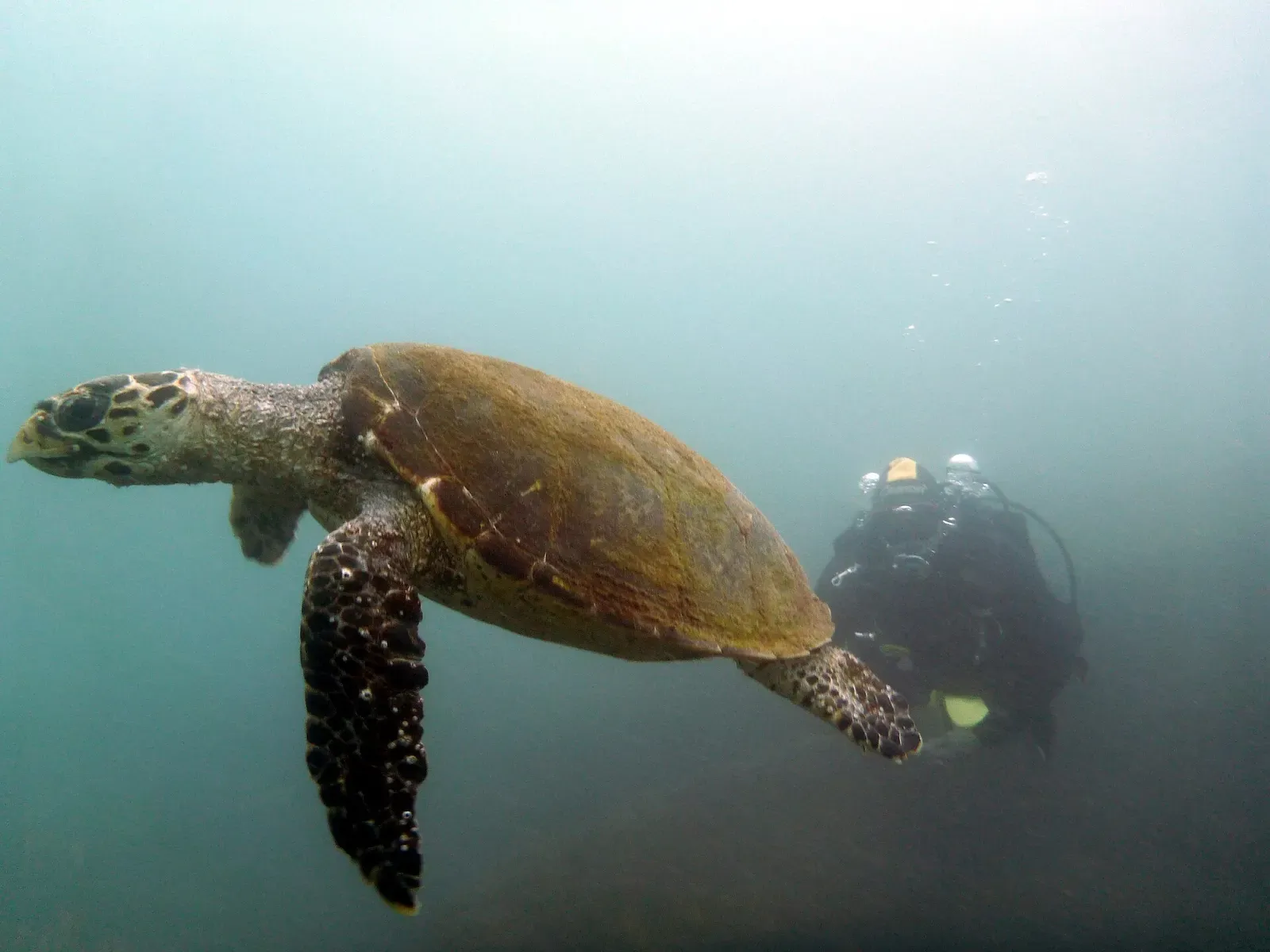
Through the whale months the humpbacks are simply present. The song carries through the water and off the rock, loud enough to be disorienting the first time, and it arrives with no clear direction, so guessing where the animal is from underwater is futile. Between tanks you watch blows and breaching from the deck. Outside that window the interest is quieter and closer in: grouper on the deeper ledges, turtles over the coral tops, dense clouds of small fish above the caps, and night dives with the polyps open.
Abrolhos suits divers who like remote, low-key trips and do not need a checklist of big pelagics: the draw is a reef architecture largely restricted to the Brazilian coast, seabird colonies on the islands, and whales overhead. Time ashore is minimal, since landing is limited and guided, so the trip is effectively lived on the boat. It serves badly anyone wanting flexibility: the fleet is small, berths go early in whale season, departures wait on weather, and there is no plan B once you have committed.
Best time to dive Abrolhos Archipelago
| Jan | Feb | Mar | Apr | May | Jun | Jul | Aug | Sep | Oct | Nov | Dec | |
|---|---|---|---|---|---|---|---|---|---|---|---|---|
| Season | Prime | Prime | Good | Fair | Fair | Fair | Good | Prime | Prime | Prime | Good | Prime |
| Sea surface | 26°C79°F | 27°C81°F | 27°C81°F | 28°C82°F | 27°C81°F | 26°C79°F | 25°C77°F | 25°C77°F | 25°C77°F | 25°C77°F | 26°C79°F | 26°C79°F |
| Daytime high | 27°C81°F | 28°C82°F | 28°C82°F | 28°C82°F | 27°C81°F | 26°C79°F | 26°C79°F | 25°C77°F | 25°C77°F | 26°C79°F | 26°C79°F | 27°C81°F |
| Rain | 91 mm3.6 in | 68 mm2.7 in | 106 mm4.2 in | 107 mm4.2 in | 79 mm3.1 in | 72 mm2.8 in | 68 mm2.7 in | 60 mm2.4 in | 41 mm1.6 in | 102 mm4.0 in | 177 mm7.0 in | 156 mm6.1 in |
| Jan | Feb | Mar | Apr | May | Jun |
|---|---|---|---|---|---|
| Prime | Prime | Good | Fair | Fair | Fair |
| Sea surface | |||||
| 26°C79°F | 27°C81°F | 27°C81°F | 28°C82°F | 27°C81°F | 26°C79°F |
| Daytime high | |||||
| 27°C81°F | 28°C82°F | 28°C82°F | 28°C82°F | 27°C81°F | 26°C79°F |
| Rain | |||||
| 91 mm3.6 in | 68 mm2.7 in | 106 mm4.2 in | 107 mm4.2 in | 79 mm3.1 in | 72 mm2.8 in |
| Jul | Aug | Sep | Oct | Nov | Dec |
|---|---|---|---|---|---|
| Good | Prime | Prime | Prime | Good | Prime |
| Sea surface | |||||
| 25°C77°F | 25°C77°F | 25°C77°F | 25°C77°F | 26°C79°F | 26°C79°F |
| Daytime high | |||||
| 26°C79°F | 25°C77°F | 25°C77°F | 26°C79°F | 26°C79°F | 27°C81°F |
| Rain | |||||
| 68 mm2.7 in | 60 mm2.4 in | 41 mm1.6 in | 102 mm4.0 in | 177 mm7.0 in | 156 mm6.1 in |
2011–2025 averages. Sea surface: NOAA Coral Reef Watch, measured at the surface, so deeper water can run colder. Daytime high and rain: NASA POWER.
Aug–Oct pairs peak humpback whale season with fair diving; visibility is clearest and warmest Dec–Mar, while Apr–Jul river runoff lowers it to around 10 m.
Best months: January, February, August, September, October, December
Abrolhos Archipelago water temperature and weather by month
The sea surface runs from 25 °C (77 °F) in August to 28 °C (82 °F) in April. Most rain falls from October to December, peaking at about 180 mm (7.1 in) in November; September is the driest. Daytime highs sit around 27 °C (81 °F) all year. The coldest water here is about 24 °C (75 °F), so pack a 3 mm full suit.
Dive types & marine life
Humpbacks are the seasonal event, present roughly July to November and clearly audible underwater through it. Turtles, large grouper and thick schools of small reef fish sit on the coral towers all year, and open polyps are the night-dive draw. Once the whales move on, the southern summer months are when you actually see the reef at any distance.
- Reef
- Coral garden
- Wall
- Night
- Whales
- Sea turtles
- Groupers
- Reef fish swarms
- Pristine corals
Best dive sites in Abrolhos Archipelago
Pinnacle
A hollow coral chamber 20 m across, bottoming out at 25 m
Pinnacle
Channels through coral towers to a chamber that holds 15 divers
Parcel das Paredes
Bank reefs and chapeirões with steep leeward walls, about 30 km off the mainland on the coastal arc.
Parcel dos Abrolhos
Extensive shallow coral reef block ringing the islands.
Timbebas Reef
One of the park's largest reef banks, on the humpback migration route.
How to get to Abrolhos Archipelago
Caravelas in southern Bahia is the jumping-off point, usually reached by road from Porto Seguro or Teixeira de Freitas; its own airstrip sees little traffic. Boats sail on fixed dates and fill early in whale season, so settle the berth first and buy flights around it, allowing a night in town rather than connecting on the morning of departure.
Photos from Abrolhos Archipelago
João D'Andretta · CC BY 4.0
João D'Andretta · CC BY 4.0
João D'Andretta · CC BY 4.0
João D'Andretta · CC BY 4.0
Gus Valentim · CC BY 2.0
Gus Valentim · CC BY 2.0
Dive videos
Mergulho - Chapeirão Faca Cega - Abrolhos - Bahia - Brasil - 09/01/2022 · Diving Around on YouTube
Deep Cavern Dive at Chapeirão Faca Cega - Secret Abrolhos Adventure at my 100th Dive! · Let's Go, Miscow! on YouTube
Photo credits
- A humpback whale's tail fin breaks the surface at Abrolhos Marine National Park, Brazil by Mia Morete, CC BY-SA 3.0, via Wikimedia Commons
- Great star coral crusts the overhanging edge of a coral tower against open blue water at Abrolhos by João D'Andretta, CC BY 4.0, via iNaturalist
- The shadowed underside of a coral overhang, with star coral on its lip, in the Abrolhos Archipelago by João D'Andretta, CC BY 4.0, via iNaturalist
- Grunts swim over a reef top crowded with rounded coral heads at Abrolhos, a coral column behind them by João D'Andretta, CC BY 4.0, via iNaturalist
- Finger coral grows below an opening in the reef, with daylight coming through from above, on the Abrolhos Bank by João D'Andretta, CC BY 4.0, via iNaturalist
- The striped lighthouse on Santa Bárbara island stands above a rocky shore and palms, seen from the sea at Abrolhos by Gus Valentim, CC BY 2.0, via Flickr
- An Abrolhos island with a small white house, seen from above through a round window at sunset by Gus Valentim, CC BY 2.0, via Flickr
Embed
Run a dive centre, club or blog? Embed this map of 2 dive sites near Abrolhos Archipelago on your own page.
Similar destinations

Granite reefs where tropical and temperate species overlap
Cold upwelling packs granite walls with fish an hour from Rio
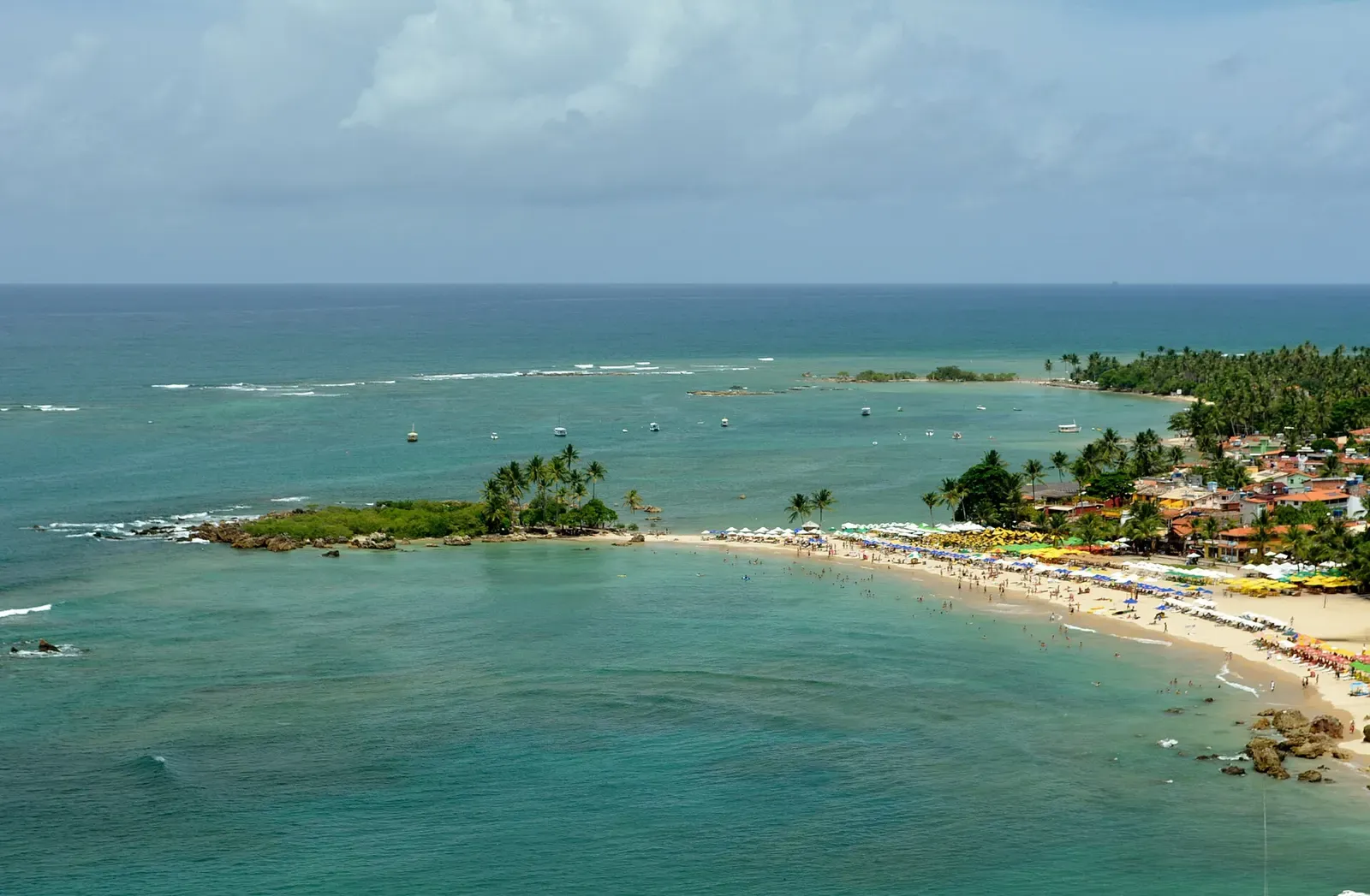
A coral reef reached from the beach, by day or by night


Dozens of wrecks on flat sand, including the 1887 steamer Pirapama