
Australia & New Zealand · Australia
Exmouth Navy Pier
Wobbegongs stacked on the ledges of a permit-only naval pier
Photo: Joshua Tagicakibau · CC BY-SA 4.0
The Navy Pier at Point Murat is regularly called one of the best shore dives in the world, and it is also one of the most restricted: it stands on an active naval communications base, so access is by permit and escorted group only. Under the boards, in 15 m of water, the pylon forest holds wobbegongs stacked on ledges, grey nurse sharks, a resident giant Queensland groper and nudibranchs in absurd density. It can only be dived on slack water.
About diving in Exmouth Navy Pier
The dive runs on the tide table rather than the clock. Slack water is short and the flow on either side of it is not something to negotiate, so the window shifts later each day and can land at dawn, at midday or well after dark; operators do run the after-dark slot when the timing falls that way. Access is arranged in advance through the operator that holds the base permit: you meet at the gate, get checked on as a group with ID, and carry kit down to the water together.
Structurally this is one object rather than a site with options. Pylons stand in rows with crossbeams between them, and the usual plan is to work down one side, round the seaward end and come back along the other, deepest at the far end and shallowing on the way home. Growth covers every surface to the point that the steel disappears under it, and the rubble and silt beneath the boards holds its own animals. Buoyancy control matters far more here than depth or navigation.
The pier stands on the gulf side of the cape rather than the ocean side, so the water is greener than the reef around the corner, with visibility running roughly 5 m to 20 m, and that nutrient load is a fair part of why the growth on the piles is so heavy. It rewards a slow, short-range dive; photographers get more out of it than sightseers do, and anyone who wants open reef scenery should spend their other days on the boat sites off the cape. Most people fit it around a wider Ningaloo trip in the dry months, April to October.
Best time to dive Exmouth Navy Pier
| Jan | Feb | Mar | Apr | May | Jun | Jul | Aug | Sep | Oct | Nov | Dec | |
|---|---|---|---|---|---|---|---|---|---|---|---|---|
| Season | Good | Good | Good | Prime | Prime | Prime | Prime | Prime | Prime | Prime | Good | Good |
| Sea surface | 27°C81°F | 28°C82°F | 28°C82°F | 28°C82°F | 27°C81°F | 25°C77°F | 24°C75°F | 23°C73°F | 23°C73°F | 24°C75°F | 25°C77°F | 26°C79°F |
| Daytime high | 40°C104°F | 40°C104°F | 39°C102°F | 36°C97°F | 32°C90°F | 28°C82°F | 27°C81°F | 30°C86°F | 33°C91°F | 35°C95°F | 37°C99°F | 40°C104°F |
| Rain | 33 mm1.3 in | 33 mm1.3 in | 39 mm1.5 in | 22 mm0.9 in | 37 mm1.5 in | 44 mm1.7 in | 12 mm0.5 in | 6 mm0.2 in | 2 mm0.1 in | 0 mm0.0 in | 3 mm0.1 in | 3 mm0.1 in |
| Jan | Feb | Mar | Apr | May | Jun |
|---|---|---|---|---|---|
| Good | Good | Good | Prime | Prime | Prime |
| Sea surface | |||||
| 27°C81°F | 28°C82°F | 28°C82°F | 28°C82°F | 27°C81°F | 25°C77°F |
| Daytime high | |||||
| 40°C104°F | 40°C104°F | 39°C102°F | 36°C97°F | 32°C90°F | 28°C82°F |
| Rain | |||||
| 33 mm1.3 in | 33 mm1.3 in | 39 mm1.5 in | 22 mm0.9 in | 37 mm1.5 in | 44 mm1.7 in |
| Jul | Aug | Sep | Oct | Nov | Dec |
|---|---|---|---|---|---|
| Prime | Prime | Prime | Prime | Good | Good |
| Sea surface | |||||
| 24°C75°F | 23°C73°F | 23°C73°F | 24°C75°F | 25°C77°F | 26°C79°F |
| Daytime high | |||||
| 27°C81°F | 30°C86°F | 33°C91°F | 35°C95°F | 37°C99°F | 40°C104°F |
| Rain | |||||
| 12 mm0.5 in | 6 mm0.2 in | 2 mm0.1 in | 0 mm0.0 in | 3 mm0.1 in | 3 mm0.1 in |
2011–2025 averages. Sea surface: NOAA Coral Reef Watch, measured at the surface, so deeper water can run colder. Daytime high and rain: NASA POWER.
Divable year-round on slack water; Apr–Oct is the dry season and overlaps the wider Ningaloo whale shark and humpback seasons.
Best months: April, May, June, July, August, September, October
Exmouth Navy Pier water temperature and weather by month
The sea surface runs from 23 °C (73 °F) in August to 28 °C (82 °F) in March. It is 24 °C (75 °F) or warmer from October to July. Rain is scarce: about 230 mm (9.1 in) falls in a typical year. Daytime highs reach 40 °C (104 °F) in February and drop to 27 °C (81 °F) in July. The coldest water here is about 21 °C (70 °F), so pack a 5 mm suit.
Dive types & marine life
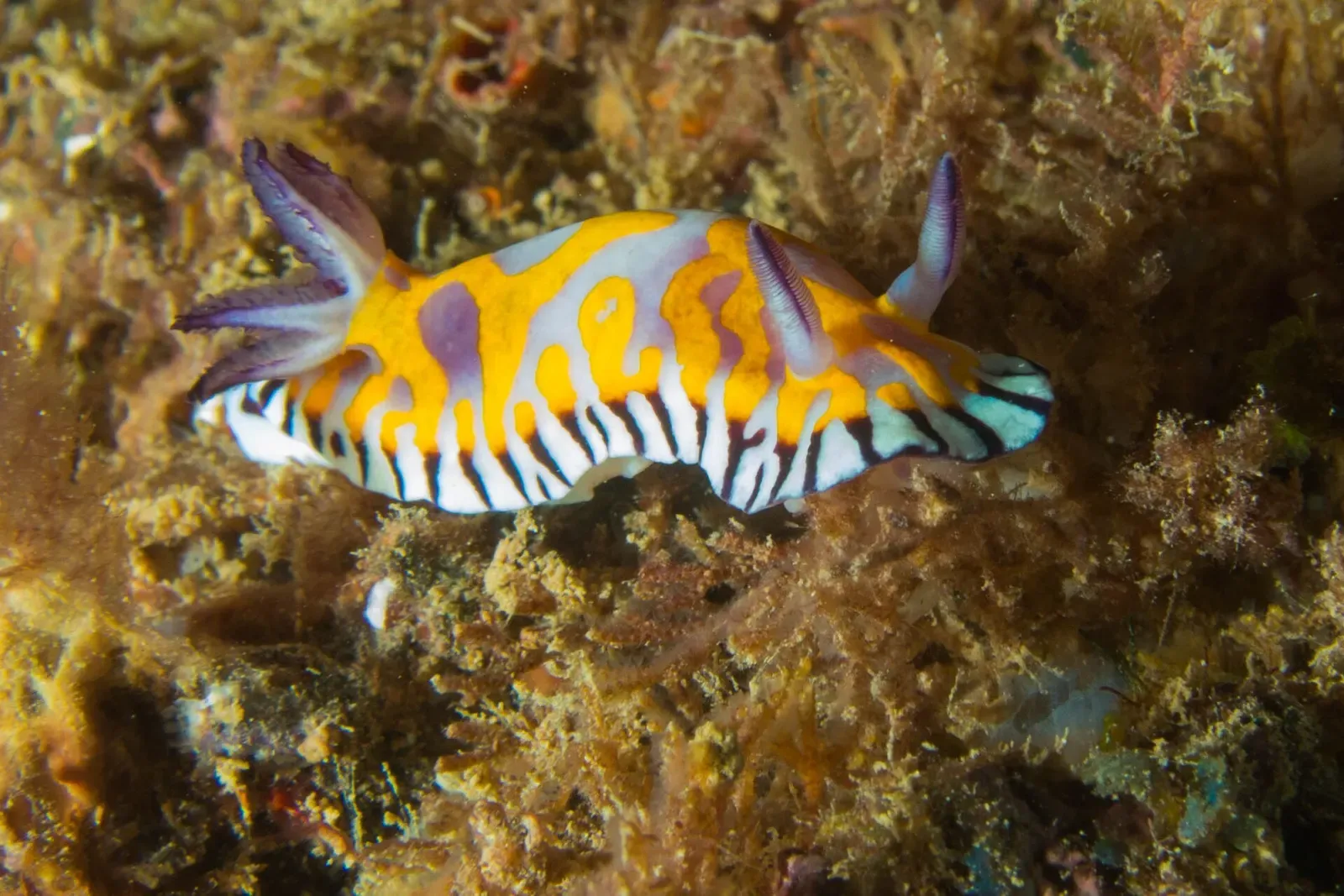
Little of this is strongly seasonal. Wobbegongs rest along the crossbeams rather than swimming and are easy to miss until you are close, while grey nurse sharks, rays and the resident groper are regular without being guaranteed. Nudibranchs, shrimp, cuttlefish and octopus are dense enough that a torch and a slow pace matter more than ground covered.
- Muck & macro
- Night
- Reef
- Wobbegongs
- Sand tiger sharks
- Groupers
- Nudibranchs
- Macro critters
- Octopus & cuttlefish
- Reef fish swarms
- Stingrays
Best dive sites in Exmouth Navy Pier
Reef
Shallow gulf reef with kayak moorings in the Bundegi Sanctuary Zone
Reef
Ledges and ground cracks in a no-take sanctuary zone
Artificial reef
Wobbegongs and grey nurse under a working navy jetty
Wobbegongs, grey nurse and whitetips under a working navy jetty
Mildura Wreck
Cattle steamer aground since 1907, in shallow water off Vlamingh Head.
How to get to Exmouth Navy Pier
Flights from Perth land at Learmonth, south of Exmouth town, which is where almost everyone bases; Point Murat is a short drive north up the cape. It is a shore dive but not a self-guided one: you dive it with the permit-holding operator, in small groups and on limited tide windows, so book the slot before you commit to flights.
Photos from Exmouth Navy Pier
Matthias Liffers · CC BY 2.0
W. Bulach · CC BY-SA 4.0
Nils Erik Mühlfried · CC BY-SA 3.0
Ben Cordia · CC BY-SA 4.0
Dive videos
World's Best Shore Dive!! Navy Pier, Exmouth Western Australia · Tommy’s Wild Adventures on YouTube
Exmouth Navy Pier Diving · Jayson Dyer on YouTube
Photo credits
- Aerial view of the rusted Mildura shipwreck resting in shallow turquoise water off Vlamingh Head by Joshua Tagicakibau, CC BY-SA 4.0, via Wikimedia Commons
- Colorful orange and white Goniobranchus roboi nudibranch crawling on reef at Ningaloo near Exmouth by Matthias Liffers, CC BY 2.0, via Wikimedia Commons
- Vlamingh Head Lighthouse overlooking scrubland on North West Cape near Exmouth, Western Australia by W. Bulach, CC BY-SA 4.0, via Wikimedia Commons
- Full moon rising over a curved bay on North West Cape, seen from Vlamingh Head near Exmouth by Nils Erik Mühlfried, CC BY-SA 3.0, via Wikimedia Commons
- Footprints crossing a sand dune down to the beach at Jansz Beach on North West Cape near Exmouth by Ben Cordia, CC BY-SA 4.0, via Wikimedia Commons
Embed
Run a dive centre, club or blog? Embed this map of 8 dive sites near Exmouth Navy Pier on your own page.
In The Logbook
- Bioluminescence: why the sea glows at nightNight diving · 7 min read
- What stings you underwater, and how to avoid itBody & health · 8 min read
Similar destinations

Whale sharks gather along the reef edge every autumn after coral spawning.

White quartz sand lifts the light over temperate sponge gardens
Weedy seadragons over temperate sponge gardens, entered from a car park


.jpeg)

Blue gropers, seagrass critters and deep collier wrecks an hour north of Sydney