The commonest light on Earth
Start with the scale, because it is the part nobody believes. In coastal habitats — the water divers live in — only about 2.5 per cent of organisms are bioluminescent, which is why the sparks feel like a special event. Step off the shelf and the proportions invert: surveys of the eastern Pacific water column have found that about 76 per cent of the main taxonomic groups of deep-sea animals can make light, and NOAA’s own fact page puts it at 80 per cent of the animals living between 200 and 1,000 metres down. Below the sunlit skin of the ocean, luminous is not the exception. It is the default body plan — fish, squid, jellies, crustaceans, worms — and that midwater is, by volume, the largest habitat on the planet. Divers meet its glow at the thin top edge, the way beach walkers meet the ocean.
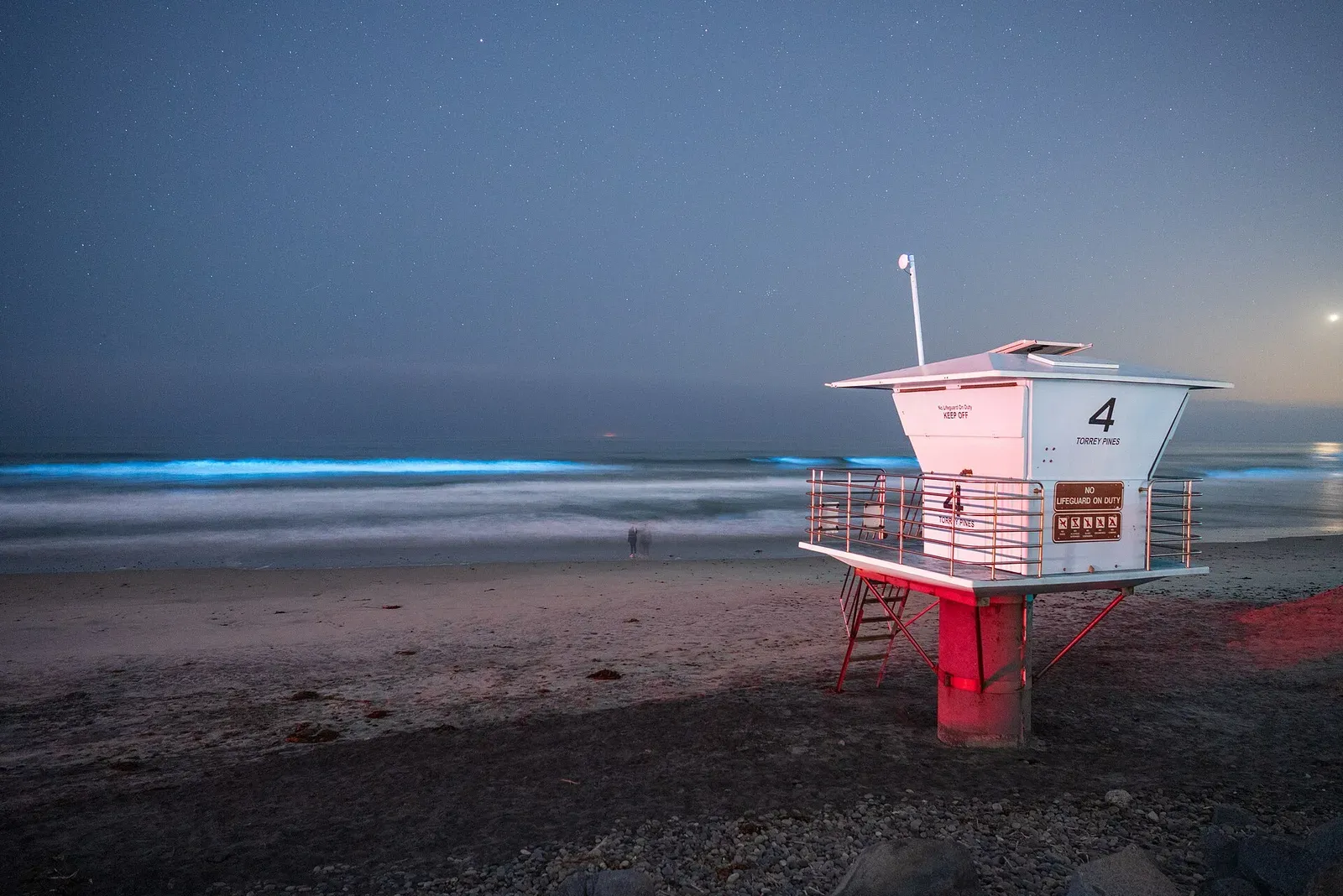
The light itself is one chemical trick with many owners: a small molecule, generically called a luciferin, is oxidised in the presence of an enzyme, a luciferase, and the reaction’s spare energy leaves as a photon instead of heat. In the dinoflagellates — the single-celled plankton behind almost every glowing wake and sparkling fin-kick — the kit is packed into tiny cytoplasmic bodies called scintillons, about half a micron across, holding the luciferase alongside a luciferin derived from chlorophyll. The trigger is mechanical: shear the cell — a breaking wave, a copepod’s lunge, your hand — and an action potential sweeps the cell membrane, the scintillons briefly acidify, the pH-sensitive luciferase snaps into shape and the cell fires a flash lasting about a tenth of a second, peaking at 476 nanometres. Blue, in other words. Specifically, that blue.
The flash is tuned to the water
The blue-sea guide computed water’s transparency window: seawater absorbs the far red end of the spectrum over a hundred times more greedily than the blue it keeps, so the open ocean holds on to blue and discards the rest. Put the dinoflagellate flash on that curve and the punchline draws itself. The clearest seawater’s attenuation bottoms out around 430 nanometres; at the flash’s 476-nanometre peak the water is still within one and a half times its own clearest point — while the same flash in 620-nanometre red would lose light eighteen times faster. A signal that has to cross open water, on a chemical energy budget, gets pushed toward blue by every generation of natural selection: NOAA’s fact page states the rule plainly — most ocean light is blue because that is the light that travels best through the water. Four billion years of evolution and the attenuation table agree with each other, which is either a coincidence or the whole point of physics.
The second chart is the same fact from the receiver’s end. Take one flash of fixed energy and march it through the clearest ocean: at 15 metres (50 feet) a blue flash still owns 79 per cent of its photons; at 30 metres, 63 per cent. Green at 550 keeps 17 per cent over the same swim, and red at 620 arrives with two hundredths of a per cent — for practical purposes, a red flash does not exist beyond the first few metres. One per cent of the blue survives to 298 metres of path; red’s one-per-cent mark is at 17. And this is the best-case water: add plankton and the gap only widens, because green water eats blue too. A deep-sea animal signalling in red would be shouting into a pillow. A few predatory dragonfish do exactly that, as a private channel almost nobody else can see — the exception that proves how expensive it is.
Why bother glowing at all
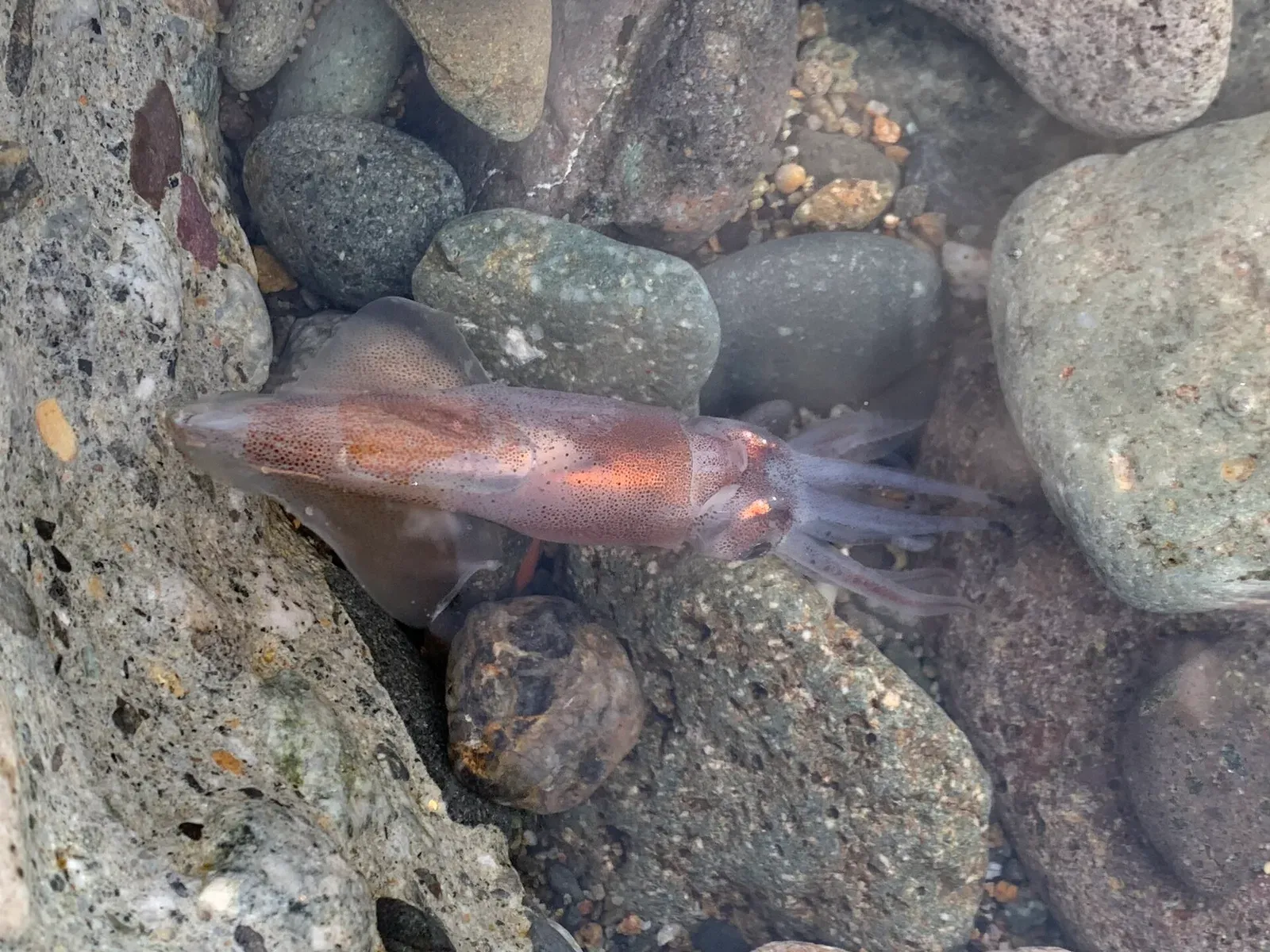
For the dinoflagellates, the best-supported answer is the wonderfully named burglar-alarm hypothesis: the flash is not aimed at the grazer eating the cell but at the grazer’s own predators. Light the copepod up like a shoplifter in a doorway and something bigger comes for it; the cell’s descendants inherit a sea with slightly warier grazers. (Recent work suggests the flash may also simply startle the grazer into jumping elsewhere — the alarm and the flash-bang need not be exclusive.) Elsewhere in the catalogue the light is a lure, a headlamp, a mating badge or a smokescreen: the flashlight fishes of the Anomalopidae carry pockets of luminous bacteria in a lidded organ under each eye, shuttered like a signal lamp to communicate, draw prey and dodge predators — a symbiosis, light worn rather than made.
The diver’s moments
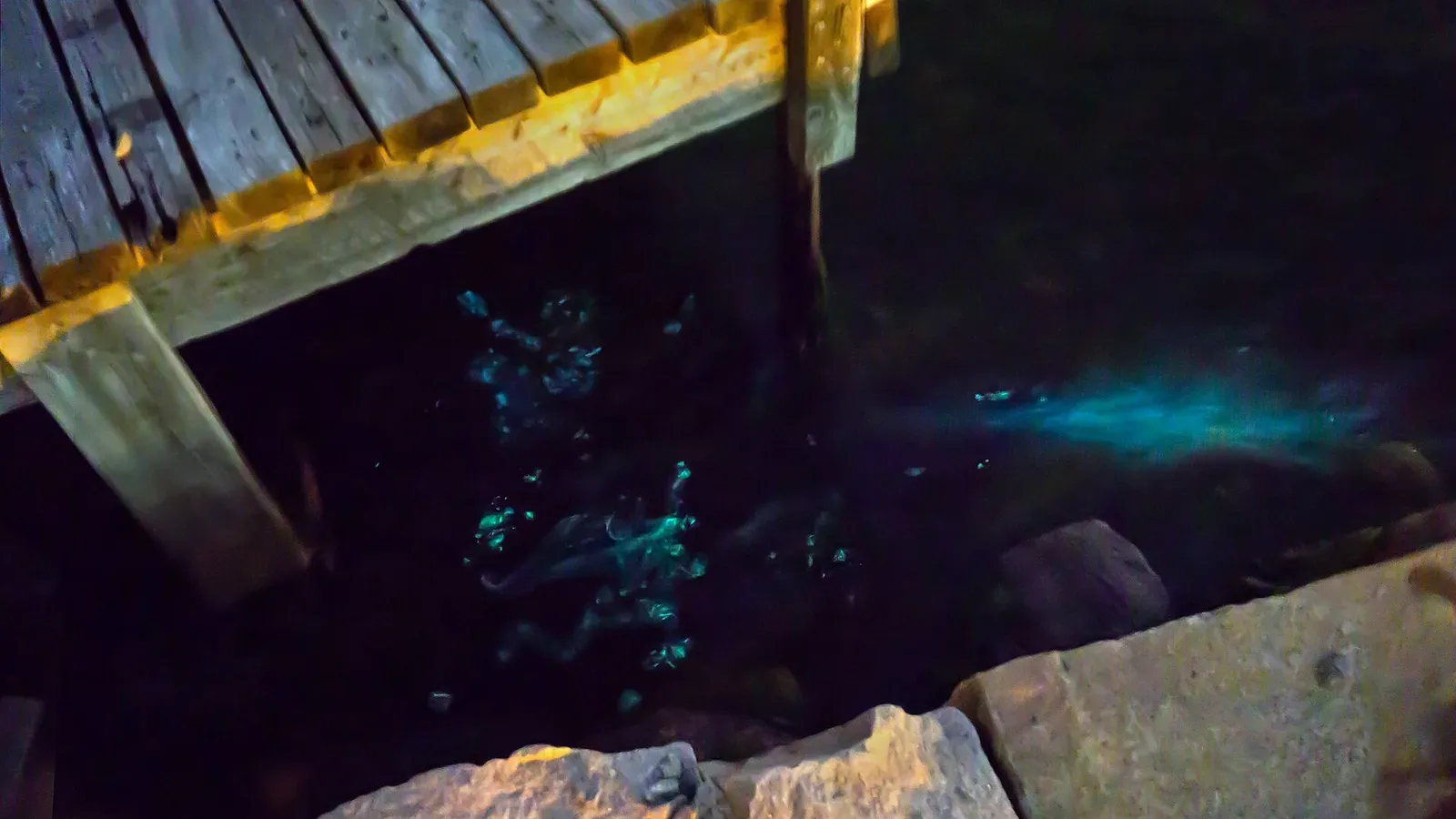
Every named phenomenon above scales down to something you can do on an ordinary night dive. The classic move costs nothing: find a patch of open water mid-dive, cover or switch off your torch, wait thirty seconds for your eyes, and stir. Our record for Lekuan 3 lists it as part of the dive — shrimps and crabs in the cracks, “bioluminescence in the water when you cover your torch” — and at Anse Chastanet the sparks share the water column with hunting squid and sleeping parrotfish. Duppy Waters on Utila is named for it — duppy is Caribbean English for ghost, and the site is dived at night for the glow. At Manta Sandy the plankton that sparkles after sunset is the same soup the mantas came for; the fireworks and the wildlife are one budget.
The concentrated version is the open-ocean night dive — clipped to a tether at Kona, or holding near the lit hang-bar over 7,000 metres of nothing at Palau — while the nightly migration of midwater animals rises past your torch. That world, its logistics and its etiquette belong to the night-diving guide; what this article adds is only the census above — out there, four in five of the animals passing your beam can answer it with light of their own.
The gazetteer of glow
At the top of the scale sit places where the display is the destination. Mosquito Bay on Vieques, Puerto Rico — certified by Guinness World Records in 2006 as the brightest bioluminescent bay in the world — keeps a resident population of the dinoflagellate Pyrodinium bahamense dense enough that everything moving through the water trails neon blue; it is a kayak-and-swim spectacle rather than a dive site, and none of the famous bio bays is in our records. Toyama Bay in Japan hosts the firefly squid run: each spring the deep-water Watasenia scintillans masses into the bay to spawn, between February and July, and is netted at night when it rises to the surface — the glow show is a fishing-harbour and shoreline phenomenon, not a diving itinerary. We list them as pilgrimages, honestly framed.
And then there is the phenomenon that closes every account of marine light, because it is the biggest and the least seen. Milky seas — sailors’ reports, centuries of them, of the ocean glowing horizon to horizon like a snowfield — are not dinoflagellates at all. The glow is bacterial, steady rather than flashed, the collective light of luminous bacteria at bloom density; the individual cells are far too small to make discernible flashes, which is why the sea looks uniformly milky rather than sparkling. In 2005, scientists reported the first photographic evidence from orbit: satellite sensors caught a patch of the north-western Indian Ocean about 15,400 square kilometres in area — the size of Connecticut — glowing for three consecutive nights, corroborated by a ship that sailed through it. A follow-up study logged an event that persisted over 40 nights. There is no way to book it. Somewhere tonight, statistically, a piece of ocean the size of a small country is quietly glowing with nobody there — the ocean does not run its light show for us, which is the best possible reason to go and stand in the shallow end of it with a torch switched off.
Where the sea glows
| Site | Depth | Level | Best months |
|---|---|---|---|
| Kona Blackwater Dive Kona · United States | to 15 m | Advanced | Dec–Apr |
| Palau Blackwater Dive Palau · Palau | to 16 m | Advanced | Dec–Mar |
| Duppy Waters Utila · Honduras | 6–24 m | Beginner | Mar–Aug |
| Anse Chastanet Reef St. Lucia · St. Lucia | 6–43 m | Intermediate | Dec–Apr |
| Lekuan 3 Bunaken · Indonesia | to 30 m | Intermediate | May–Oct |
| Manta Sandy Raja Ampat · Indonesia | 8–15 m | Beginner | Nov–Mar |
| Secret Bay Anilao · Philippines | to 24 m | Beginner | Dec–Apr |
| Police Pier Lembeh Strait · Indonesia | 8–15 m | Intermediate | May–Oct |
| Navy Pier Exmouth Navy Pier · Australia | to 14 m | Intermediate | Apr–Oct |
| Something Special Bonaire · Caribbean Netherlands | to 35 m | Intermediate | Dec–Apr |
Blackwater Diving Kona, Hawaii | Kona Honu Divers | In the Night Time Pelagic Magic Happens · Kona Honu Divers on YouTube
The physics under this article lives in why the sea is blue and why some seas are green — the same attenuation table, run for sunlight instead of flashes. The craft of diving in the dark, blackwater included, is the night guide’s subject. And if the plankton itself is your quarry, the animals that eat it wholesale have guides of their own, from mantas to whale sharks.


