Nothing down there is hunting you
Here is the reorientation this whole article hangs on: no animal in the sea regards a diver as food, and almost none regards one as a threat worth crossing open water for. DAN’s overview of hazardous marine life says interactions are “almost uniformly uneventful” when divers pay attention to their own behaviour — and its medical reference opens by calling envenomations rare. Even the most feared animal in these pages runs gentler numbers than its reputation: of 225 analysed stings by Chironex fleckeri, the big Australian box jellyfish, only 8 per cent needed hospital admission and 5 per cent antivenom, with a single fatality — a three-year-old child, not a diver in a suit.
What actually connects the injuries is not aggression but contact, and the contact is almost always ours. The dangerous cast is overwhelmingly stationary or slow, camouflaged or transparent, and armed for defence: venom delivered by being stepped on, brushed, knelt on or picked up. Which means the subject of this article is really the diver’s own hands, knees and fins — and that the fix is not courage but buoyancy. So let’s walk the cast the honest way: not a species list, but by how you touch them.
What you tread on
The classic marine envenomation is a foot injury at the waterline. The reef stonefish — the most venomous fish known, per its Wikipedia page, with stings that can be fatal — is a sit-and-wait predator whose entire strategy is to be indistinguishable from a stone, and most stings happen exactly the way you would guess: someone steps on it and drives the dorsal spines into a foot. It is a shore-entry and shallow-reef hazard more than a diving one, which is why our record for Lady Elliot’s Coral Gardens says flatly: wear reef shoes or fins whenever you enter the water. Stingrays sit half-buried on the same sandy ground and strike with the tail barb only when trodden on or threatened — DAN’s advice is the famous stingray shuffle: slide your feet through the sand on walk-in entries so the vibration clears the ground ahead of you, a habit worth pairing with everything in the shore-diving guide. And the humble sea urchin out-injures all of them: DAN’s medical team reports at least one call a week about urchin punctures, mostly from shallow rocky shores — our Two Step record notes them sitting right beside the lava-step entry. Contrary to reputation, very few urchin species are venomous; the pain is mostly your body objecting to broken-off foreign spines.
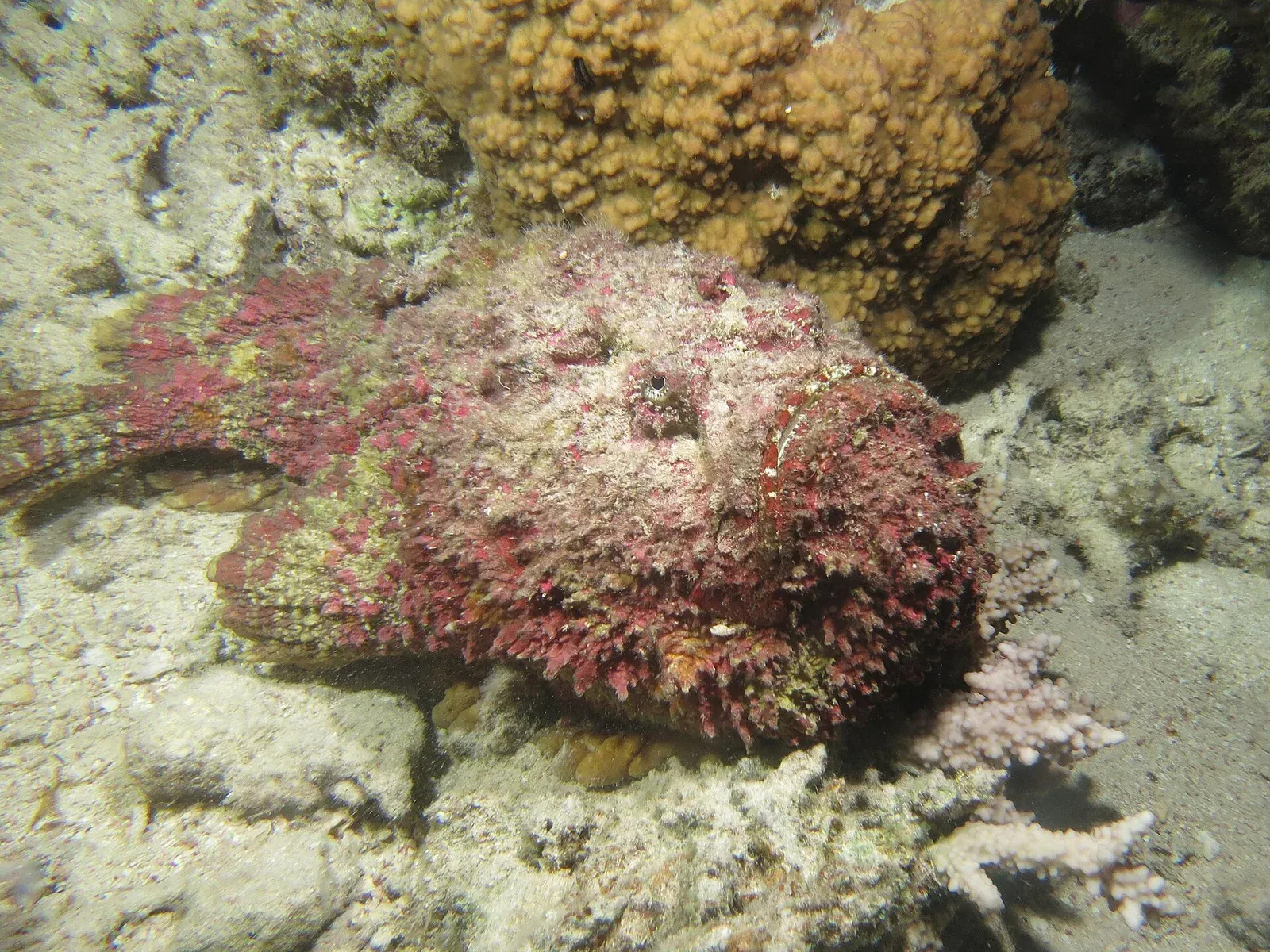
Divers meet the tread-on cast a second way: as a handhold. Under Exmouth’s Navy Pier, stonefish and scorpionfish sit among the growth on the pylons, and the briefing in our record is the whole philosophy in one line — nothing on the structure is a handhold, and fins stay clear of the bottom.
What you brush
The brush-past injuries belong to the stinging-cell family. Fire coral is the one that catches new divers, because it looks like the scenery: despite the name it is not a true coral but a hydrozoan, a relative of the Portuguese man-of-war wearing a limestone skeleton, and a bare forearm dragged across it comes up burning. DAN notes that fire-coral incidents are common among divers with poor buoyancy control, which makes it less a hazard than an exam: brush injuries are what the reef gives you instead of a trim score.
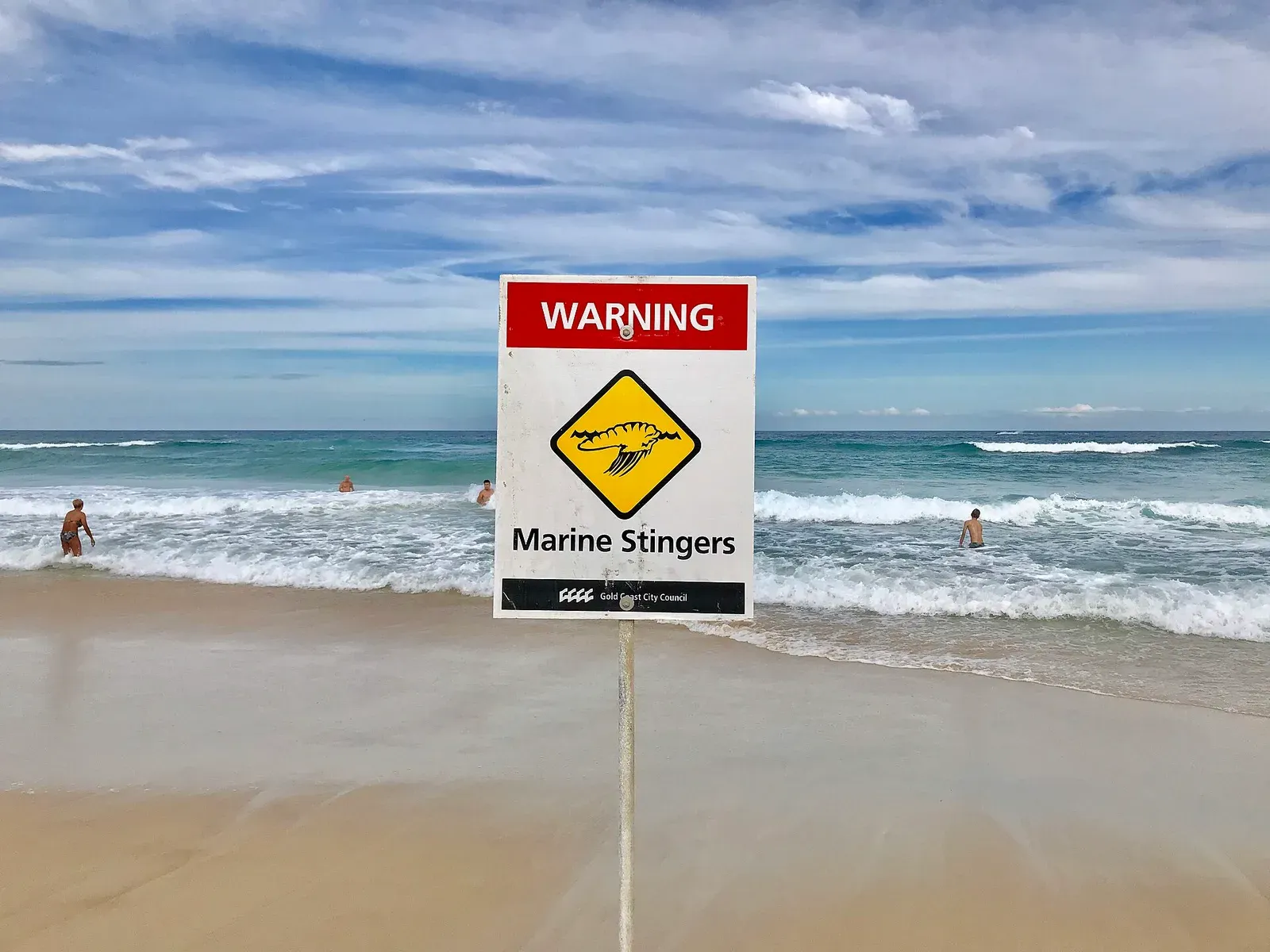
Jellyfish are the same weapon set adrift. Most stings anywhere in the world are painful and minor; the tropical Indo-Pacific box jellyfishes are the exception that earns the infrastructure. Queensland runs its stinger season as a calendar: our Blue Pearl Bay record carries it as a plain instruction — marine stinger season November to May in the Whitsundays, dive inshore in a stinger suit through those months — and further north the Irukandji literature opens the window at October. Chironex fleckeri, “the most lethal jellyfish in the world” with at least 64 recorded Australian deaths since 1884, and the tiny Irukandji jellyfishes — whose sting feels like a mosquito bite for half an hour and then becomes a syndrome of pain and hypertension — are managed with a calendar, nets and lycra, not with nerve. The season is as plannable as a tide table, and the locals plan it.
What you pick up
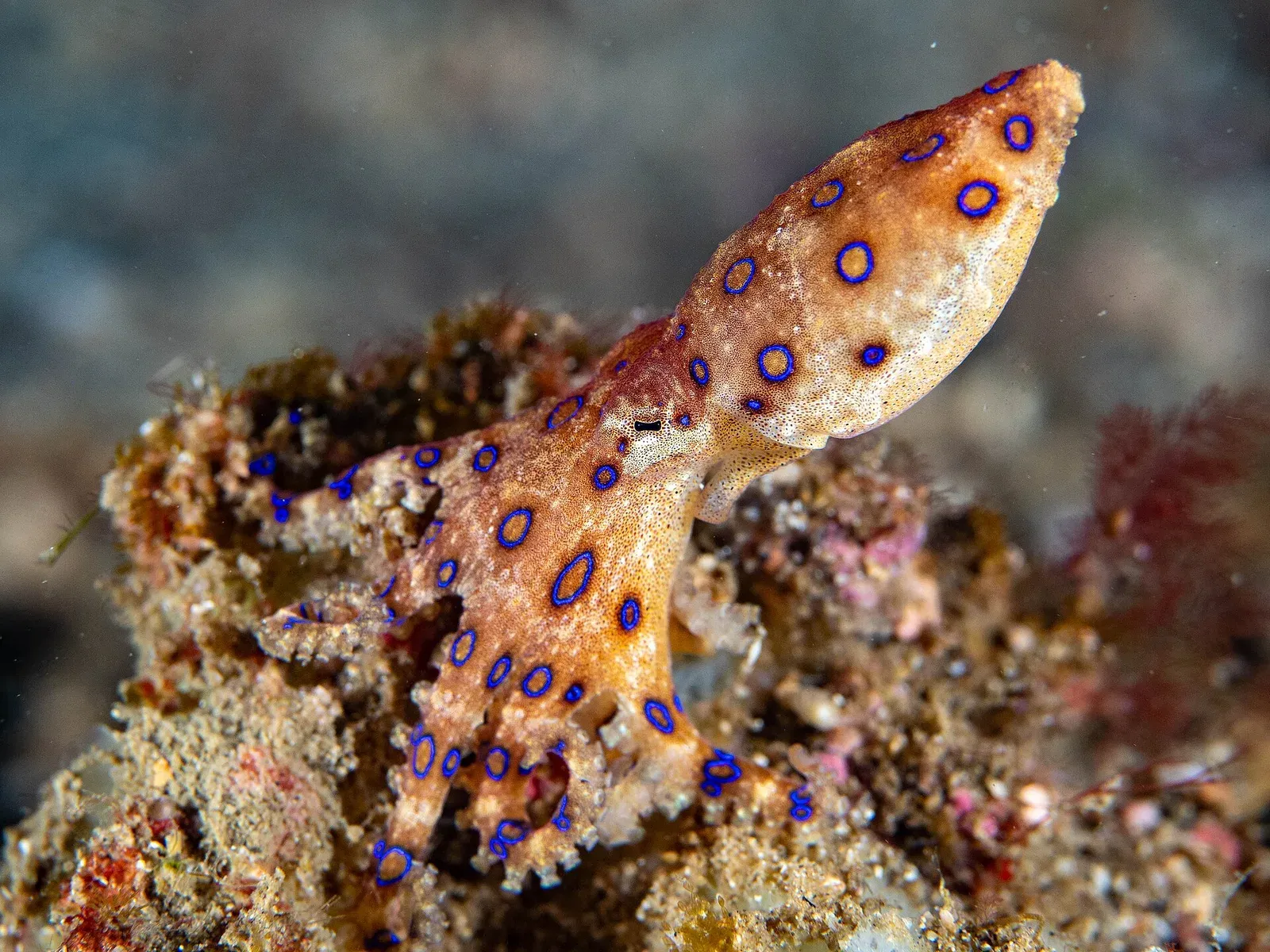
Now the two animals with the most sinister reputations — and the cleanest records of never touching anyone who didn’t touch them first. The blue-ringed octopus is golf-ball small, docile, and carries tetrodotoxin: bites are tiny and often painless, there is no antivenom, and the emergency is respiratory paralysis — yet Wikipedia’s summary and DAN’s alike say the danger arises when the animal is handled. Our own records repeat the rule at site level: at Lipayo Point, look and photograph, keep hands off the rubble and the empty shells they shelter in; at Giant Clams, hands off anything small and mottled on the sand. Cone snails are the same story in a prettier package: a harpoon that can pierce gloves and wetsuits, roughly 30 recorded human deaths, and injuries that happen overwhelmingly to people picking up shells. Coral Gardens again, from our record: cone shells are present and can kill; nothing on this reef is worth picking up.
Lionfish round out the hand-delivered class from the other side: 18 venomous spines, a sting that is agony but rarely fatal to healthy adults, and a DAN case file dominated by careless handling during spearing and preparation — a real issue in the invaded Atlantic and Caribbean, where culling is reef stewardship, and a non-issue for the diver photographing one on the Cedar Pride or Hilma Hooker from a sensible metre away. The pattern across all three should be landing by now: the “deadliest” animals underwater are essentially peaceful, and gloves are not protection so much as permission — the hand that feels armoured is the hand that reaches.
Who defends, and who bites
A short list of animals will actively come at you, and every one is defending something. The titan triggerfish guarding a nest is the reef’s honest thug: Wikipedia describes its territory as a cone extending upward from the nest, so the instinctive escape — ascending — takes you deeper into the fight. Swim out horizontally, low and away. Our records time the behaviour precisely: nesting aggression at Black Forest in May, June and July, and a resident at White Rock with a reputation as the most aggressive on Koh Tao. The bite is toothy, not venomous — a wetsuit puncture and a story.
Sea snakes carry venom in the top league, and the sites that know them best describe a striking indifference to divers. At Snake Gully, where katuali gather by the dozens, the operator’s line in our record is that no one has ever been bitten in the water by a Niuean sea snake — let them come to you. Gato Island has been a sea-snake sanctuary since 1997 and asks only that divers keep a guide alongside. And the moray, the pantomime villain of a thousand night dives, is why every briefing includes the line about hands and holes: it is an ambush hunter holding a den, not a pursuer. Keep your fingers where you can see them and a moray is a face in a crevice, all threat display and no chase.
First aid, in classes not species
This is awareness, not a medical manual — the numbers below are DAN’s and ANZCOR’s, and a real envenomation is a call to emergency services and DAN, not a paragraph. But the field logic compresses well, because treatment follows the weapon, not the species:
Venomous fish and urchins — heat. Stonefish, lionfish, scorpionfish, stingray and urchin venoms are heat-labile proteins. DAN’s instruction is hot-water immersion, upper limit 45 °C, for 30 to 90 minutes — hottest you can tolerate without scalding, tested on yourself first if you are the rescuer. Stonefish stings additionally have an antivenom, the second-most administered in Australia.
Jellyfish and fire coral — seawater, then the regional rule. Rinse with seawater, never fresh — fresh water fires the unfired stinging cells. In Australian tropical waters, ANZCOR’s guideline is vinegar for 30 seconds for suspected box-jellyfish and Irukandji stings, because vinegar permanently deactivates undischarged nematocysts — but not for bluebottle stings, which get hot water at 43–45 °C instead. Do not export the vinegar rule beyond the animals it was written for, and do not bandage a jellyfish sting: pressure immobilisation for box jellies was abandoned in 2005 when research showed compression discharges more venom.
The paralysis toxins — pressure and breath. Blue-ringed octopus, cone snail and sea snake envenomations get the pressure immobilisation technique per ANZCOR — a firm bandage over the bite and up the limb, splinted, victim still. Heat does nothing here; tetrodotoxin is heat-stable. The blue-ring emergency is breathing: the toxin paralyses the muscles while the patient stays conscious, so rescue breathing bridges to a ventilator, and victims who survive the first 24 hours usually recover completely.
Where the venomous stars live
The final inversion is the best one: run the list back through our dataset and the “dangerous” animals turn out to be the attractions. Divers pay boat fares specifically to find blue-ringed octopus at Secret Bay, fire urchins and stonefish among the frogfish at Laha 1, and sea kraits by the hundred at Snake Gully. The muck coasts sell what this article warns about, one careful metre at a time — which is the correct final image: the cast is not a list of monsters, it is a list of neighbours with door policies.
| Site | Depth | Level | Best months |
|---|---|---|---|
| Navy Pier Exmouth Navy Pier · Australia | to 14 m | Intermediate | Apr–Oct |
| Coral Gardens Lady Elliot Island · Australia | to 12 m | Beginner | May–Sep |
| Blue Pearl Bay Whitsundays · Australia | to 18 m | Beginner | May–Sep |
| Secret Bay Anilao · Philippines | to 24 m | Beginner | Dec–Apr |
| Lipayo Point Dauin · Philippines | 12–18 m | Beginner | Apr–May |
| Laha 1 Ambon · Indonesia | 2–12 m | Beginner | Mar–Apr |
| Black Forest Balicasag · Philippines | 25–40 m | Advanced | Nov–May |
| White Rock Koh Tao · Thailand | 10–20 m | Beginner | Mar–May |
| Snake Gully Niue · Niue | 5–30 m | Intermediate | Jul–Sep |
| Gato Island Malapascua · Philippines | 10–30 m | Intermediate | Apr–May |
| Giant Clams / The Hill Puerto Galera · Philippines | 5–18 m | Intermediate | Jan–Apr |
| Hilma Hooker Bonaire · Caribbean Netherlands | to 30 m | Advanced | Dec–Apr |
| Two Step (Honaunau Bay) Kona · United States | 3–12 m | Intermediate | Dec–Apr |
| Cedar Pride Wreck Aqaba · Jordan | 10–27 m | Advanced | May–Sep |
Diving @ Snake Gully in Niue 2016 · Damien Wittmack - Underwater Video on YouTube
Buoyancy, the actual safety skill, has its own guide; shore entries and their barefoot hazards run through the shore-diving guide; the after-dark version of look-don’t-touch is in night diving; and the celebration of everything venomous, small and wonderful is muck diving.


