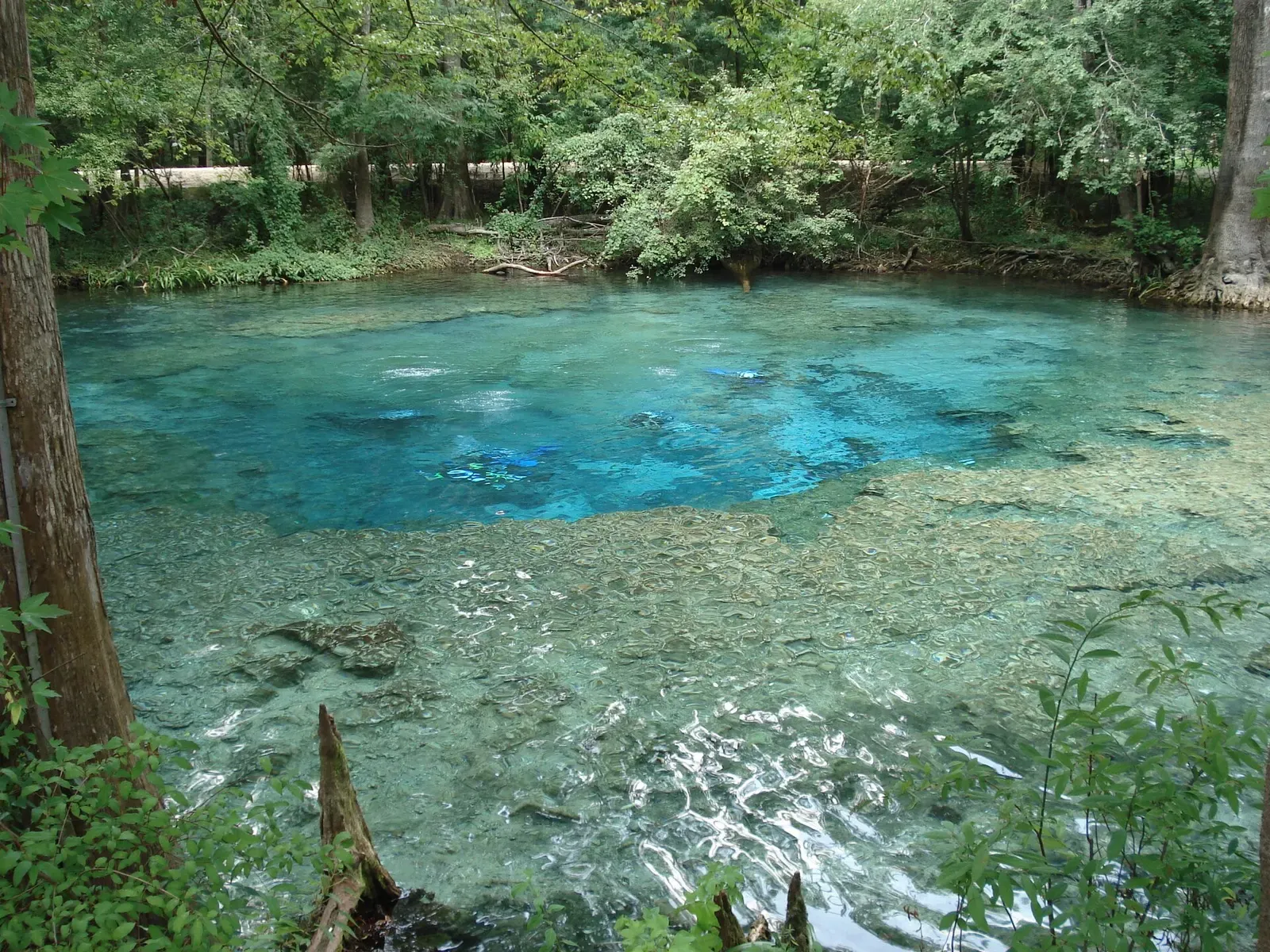
North Florida Springs · United States · Cave & cavern · Freshwater
Ginnie Springs
An iron grate closes the most dangerous part of the cave in the Ballroom
Photo: (WT-de) Mistoffeles · CC BY-SA 4.0
Three separate dives sit on one private property on the south side of the Santa Fe River: the Ginnie Ballroom cavern, the Devil's Spring System, and the river itself. The seven springs on the land run at 72 degrees Fahrenheit, about 22C, year-round, and the clarity is what the place is known for, with Jacques Cousteau's line about visibility forever still quoted by the owners. Which of the three you dive depends on your training.
Where it is and how deep
29.8362° N, 82.7003° WPublished position for this site.
The dive
Which dive you get depends on your card. The Ginnie Ballroom is the cavern most divers see first, and it is a closed proposition by design: with diver deaths increasing, the owner put an iron grate over what he judged the most dangerous part of the cave, so the dive is the lit chamber inside the spring and no further. The water is the same 72 degrees Fahrenheit, about 22C, that every spring on the property holds in any month of the year.
The nearby Devil's Spring System is a different kind of dive: three springs, Devil's Eye, Devil's Ear and Devil Spring, with warning signs at the entrances and a rule that only certified cavern or cave divers carry lights. The third option is the Santa Fe River, which the springs sit beside and connect to, and where the water runs warmer than the 22C coming out of the ground, so the same day can hold a cavern dive, a cave dive and a river dive.
Background
The Wray family has owned the springs since 1971, and the property began functioning in 1976. In the mid-1990s, as scuba diving grew in popularity, Bob Wray opened the springs to the public, and with the number of diver deaths rising he took the precautions the site is still known for: an iron grate over the most dangerous part of the cave in the Ginnie Ballroom cavern, and warning signs at the entrances to the nearby Devil's Spring system.
Marine life and season
The sources we used don't single out particular species here.
| Jan | Feb | Mar | Apr | May | Jun | Jul | Aug | Sep | Oct | Nov | Dec |
|---|---|---|---|---|---|---|---|---|---|---|---|
| Good | Good | Good | Good | Good | Good | Good | Good | Good | Good | Good | Good |
Season follows North Florida Springs: The spring water holds a constant 22 °C (72 °F), so diving runs all year; Ginnie Springs is crowded on weekends from Memorial Day to Labor Day.
Know before you go
- The passage beyond the Ginnie Ballroom is closed by an iron grate, and only certified cavern or cave divers may carry lights at the Devil's Spring System entrances.
Photos from Ginnie Springs
(WT-de) Mistoffeles · CC BY-SA 4.0
(WT-de) Mistoffeles · CC BY-SA 4.0
Dive videos
Diving a high-flow cave! The Devil's Spring system at Ginnie Springs in Florida! · BlueWorldTV on YouTube
Questions divers ask
Do you need a cave certification to dive Ginnie Springs?+
Not for the Ginnie Ballroom, which is a cavern with the passage beyond it closed off by an iron grate. The Devil's Spring System is different: warning signs mark the entrances, and only certified cavern or cave divers may carry lights there.
How cold is the water at Ginnie Springs?+
72 degrees Fahrenheit, about 22C, year-round across the seven springs on the property. The Santa Fe River the springs connect to runs warmer. Neither figure moves with the month, so the season makes no difference to what you wear.
Sources
- Ginnie Springs — Wikipedia
- Ginnie Springs dive site — ScubaGo / SSI MyDiveGuide
- Ginnie Springs Outdoors — Ginnie Springs Outdoors
- Ginnie Springs dive site — PADI
- Ginnie Spring (OpenStreetMap node) — OpenStreetMap
Photo credits
- Deep blue-green spring boil at Ginnie Springs surrounded by clear turquoise shallows by (WT-de) Mistoffeles, CC BY-SA 4.0, via Wikimedia Commons
- Snorkelers floating in the clear turquoise water of Ginnie Springs with a wooden dock behind them by (WT-de) Mistoffeles, CC BY-SA 4.0, via Wikimedia Commons
- Swimmers in the turquoise spring pool at Ginnie Springs, ringed by hardwood forest by (WT-de) Mistoffeles, CC BY-SA 4.0, via Wikimedia Commons
In The Logbook
- Cave diving: what it takes and where to goCaves & caverns · 12 min read
- Freshwater diving: lakes, springs and quarriesFreshwater · 15 min read
- DPV diving: what an underwater scooter changesGear & kit · 10 min read
- Cavern and cenote diving without cave trainingCaves & caverns · 8 min read
More dive sites in North Florida Springs
Cave & cavern
Clear water to 30 metres in a cavern worked by training courses
Cave & cavern
Daylight drops through a collapsed roof into a 37 m (120-foot) chamber
Freshwater
A 15-to-20-foot (6 m) spring pool, entered by stairs from the park
Cave & cavern
Manatees in the run, miles of mapped cave under it
7,408 metres of mapped passage, and a 2010 connection added 3,000 more
Wreck
A Confederate steamer, scuttled in 1863, in shallow spring water
Similar dives elsewhere

A 60 m spring basin with a vent bottoming out around 20 m
A guano-floored side pool linked underwater to the main Sleeping Pool shaft
Taíno artefacts in place in a 9 m freshwater cave


A flooded cave running under the streets of Mount Gambier