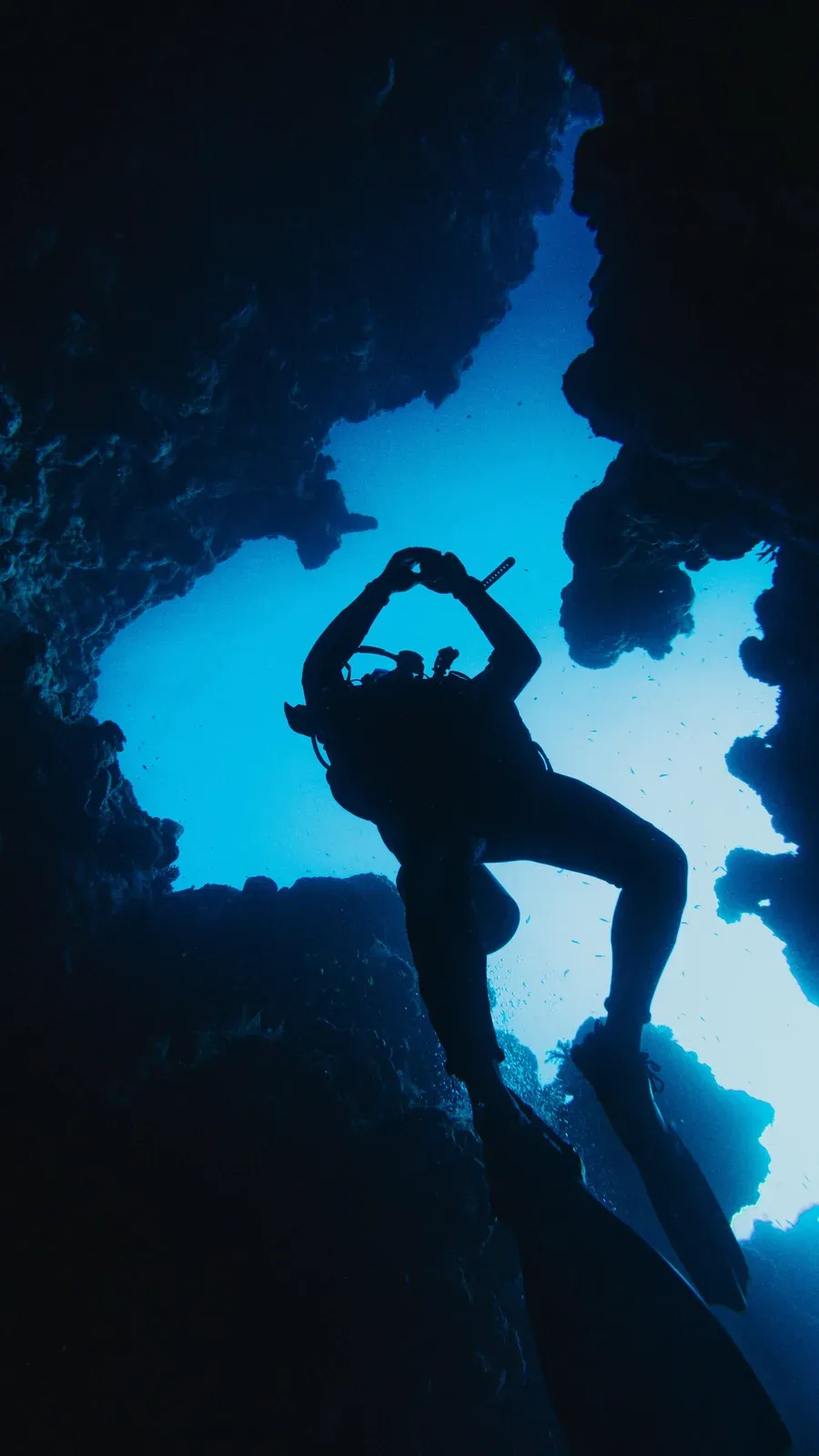
Cavern or cave?
The words matter, because one is a recreational dive and the other is a specialty with a fatality record. A cavern dive stays in the daylight zone: you can always see natural light from the entrance, the exit is a short, direct swim away, and there are no restrictions you cannot pass side by side with your buddy. Guides run cavern dives on a permanent line, inside those limits, for divers with an ordinary certification. A cave dive goes past the daylight, past the line’s end, into passages where the only way out is the way you came and the only light is the one you carry. That needs cave training, cave equipment and a plan for gas that assumes something goes wrong.
Every site in this guide is either dived as a cavern, in the daylight zone with a guide, or is included specifically to say that it is not. The difference between the two is usually a single line laid across the floor, and the whole discipline comes down to not crossing it.
Mexico’s cenotes
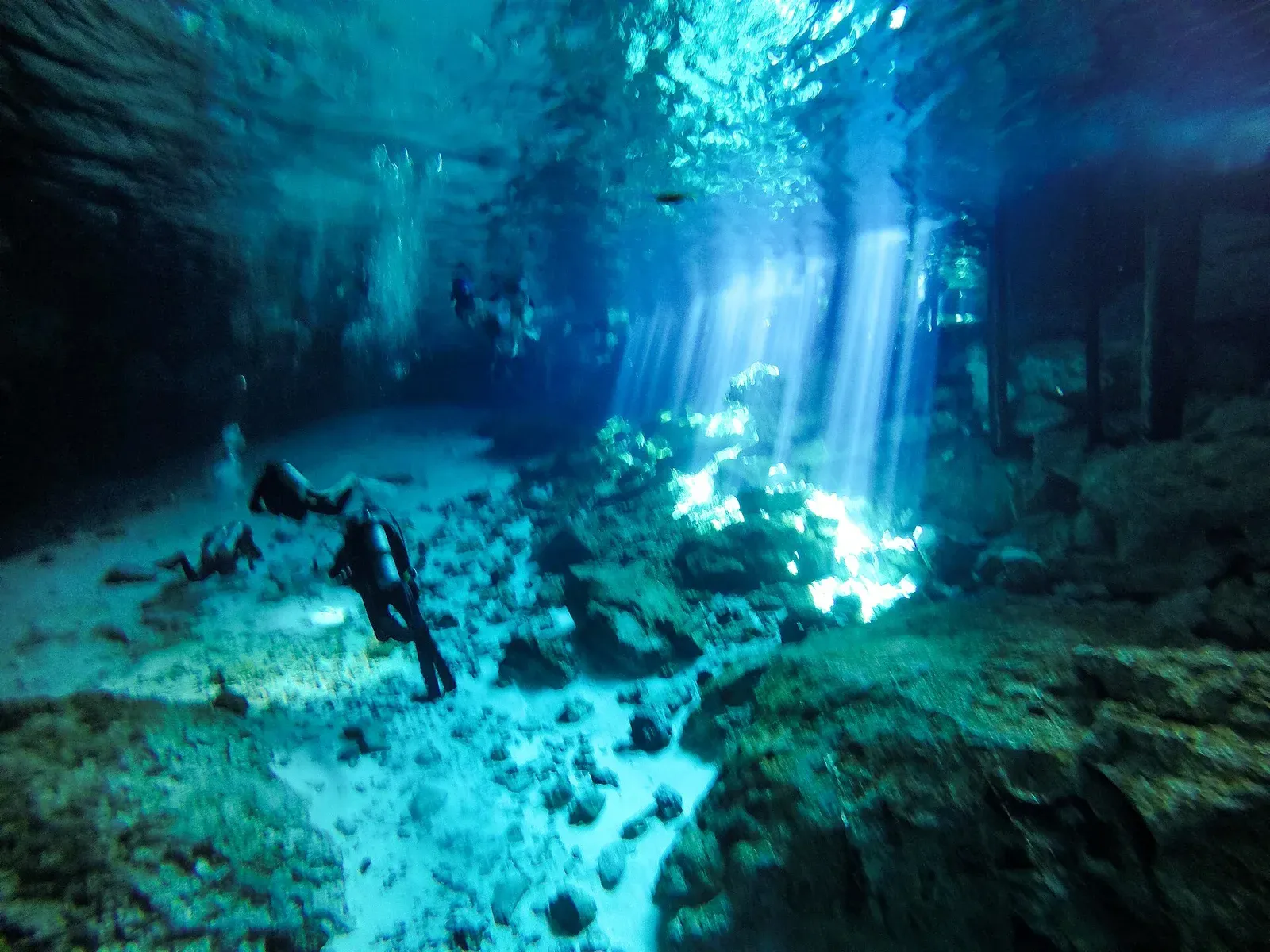
The Yucatán has no rivers. Its rainfall drains through limestone into the largest flooded cave network on earth, which surfaces in hundreds of cenotes between Puerto Morelos and Tulum, and the guided cavern dives at the front of that network are the most famous overhead dives in the world. A cenote day is a road trip: an operator collects you in Playa del Carmen or Tulum, drives out to a gated jungle track, pays the landowner, and carries kit down wooden stairs to a platform at the water. Groups run four divers to a guide, the water is 25 °C in every month, and there is no swell, no current and nothing to swim against.
Dos Ojos is the one to start on: two flooded sinkholes opening onto the shallow end of a system with 82 km of surveyed passage, dived on guided circuits between the two entrance pools at 5 to 7 m, close under a ceiling hung with stalactites that grew in open air before the sea rose. Gran Cenote is where the survey of Sistema Sac Actun began, a cavern at around 10 m shared with snorkellers in the entrance pool. Angelita is different: a single flooded shaft with a layer of hydrogen sulphide hanging across it at about 27 m (90 ft) like the surface of a second river, which you hover above and put a hand through; the shaft continues to 55 m and the turn depth is agreed on the surface, not at the cloud.
| Site | Depth | Level | Best months |
|---|---|---|---|
| Dos Ojos Riviera Maya Cenotes · Mexico | 5–7 m | Intermediate | Nov–Apr |
| Gran Cenote Riviera Maya Cenotes · Mexico | to 10 m | Intermediate | Nov–Apr |
| Angelita Riviera Maya Cenotes · Mexico | to 27 m | Advanced | Nov–Apr |
Florida’s springs and a Brazilian abyss
North Florida’s limestone springs pump out water at a constant 21 to 22 °C with visibility that can exceed 30 m, and there are no boats and no schedule: you drive to the spring, pay at the gate and carry gear down to the water. Devil's Den is a karst window, a chamber about 120 feet across whose roof collapsed to let the daylight in, dived as a circuit of one flooded room under the opening. Blue Grotto is called the largest clear-water cavern in the state’s spring country and goes to 30 m, which is why it is a training site rather than a scenic one. Ginnie Springs shows the line between cavern and cave in iron: the Ginnie Ballroom is a lit chamber closed off by a grate the owner fitted over the most dangerous part of the cave as deaths rose, while the neighbouring Devil’s Spring System is for certified cavern and cave divers only, and only they may carry lights at its entrances.
Brazil has the strangest cavern entry anywhere. Abismo Anhumas is a cave lake 80 m deep under the limestone outside Bonito, reached by a 72 m rope descent through a hole in the ground; certified divers are guided to 18 m over submerged stalagmites that rise as much as 18 m from the floor, and the rappel, not the dive, is the part of the day that decides whether you can do it.
| Site | Depth | Level | Best months |
|---|---|---|---|
| Devil's Den North Florida Springs · United States | to 20 m | Intermediate | Nov–Apr |
| Blue Grotto North Florida Springs · United States | to 30 m | Intermediate | Nov–Apr |
| Ginnie Springs North Florida Springs · United States | to 12 m | Intermediate | Nov–Apr |
| Abismo Anhumas Bonito · Brazil | to 18 m | Intermediate | Apr–Aug |
Mediterranean sea caves
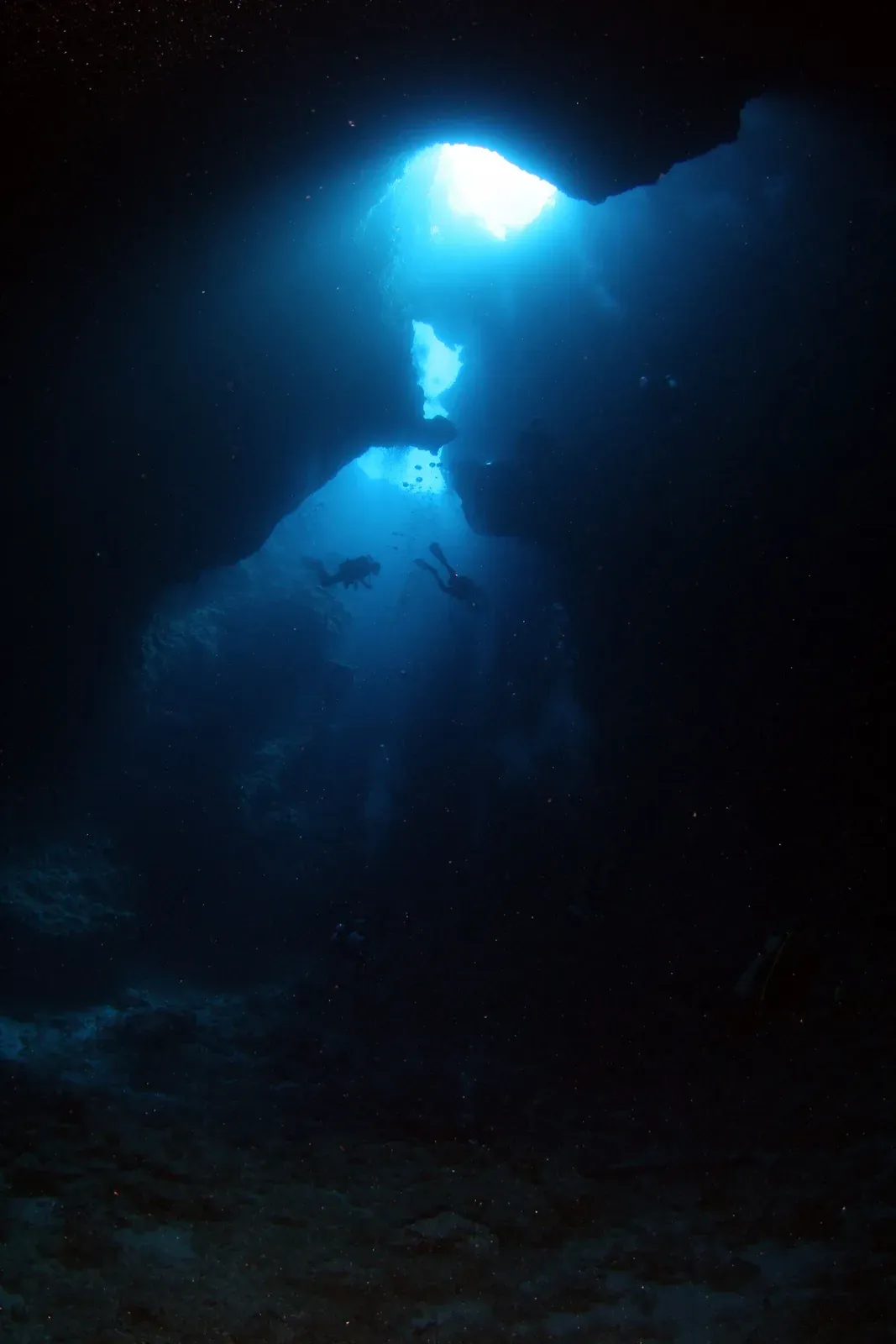
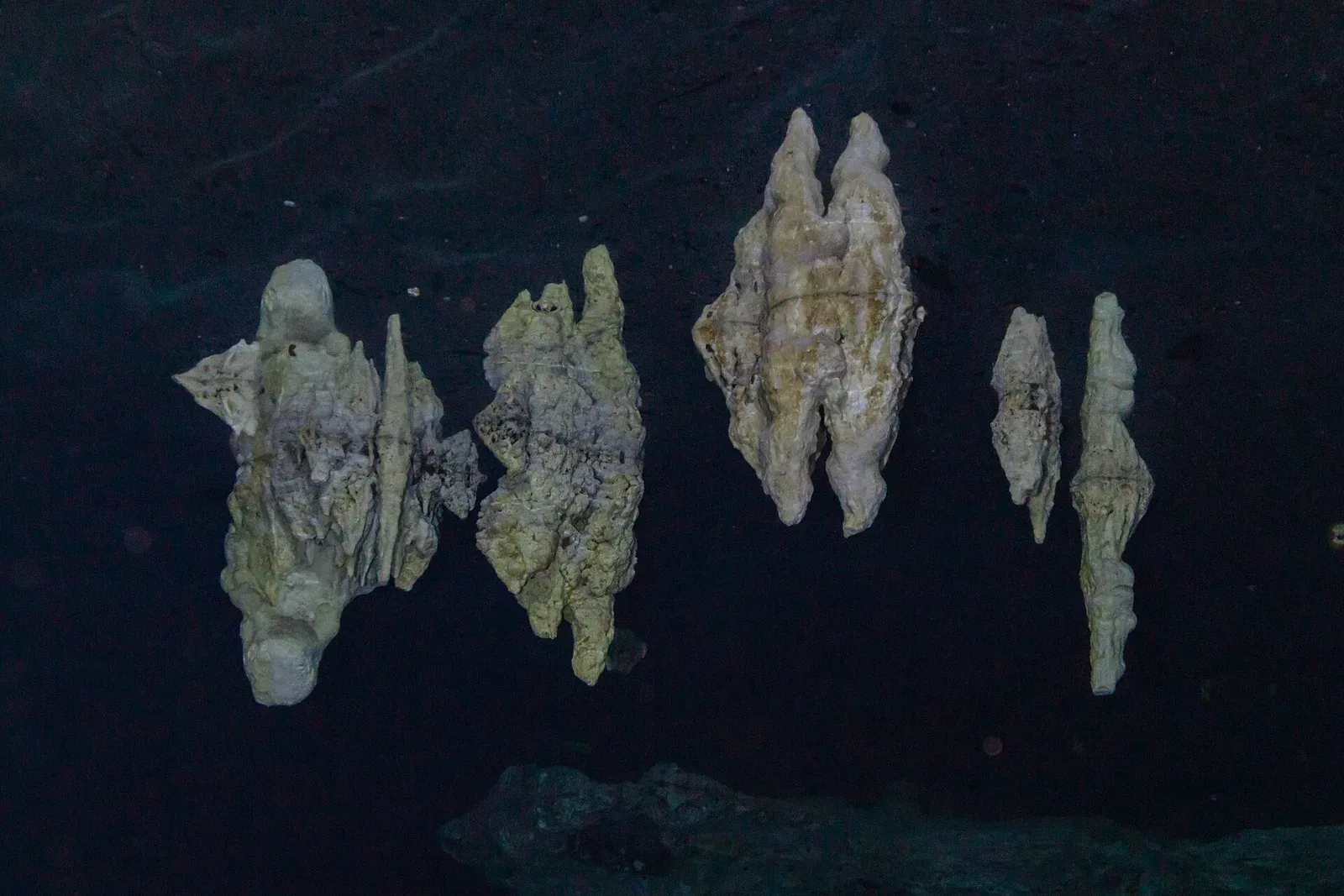
The Mediterranean’s caves are drowned dry caves, and the best of them still carry the dripstone. On Crete, The Cathedral is a chamber in the cliff at Kalathas Bay whose mouth opens at 14 m and throws light beams across intact stalactites and stalagmites, with haloclines shimmering where fresh water works into the salt; Elephant Cave runs 40 m into Cape Drapano to a chamber that still holds air, its roof 13 m above the water and its rock carrying the fossil bones of a dwarf elephant. Gozo’s Blue Hole and Inland Sea are both walked into at Dwejra: a collapsed sea cave with a rectangular archway to the open blue, and a lagoon draining through an 80 m tunnel in the cliff.
Spain’s La Vaca is a tunnel system inside Meda Gran with gorgonians at the mouth and light filling the passages, and Croatia’s Katedrala is entered at 27 m and worked up through linked chambers to 12 m under a roof so riddled with holes that it never quite feels like a cave. Sardinia’s Grotta di Nereo is considered the biggest marine cave in the Mediterranean, with around ten entrances, red coral on the walls and air chambers inside; it is graded advanced, and the exit is often not the entrance you came in by. In the Red Sea, Umm Kharārīm is a reef block in 6 to 10 m riddled with connected tunnels where sunlight streams through cracks in the roof, an open structure rather than a true cave.
| Site | Depth | Level | Best months |
|---|---|---|---|
| Blue Hole & Inland Sea Malta & Gozo · Malta | 10–30 m | Intermediate | Jun–Sep |
| The Cathedral Crete · Greece | 14–21 m | Intermediate | Jun–Oct |
| Elephant Cave Crete · Greece | 3.5–18 m | Intermediate | Jun–Oct |
| La Vaca Medes Islands · Spain | 11–25 m | Intermediate | Jun–Sep |
| Katedrala Premuda · Croatia | 12–30 m | Intermediate | Jun–Sep |
| Grotta di Nereo Capo Caccia & Nereo Cave · Italy | to 35 m | Advanced | Jun–Sep |
| Umm Kharārīm St John's Reefs · Egypt | 6–10 m | Intermediate | Apr–Jun |
Japan and the Pacific
Miyako-jima is a raised limestone island with no rivers to silt its water, drilled through by rain and sea into the most elaborate cavern topography in Japan, and its dives are timed for the hours when the sun is high enough to land the beams. Devil's Palace is entered through a crack in the reef at around 15 m, passes a genuinely dark corridor and opens into a main hall where blue light pours down through holes in the ceiling; Toriike is a pair of collapsed sinkholes joined underground to the sea, swum into through an arch and surfaced inside, the water shifting from ocean blue to pond green on the way. Okinawa’s Blue Cave is a half-flooded tunnel at Cape Maeda with 5 to 8 m of water inside, shared with snorkellers; Zamami Lighthouse has sunlit crevasses and caves in a rock wall from 3 to 22 m and is rated beginner ground.
Across the Pacific the caverns are cut into coral and lava. Yap Caverns is a honeycomb of chasms and chimneys in the outer reef wall lit by skylights, dived at slack tide with usually no current. Saipan’s The Grotto is entered by giant stride into a pool inside a limestone cavern, then swum out through one of three openings into the open Pacific, and the rule that matters is never to plan to surface outside. Bubble Cave leads to a chamber cut off from land where sea kraits lay their eggs on the rocks, and Thundercliff Cave runs back into the limestone to surface in a chamber open to the sky. Fish Rock Cave in New South Wales is a 120 m tunnel under a rock, taken one way from a 24 m entrance up a dark chimney to a blue-water opening where grey nurse sharks hold; it is graded advanced and gas has to cover the whole tunnel. Rikoriko Cave in New Zealand is the largest sea cave by volume in the southern hemisphere, big enough for a tour boat to motor into. And the Philippines’ Gato Island is a 30 m swim-through under an island at 10 m where whitetip, nurse and bamboo sharks rest, and divers wait at the mouth until they leave.
The Caribbean’s caverns are coral. Grand Cayman’s Devil's Grotto is a maze of massive coral heads riddled with open chimneys from 15 m to just below the surface, a shore dive off George Town that fills with silversides in high summer; Trinity Caves is a chain of three coral caves that all open onto the wall at around 30 m and are linked in whatever order the briefing calls for.
| Site | Depth | Level | Best months |
|---|---|---|---|
| Devil's Palace Miyako-jima · Japan | 19–30 m | Intermediate | Nov–Apr |
| Toriike Miyako-jima · Japan | 20–35 m | Advanced | Apr–Jun |
| Blue Cave Okinawa · Japan | 5–15 m | Beginner | Mar–May |
| Zamami Lighthouse Kerama Islands · Japan | 3–22 m | Beginner | Apr–Aug |
| Yap Caverns Yap · Micronesia | 3–30 m | Intermediate | Dec–Mar |
| The Grotto Saipan & Tinian · Northern Mariana Islands | 5–18 m | Advanced | Dec–May |
| Bubble Cave Niue · Niue | 5–24 m | Intermediate | Jul–Sep |
| Thundercliff Cave Christmas Island · Australia | 5–22 m | Intermediate | May–Sep |
| Fish Rock Cave South West Rocks · Australia | to 24 m | Advanced | Jun–Oct |
| Rikoriko Cave Poor Knights Islands · New Zealand | 12–30 m | Intermediate | Jan–Apr |
| Gato Island Malapascua · Philippines | 10–30 m | Intermediate | Apr–May |
| Devil's Grotto Grand Cayman · Cayman Islands | 4–15 m | Beginner | Dec–Apr |
| Trinity Caves Grand Cayman · Cayman Islands | 15–30 m | Advanced | Dec–Apr |
Blue holes, and the ones that are not for you
Two more are odd rather than dangerous. Coron’s Barracuda Lake is a limestone-walled lake with 4 m of warm fresh water over salt, a thermocline and halocline stacked at 14 m that blur everything for a few metres, and water that heats to 38 °C at depth; it is dived for the water, not the life. And Miyako-jima’s Toriike, above, is the rare cave dive that ends in a pond.
| Site | Depth | Level | Best months |
|---|---|---|---|
| Great Blue Hole Belize Barrier Reef · Belize | 5–40 m | Advanced | Mar–Jun |
| Blue Hole Dahab · Egypt | 6–40 m | Advanced | Apr–May |
| Turtle Tomb Sipadan · Malaysia | 18–40 m | Advanced | Mar–Sep |
| Barracuda Lake Coron · Philippines | to 30 m | Advanced | Year-round |
How to dive a cavern
Stay in the light. The rule of the daylight zone is the whole safety case. If you cannot see the glow of the entrance, you are past the cavern and into the cave, and the line on the floor is the limit of the guided dive, not a suggestion.
Buoyancy and finning decide the visibility. Every cavern floor is silt, sand or dust, and one careless kick blinds the divers behind you under a roof. Trim horizontal, frog kick, keep your fins up, and stay off the walls; the formations you have come to see grew over millennia and a dropped fin breaks them in a second.
Carry a light, and a second one. Even in the daylight zone the interesting rock is in the shadows, and if the primary fails the backup is what gets you back to the glow.
Know the exit before you go in. At the Grotto, at Fish Rock and at Nereo the exit is not where you entered; at Devil’s Den and Bubble Cave it is the only opening there is. The briefing that covers the route and the turn pressure is the most important five minutes of the day.