Cavern or cave: where the daylight ends
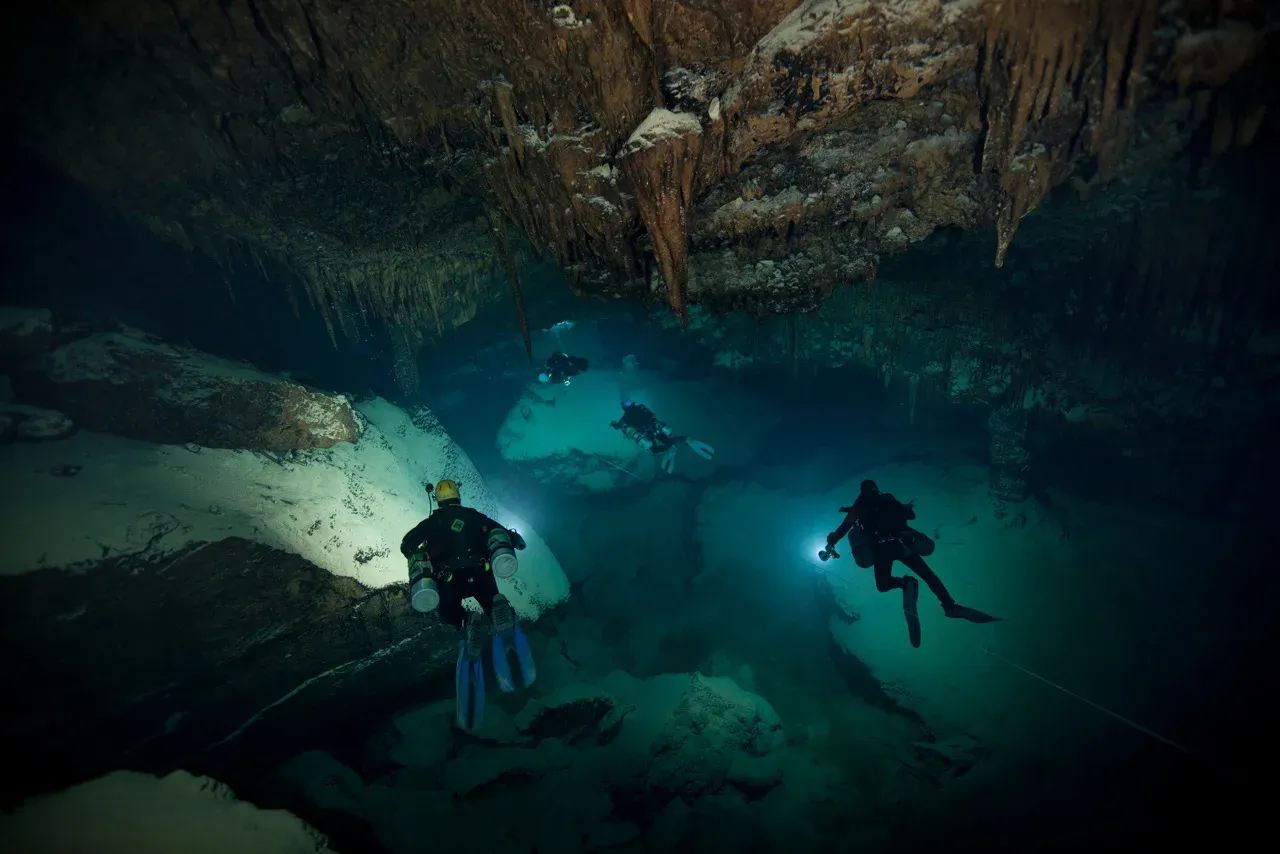
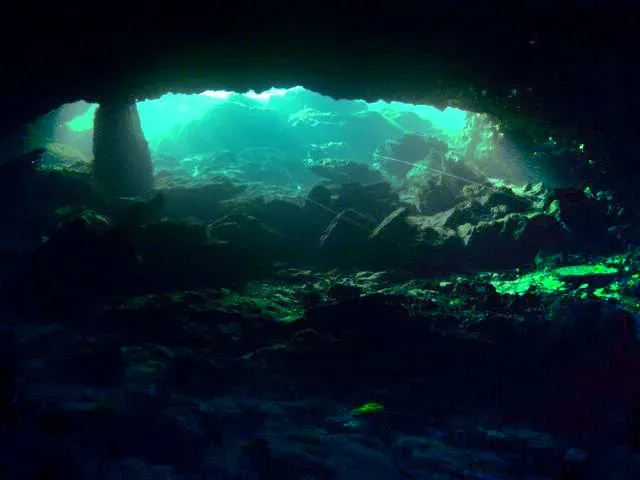
A cavern dive stays where you can see daylight from the entrance. A cave dive goes past that point, into rock where there is no daylight, no free surface overhead and one way out: back along the route you came in by. Everything in this guide follows from that second condition. In open water, a diver with a problem can go up. In a cave, the problem has to be solved where it happens, and then the diver still has to swim the whole way out.
The line between the two is drawn differently by different agencies. Technical Diving International limits its cavern divers to 61 linear metres (200 ft) from the surface and 40 m (130 ft) of depth, with no restriction too small for two divers to swim through side by side. The Cave Divers Association of Australia defines a cavern as fresh water no deeper than 20 m where daylight is always visible. Neither number is a law of nature. What they share is the idea that a cavern diver who loses everything can still see the way out.
Our guide to cavern and cenote diving covers the daylight zone: Dos Ojos, Gran Cenote, Devil’s Den and the sea caves you can dive with an ordinary card and a guide. This one is about what lies past the light, who goes there and what it takes.
Why cave divers die: the accident analysis
In 1979 the Cave Diving Section of the National Speleological Society published a short book by Sheck Exley, a cave diver who taught mathematics at a high school in Live Oak, Florida. Basic Cave Diving: A Blueprint for Survival has ten chapters, and each one is built on an accident report. In the foreword Exley explains that the idea came from state highway patrol accident photographs, and from how well they brought home the consequences of unsafe driving. Taking accident reports apart to find what they have in common is now called accident analysis, and introductory cave courses still teach it.
The rules the cave community drew from that work settled at five by 1984. The first three were the agencies’ consensus on what was killing divers. The last two were added later.
- The thirds rule. Turn the dive when a third of the starting gas is gone.
- The line rule. Keep a continuous guideline from the team to open water.
- The gas rule. Stay at or shallower than a safe depth for the gas you are breathing.
- Training. Nobody enters a cave without cave training.
- Lights. Carry three light sources, each able to burn for the whole dive.
The best test of whether the rules still matter is a 2016 review by Divers Alert Network researchers, published in Diving and Hyperbaric Medicine. It covered every cave-diving death DAN recorded in the United States between July 1985 and June 2015: 161 divers. Of those, 67 were trained cave divers, 89 were untrained and five could not be classified. The yearly toll fell over the three decades from about eight to fewer than three. In the first fifteen years untrained divers were 69 per cent of the dead. In the second fifteen they were 38 per cent, and trained cave divers were the majority. The authors suggest, cautiously, that wider training and restricted access to caves explain the fall. They also note that nobody knows how many cave dives were made, so there is no rate to compare.
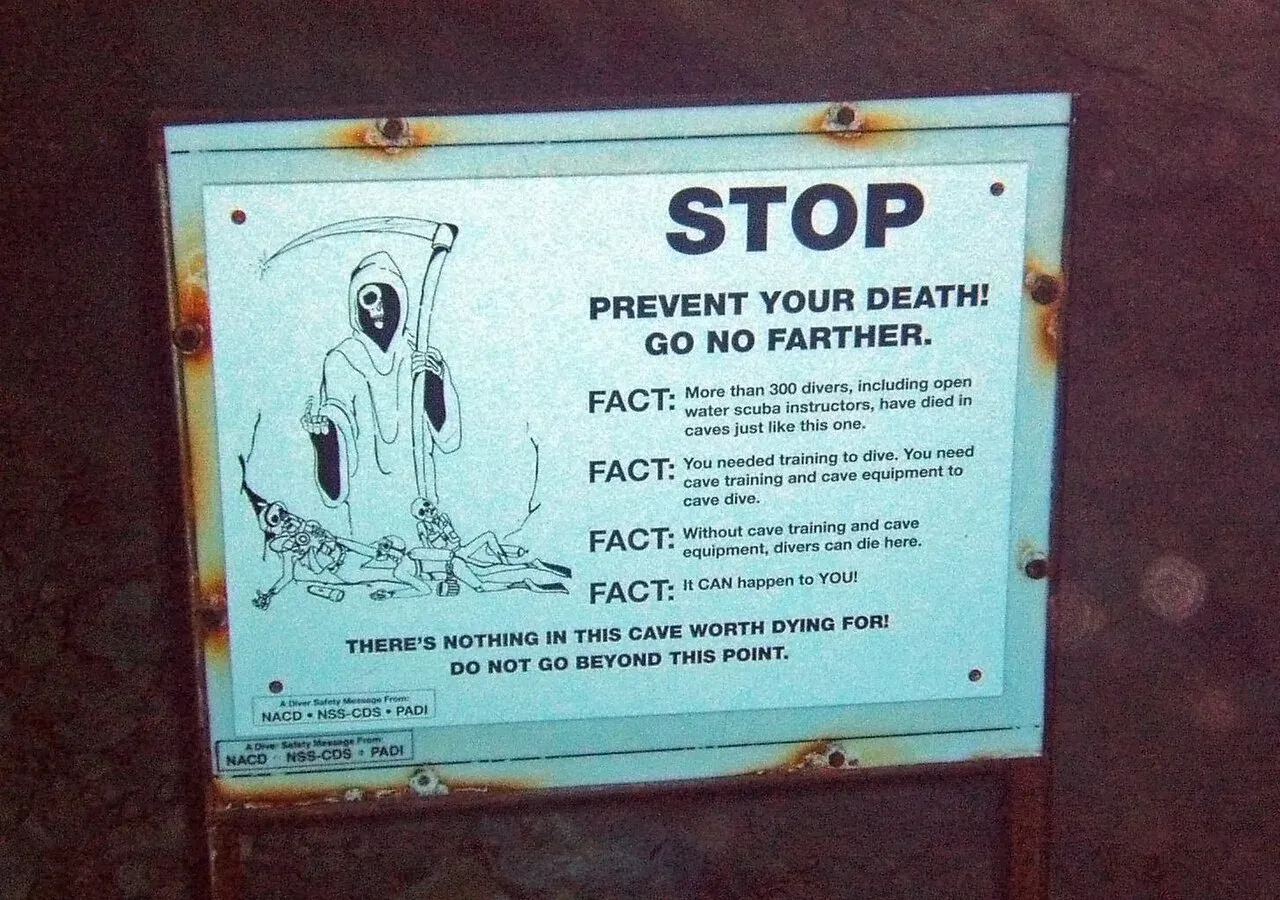
The reviewers then took the 67 trained divers and asked which rules each had broken and whether that break mattered to the outcome. The thirds rule was relevant in 11 deaths, the line rule in 7 and the gas rule in 4. Four divers had breathed an oxygen-rich decompression gas at depth. The lights rule was relevant in none. The most common chain of events was drowning after running out of gas. Of the 41 drownings, 28 followed running out of gas, and the most common step before that was getting lost, often when silt stirred up from the floor took the visibility away. Two divers did not trust the arrows on the line pointing to the exit and swam further in. Their buddies followed the arrows and got out.
That is the honest answer to “is cave diving safe”. No reliable worldwide count of cave-diving deaths exists, so there is no rate to quote. What the records do show is that trained divers die most often by getting lost off the line or running out of gas. The authors’ conclusion is plain: the line rule and the thirds rule “are as relevant as ever”. Of the 67 trained divers who died, 61 died in Florida, where many of the flooded caves are.
The rule of thirds, computed
The thirds rule is simple. Use a third of the gas going in, a third coming out, and keep a third for the team. Take twin 12-litre cylinders as the example: a fill of 232 bar turns at 155 bar and a fill of 200 bar at 133. How far in that third takes you depends on depth, because every breath at depth takes more gas from the cylinder (see how long a tank lasts for the arithmetic). For a diver whose surface breathing rate is 18 litres a minute:
| Depth | One third of a twin 12 at 232 bar | Minutes of swimming in |
|---|---|---|
| 10 m (33 ft) | 1,856 litres | 51 |
| 20 m (66 ft) | 1,856 litres | 34 |
| 30 m (98 ft) | 1,856 litres | 26 |
The same cylinders buy half as much cave at 30 m as at 10 m. Depth does not change the rule, but it shrinks the distance you can cover under it.
The reserve third is less comfortable than it sounds. The rule exists for one case: a buddy loses all their gas at the turn, the furthest point from the exit. The donor has two thirds left, and those two thirds now have to feed two divers for the whole swim out, which takes as long as the swim in did. If both breathe at the rate the donor swam in on, the gas runs out at the entrance. There is no margin at all. The rule is designed to come out exactly even.

Embed this diagram
<figure>
  <img src="https://reefwander.com/og/diagrams/thirds-exit.svg" alt="The rule of thirds, run to its worst moment: a buddy loses all their gas at the turn. The donor’s two thirds reach the entrance only if neither diver breathes harder than on the way in." loading="lazy">
  <figcaption>Diagram by Reefwander, licensed under CC BY 4.0.</figcaption>
</figure>
As soon as either diver breathes harder, the reserve falls short. Suppose the diver who lost their gas breathes 30 litres a minute, the stressed rate our minimum-gas model assumes, while the donor stays calm. The pair get three quarters of the way out; at 20 m that leaves 8.6 minutes still to swim. If both breathe 30, they get 60 per cent of the way, 13.7 minutes short. Depth and cylinder size cancel out of that fraction, so it is the same at 10 m as at 40.
Two things change the picture in a real cave, one for the better and one for the worse. North Florida’s caves are springs, and the water flows out of them, so the swim out runs with the current. Where the flow runs the other way, into a siphon, the swim out takes longer than the swim in, the thirds rule does not hold and cave divers carry a larger reserve. Teams with unequal cylinders base the turn on the smaller set. TDI’s cavern and introductory cave divers in doubles turn at a sixth. The DAN reviewers suggested that divers diving solo or in pairs ask whether thirds is conservative enough for their dive. Their reason was that the rule “may not adequately account for unintended delays” such as silt, entanglement or getting stuck in a restriction. Among the trained divers whose deaths did not turn on the thirds rule, 19 still ran out of gas after something else went wrong.
How the training ladder runs
Cave training is taught in stages, and each stage is meant to be followed by real diving before the next. Accident analysis showed that classroom training without experience is not enough when something goes wrong underwater.
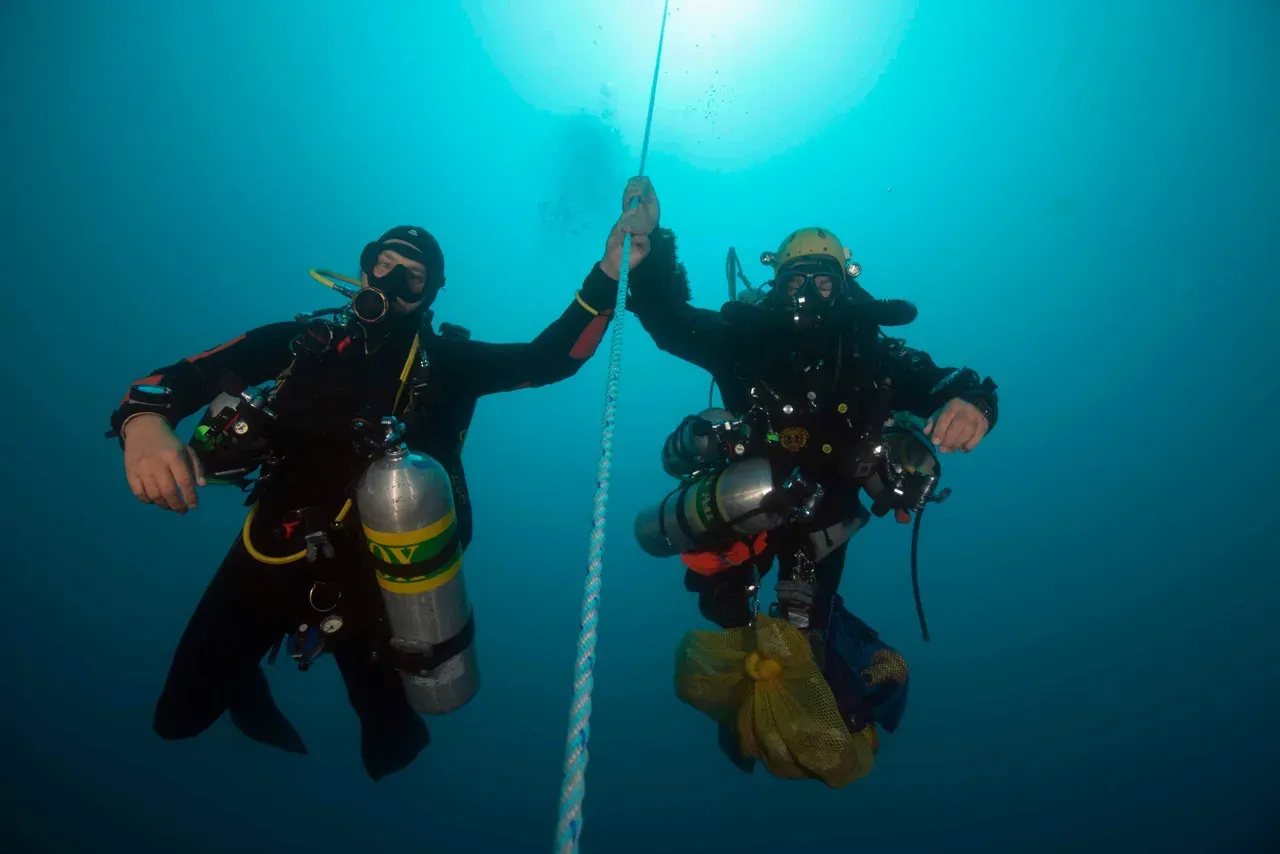
TDI’s ladder has three steps. Cavern Diver needs an open-water card and a minimum age of 18, or 15 with parental consent. It covers guideline work, sharing gas along the line with eyes closed and using a backup light after a primary failure, all inside the limits of light penetration. Intro to Cave is cave diving on a single primary guideline, with penetration held to the thirds rule and 40 m. Full Cave adds jumps and gaps between lines, circuits and traverses, lost-line and lost-diver drills, and diving in different kinds of flow, still within thirds and 40 m. Decompression in training needs a separate decompression card.
In South Australia, where cave access is controlled by the CDAA, the ladder has different names. Basic Cave covers caverns, fresh water no deeper than 20 m with daylight always visible, and sinkholes, which go deeper than 20 m but have no restriction too small for two divers side by side. To enrol you need an Advanced Open Water card and at least 50 logged dives after Open Water, totalling at least 25 hours, including two night dives and five dives deeper than 20 m. Cave takes you into passages with silt, darkness and places too narrow for two divers to turn together. Advanced Cave covers staged diving in complex interlinked systems.
TDI’s cave cards stop at 40 m. Deeper cave passages are dived on helium mixes, planned as air, nitrox and trimix explains, and a scooter needs its own training and its own gas plan (see diving with a DPV). Peacock Springs, below, bans them outright.
Where cave divers go
Florida’s springs
North Florida’s limestone holds the caves Exley dived and mapped. Peacock Springs is a state park built around several entrances into one of the longest mapped underwater systems anywhere: 7,408 m of passage by June 2008, with another 3,000 m added by a connection in 2010. Exley led the National Speleological Society team that completed its first map in 1995, after more than 521 dives. Orange Grove, the basin, is open to certified divers. Everything past the daylight needs full cave certification, and diver propulsion vehicles have been banned in the system since 25 April 2002.
At Ginnie Springs, the owner fitted an iron grate over the most dangerous part of the Ballroom cave as deaths rose. In the Devil’s Spring System next to it, only certified cavern or cave divers may carry lights. The no-lights rule stops untrained divers going further than daylight lets them see. Manatee Springs has four cavern openings over several miles of passage. Keep away from the siphon side of Catfish Hotel, where the flow is immense, and never plan to use Sue Sink as a way in or out: it is an emergency exit only. Ginnie and Manatee hold 22 and 23 °C (72 and 73 °F) all year.
| Site | Depth | Level | Best months |
|---|---|---|---|
| Peacock Springs North Florida Springs · United States | 6–20 m | Advanced | Nov–Apr |
| Ginnie Springs North Florida Springs · United States | to 12 m | Intermediate | Nov–Apr |
| Manatee Springs North Florida Springs · United States | to 27.4 m | Advanced | Nov–Apr |
Mexico’s Riviera Maya
The Yucatán’s cenotes are the doors into flooded cave systems measured in tens of kilometres. The famous cavern tours are in our cenotes guide. The cenotes below are where the cave begins. Cenote Nohoch Nah Chich, 16.5 km south of Akumal, is the entrance to a cave surveyed to 67 km across 36 cenotes by early 2007. In that year it was connected into Sistema Sac Actun, which made the combined system the longest surveyed underwater cave in the world. Its deepest point, the Blue Abyss, is 71.6 m down.
Cenote Chan Hol runs for more than 5,000 m. Between 2006 and 2016, divers found three prehistoric human skeletons in its passages, one at around 8.5 m, so nothing on its floor gets touched. Cenote Taak Bi Ha is a shallow, densely decorated cavern at 7 m. Beyond it, the cave route to Tikim Chi runs about 2 km and reaches 16.2 m.
| Site | Depth | Level | Best months |
|---|---|---|---|
| Cenote Nohoch Nah Chich Riviera Maya Cenotes · Mexico | to 71.6 m | Advanced | Nov–Apr |
| Cenote Chan Hol Riviera Maya Cenotes · Mexico | to 8.5 m | Advanced | Nov–Apr |
| Cenote Taak Bi Ha Riviera Maya Cenotes · Mexico | to 7 m | Advanced | Nov–Apr |
Mount Gambier
South Australia’s Limestone Coast is dived under a rating system, not by agency card alone. The CDAA was formed in September 1973 after a run of deaths in the region’s caves and sinkholes, four of them at The Shaft that May. The testing and site-rating scheme it introduced from the mid-1970s is credited with cutting the deaths sharply. Each site carries a grade, and you need the matching rating to dive it.
Gouldens Sinkhole is the district’s training sinkhole, rated Basic Cave and about 20 m deep. Engelbrecht Cave runs under the streets of the town. Its eastern passage, about 70 m to an air chamber, needs the Cave grade. The western passage, roughly 300 m long and running under Jubilee Highway West, needs Advanced Cave. Piccaninnie Ponds is permit-only, and every permit caps the dive at 36.5 m, whatever card you hold, although the Chasm goes on past 100 m. The Shaft is a hole about a metre wide in a paddock. It opens into a chamber some 140 m long, with tunnels running to 124 m. A dive within the Basic Cave rating stays at the rock pile, about 36 m down, and the only way out for anyone is back up through that one small hole.
| Site | Depth | Level | Best months |
|---|---|---|---|
| Gouldens Sinkhole Mount Gambier · Australia | to 20 m | Advanced | May–Aug |
| Engelbrecht Cave Mount Gambier · Australia | to 12 m | Advanced | May–Aug |
| Piccaninnie Ponds Mount Gambier · Australia | 10–36.5 m | Intermediate | May–Aug |
| The Shaft Mount Gambier · Australia | 36–124 m | Advanced | May–Aug |
The Bahamas’ blue holes
Abaco’s inland caves are dived on strict terms: full-cave certification, a guide, and one or two divers per trip, through a single operator. Dan's Cave is entered through a sinkhole in the pine forest down to the Cascade Room at about 24 m. Together with its neighbour, Ralph's Cave, it counts more than 18 km of surveyed passage, most of Dan’s passable only in sidemount, with rooms hung with soda straws, helictites and columns up to nine metres tall. A halocline at 15 to 17 m clouds the water behind the lead diver, and most dives involve staged decompression. Ralph’s formations are dated at 13,000 to 350,000 years old, and its deeper passage roller-coasters between about 37 and 47 m. For how these holes formed, see our guide to blue holes.
| Site | Depth | Level | Best months |
|---|---|---|---|
| Dan's Cave South Abaco Blue Holes · Bahamas | 23–46 m | Advanced | Jan–Apr |
| Ralph's Cave South Abaco Blue Holes · Bahamas | 23–47 m | Advanced | Jan–Apr |
Chinhoyi
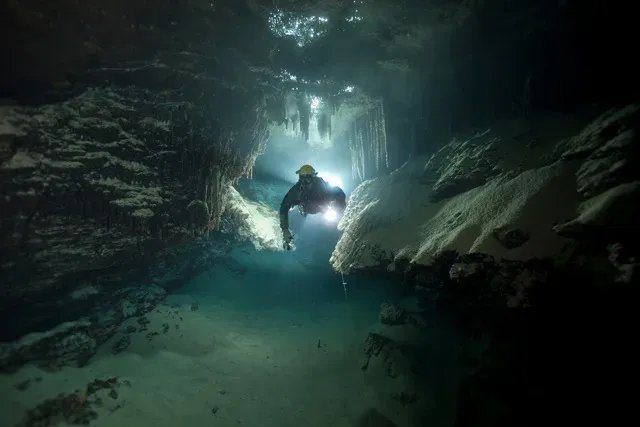
Zimbabwe’s Sleeping Pool is a cobalt lake at the bottom of a collapsed sinkhole. You reach it by walking down about 45 m of cut steps. A scree slope takes any certified diver on a club trip to about 20 m. Below that, a near-vertical shaft has been dived past 100 m and still has no agreed bottom, and that part is cave and technical diving only. Bat Cave is a smaller pool whose floor connects underwater to the main shaft. The Sleeping Pool holds 22 to 24 °C, but it sits at around 1,150 to 1,200 m above sea level, so plan with altitude tables or a computer set for diving at altitude.
| Site | Depth | Level | Best months |
|---|---|---|---|
| Sleeping Pool Chinhoyi Caves · Zimbabwe | to 20 m | Advanced | Aug–Nov |
| Bat Cave Chinhoyi Caves · Zimbabwe | to 13 m | Advanced | Aug–Nov |
Sea caves that still need a guideline
A cave that opens to the ocean is not a cavern just because the sea is on the other side. What makes a dive a cave dive is being out of sight of daylight with no way straight up, and several famous sea caves are exactly that. The rules are the same five.
At Custom Caves in the Solomon Islands, you walk through mangroves to a freshwater pool about two metres across. You drop through murky fresh water into the salt water below and follow a guideline through near-total darkness. The cave comes out at 35 m on a soft-coral wall, so the deepest point of the dive comes at the end of the overhead section.
Sipadan’s Turtle Tomb is a maze of tunnels inside the island’s limestone column. Its entrance is at about 18 m, and passages run up to 200 m from it. The floor is covered in thick dust that one careless fin stroke turns to zero visibility, and only divers with cave certification and a specialist guide go past the mouth.
Mactan’s Marigondon Cave has its roof at around 29 m and its floor at about 40. The chamber is full of flashlightfish, and sidemount or a twinset is treated as a requirement.
Nusa Penida’s Bat Cave opens at 8 m and runs about 200 m to an air space where bats roost. It has one way out, and visibility at the mouth can drop to around 5 m.
On Spain’s Costa Blanca, Moraig's Cave shows the boundary inside a single site. The lit entrance caverns at 15 m suit almost anyone. One of the two systems continues into a cave 2 km long, which is for trained cave divers only.
| Site | Depth | Level | Best months |
|---|---|---|---|
| Custom Caves Solomon Islands · Solomon Islands | to 35 m | Advanced | Jun–Sep |
| Turtle Tomb Sipadan · Malaysia | 18–40 m | Advanced | Mar–Sep |
| Marigondon Cave Mactan & Olango · Philippines | 29–40 m | Advanced | Mar–May |
| Bat Cave Nusa Penida · Indonesia | to 8 m | Advanced | Jul–Oct |
| Moraig's Cave Costa Blanca · Spain | to 15 m | Beginner | Jun–Sep |