What a scooter actually changes
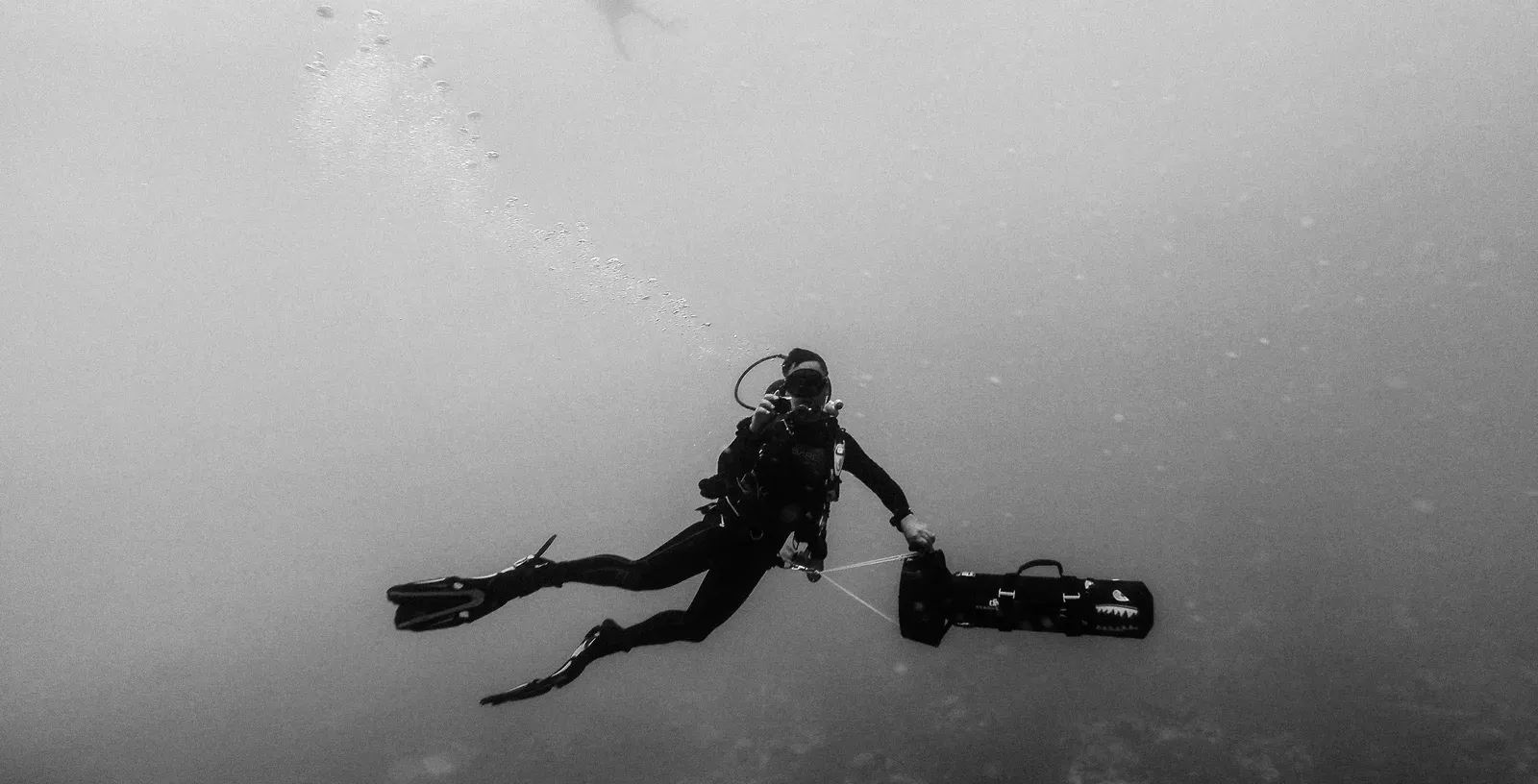
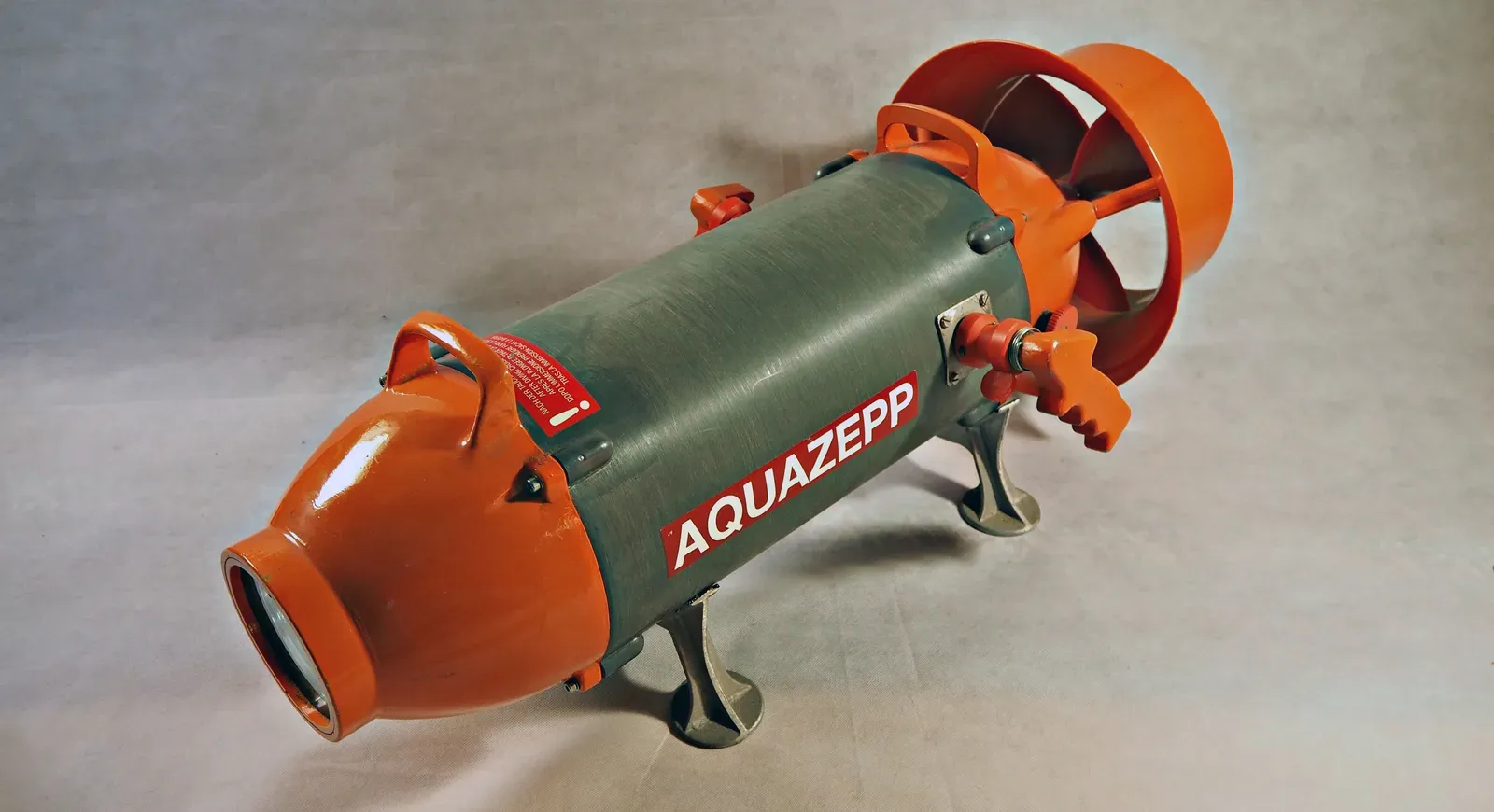
A diver propulsion vehicle is a battery, a motor and a propeller in a sealed tube with a trigger on it, and what it changes is not the thing most people expect. It is not speed for its own sake. A recreational scooter cruises at around 45 metres a minute and tops out near 70 — Suex quote exactly those two figures for the VR Voyager, and Dive Xtras quote 150 feet a minute of cruise for the BlackTip — against maybe 15 metres a minute for a diver finning at a pace they can hold for an hour. Three times a swimming pace sounds like the point. It isn’t. What matters is what three times a swimming pace does to the rest of the dive.
It changes how much of a site you see. Big dive sites are dived in slices. A 172-metre ferry gets done as “the stern this morning, the bridge tomorrow”; a two-kilometre reef gets done as whichever 200 metres the boat happened to moor over. A scooter joins the slices up. That is the whole argument, and on the right site it is a very good one.
It changes your gas. Finning is work, work is gas, and a diver being pulled along is doing almost none of it. The same fill lasts longer at the same depth, which is why the extra range does not simply cancel itself out.
It changes what a current means. A moderate current that turns a site into a one-way drift becomes a route you can work back along, because most reef currents run slower than a scooter cruises.
And it changes the ratio of transit to diving. Every long shore dive has a dull section — the sand between the entry and the reef, the swim out to the drop-off, the crawl back along the shallows with a headwind of current. A scooter compresses that to nothing and gives the time back to the part you came for.
What you pay is attention. A scuba diver is already managing depth, buoyancy, gas, a buddy and a route; a scooter adds a machine that will happily fly you somewhere none of those five agree with. It also adds a way to hurt a dive site — prop wash silts a wreck deck or a cave floor from several metres away.
And it makes plenty of dives worse. On a coral garden where the whole point is hovering half a metre off the reef looking at things the size of a fingernail, a scooter is a liability with a handle on it. The question to ask is never “would a scooter be fun here”, because it always would be. The question is whether the site is bigger than a dive.
The dives where a scooter earns its place
Three shapes of site pass that test, and they have almost nothing else in common.
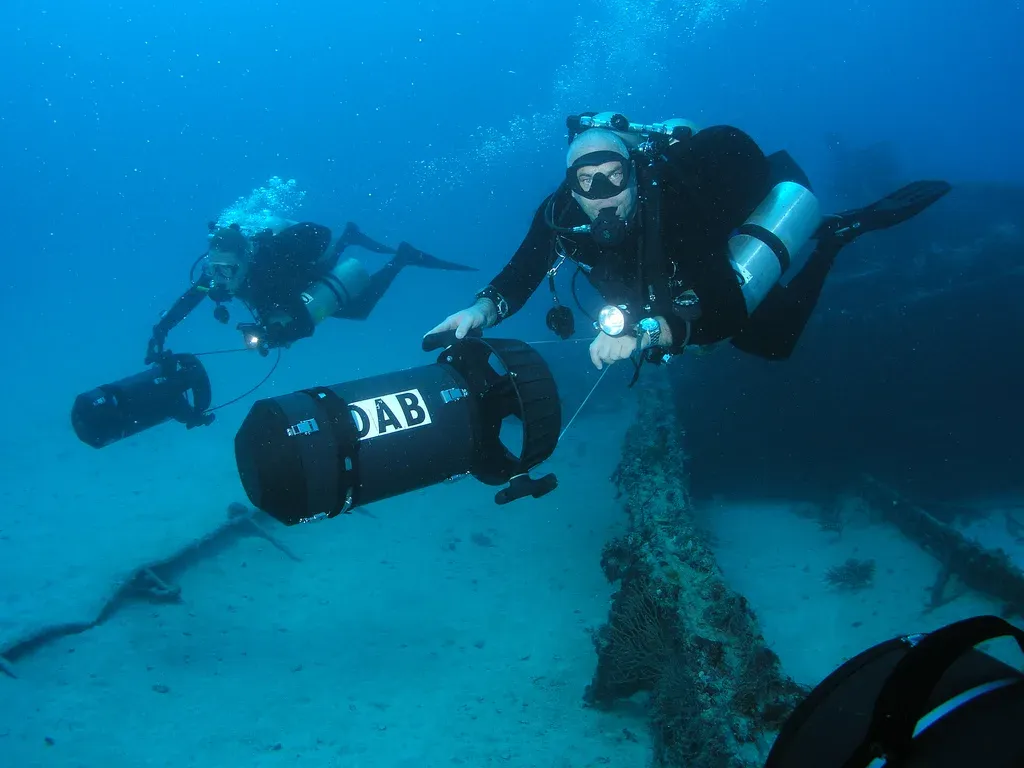
Ships longer than a dive. The Zenobia is the clearest case in recreational diving: 172 metres of roll-on/roll-off ferry on her port side off Larnaca, the top at 18 metres (60 feet) and the sand at 42, dived in graded stages precisely because no single dive covers her. The President Coolidge is 199 metres of liner running downhill from a bow at 21 metres to a stern at 73, so the wreck is normally split into three or four dives with separate moorings. Heian Maru, the largest wreck in Chuuk Lagoon at 163 metres, and the carrier USS Saratoga at 270, are both far longer than a no-stop dive. In colder water, SMS Markgraf is 175 metres of upturned dreadnought with 25 metres of water over the hull and 45 under it. Off Florida, Spiegel Grove and the Vandenberg are 160 and 159 metres respectively, both sunk deliberately and both routinely dived as fragments. Malta’s Um El Faroud and the deeper Hephaestus off Gozo are shore dives onto big steel, where the scooter buys back the surface swim as much as the lap. And Bonegi I — 155 metres of Japanese transport that you reach by walking off a beach near Honiara, bow in the shallows and stern at 55 — is a site where your maximum depth is decided by how far along the hull you get.
Coasts where the good part is a swim away. Bonaire is dived by parking a truck and walking in, and the reef at Karpata and 1000 Steps runs for kilometres in both directions from each entry; a scooter turns two named sites into one continuous piece of coast. Tulamben’s Drop-Off, Playa Chica in Puerto del Carmen — where more than ten separate sites are reached from a single cove — and the run north from The Canyon to the Blue Hole at Dahab are the same idea in different water. Two-Mile Reef at Sodwana is two kilometres long and about one wide, a run of ledges, gullies and pinnacles rather than a single feature, and most divers only ever see the bit nearest the mooring.
Overhead, where all of this was invented. Cave divers built the technique, the rules and most of the hardware, because a long system is unreachable any other way. Peacock Springs had 7,408 metres of mapped passage in 2008 and gained another 3,000 when a connection was made in 2010; the main line at Ginnie Springs runs some 3,200 feet before it narrows. Recreational divers should read this section as history rather than a shopping list — cave scootering sits behind a cave certification and a separate DPV course — but every rule in the next section came out of these tunnels.
| Site | Depth | Level | Best months |
|---|---|---|---|
| Zenobia Wreck Larnaca · Cyprus | 16–42 m | Intermediate | Jun–Oct |
| The Bow Espiritu Santo · Vanuatu | to 21 m | Intermediate | Apr–Nov |
| Heian Maru Chuuk Lagoon · Micronesia | 12–33 m | Intermediate | Nov–May |
| USS Saratoga Bikini Atoll · Marshall Islands | 27–38 m | Advanced | Apr–Nov |
| SMS Markgraf Scapa Flow · United Kingdom | 25–45 m | Advanced | Jun–Aug |
| USS Spiegel Grove Florida Keys · United States | 21–40 m | Advanced | Apr–Aug |
| USNS Vandenberg Key West · United States | 12–45 m | Advanced | Apr–May |
| Um El Faroud Malta & Gozo · Malta | 28–35 m | Advanced | Jun–Sep |
| MT Hephaestus Malta & Gozo · Malta | to 46 m | Advanced | Jun–Sep |
| Bonegi I Iron Bottom Sound · Solomon Islands | to 55 m | Intermediate | Apr–Jun |
| Karpata Bonaire · Caribbean Netherlands | to 45 m | Advanced | Dec–Apr |
| 1000 Steps Bonaire · Caribbean Netherlands | to 40 m | Advanced | Dec–Apr |
| Drop-Off (Tulamben) Tulamben · Indonesia | to 30 m | Advanced | May–Oct |
| Playa Chica Lanzarote & Museo Atlántico · Spain | 15–21 m | Intermediate | Jun–Oct |
| The Canyon Dahab · Egypt | 18–30 m | Advanced | Apr–May |
| Blue Hole Dahab · Egypt | 6–40 m | Advanced | Apr–May |
| Two-Mile Reef Sodwana Bay · South Africa | 9–18 m | Intermediate | Nov–Feb |
| Peacock Springs North Florida Springs · United States | 6–20 m | Advanced | Nov–Apr |
Range, gas and the walk home
Manufacturers publish two numbers and you need both. Suex rate the VR Voyager at 355.6 Wh — four modular batteries of about 89 Wh each — for 130 minutes at a 45 m/min cruise, or 60 minutes flat out at 70. The larger VR Quantum carries 585.7 Wh for 220 minutes and around 10 kilometres. Dive Xtras publish the same shape of figures for the BlackTip Travel: 50 minutes and 2.2 kilometres on a 5 Ah tool battery, 123 minutes and 5.6 kilometres on a 12 Ah one. Those are new-battery numbers at a steady cruise, in a pool of assumptions that includes your drag, your trim and the water temperature.
So treat them as a ceiling, not a plan. Cave divers burn-test their packs on a bench each year and expect capacity to fall — a pack sold as 1,000 Wh may test at 860 after two seasons — and then plan against no more than about 70 per cent of what it actually measured. Half of that goes out and half comes back. A machine advertised at 130 minutes becomes 90 minutes of tested runtime and a 45-minute turn.
The rule underneath all of it is simple to say. A scooter is allowed to take you as far out as you can get back from without it. In open water that usually means: could you fin or drift back to the boat, the line or the beach on the gas you have left, from the furthest point of the dive, at the depth you would have to do it? On the Zenobia that is a fair swim in mild current and the answer is normally yes. On a coast with a running current and a single exit, the answer changes with the tide.
In an overhead the same rule has teeth. The classic cave version is thirds against the swim: never go deeper into a system than you can swim out of, and turn while you still hold twice the gas that swim would need. Long-range cave divers now argue that this breaks down at real distances — a 3,000-metre penetration at 20 metres a minute of hard finning is two and a half hours of maximum effort and hundreds of cubic feet of gas, which is not a rescue plan, it is a story about one — and carry a spare scooter instead beyond roughly 120 feet of depth or 3,000 feet of penetration. Both camps agree on the part that matters to everyone else: swimming out is not a plan you get to invent underwater.
Whatever the environment, you now have two clocks. Turn the dive on gas or on burn time, whichever runs out first, and check both at the same points you would normally check one.
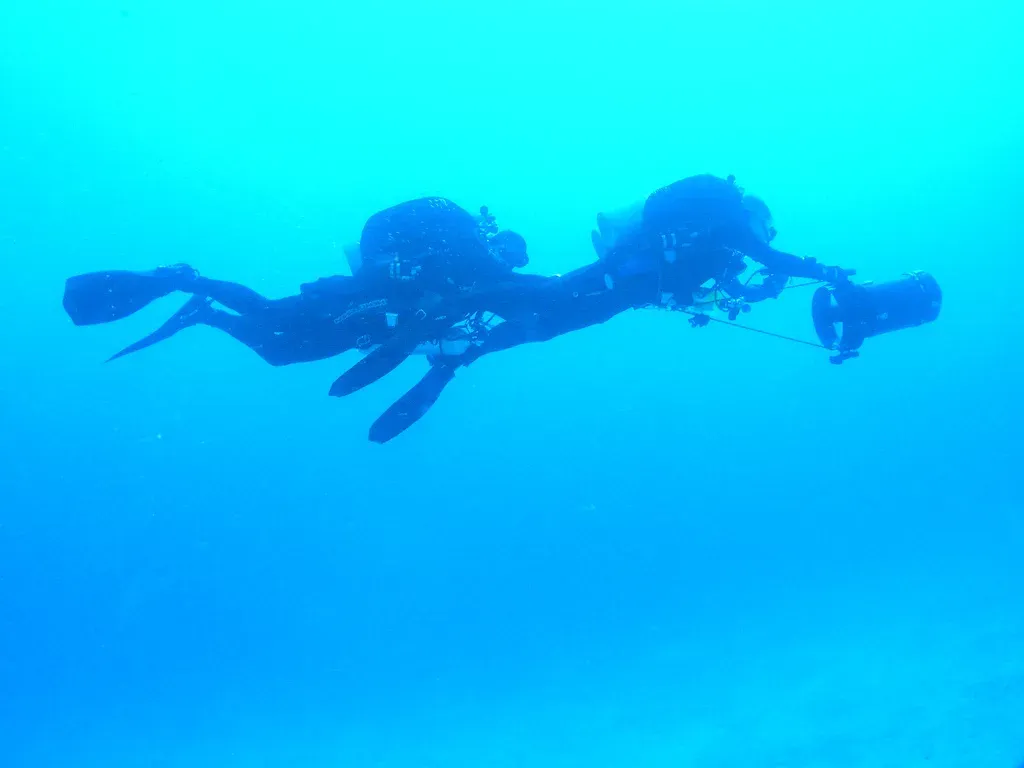
The failure you should have rehearsed is the ordinary one: a trigger that stops working halfway through. Two divers on one scooter is a real technique — the passenger holds the driver’s ankle or a tow strap and stays out of the wash — and it is much slower and much clumsier than it looks. Practise it on a shallow dive with nothing riding on it.
The last hazard is the least discussed. A scooter makes it effortless to be deep, and to stay deep, for the whole dive. Nothing about the machine tells you that; the exertion cue you would normally get from finning is gone, so your computer is the only thing left keeping score. On a wreck like the USS Spiegel Grove or MT Hephaestus, where the deck is a long way above the sand, that matters more than the battery does.
Trim, technique, and what goes wrong
Ride it through your hips. The tow cord clips to a crotch D-ring so the pull goes through your harness rather than your arms; your hands steer and your body is the rudder. Divers who hold a scooter out at arm’s length and hang off it end up in a permanent head-down attitude, fighting the machine for a whole dive.
Depth is the thing that bites. A scooter will fly you down a slope faster than your ears can clear, or up one faster than any ascent rate you would accept, and it does both without feeling like effort. Pick a depth, hold the machine level, and let go of the trigger before you correct — this is the single most common way a DPV dive goes wrong.
Come off the trigger early. Prop wash reaches further than you think. Approaching a wreck deck, a silty floor or anything with a photographer on it, stop driving well short and glide in.
Slow is usually right. Most scooters have several speeds and most reef diving wants the lowest of them. Top speed costs battery out of proportion to the distance it buys, and it removes the only thing you came for, which is time to look.
Fly side by side. Out of each other’s wash, close enough to touch, and with a lost-buddy plan that accounts for the arithmetic: at 45 metres a minute, a minute of not looking is 45 metres of separation each, in opposite directions.
Never point a running scooter at a person, and never carry one down a ladder switched on. Both are obvious and both happen.
Where you cannot take one
The rules are patchier than the gear catalogues suggest, and a scooter is one of the few pieces of kit that can be flatly banned at a destination you have already flown to.
Marine parks are the usual reason. In Cozumel, DPVs are not permitted inside the national park — which is most of the diving, including Palancar — and the operators that run scooter dives there use sites outside the park boundary. Florida’s springs have their own rules: Ginnie Springs allows no open-water DPV diving at all, including snorkelling with one, and permits open-water DPV training only between October and March. Assume you need permission, ask the park or the operator before you book, and expect a boat to have opinions about where a scooter goes during a surface interval.
Then there is getting the thing there. Lithium batteries above 160 Wh are forbidden on passenger aircraft outright; 101–160 Wh needs the airline’s approval and is capped at two spares per person; at or below 100 Wh they travel normally. Spares must go in the cabin, never the hold. A single-pack cave scooter is several hundred watt-hours and simply cannot fly with you — Suex say plainly that their lithium XK, XJS and VRX models travel as cargo only, and sell nickel-metal-hydride conversions for people who fly. The modern answer is to split the pack: the VR Voyager’s 355.6 Wh comes as four ~89 Wh modules, each inside the carry-on limit, and the BlackTip Travel runs on cordless-power-tool batteries you can buy anywhere. Check the watt-hour figure printed on the pack, not the model name, and check it before you buy the scooter rather than the week before the trip.
Renting, learning, and buying last
Rent first, and rent at a site that justifies one. Cyprus is the obvious place to try it: operators there rent Suex XJOY 7 units from around €40 a dive and want to see a DPV certification before they hand one over. Cozumel has shops that run scooter dives as a normal part of the schedule, at sites outside the park boundary.
The training is short. PADI’s Diver Propulsion Vehicle specialty is two dives on top of an Open Water card, and it exists mostly to make you do the awkward things — flooding drills, tows, runaway triggers, buddy positioning — somewhere shallow and boring. If the plan is caves or long-range wreck work, that course is the wrong one; the technical agencies run DPV courses built around burn tests, spare scooters and gas planning, and they take considerably longer.