Pacific Islands · Micronesia
Kosrae
Unbroken hard coral on an island that sees a few hundred divers a year
Kosrae is a single mountainous island at the eastern end of Micronesia with no lagoon, no rivers carrying silt onto the reef and almost no divers — the whole island sees a few hundred a year. The result is hard coral in a state that has become rare anywhere: unbroken plate and staghorn thickets running along a fringing reef that drops from the shallows into deep blue, with visibility that regularly passes 40 m and no current worth the name.
About diving in Kosrae
Days are short-range and boat-based. Operators run small skiffs from the island's two harbours, Okat in the northwest and Lelu on the east side, and because the fringing reef starts close in the ride to a site is rarely long. Which coast you dive is settled at the dock by the trade winds: with no lagoon to duck into, crews work whichever side is in the lee and move around the island as the wind turns. Two tanks in the morning is the usual rhythm, boats back before the rain that this climate delivers most afternoons.
The underwater shape barely changes around the island - a shallow reef flat, a rim where it tips over, a face falling away into open water - and what differs is the angle. Hiroshi Point sits where the reef turns and fish stack along the edge. Walung, on a stretch of west coast the road never reaches, is dived as a slow cruise off the boat that brought you. The Blue Hole is the one site with a route to follow rather than a contour to swim. Little of it needs to be deep: the coral that justifies the trip sits well inside recreational limits, and the wall below is scenery rather than the point.
What you come for is the reef itself rather than encounters. Moorings mean boats do not anchor on the coral, and a dive is spent reading structure - how the plates overlap, where the rim rolls into the drop - instead of waiting for something large to arrive. That makes it an island for wide-angle photographers and for divers content with small lodges, quiet evenings and no dive-town scene. Surface days go to jungle rivers, mangrove channels and the basalt ruins at Lelu, the old seat of the Kosraean kings. Big animals show up, but incidentally.
Best time to dive Kosrae
| Jan | Feb | Mar | Apr | May | Jun | Jul | Aug | Sep | Oct | Nov | Dec | |
|---|---|---|---|---|---|---|---|---|---|---|---|---|
| Season | Good | Prime | Prime | Prime | Good | Good | Good | Good | Good | Good | Good | Good |
| Sea surface | 29°C84°F | 29°C84°F | 29°C84°F | 29°C84°F | 29°C84°F | 30°C86°F | 30°C86°F | 30°C86°F | 30°C86°F | 30°C86°F | 30°C86°F | 29°C84°F |
| Daytime high | 29°C84°F | 29°C84°F | 29°C84°F | 29°C84°F | 29°C84°F | 29°C84°F | 29°C84°F | 29°C84°F | 30°C86°F | 30°C86°F | 30°C86°F | 30°C86°F |
| Rain | 237 mm9.3 in | 243 mm9.6 in | 301 mm11.9 in | 333 mm13.1 in | 328 mm12.9 in | 270 mm10.6 in | 287 mm11.3 in | 214 mm8.4 in | 234 mm9.2 in | 212 mm8.3 in | 253 mm10.0 in | 282 mm11.1 in |
| Jan | Feb | Mar | Apr | May | Jun |
|---|---|---|---|---|---|
| Good | Prime | Prime | Prime | Good | Good |
| Sea surface | |||||
| 29°C84°F | 29°C84°F | 29°C84°F | 29°C84°F | 29°C84°F | 30°C86°F |
| Daytime high | |||||
| 29°C84°F | 29°C84°F | 29°C84°F | 29°C84°F | 29°C84°F | 29°C84°F |
| Rain | |||||
| 237 mm9.3 in | 243 mm9.6 in | 301 mm11.9 in | 333 mm13.1 in | 328 mm12.9 in | 270 mm10.6 in |
| Jul | Aug | Sep | Oct | Nov | Dec |
|---|---|---|---|---|---|
| Good | Good | Good | Good | Good | Good |
| Sea surface | |||||
| 30°C86°F | 30°C86°F | 30°C86°F | 30°C86°F | 30°C86°F | 29°C84°F |
| Daytime high | |||||
| 29°C84°F | 29°C84°F | 30°C86°F | 30°C86°F | 30°C86°F | 30°C86°F |
| Rain | |||||
| 287 mm11.3 in | 214 mm8.4 in | 234 mm9.2 in | 212 mm8.3 in | 253 mm10.0 in | 282 mm11.1 in |
2011–2025 averages. Sea surface: NOAA Coral Reef Watch, measured at the surface, so deeper water can run colder. Daytime high and rain: NASA POWER.
Divable year-round in a wet equatorial climate; Feb–Apr is generally driest and calmest, with little seasonal variation.
Best months: February, March, April
Kosrae water temperature and weather by month
The sea surface stays between 29 and 30 °C (84–86 °F) all year. Rain falls through the year, about 270 mm (11 in) a month on average, with April the wettest. Daytime highs sit around 29 °C (84 °F) all year. The coldest water here is about 27 °C (81 °F), so pack a 3 mm, or even a 2 mm, suit.
Dive types & marine life
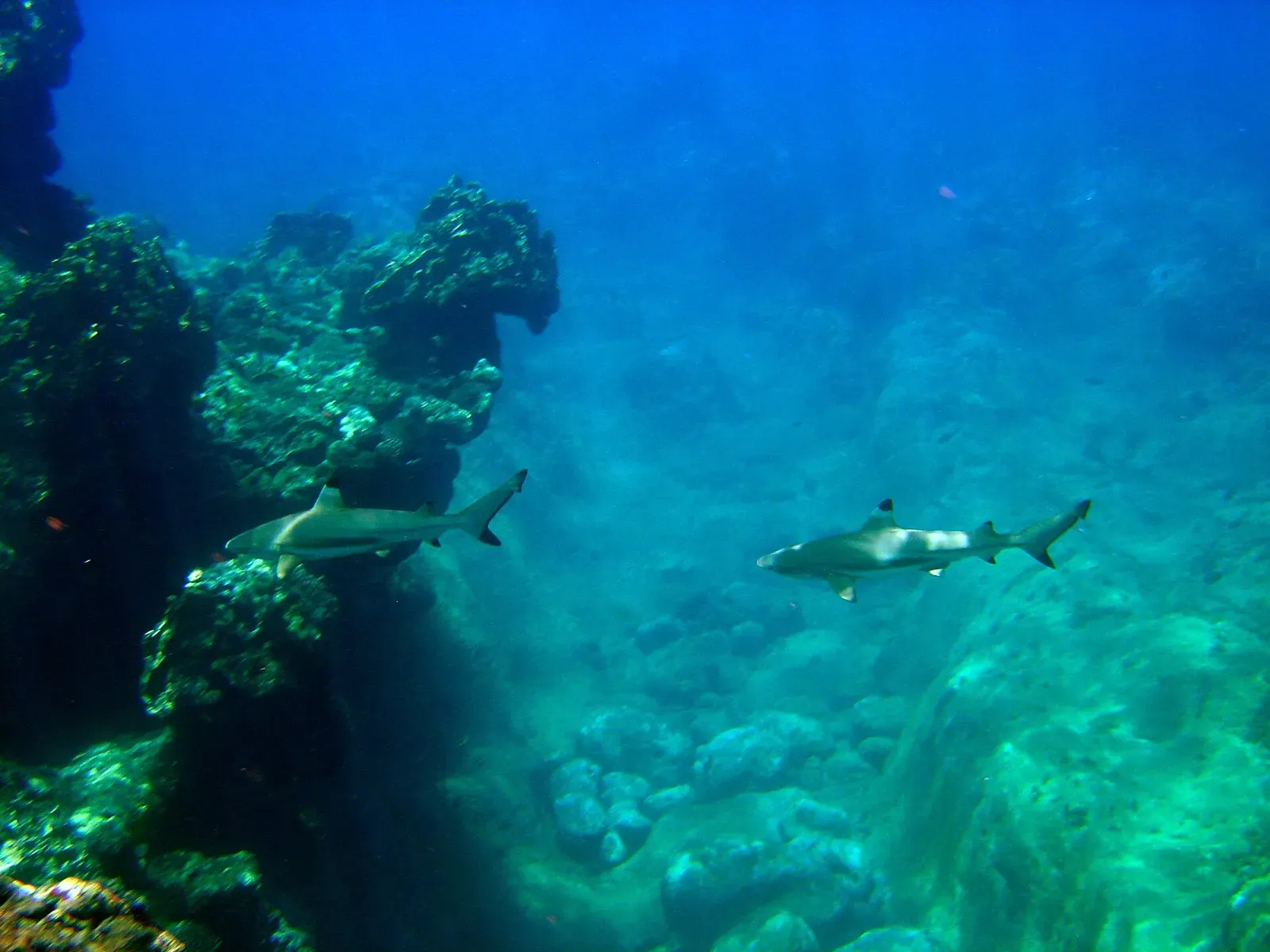
The cast is resident rather than seasonal: napoleon wrasse and turtles working the coral, jacks and barracuda holding off the corners, eagle rays crossing the wall, and reef sharks in ones and twos rather than groups. No month is a write-off; the calmer Feb-Apr stretch mainly buys access to the exposed sides, not different animals.
- Wall
- Reef
- Coral garden
- Drift
- Night
- Pristine corals
- Reef sharks
- Sea turtles
- Napoleon wrasse
- Trevally & jacks
- Reef fish swarms
- Eagle rays
- Barracuda
Best dive sites in Kosrae
Reef
Very large hard corals inside 6 m, straight off the beach
Wall
Sharks, barracuda and dog-tooth tuna along a current-swept wall
Coral garden
Hard coral on a low-current reef top at 12 to 18 m
Walung Drop-off
Western wall falling into blue, thick with plate coral on the rim.
Blue Hole
Sand-floored hole in the reef flat opening onto the outer wall.
Yeseng
Sheltered northern reef used for check dives and night diving.
How to get to Kosrae
The United Island Hopper between Honolulu and Guam is the practical way in, landing at Okat on the northwest coast. Lodges sit along the coast road and run their own day boats; the wide reef flat keeps diving boat-based rather than shore entry. Kosrae observes Sunday strictly, and dive operations generally stand down for it.
Photos from Kosrae
François Michonneau · CC BY 3.0
Dive videos
Diving the reefs of Kosrae, Micronesia · Joshua Ptasznyk on YouTube
Kosrae - Walung Dropoff~! · CnC Divers on YouTube
Photo credits
- A spiny sea cucumber rests on coral rubble and sand on a reef in Kosrae, Micronesia. by François Michonneau, CC BY 3.0, via Wikimedia Commons
Similar destinations
Pacific Islands
A pinnacle rising 900 m from the seabed to within metres of the surface
Pacific Islands
A hundred kilometres of barrier reef with almost no divers on it
Pacific Islands
Majuro & Mili
Marshall Islands
Ride a channel that flushes a forty-kilometre lagoon on the tide

Wrecks from two wars touching in Apra Harbor, plus the Blue Hole sinkhole