Pacific Islands · Guam
Guam
Wrecks from two wars touching in Apra Harbor, plus the Blue Hole sinkhole
Photo: David Burdick, NOAA · Public domain
Guam pairs wartime wrecks with reefs, walls and shore dives. In Apra Harbor the Japanese freighter Tokai Maru, sunk in 1943, leans against the WWI German auxiliary cruiser SMS Cormoran, two wrecks from two wars touching. The Blue Hole, a sinkhole in northern Agat Bay, drops through the reef to an exit on the outer wall, Gab Gab Reef suits divers of every level, and Piti Bomb Holes is a favoured spot for introductory night dives.
About diving in Guam
Many sites can be reached from land, many of them through the U.S. military bases that hold much of the island. The Blue Hole sits below sheer cliffs and is dived only by boat, typically out of Cabras Marina in Apra Harbor, 20 minutes away; the exit usually means deploying a surface marker buoy for an open-ocean pickup. Boats often follow it with a shallower second dive at Hap's Reef or Finger Reef. Sites inside Apra Harbor stay diveable when rough weather makes most of the island's sites undiveable.
Underwater, Guam mixes wrecks, reef, walls and caverns. The Tokai Maru and SMS Cormoran lie side by side in Apra Harbor, Finger Reef is a well-developed reef wall inside the harbor, and Anae Caverns has wide caverns with side openings and exits. Piti Bay's outer reef has a large cut and a coral-lined channel where marbled rays, pink whiprays and eagle rays keep to the sandy seafloor, and the man-made Piti Channel at the far end of the bay turns up nudibranchs, pompom boxer crabs and decorator crabs, best on a night dive.
Many sites are introductory level for Open Water divers. Outhouse Beach has little reef, but its easy entry with no coral to cross and its place inside Apra Harbor make it a popular site for Open Water certification dives. Guam also has more advanced sites. At the Blue Hole the clear water and the depth along the wall can draw unprepared divers deeper than they intended, and the SMS Cormoran is a deep boat wreck for experienced divers, with penetration only for properly trained divers using a line.
Best time to dive Guam
| Jan | Feb | Mar | Apr | May | Jun | Jul | Aug | Sep | Oct | Nov | Dec | |
|---|---|---|---|---|---|---|---|---|---|---|---|---|
| Season | Good | Good | Good | Good | Good | Good | Good | Good | Good | Good | Good | Good |
| Sea surface | 28°C82°F | 28°C82°F | 28°C82°F | 28°C82°F | 29°C84°F | 30°C86°F | 30°C86°F | 30°C86°F | 30°C86°F | 30°C86°F | 29°C84°F | 29°C84°F |
| Daytime high | 29°C84°F | 28°C82°F | 29°C84°F | 29°C84°F | 30°C86°F | 30°C86°F | 30°C86°F | 30°C86°F | 30°C86°F | 30°C86°F | 30°C86°F | 29°C84°F |
| Rain | 94 mm3.7 in | 56 mm2.2 in | 48 mm1.9 in | 59 mm2.3 in | 63 mm2.5 in | 87 mm3.4 in | 217 mm8.5 in | 281 mm11.1 in | 295 mm11.6 in | 239 mm9.4 in | 109 mm4.3 in | 71 mm2.8 in |
| Jan | Feb | Mar | Apr | May | Jun |
|---|---|---|---|---|---|
| Good | Good | Good | Good | Good | Good |
| Sea surface | |||||
| 28°C82°F | 28°C82°F | 28°C82°F | 28°C82°F | 29°C84°F | 30°C86°F |
| Daytime high | |||||
| 29°C84°F | 28°C82°F | 29°C84°F | 29°C84°F | 30°C86°F | 30°C86°F |
| Rain | |||||
| 94 mm3.7 in | 56 mm2.2 in | 48 mm1.9 in | 59 mm2.3 in | 63 mm2.5 in | 87 mm3.4 in |
| Jul | Aug | Sep | Oct | Nov | Dec |
|---|---|---|---|---|---|
| Good | Good | Good | Good | Good | Good |
| Sea surface | |||||
| 30°C86°F | 30°C86°F | 30°C86°F | 30°C86°F | 29°C84°F | 29°C84°F |
| Daytime high | |||||
| 30°C86°F | 30°C86°F | 30°C86°F | 30°C86°F | 30°C86°F | 29°C84°F |
| Rain | |||||
| 217 mm8.5 in | 281 mm11.1 in | 295 mm11.6 in | 239 mm9.4 in | 109 mm4.3 in | 71 mm2.8 in |
2011–2025 averages. Sea surface: NOAA Coral Reef Watch, measured at the surface, so deeper water can run colder. Daytime high and rain: NASA POWER.
Dry season runs January to June and rainy season July to December; the water stays warm and diving continues all year.
Best months: January, February, March, April, May, June, July, August, September, October, November, December
Guam water temperature and weather by month
The sea surface stays between 28 and 30 °C (82–86 °F) all year. Most rain falls from July to October, peaking at about 300 mm (12 in) in September; it stays largely dry from February to May. Daytime highs sit around 29 °C (84 °F) all year. The coldest water here is about 27 °C (81 °F), so pack a 3 mm, or even a 2 mm, suit.
Dive types & marine life
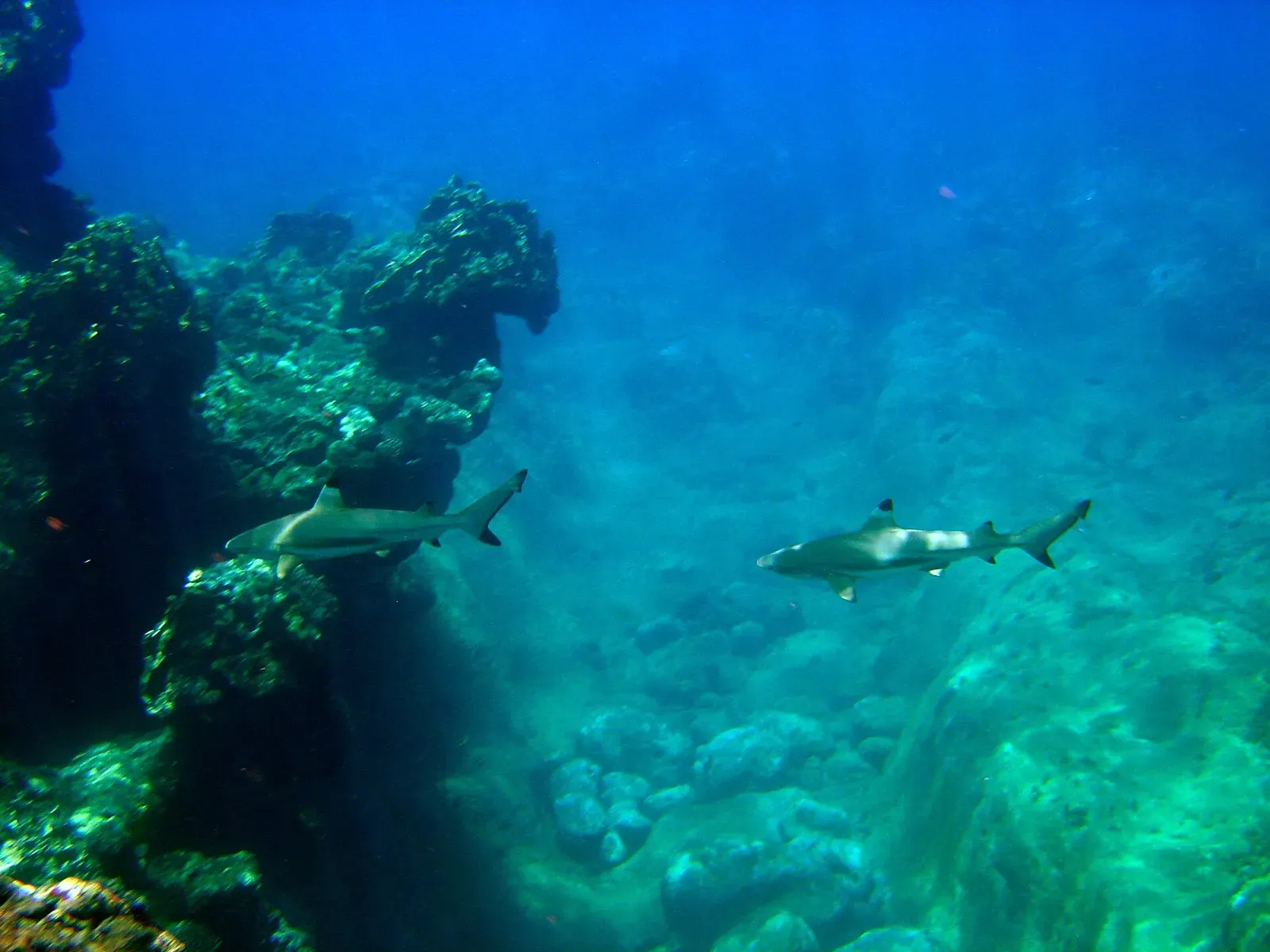
White-tip and black-tip reef sharks are seen on most dives at Barracuda Rock, while barracuda there are now only occasional. In Piti Bay, blacktips come in early in the morning and again in the evening, in groups of as many as eight, and green and hawksbill turtles use the sinkholes.
- Wreck
- Wall
- Cave & cavern
- Reef
- Night
- Drift
- Reef fish swarms
- Sea turtles
- Reef sharks
- Barracuda
- Nudibranchs
- Macro critters
- Eagle rays
- Napoleon wrasse
Best dive sites in Guam
- 1
Blue Hole
Sinkhole from about 18 m (60 ft) to an exit on the wall at about 40 m (130 ft); sharks and pelagics are common.
- 2
SMS Cormoran & Tokai Maru
WWI German auxiliary cruiser on her side at 34 m (110 ft); the Tokai Maru, sunk in 1943, leans against her propeller.
- 3
Gab Gab Reef
First reef at Gab Gab suits divers of every age and level; turtles and anemones are common.
- 4
Piti Bomb Holes
Marine preserve in Piti Bay, a favoured spot for introductory night dives.
- 5
Double Reef
Northern coral reef from 3 to 21 m (10 to 70 ft) with schooling fish and clear water.
- 6
Barracuda Rock
Orote peninsula reef averaging 14 m (45 ft), where about a dozen green sea turtles hang out.
- 7
Napoleon Cut
Reef fish, clams, octopus, sharks and turtles, plus large Napoleon wrasse.
Site guides
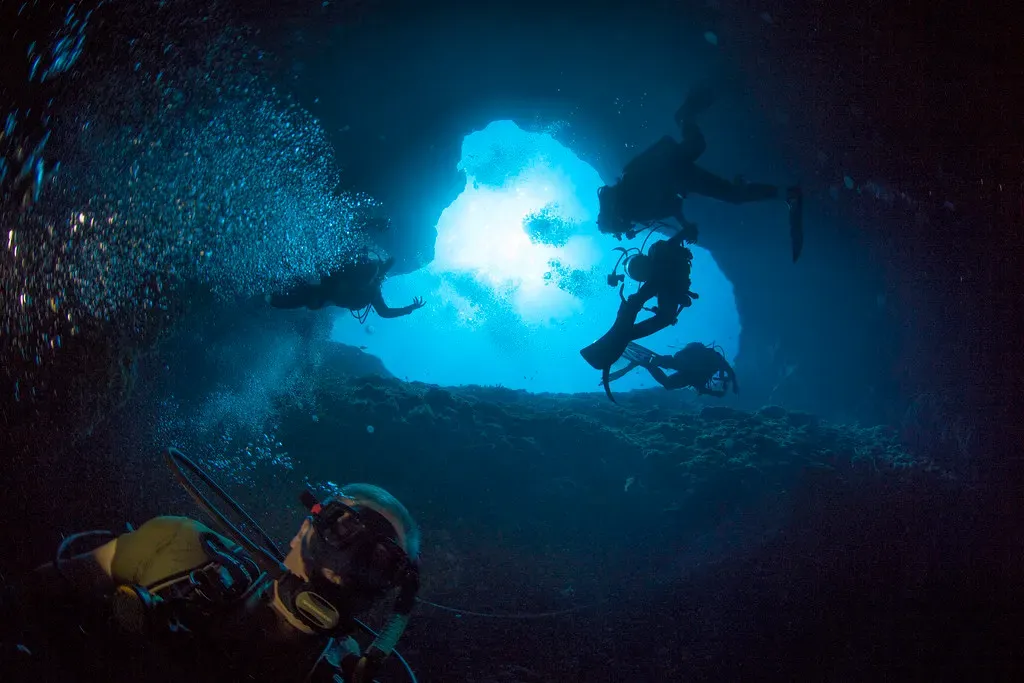
A reef sinkhole with a window at 40 m opening onto the outer wall
Reef
Stairs down to a harbour reef that steps out to a 37 m drop-off
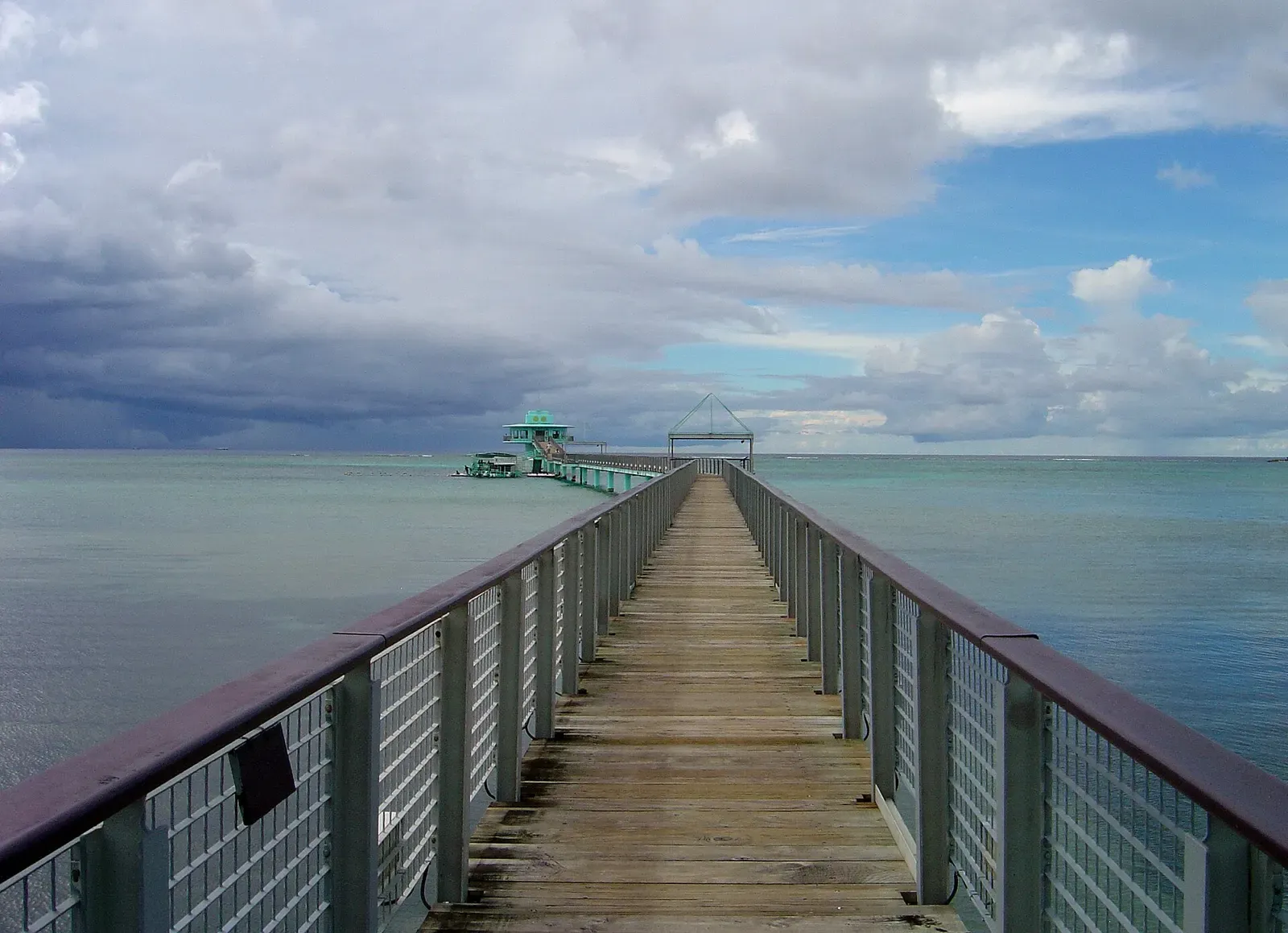
Natural percolation pits in a reef flat, 9 m at their deepest
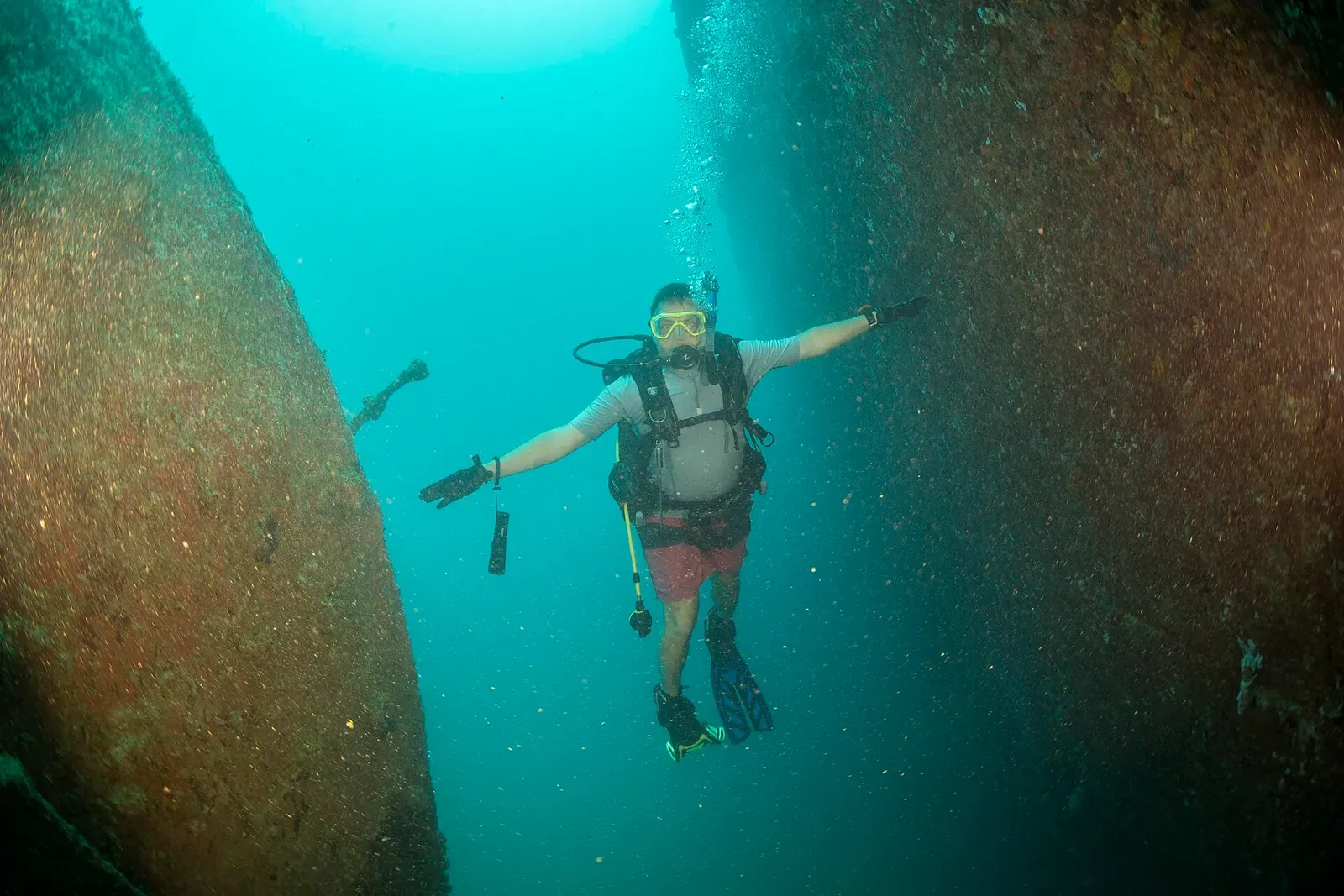
A 1917 raider and a 1943 freighter lying against each other
How to get to Guam
Antonio B. Won Pat International Airport has offices of all the major U.S. car rental companies. Gun Beach is the only dive site in Tumon Bay, the main hotel area; most other sites are about a 30-minute drive from the Tumon hotel district.
Photos from Guam
Jonathan Miske · CC BY-SA 2.0
Jonathan Miske · CC BY-SA 2.0
Dive videos
Guam Dive Sites: Blue Hole · Random Adventure & Interest on YouTube
Tokai and Cormoran Apra Harbor, Guam · Phillippe Brule on YouTube
Questions divers ask
What certification does the Blue Hole need?+
Its exit at about 40 m (130 ft) sits just within the limits of an advanced recreational dive, depending on the certifying agency. The bottom lies far deeper, and diving past 40 m (130 ft) needs a special certification.
Can Gab Gab be dived from shore?+
Only by military personnel: Gab Gab Beach lies inside a restricted naval base. Other divers reach it by boat. Elsewhere, some shore entries need a long walk over coral or a long surface swim.
Is Guam diveable in the rainy season?+
Diving runs all year, but currents can be swift and unpredictable depending on the season. Double Reef, reached only by boat, is usually dived in the summer months when winds and seas are calm.
Where can a newly certified diver try a night dive?+
Piti Bomb Holes is a favoured spot for introductory night dives. The pier lights are turned off early in the evening, but street lighting from Marine Corps Drive gives some ambient light and easy orientation.
Sources
- Diving in Guam — Wikivoyage
- Blue Hole (Guam) — Wikipedia
- SMS Cormoran (1914) — Wikipedia
- Piti Bomb Holes Marine Preserve — Wikipedia
- Shooting Across Guam: 10 Top Underwater Photography Sites — Dive Photo Guide
- Dive Sites in Guam, United States — PickADive
- Blue Hole — Micronesian Divers Association
- Barracuda Rock - Guam — ScubaGo
- Double Reef - Guam — ScubaGo
- Napoleon Cut — Guam Dive Guide
- Gab Gab — Guam Dive Guide
- Guam — Wikivoyage
Photo credits
- Silhouetted headland at sunset over Orote Point, the entrance to Apra Harbor, Guam by Jonathan Miske, CC BY-SA 2.0, via Wikimedia Commons
- Two blacktip reef sharks cruising over a coral reef off Guam by David Burdick, NOAA, Public domain, via Wikimedia Commons
- Palm trees silhouetted at dusk on Gab Gab Beach, Guam by Jonathan Miske, CC BY-SA 2.0, via Wikimedia Commons
Embed
Run a dive centre, club or blog? Embed this map of 4 dive sites near Guam on your own page.
In The Logbook
- Wetsuit thickness by water temperatureGear & kit · 11 min read
- What is a blue hole, and what's down there?Caves & caverns · 13 min read
- Deep wreck diving: where recreational stopsWrecks · 8 min read
- The best shore dives in the worldShore diving · 8 min read
Similar destinations

Swim out of a collapsed limestone cavern into the open Pacific
Pacific Islands
Port Vila & Efate
Vanuatu
A tall, narrow cavern and several wrecks a short boat ride from the capital

Forty-metre visibility over lava caves and canyons, straight off the reef


.jpg)
.jpg)
Molokini's crater wall and Lānaʻi's skylit lava caverns