Indian Ocean · Oman
Musandam
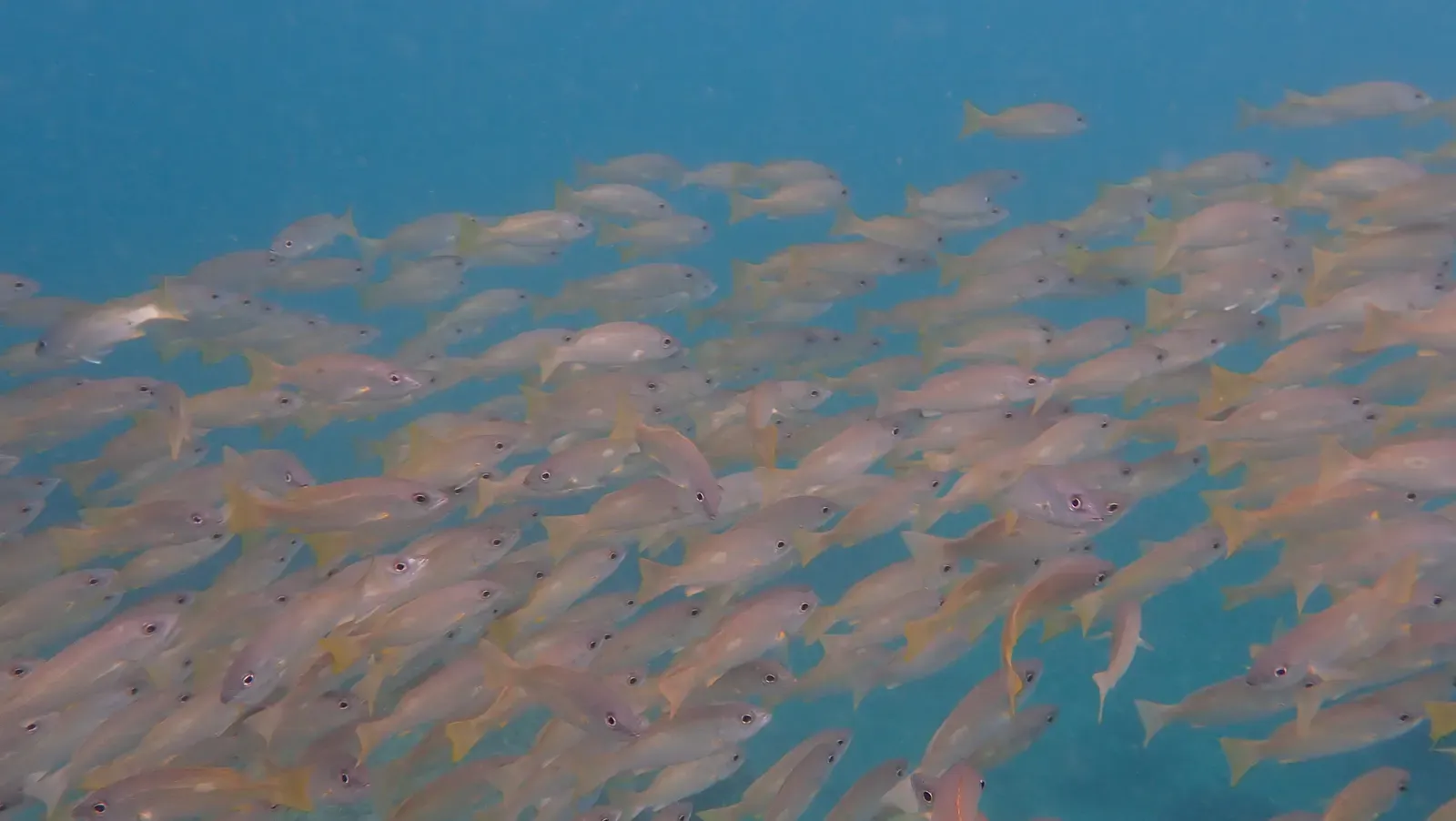
Green, plankton-rich water and huge fish schools in the fjords of Arabia
Photo: Nicola Crockford · CC BY 4.0
The Musandam peninsula juts into the Strait of Hormuz as a maze of steep-sided inlets that get called the fjords of Arabia, and diving here is nothing like the Red Sea. Plankton-rich water keeps visibility low and the water green, but it supports fish density that clearer seas cannot: walls of fusiliers, barracuda and jack schools, and rays over the sand. Lima Rock and Octopus Rock, two rock stacks off Lima, are the anchors.
About diving in Musandam
A diving day here is usually spent on a wooden dhow rather than a RIB. Boats leave Dibba or Khasab early, cruise for an hour or more with tanks lashed along the rail, and put divers in twice with a long surface interval and lunch on deck between them. The cruising counts as part of the trip rather than dead time — cliffs dropping straight into the water, no road and no building in sight — and it means a day out here is a full day, not two tanks before noon.
Conditions change layer by layer as much as site by site. It is normal to descend through a warm, green, near-opaque surface band, pass a thermocline, and find cooler and noticeably clearer water underneath, then lose it again on the way back up. Tide drives the planning: the exposed rocks get timed around it, while the sheltered inlets stay workable when the outside is running. Below the murk the ground is boulder slope, sheer face and rock fingers reaching out into open water over sand.
Big animals are as often spotted from the boat as found on a dive. Mobulas pass in loose groups and whale sharks turn up in the warm, plankton-heavy water of late summer into autumn, usually sighted from the deck and then dropped in on. Sea snakes appear often enough that they stop registering. When visibility collapses altogether the answer is to shorten the range and work the rock instead — nudibranchs, morays wedged into cracks, cuttlefish and shrimp among the boulders.
It suits divers who care more about what is in the water than how far they can see through it, and who accept that a good day and a clear day are not the same thing here. Because it is a few hours from Dubai, it gets dived on weekends rather than as a once-in-a-lifetime trip, so the boat tends to fill with returning regulars who know which rock has been fishing well that month — which is worth more than any site list when the surface layer is thick.
Best time to dive Musandam
| Jan | Feb | Mar | Apr | May | Jun | Jul | Aug | Sep | Oct | Nov | Dec | |
|---|---|---|---|---|---|---|---|---|---|---|---|---|
| Season | Good | Good | Prime | Prime | Good | Fair | Fair | Fair | Good | Prime | Prime | Prime |
| Sea surface | 24°C75°F | 23°C73°F | 23°C73°F | 25°C77°F | 28°C82°F | 31°C88°F | 32°C90°F | 32°C90°F | 32°C90°F | 30°C86°F | 28°C82°F | 26°C79°F |
| Daytime high | 25°C77°F | 26°C79°F | 28°C82°F | 32°C90°F | 36°C97°F | 39°C102°F | 39°C102°F | 38°C100°F | 36°C97°F | 34°C93°F | 31°C88°F | 27°C81°F |
| Rain | 40 mm1.6 in | 17 mm0.7 in | 24 mm0.9 in | 15 mm0.6 in | 2 mm0.1 in | 0 mm0.0 in | 4 mm0.2 in | 1 mm0.0 in | 1 mm0.0 in | 4 mm0.2 in | 13 mm0.5 in | 26 mm1.0 in |
| Jan | Feb | Mar | Apr | May | Jun |
|---|---|---|---|---|---|
| Good | Good | Prime | Prime | Good | Fair |
| Sea surface | |||||
| 24°C75°F | 23°C73°F | 23°C73°F | 25°C77°F | 28°C82°F | 31°C88°F |
| Daytime high | |||||
| 25°C77°F | 26°C79°F | 28°C82°F | 32°C90°F | 36°C97°F | 39°C102°F |
| Rain | |||||
| 40 mm1.6 in | 17 mm0.7 in | 24 mm0.9 in | 15 mm0.6 in | 2 mm0.1 in | 0 mm0.0 in |
| Jul | Aug | Sep | Oct | Nov | Dec |
|---|---|---|---|---|---|
| Fair | Fair | Good | Prime | Prime | Prime |
| Sea surface | |||||
| 32°C90°F | 32°C90°F | 32°C90°F | 30°C86°F | 28°C82°F | 26°C79°F |
| Daytime high | |||||
| 39°C102°F | 38°C100°F | 36°C97°F | 34°C93°F | 31°C88°F | 27°C81°F |
| Rain | |||||
| 4 mm0.2 in | 1 mm0.0 in | 1 mm0.0 in | 4 mm0.2 in | 13 mm0.5 in | 26 mm1.0 in |
2011–2025 averages. Sea surface: NOAA Coral Reef Watch, measured at the surface, so deeper water can run colder. Daytime high and rain: NASA POWER.
October to December is the peak: the summer heat breaks, the air turns comfortable, the water is still warm, and the last weeks of the May-to-October whale shark season fall in October. January to April is the cool half of the year, with the water down to about 22 °C in winter and often clearer than in summer, though wind can chop up the surface in February and March. May warms up again and opens the whale shark months. June to August is the hard stretch: the sea reaches about 30 °C, air temperatures are extreme, and dives drop through thermoclines into cooler water below the warm surface layer. At any time of year visibility can swing between 5 and 20 m from one day to the next.
Best months: March, April, October, November, December
Musandam water temperature and weather by month
The sea surface runs from 23 °C (73 °F) in February to 32 °C (90 °F) in August. It is 24 °C (75 °F) or warmer from April to January. Rain is scarce: about 150 mm (5.9 in) falls in a typical year. Daytime highs reach 39 °C (102 °F) in June and drop to 25 °C (77 °F) in January. The coldest water here is about 22 °C (72 °F), so pack a 5 mm suit.
Dive types & marine life
Barracuda and fusilier schools hold on the same exposed pinnacles trip after trip, so the question is rarely whether they are there but how clear the water is. Stingrays cross the sand, turtles are routine and sea snakes are everywhere; reef sharks turn up occasionally rather than reliably. Whale sharks are a May-to-October chance, with September to November often the best odds.
- Reef
- Wall
- Drift
- Muck & macro
- Night
- Reef sharks
- Whale sharks
- Sea turtles
- Trevally & jacks
- Barracuda
- Stingrays
- Nudibranchs
- Macro critters
- Mobula rays
- Sea snakes
Best dive sites in Musandam
- 1
Lima Rock
Limestone island off Ras Lima dived as two sites: caves and overhangs to the north, a wall past 60 m to the east.
- 2
Octopus Rock
Isolated stack 3 km north of Lima, sheltered enough for most tides and thick with fish and soft coral.
- 3
Ras Musandam
Current-swept point off Jazirat Musandam, a fast drift for advanced divers with jacks, tuna and barracuda.
- 4
Ras Lima
Sloping soft-coral reef at 5–18 m inside the bay by Lima village, an easy third or night dive with rays and turtles.
- 5
Ras Sarkan
Headland at the mouth of Habalyn Bay where a coral slope turns into a wall, 10–40 m, with barracuda and jacks.
Site guides
Pinnacle
Caves and overhangs north, a wall past 60 m east
How to get to Musandam
Two ways in: Dibba on the UAE east coast, where the dive port sits on the Omani side of the border and day dhows run from there, or Khasab, reached by road from Dubai or Ras al Khaimah through the Tibat crossing. Carry a passport for either, and check current visa rules with the operator — the two crossings are handled differently. Overnight dhows reach the remoter northern sites.
Photos from Musandam
fiverlocker · CC BY-SA 2.0
shankar s. · CC BY 2.0
shankar s. · CC BY 2.0
Xiaotong Gao · CC BY-SA 3.0
Banja-Frans Mulder · CC BY 3.0
Banja-Frans Mulder · CC BY 3.0
Dive videos
Musandam Oman Dive Trip | Dubai Dive Report | 31 Aug & 1 Sept · Brian Davies Scuba on YouTube
Musandam Diving trip - Oman 05/04/24 - 07/04/24 · Nick Ward on YouTube
Questions divers ask
Should divers base in Dibba or Khasab for Musandam?+
Either works, and each reaches different water. Dibba, on the east coast at the UAE border, is the base for Lima Rock, Octopus Rock and the sites within about two hours by boat. Khasab, a two- to two-and-a-half-hour drive from Dubai or a flight from Muscat, is the base for the northern inlets and the Strait of Hormuz.
Is a visa needed to dive Musandam from the UAE?+
Usually an Omani entry is needed at the border, and the rules differ between the Khasab and Dibba crossings and change often. Visitors already in the UAE on a tourist visa have been able to enter free for up to ten days at the Khasab road crossing. Carry a passport either way and check the current rules with the dive centre before travelling.
What is the water temperature in Musandam?+
About 22 °C in winter, rising to around 30 °C in summer, with an average near 25 °C. From June to August divers often pass through a thermocline into cooler water below the warm surface layer.
When is whale shark season in Musandam?+
May to October, when whale sharks come into the plankton-rich water near the Strait of Hormuz, with September to November often named the best window. Sightings are chance encounters rather than something a trip can promise.
Is Musandam suitable for beginner divers?+
Partly. Sheltered sites such as Ras Lima suit new divers, but the exposed rocks, the south side of Lima Rock and Ras Musandam run strong current and are dives for experienced divers. Visibility of 5 to 20 m that changes from day to day also makes navigation harder than in clearer seas.
Sources
- Musandam, Oman diving guide — Divezone
- Musandam — Wikivoyage
- Musandam Governorate — Wikipedia
- Dschazirat Lima (Lima Rock) — Wikipedia
- Musandam Fjords in Oman — Dive Worldwide
- Diving the Musandam — Sheesa Beach
- Ras Musandam dive site — Sheesa Beach
- Ras Lima dive site — Sheesa Beach
- Ras Sarkan North dive site — Sheesa Beach
- Octopus Rock in Musandam — Nemo Diving Center
- 10 Best Dive Sites in Musandam, Oman — Dhow Khasab Tours
- Diving in Musandam — PADI
Photo credits
- A dense school of Ehrenberg's snapper fills the blue water off Khasab in Musandam by Nicola Crockford, CC BY 4.0, via iNaturalist
- A large ray rests on the sandy seabed during a dive in Musandam by fiverlocker, CC BY-SA 2.0, via Openverse
- Long-spined sea urchins beside a coral head, seen from a boat at Telegraph Island, Musandam by shankar s., CC BY 2.0, via Openverse
- A school of yellowbar angelfish seen from a boat in turquoise Musandam water by shankar s., CC BY 2.0, via Openverse
- A weathered limestone pinnacle rises from the sea off the Musandam peninsula by Xiaotong Gao, CC BY-SA 3.0, via Wikimedia Commons
- Dolphins surface in the choppy water off Khasab, a common sighting on Musandam boat trips by Banja-Frans Mulder, CC BY 3.0, via Wikimedia Commons
- Steep limestone cliffs enclose a narrow turquoise inlet near Khasab in the Musandam fjords by Banja-Frans Mulder, CC BY 3.0, via Wikimedia Commons
Embed
Run a dive centre, club or blog? Embed this map of 1 dive sites near Musandam on your own page.
In The Logbook
- Sunfish diving: where and when to see a molaBig animals · 11 min read
- Where to dive with whale sharks, month by monthBig animals · 16 min read
Similar destinations

Oman's first marine reserve, with whale sharks arriving each late summer

Barracuda schools circle Barren Island, home to India's only active volcano

Resident manta rays clean daily at Passe en S inside the barrier reef lagoon


Whale sharks live year-round on the South Ari reef shelf