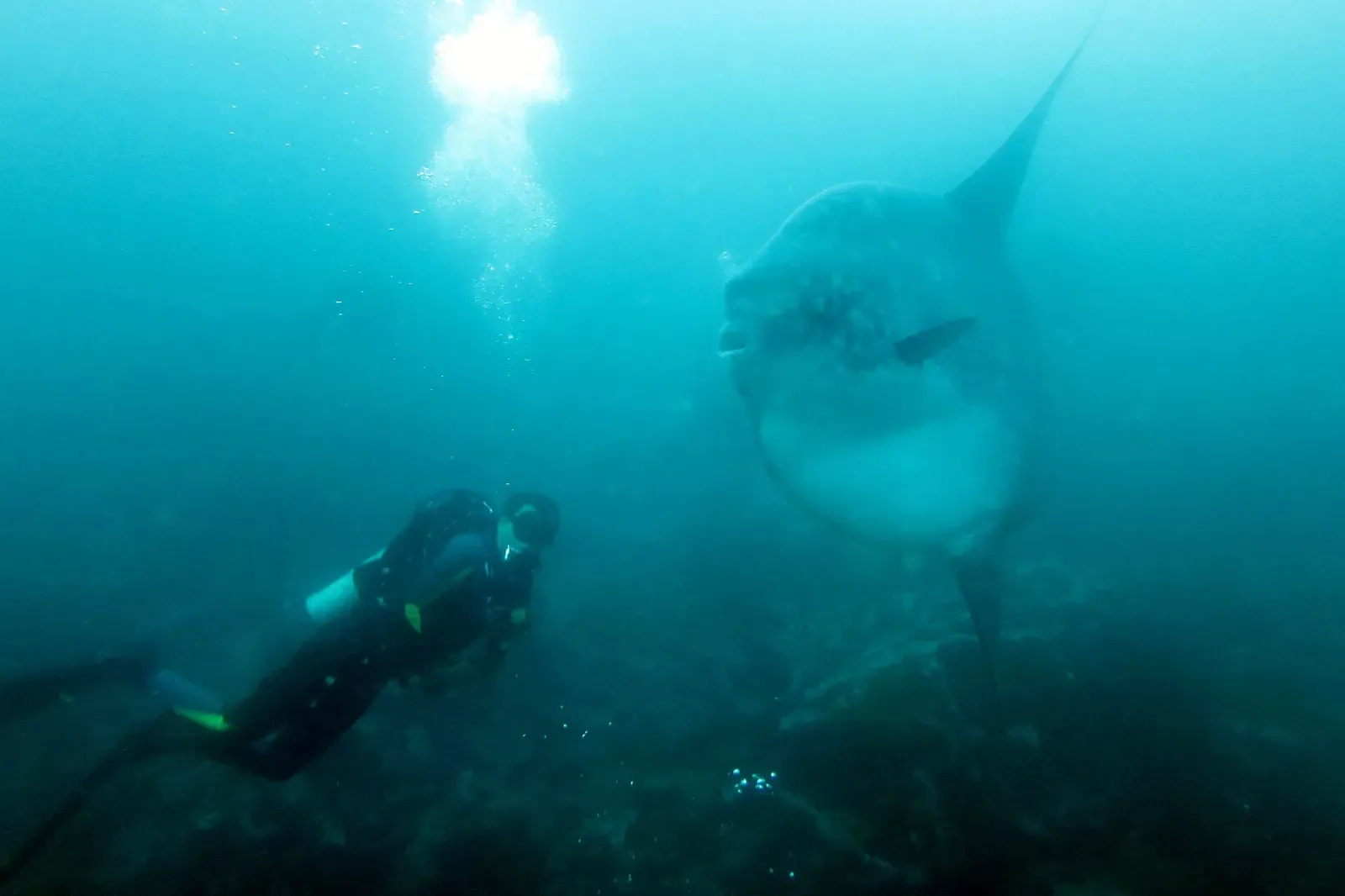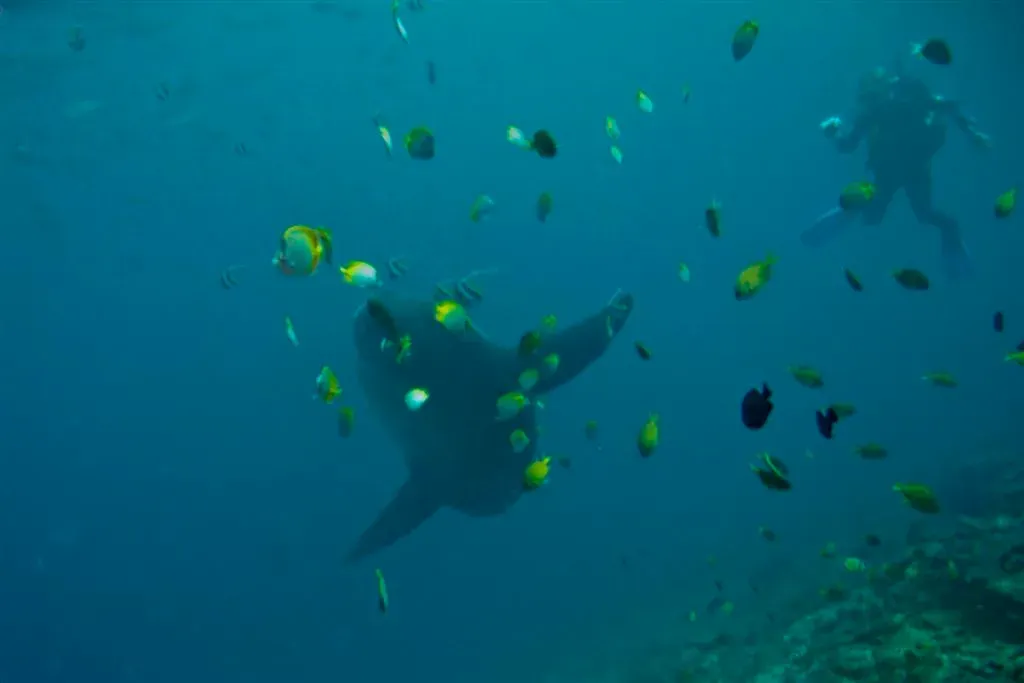
The record fish is not the species on the brochure
In late 2021, boaters near Faial Island in the Azores found an enormous fish floating dead in open water. Researchers from a local natural-history association brought it ashore, moved it with a forklift and weighed it hanging from a crane-suspended cargo scale: 2,744 kg, 3.25 metres from nose to clavus. It was the heaviest bony fish ever recorded, beating the previous record — a 2,300 kg animal caught off Kamogawa, Japan, in 1996 — by more than 400 kg. And when the necropsy was published in the Journal of Fish Biology, the species on the paper was not Mola mola. It was Mola alexandrini, the giant or bump-head sunfish.
That distinction would have been close to meaningless for most of diving’s history, when every huge, improbable, door-shaped fish hanging at a cleaning station was simply “a mola mola”. Then 2017 happened to the genus twice. First, a team including the taxonomists Etsuro Sawai and Marianne Nyegaard untangled a century of confusion and confirmed Mola alexandrini as a valid species in its own right — and found the original 1758 type material for Mola mola itself so inadequate that they had to designate a new reference specimen just to keep the two apart. Seven physical characters separate them; the short version is that M. alexandrini carries a bump on its head, another on its chin, and a rounded rather than wavy rear margin. Second, and in the same year, Nyegaard’s team described an entirely new species that had been hiding inside the paperwork all along: Mola tecta, the hoodwinker sunfish — tecta meaning hidden — first picked up as a stranded specimen on a beach near Christchurch, New Zealand, in 2014. It was the first new sunfish species named in around 130 years, and it lives across the temperate Southern Hemisphere: New Zealand, southern Australia, South Africa, Chile.
Which brings us to Bali. The sunfish that divers queue for at Nusa Penida are, on range and on the animals’ own build, very likely M. alexandrini rather than M. mola — the same species as the Azores record-holder. We could not find a published study that pins Crystal Bay’s individuals to species level, so we will not state it harder than that; but specimens of M. alexandrini have been collected from Japan, Taiwan, Oman, the Galápagos, Australia and New Zealand — and from Spain, so even the Mediterranean is not a clean M. mola zone. What can be said is that the temperate Atlantic sightings in this guide, Portugal’s above all, are classic M. mola ground. The practical upshot for a diver is simple and slightly delicious: the marketing says Mola mola, and at the world’s most famous mola destination the fish in front of you is probably something else.
Nusa Penida, where the season is real
Almost everywhere sunfish are seen by divers, they are passing trade. Nusa Penida, off southeast Bali, is the exception with a calendar. Between roughly July and October, cold, nutrient-rich water rises from the Indian Ocean side and floods the channels around the island, and the sunfish ride it up from depth to cleaning stations where reef fish pick their parasites. August and September are the peak. Our own season rating for the area — prime July to October — is, unusually, the same thing as the animal calendar, because the upwelling that makes the diving “prime” by Nusa Penida’s logic is the same physical event that brings the fish. Be clear-eyed about what prime means here, though: it is the coldest water of the year, 16 to 22 °C and coldest June to October, with strong and sometimes downward-running current. Prime is not pleasant. It is the reason to come.
Crystal Bay is the name everyone arrives with. The coral is at its best at 15 to 20 metres, and that is where most of the dive is spent; a chance at a sunfish means dropping to around 30 metres (100 feet), so the mola leg is short, deep and cold, and it deserves a proper gas and no-stop plan rather than an impulse. The site’s specific warning is downward current, and the boats make a go or no-go call on the day — a booking is a request, not a promise. A 5 mm full wetsuit is the local minimum recommendation, and plenty of guides wear more.
Crystal Bay, Nusa Penida (Bali) Indonesia (HD) · WesternRoo on YouTube
Blue Corner, off the northwest tip of neighbouring Nusa Lembongan, is the same upwelling with the comfort removed. The plateau sits around 20 metres but the dive is worked closer to 30 with a maximum near 40, the current is strong enough that a reef hook is standard kit, and down currents can appear on the plateau with little warning — which is why some operators restrict it to advanced divers with dozens of logged dives. One local operator is refreshingly candid that the odds here are no better than anywhere else around the island: a good day can turn up several sunfish, a bad one turns up nothing at all. Treat it as a serious drift dive that sometimes has a mola in it, not a mola dive with a drift attached.
Two honest footnotes to the Bali picture. The Gili Islands, a short hop east, rate sunfish as an outside chance on deeper ground in the same August-to-October window rather than something to plan around. And if the sunfish do not show, the same Nusa Penida crossing runs mantas at Manta Point in every month of the year — the rare consolation prize that is genuinely reliable.
The code exists because divers broke this once
Nusa Penida’s etiquette rules are not generic reef-manners boilerplate. They exist because the encounter was measurably damaged before. Between October 2004 and August 2005, by the local operators’ own account, overly aggressive divers routinely pushed sunfish off their cleaning stations at Nusa Lembongan and Nusa Penida; sighting records kept since the early 1990s suggest the fish had previously been present in higher numbers, more stationary and more settled at known stations. The code of conduct that came out of that episode was drawn up in consultation with sunfish researchers, marine managers and guides who had worked the area for over 15 years, and it is published, with the same numbers, by multiple Bali operators. It reads like a document written by people who watched the resource almost disappear.
A fish built for cold water in small doses
The sunfish’s reputation — a dim-witted drifter that suns itself and eats jellyfish — has been dismantled by two studies in the last decade, and both explain the dive you are actually trying to do.
The first is about the basking. In 2015, researchers who fitted ocean sunfish with accelerometers and animal-borne cameras showed they are active, diurnal deep-divers: they forage mostly at 100 to 200 metres, in water colder than 12 °C, and the single most abundant prey their cameras caught them eating was siphonophores. Their body temperature falls during those deep excursions and recovers at the surface — and the heat-transfer arithmetic showed they rewarm three to seven times faster than they cool, which is what you would expect from a deliberate thermal strategy rather than passive drifting. A sunfish flat on its side at the surface is not sunbathing for pleasure; it is recharging so it can go back down into the cold where the food is. Their preferred temperature is around 16 to 17 °C — which is, not coincidentally, roughly what Crystal Bay’s upwelling serves in season.
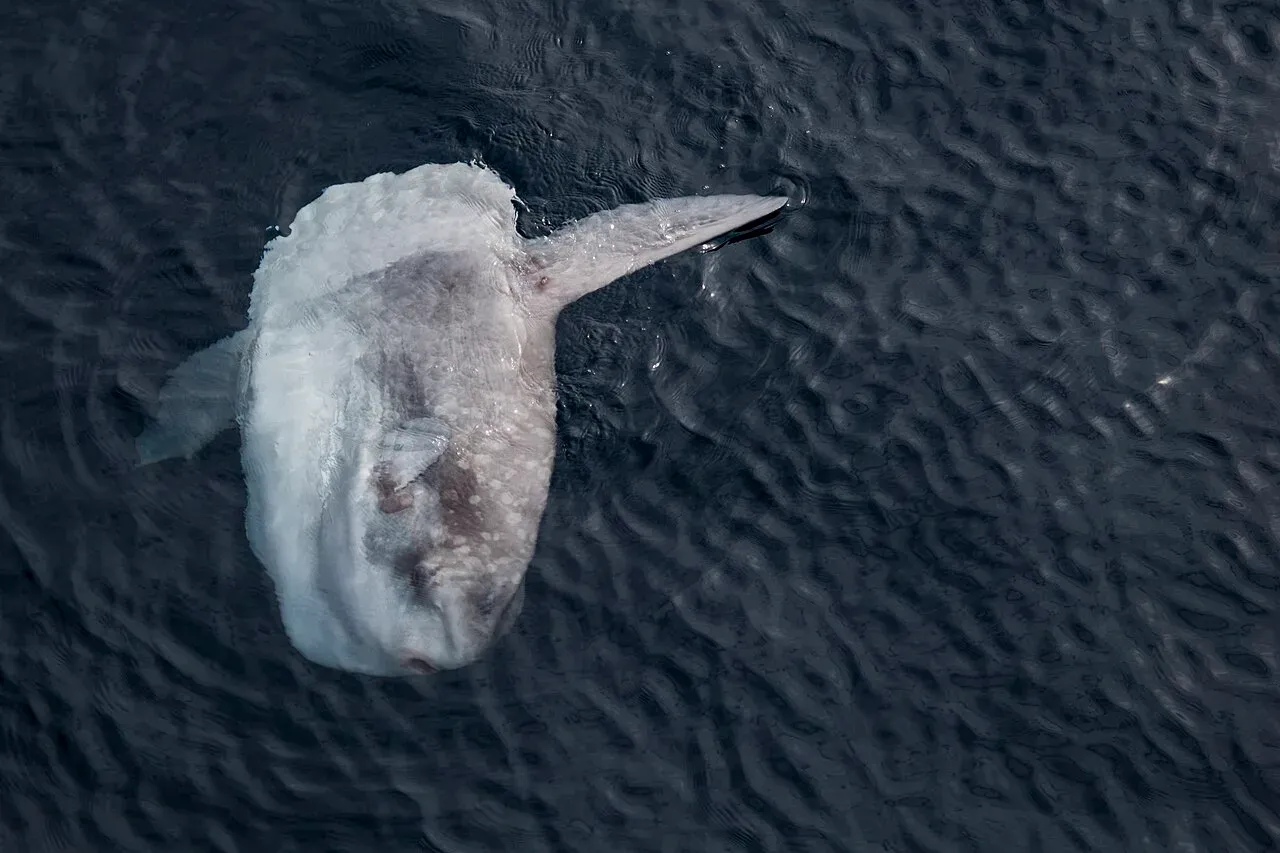
The second is about the menu. A 2016 study that DNA-barcoded ocean sunfish stomach contents in the North Atlantic found generalist predators, not jellyfish specialists: mostly small fish, fish larvae, squid, crustaceans and other soft-bodied invertebrates, with jellyfish and salps making up only around 15 per cent of the diet. That result comes from M. mola off Portugal, so it should not be blanket-applied to all three species — but it has replaced the jellyfish-only story as the modern consensus.
The cleaning is the part a diver gets to watch. In temperate seas, sunfish visit drifting kelp where cleaner wrasses work them over; in the tropics they solicit reef fish, and at the surface they will lie flat and let seabirds pick parasites off their skin. They have even been recorded breaching — clearing the water by up to three metres — apparently to dislodge the hangers-on. At Bali’s stations the cleaners are reef fish, with bannerfish most often given the credit locally. The station is the whole reason the encounter exists: a fish that lives cold and deep comes briefly shallow to be serviced, and a diver who spooks it off the station has ended the dive for everyone, which is exactly what the code of conduct is protecting.
The Galápagos wall
The world’s other genuine sunfish venue is the far side of the Pacific, at the base of a collapsed volcano. Punta Vicente Roca, on the northwestern point of Isabela in the western Galápagos, sits directly in the path of the Cromwell Current, an equatorial undercurrent that wells up here more than almost anywhere else in the archipelago and can drop the water into the mid-teens Celsius on the equator itself. PADI lists the site among its top Galápagos dives for exactly this reason: sunfish come in against the wall to be cleaned. The dive is a crevice-filled wall down to a sandy shelf around 18 to 22 metres, entered as a quick negative descent because the current will not wait for a surface pause, with red-lipped batfish walking the sand and Galápagos penguins and sea lions dropping in from above. A 7 mm suit or a drysuit, hood and gloves are standard kit. It is liveaboard-only, on itineraries running the western Isabela–Fernandina leg — no land visits, no day boats.
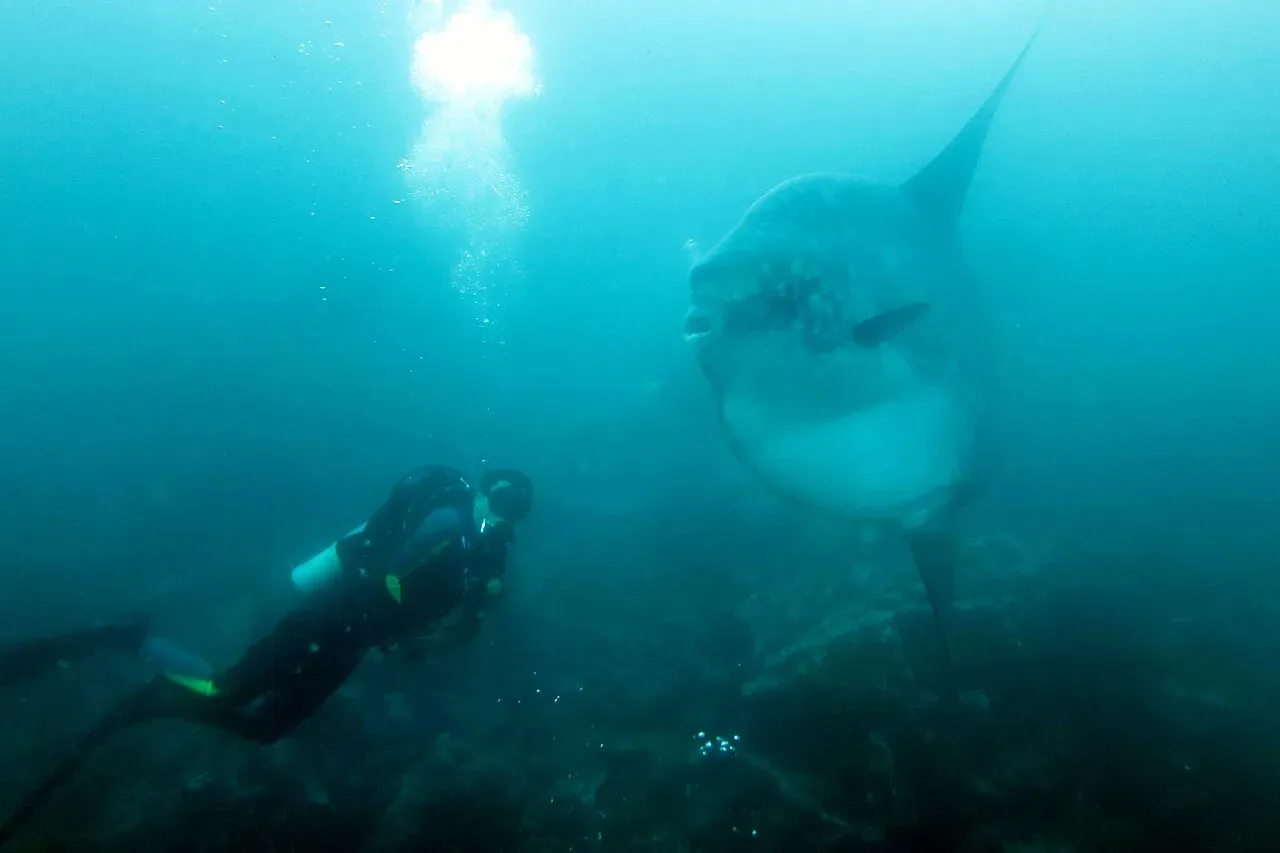
One honesty note our own dataset forces on us: the area’s season rating runs prime January to April, because that is when the water is warm, calm and easiest to dive. The sunfish lean the other way — the Galapagos Conservation Trust describes sightings as year-round but sporadic, and most operators point to the colder, rougher, murkier June-to-November upwelling as the stronger window. At Nusa Penida the conditions calendar and the animal calendar coincide; here they pull in opposite directions, and you should book against the animal, not the rating. The same western leg usually pairs Punta Vicente Roca with Cabo Marshall, an oceanic manta cleaning station under Wolf Volcano with gentler current — so a cold, green, no-show sunfish day still has somewhere to go. The famous northern circuit is no substitute: the Darwin and Wolf area’s own wildlife notes say plainly that sunfish belong to the cold western sites, not to Darwin.
Everywhere else, a sunfish is a bonus
Thirteen sites in our dataset carry sunfish in their marine-life record, and we would only tell you to plan a trip around three of them — Crystal Bay, Blue Corner and Punta Vicente Roca. The rest are places where a sunfish crosses a dive that exists for other reasons, and our own site copy is careful to say so. At Farikede off Fuvahmulah, sunfish are on a pelagic drift roster alongside hammerheads, threshers and whale sharks. Lima Rock in Oman has a cleaning station on its exposed eastern end that has produced whale sharks, rays and sunfish. Off Japan’s Izu Peninsula, Hirizo Beach logs the occasional sunfish further out, and the Mikomoto area’s notes call them an occasional cool-water sighting at either end of the hammerhead season — we would not put it more precisely than that. In Iberia, Primavera at the Berlengas rates them “an occasional visitor rather than something to plan a dive around”, Naranjito’s own record calls the sunfish the outlier on its sightings list, and Els Farallons has them passing the stacks with the tuna. Palancar Gardens keeps them on the list of what turns up off the drop-off. Even the Liberty wreck carries the tag, though its own page never actually mentions the fish — a fair reminder that a tag is a record of possibility, not a forecast.
Two more for the file. The Azores carry sunfish in their area record without a single tagged site — and that is the ocean that produced the 2,744 kg record fish, so the gap says more about our dataset than about the animals. And California’s Monterey Bay is often mentioned for autumn surface sightings of basking sunfish from whale-watching boats; we have seen enough operator reports to pass it on, but not enough verified sourcing to promise anything, and it is boat-watching rather than a targeted dive.
| Site | Depth | Current | Level | Best months |
|---|---|---|---|---|
| Crystal Bay Nusa Penida · Indonesia | 15–30 m | Strong | Advanced | Jul–Oct |
| Blue Corner Nusa Penida · Indonesia | 20–30 m | Strong | Advanced | Jul–Oct |
| Punta Vicente Roca Galápagos West (Isabela & Fernandina) · Ecuador | 12–27 m | Strong | Advanced | Jan–Apr |
| Farikede Fuvahmulah · Maldives | to 30 m | Strong | Advanced | Dec–Apr |
| Lima Rock Musandam · Oman | to 30 m | Strong | Advanced | Mar–Apr |
| Hirizo Beach Mikomoto & Nakagi · Japan | to 20 m | Mild | Intermediate | Jul–Sep |
| Parede de Rabo de Asno Berlengas & Peniche · Portugal | 28–30 m | Moderate | Advanced | Jun–Aug |
| Primavera Berlengas & Peniche · Portugal | 16–24 m | Mild | Intermediate | Jun–Aug |
| Bajo de Fuera Cabo de Palos & Islas Hormigas · Spain | 3–20 m | Moderate | Intermediate | Jun–Oct |
| Naranjito Cabo de Palos & Islas Hormigas · Spain | 28–42 m | Moderate | Advanced | Jun–Oct |
| Els Farallons Cap de Creus · Spain | to 40 m | Moderate | Advanced | Jun–Sep |
| Palancar Gardens Cozumel · Mexico | 15–34 m | Moderate | Intermediate | Jan–Apr |
| USAT Liberty Wreck Tulamben · Indonesia | 5–30 m | Mild | Intermediate | May–Oct |
Vulnerable, and only a third assessed
The IUCN Red List assessed Mola mola as Vulnerable in 2015, with the population decreasing. The main pressure is bycatch: reported figures put sunfish at up to roughly 30 per cent of California’s drift-gillnet swordfish catch, and at 71 to 90 per cent of the total catch in the Mediterranean swordfish fishery — numbers that are hard to read twice. The other pressure is depressingly modern: floating plastic bags look enough like gelatinous prey that swallowed ones can choke a sunfish or pack its stomach until it starves. Mola alexandrini — the probable Bali fish and the confirmed record-holder — has not been separately assessed at all, and neither has M. tecta; two-thirds of the genus is a blank on the Red List. Indonesia’s marine affairs and fisheries ministry reportedly has sunfish on a national protection plan, which matters because Bali is where the most concentrated sunfish tourism on earth happens. None of the big pressures are things a diver controls from a cleaning station. The one thing you do control is whether the fish stays on the station — which is the code of conduct again, and why we quoted its numbers in full.
Where this connects in the Logbook
Sunfish share their water with better-known headliners, and three other guides cover the overlaps. Farikede and Mikomoto both appear in our month-by-month hammerhead guide — at Mikomoto the sunfish bracket the hammerhead season rather than sharing its peak. Lima Rock, Farikede and the Liberty wreck all feature in the whale shark guide, where the same cleaning stations and drift plateaus serve a bigger customer. And Nusa Penida’s other half — the mantas that run year-round at Manta Point — is in the manta guide. If the cold-water drift diving itself is the part that gives you pause, our drift diving guide covers the skills that Crystal Bay and Blue Corner quietly assume you have.