Palau · Palau · Channel & pass · Sand slope · Reef
German Channel
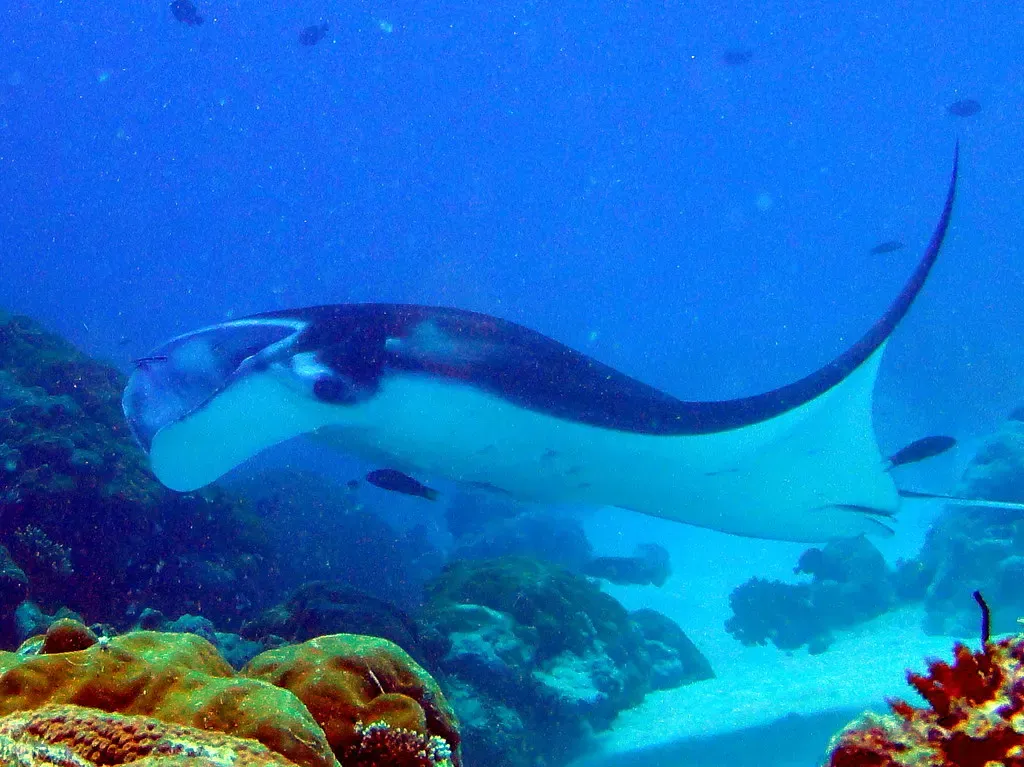
A manta cleaning station at the mouth of a channel cut in 1908
Photo: mattk1979 · CC BY-SA 2.0
German Channel is an artificial cut through the south-west side of Palau's barrier reef, dug around the end of 1908 to shorten the phosphate run from Angaur to Koror. The channel itself is too shallow to dive, so the dive happens at its mouth, on a slope of sand and rocky outcrops that works as a cleaning station for manta rays. Eagle rays, grey reef sharks and heavy schools of fish use the same tidal flow.
Where it is and how deep
7.1272° N, 134.2842° EPublished position for this site.
The dive
You drop in at the south-west mouth of the channel rather than in the channel itself. Descending here, the reef slopes from about 10 m to around 40 m before dropping vertically into the blue. Tidal movement funnels a large volume of water through this relatively tight and very shallow cut, so which way the dive runs, and how much push there is, is decided by the state of the tide when you go in.
The cleaning station is the point of the dive: a sandy area with rocky outcrops where cleaner wrasses and butterflyfish nibble parasites from the skin of manta rays, sharks and large reef fish. Settle on the sand at a distance and wait rather than swimming at the animals. Manta numbers are highest during the mating season between December and March, and eagle rays, grey reef sharks, whitetips and impressive schools of fish work the same water. Tiger sharks have been observed here feeding on dead mantas.
The sand itself is worth reading. Fields of garden eels crane their heads into the current to feed, mantis shrimp scuttle across the floor, jawfish gawp up from their sandy lairs and shrimpgoby partnerships keep house together. Cuttlefish, nudibranchs and crocodilefish are commonly seen here too, so the site gives a photographer something to do on the days the mantas are slow to show.
Background
The channel is artificial. It was cut into the south-west side of Palau's barrier reef by the Germans around the end of 1908, during the period when Palau was a German colony, to connect the lagoon to the Pacific Ocean. The purpose was to shorten the transport route from the island of Angaur, which lies outside the reef and where phosphate was mined, to the port of Koror in the north-east.
Marine life and season
- Manta rays
- Eagle rays
- Reef sharks
- Tiger sharks
- Octopus & cuttlefish
- Nudibranchs
- Macro critters
- Reef fish swarms
| Jan | Feb | Mar | Apr | May | Jun | Jul | Aug | Sep | Oct | Nov | Dec |
|---|---|---|---|---|---|---|---|---|---|---|---|
| Prime | Prime | Prime | Prime | Good | Fair | Fair | Fair | Fair | Fair | Good | Prime |
Season follows Palau: Boats run every month; November to April has the best conditions, and June to December is typhoon season.
Know before you go
- Tidal movement funnels a large volume of water through the cut, so the flow at the mouth can be fast; go in on the tide the crew calls and stay with the group.
- The slope drops vertically past 40 m into open water, which makes it easy to keep following it down; set a hard depth before you descend.
Photos from German Channel
mattk1979 · CC BY-SA 2.0
Luka Peternel · CC BY-SA 4.0
Matt Kieffer from London, United Kingdom · CC BY-SA 2.0
Dive videos
Shark TV - Palau - Diving the German Channel by underwatercam · underWATERcam - Your Window to the Ocean & Nature on YouTube
Manta Rays (with a sequence of a Baby Manta) @ German Channel, Palau HD · gecco01 on YouTube
Questions divers ask
When is the best time to see mantas at German Channel?+
Manta numbers are highest during the mating season, between December and March. They come in to the cleaning station on the sandy slope, where cleaner wrasses and butterflyfish pick parasites off them, so that is where the dive is spent.
How deep is German Channel?+
The published range is 3 to 40 m. The dive starts at the channel mouth, where the reef slopes from about 10 m to around 40 m before dropping vertically, so you choose a depth on the slope rather than committing to the bottom.
Sources
- German Channel — Wikipedia
- Diving in Palau, Micronesia — Dive The World
- Tiger shark — Wikipedia
Photo credits
- A manta ray glides over the reef with coral in the foreground. by mattk1979, CC BY-SA 2.0, via Openverse
- A dense school of fish shoals directly above the coral reef. by mattk1979, CC BY-SA 2.0, via Openverse
- Aerial view of the artificial channel cut through Palau's barrier reef. by Luka Peternel, CC BY-SA 4.0, via Wikimedia Commons
- A cloud of glassfish hovers over a coral head on the reef. by Matt Kieffer from London, United Kingdom, CC BY-SA 2.0, via Wikimedia Commons
In The Logbook
- Drift diving: how to read and ride a currentDrift & current · 8 min read
- Where to dive with manta rays, month by monthBig animals · 8 min read
More dive sites in Palau
Grey reef, whitetip and leopard sharks patrolling a wall into the deep
Hook into the plateau lip and let the sharks stack up off the edge
Cave & cavern
Four holes in the reef top that open into a single large cavern
Cave & cavern
Surfacing inside air-filled limestone chambers under Malakal Island
Wreck
A freighter so thick with lionfish it took their name
Wreck
Rifles, ammunition and helmets still aboard an upright mystery ship
Wreck
Following the mooring line down to the forward tower of an upright fleet oiler
Wreck
A coral-covered Japanese Navy seaplane visible from the surface
Similar dives elsewhere

Every manta in or out passes through one narrow restriction
Mantas and eagle rays in the outer reaches of a tidal cut


.jpg)
Tuna, wahoo and gray reef sharks over a reef bridge
Channel & pass
Avapehi Pass
Huahine · French Polynesia
Adult grey reef sharks breed in the swell-driven current