
Yap · Micronesia · Channel & pass · Drift · Reef
Mi'il Channel
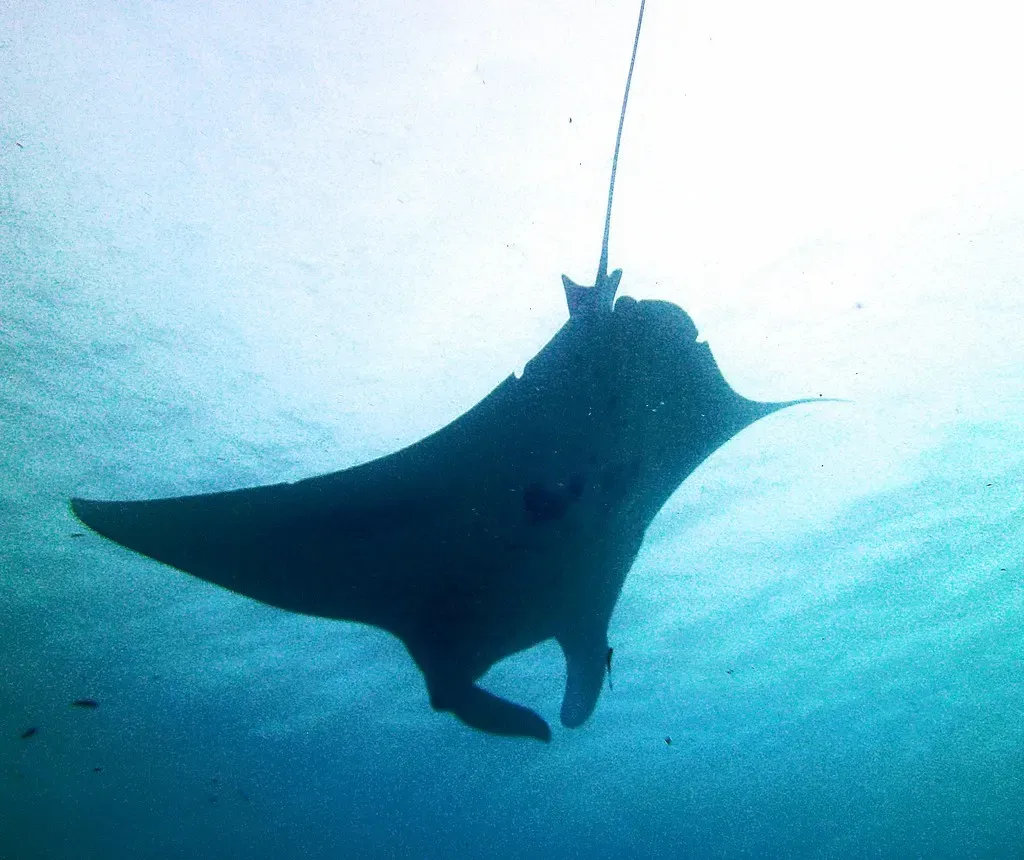
Mantas and eagle rays in the outer reaches of a tidal cut
Area photo: Jeff Hemminger · CC BY-SA 3.0
A tidal cut through Yap's barrier reef, with a sandy coral rubble bottom and vertical coral walls on both sides. Depths run 15 to 30 m, and on an incoming tide the channel becomes a drift down the middle with both walls in sight at once. Mantas, hawksbill turtles, reef sharks and eagle rays are sighted in the outer reaches, and visibility ranges from 9 m to over 30 m.
Also known as Mi'l Channel.
Where it is and how deep
No published position for this site — the map shows Yap and its other sites; operators know the mooring.
The dive
The dive is set by the tide rather than by a departure time. The channel cuts through the barrier reef with a sandy coral rubble bottom and vertical coral walls on either side, and the floor runs between 15 m and 30 m. At slack water the current is barely perceptible and the walls can be worked slowly; the nooks and crannies in them hold lobsters and octopus.
On an incoming tide the same water becomes a drift. You drop in and let the flow carry you down the centre of the channel, close enough to the middle that both sides stay in view at once. Mantas are the reason the boats come, but the outer reaches of the channel are where the rest of the traffic turns up: hawksbill turtles, large barracuda, reef sharks, eagle rays and schools of jacks and snappers.
Timing is the whole dive. The same channel that is barely moving at slack can rip to as much as 4 mph (6 km/h) once the tide changes, so the boat works to the tide table and the window it gives you. Visibility runs from 9 m to more than 30 m. Across the tide cycle the flow moves between 0 and 6 km/h, which is the difference between hanging on the walls and taking a one-way ride down the middle.
Marine life and season
- Manta rays
- Sea turtles
- Reef sharks
- Eagle rays
- Barracuda
- Trevally & jacks
- Octopus & cuttlefish
| Jan | Feb | Mar | Apr | May | Jun | Jul | Aug | Sep | Oct | Nov | Dec |
|---|---|---|---|---|---|---|---|---|---|---|---|
| Prime | Prime | Prime | Good | Good | Fair | Fair | Fair | Fair | Good | Good | Prime |
Season follows Yap: Mantas are present year-round, but the Dec-Mar dry season brings calmer seas and clearer water for photographing the cleaning stations.
Know before you go
- Current swings from barely perceptible at slack to as much as 4 mph (6 km/h) at the tide change; dive the briefed tidal window rather than the boat's convenience.
Dive videos
Yap 2011, Mi'l channel, giant mantas at cleaning station · SCUBADON44 on YouTube
Questions divers ask
How deep is Mi'il Channel?+
The channel runs from about 15 m at the shallow end down to 30 m, over a sandy coral rubble bottom with vertical coral walls on both sides.
When is the current strongest?+
At the tide change, when the flow can rip to as much as 4 mph (6 km/h). At slack water it is barely perceptible, and on an incoming tide it is enough to turn the channel into a drift with both walls in view.
Sources
- Mi'l Channel dive site — Manta Ray Bay Resort / Yap Divers
In The Logbook
- When is slack water? Tides for diversOcean science · 7 min read
- Drift diving: how to read and ride a currentDrift & current · 8 min read
More dive sites in Yap
Channel & pass
Every manta in or out passes through one narrow restriction
Channel & pass
A landing craft, a torpedo and a circus boat in one channel
Three manta cleaning stations in one stretch of channel
Swim-through chimneys lit by skylights in the coral
Similar dives elsewhere
Sharks, jacks and eagle rays on the channel-mouth current
Channel & pass
Avapehi Pass
Huahine · French Polynesia
Adult grey reef sharks breed in the swell-driven current
Channel & pass
Calalin Channel
Majuro & Mili · Marshall Islands
A fast tidal drift past sharks, eagle rays and trevally
.jpeg)
A gentle drift down a sand channel that ends at the drop-off