Santo Antão is a Cabo Verde island whose diving is mostly boat diving along the coast near Porto Novo. The reefs include a labyrinth of walls ringed by white sand, Hanging Garden is a wall hung with gorgonians and black coral, and Atlantis Palace is a big cavern explored from its deepest entrance. Frogfish, nurse sharks and big schools of fish turn up on the dives, and with luck a manta ray or whale shark passes, most likely in autumn.
About diving in Santo Antão
Diving on Santo Antão is mostly boat diving; the exception is the shore dive inside Porto Novo harbour, entered by stairs and usually made at night. Gear crates ride in a pickup from the dive centre in Porto Novo for the short drive to the boat. Depending on wind and waves the ride to the sites takes about 20 minutes, and the farthest site is 50 minutes away. Two dives are made in the morning, with the surface interval on the boat in a quiet spot, and the boat is usually back around 1:30 p.m.; weather allowing, one or two more dives can follow.
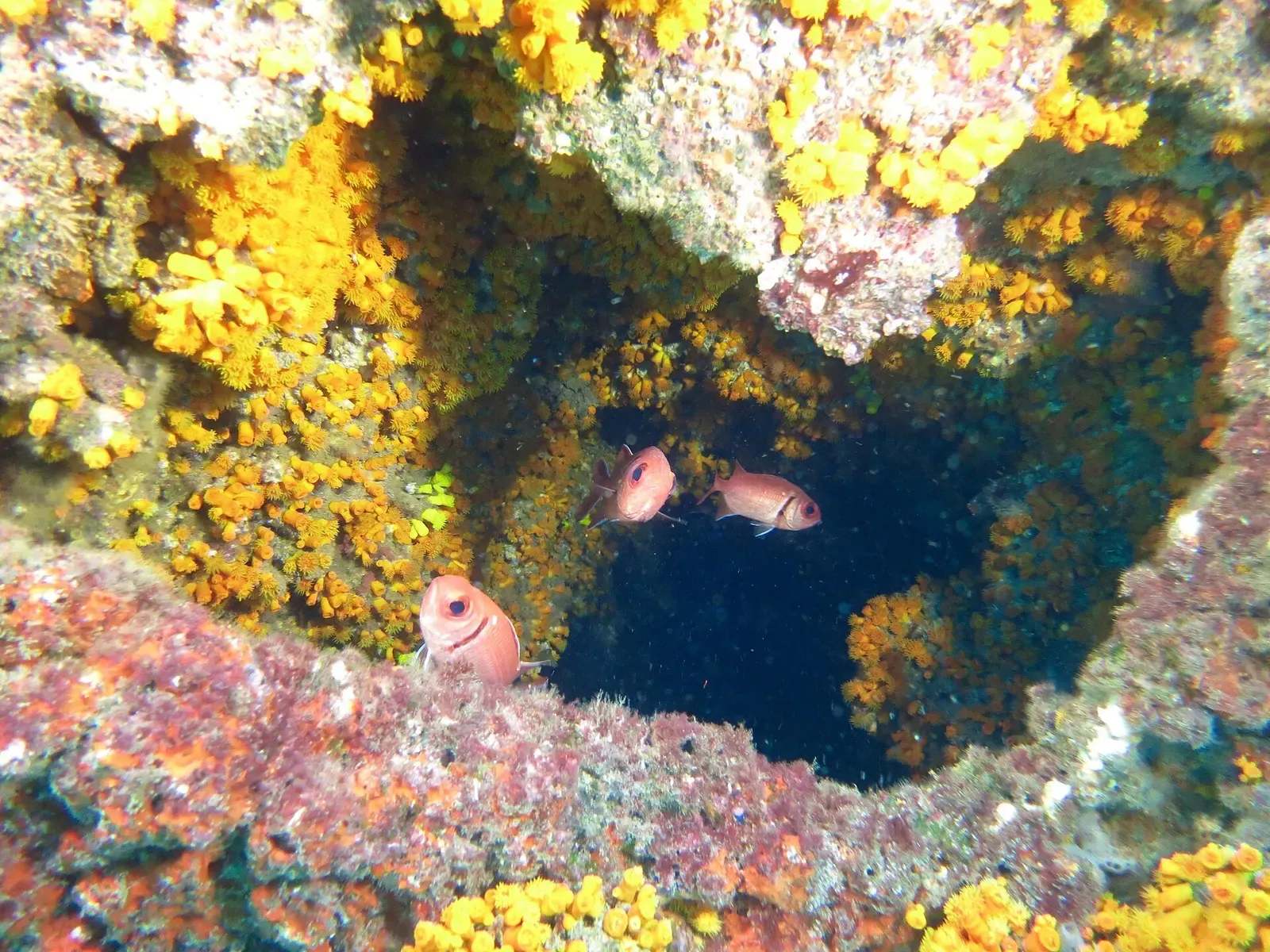
The terrain is mostly rock and white sand. At the labyrinth site the reef rises to 6 m from a sandy bottom at 12 m, and schools of fish gather when the current runs. Hanging Garden and Pared Bitxon start on a sandy descent to a wall drop, at 30 m and 33 m respectively, then climb slowly along the wall edge. Atlantis Palace is a big cavern whose ceiling is covered in yellow coral polyps, with schools of fish moving between its entrances. Trumpetfish, turtles, rays and anglerfish are common sights.
Praia do Vulcão is a calm, relaxed dive along a reef on a sandy descent, and Critters Walk is a slow, shallow search of the reef's small holes for rare animals, aimed at macro photographers. The 30 m drop-off at Praia do Vulcão is made with experienced divers with low air consumption, and at Ponta de Peça the rock wall continues past 40 m. Ponta Tubarão sits on a cape in the channel, where current can pick up around the change of the moon, and the shallow Vapor wreck is often ruled out by sea conditions. A 5 mm or 7 mm wetsuit or a drysuit is the recommended protection.
Best time to dive Santo Antão
| Jan | Feb | Mar | Apr | May | Jun | Jul | Aug | Sep | Oct | Nov | Dec |
|---|---|---|---|---|---|---|---|---|---|---|---|
| Good | Good | Good | Prime | Prime | Prime | Good | Good | Good | Prime | Prime | Good |
Diving runs all year. The first best window opens in April and lasts through May and June. July, August and September stay good for diving. October and November form the second best window: the water is already warm, and autumn gives the greatest chance of a passing manta ray or whale shark. Early December still belongs to the best period, and January to March stay diveable outside the two windows.
Dive types & marine life
Frogfish are the main quarry on day dives in Porto Novo harbour, and nurse sharks, turtles, rays and large schools of fish turn up on the boat sites. Manta rays and whale sharks are a matter of luck; the best chance of either comes in autumn, once the water has warmed.
- Reef
- Wall
- Cave & cavern
- Wreck
- Night
- Muck & macro
- Frogfish
- Reef fish swarms
- Sea turtles
- Manta rays
Best dive sites in Santo Antão
- 1
Wish You Were Here
Labyrinth of reef walls ringed by white sand, from 6 m to 12 m, with schools of fish in current
- 2
Hanging Garden
Sandy, rocky descent to a wall drop at 30 m; the wall is full of gorgonians and black coral
- 3
Atlantis Palace
Big cavern with a sandy floor and yellow coral polyps on the ceiling
- 4
Praia do Vulcão
Calm, relaxed reef dive on a sandy descent, reaching a 30 m drop-off with experienced divers
- 5
Pared Bitxon
Wall drop at 33 m, ascending along the edge with an eye on the blue
- 6
Ponta de Peça
Rocky wall past 40 m at the last point before Tarrafal
- 7
Critters Walk
Shallow, slow reef dive searching small holes for rare animals; suits macro photographers
- 8
Ponta Tubarão
Cape in the channel with boulders sheltering marine life; current around the moon's change
Site guides
Wall
A wall face hung with gorgonians and black coral
Wall
A deep start at the foot of the wall
Wall
Mantas can pass off the cape
Reef
Reef on one side, sand on the other, and a drop-off beyond
A labyrinth of reef walls ringed by white sand
How to get to Santo Antão
Santo Antão cannot be reached by plane. Flights land on São Vicente, where a transfer runs to the ferry hall in Mindelo, and the ferry crosses to Porto Novo in about an hour. Ferry times can mean returning to Mindelo a day early for the last night.
Photos from Santo Antão
MariaCurista · CC BY-SA 4.0
Dive videos
Ilha de Santo Antão Cabo Verde | Mergulho subaquático · Carlos Delgado on YouTube
Questions divers ask
Is diving on Santo Antão from shore or by boat?+
Most dives are boat dives to sites along the coast near Porto Novo. The exception is the shore dive inside Porto Novo harbour, with stairs for entry and exit; it is usually made at night.
What wetsuit is needed for Santo Antão?+
A 5 mm or 7 mm wetsuit or a drysuit is recommended, even though the sea stays between about 23 °C (73 °F) and 27 °C (81 °F) through the year.
Which Santo Antão dives need experience?+
The drop-off at Praia do Vulcão, at 30 m, is made with experienced divers with low air consumption. Critters Walk, by contrast, is a very calm, shallow dive along the reef from the same sandy platform.
Sources
- Dive Sites | Green Turtle — Green Turtle Diving Center
- Santo Antao Art Resort diving holiday — EWDR
- Santo Antao dive sites — Scubago
- Porto Novo Average Sea Temperatures — seatemperature.org
- Santo Antão - Wikivoyage — Wikivoyage
- Green Turtle Diving Center — Green Turtle Diving Center
Photo credits
- Calm blue sea under a clear sky, a harbour breakwater at left and a mountainous island on the horizon by MariaCurista, CC BY-SA 4.0, via Wikimedia Commons
Embed
Run a dive centre, club or blog? Embed this map of 1 dive sites near Santo Antão on your own page.
Similar destinations
A shallow wreck, a cave dive and drifts, all a short boat ride from Mindelo
Atlantic
Tenerife
Spain
Black sand and lava arches metres from shore, with resident pilot whales

Around three hundred charted wrecks, most of them shallower than 20 m


Lava arches, canyons and tunnels reachable from a rocky beach entry