Thunder Bay · United States · Wreck
Montana
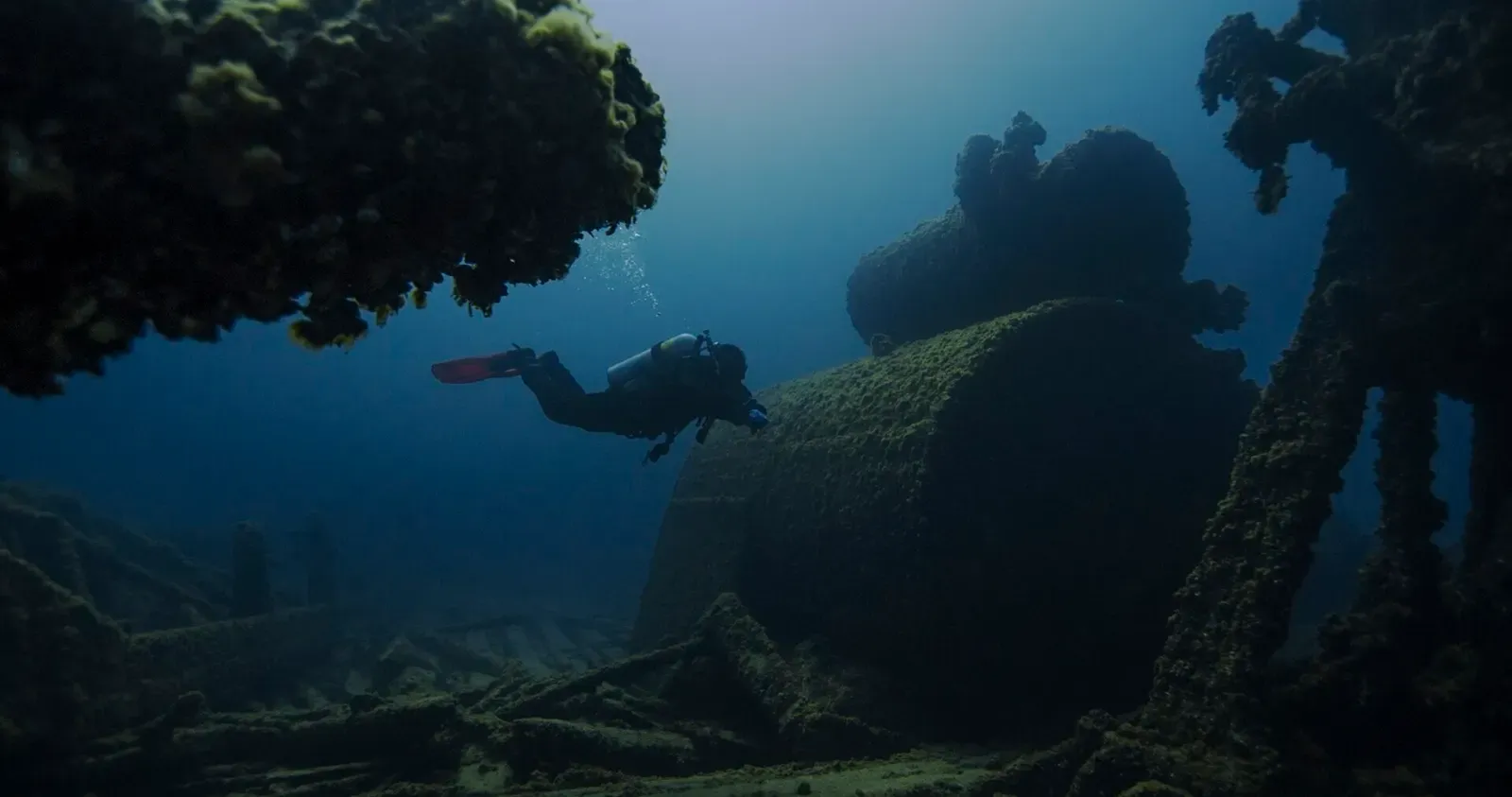
A three-storey steam engine standing intact at 20 m
Photo: National Marine Sanctuaries · Public domain
A 72-metre wooden steam barge that caught fire off Thunder Bay at dusk in September 1914, after more than forty years of work on the lakes. The hull rests in 20 metres and the fire left the machinery standing: a massive boiler, a three-storey steam engine, the drive shaft and the propeller are all intact and still in line. That power train is the reason to dive it.
Where it is and how deep
44.9838° N, 83.2669° WPublished position for this site.
The dive
The wreck rests in 20 metres and the hull is the first thing you meet: a 72-metre run of wooden framing and planking lying on the bottom, with the shape of the barge still legible in it. The fire that sank the ship in 1914 broke out in the bow at dusk and spread rapidly through a hull carrying years of paint, coal dust and lubricants. Orientation is easy — the machinery stands aft, and everything else runs forward from it.
The reason to be here is aft. The power train survived the fire intact and stands more or less as it was fitted: a massive boiler, a steam engine three storeys tall, the drive shaft running back from it and the propeller at the end. Swimming that assembly from boiler to blade is the dive. It is rare to find a lake steamer's machinery still in line like this, and it photographs well with a light behind it.
Twenty metres in Lake Huron is colder and darker than the same depth in the sea, so charters usually run this as the deeper dive of the day and follow it with something shallow. Carry a torch even in midsummer, plan the swim aft before you descend, and leave the machinery alone — everything inside Thunder Bay National Marine Sanctuary is protected and stays where it lies.
The wreck
- Vessel
- Montana
- Type
- Wooden steam barge
- Length
- 72 m (236 ft)
- Built
- 1872
- Sunk
- 1914
- Cause
- Fire broke out in the bow at dusk while the ship was passing Thunder Bay, and spread rapidly
- Lies
- In 20 m with the power train intact: boiler, three-storey steam engine, drive shaft and propeller
Montana was launched in 1872 by Muir and Livingston at Port Huron, Michigan. Built for speed, it initially carried all types of freight and passengers, and was later converted to the lumber trade, staying in service more than forty years. On 6 September 1914, as it passed Thunder Bay at dusk, fire broke out in its bow and spread rapidly. The ship burned and sank, and today the hull rests in 20 metres with its machinery still standing.
Marine life and season
The sources we used don't single out particular species here.
| Jan | Feb | Mar | Apr | May | Jun | Jul | Aug | Sep | Oct | Nov | Dec |
|---|---|---|---|---|---|---|---|---|---|---|---|
| Off-season | Off-season | Off-season | Off-season | Fair | Good | Prime | Prime | Prime | Fair | Off-season | Off-season |
Season follows Thunder Bay: The season runs late May to early October, with July and August warmest; the lake is unworkably cold and rough otherwise.
Know before you go
- Twenty metres of cold fresh water eats bottom time and gas faster than divers used to warm water expect; agree a turn pressure before the descent, not at the propeller.
- The hull is broken wooden structure with heavy machinery standing over it: there is nothing to penetrate, and careless fin strokes will take the visibility away from whoever is behind you.
Questions divers ask
How deep is the Montana shipwreck?+
The wreck rests in 20 metres of water off Thunder Bay. That is deeper than most divers want for a first cold-water dive, so it is usually run as the deeper tank of a two-dive day, with a drysuit and a torch.
What can you see on the Montana?+
The fire that sank it in 1914 left the power train intact: a massive boiler, a steam engine three storeys tall, the drive shaft and the propeller, all still in line. The wooden hull around them lies on the bottom as framing and planking, with the barge's outline still legible.
Sources
- Montana Shipwreck — NOAA Thunder Bay National Marine Sanctuary
Photo credits
- Diver swims beside mossy wooden wreckage of the steam barge Montana in dark Lake Huron water by National Marine Sanctuaries, Public domain, via Wikimedia Commons
In The Logbook
- Cold-water diving: is it worth the drysuit?Cold water · 8 min read
- Freshwater diving: lakes, springs and quarriesFreshwater · 15 min read
More dive sites in Thunder Bay
Wreck
Ghost schooner upright at 56 m, masts still standing
Wreck
Steering wheel and chained windlass on a broken schooner
Wreck
The sanctuary's largest wreck, 162 m and inverted
Wreck
An intact 1848 schooner on an even keel at 56 m
Wreck
Three masts still on deck at 63 m
Upright steel freighter with engine and boilers still in place
Wreck
A Great Lakes freighter lying inverted at 53 m
An 1862 schooner in 18 m on a mooring buoy
Similar dives elsewhere
Wreck
C-54 Agustin Melgar wreck
Loreto Bay National Park · Mexico
A WWII minesweeper sunk for divers, with easy penetrations
A scuttled navy hull in about 18 m of island water


A 1940 Lunenburg schooner scuttled for divers at 17 m
Wreck
Dredge #906
Milwaukee & Port Washington · United States
Upturned 1956 dredge barge with room to swim beneath it