
Thunder Bay · United States · Wreck · Freshwater
Norman
Pilothouse and engine room intact at 61 m
Area photo: NOAA's National Ocean Service · CC BY 2.0
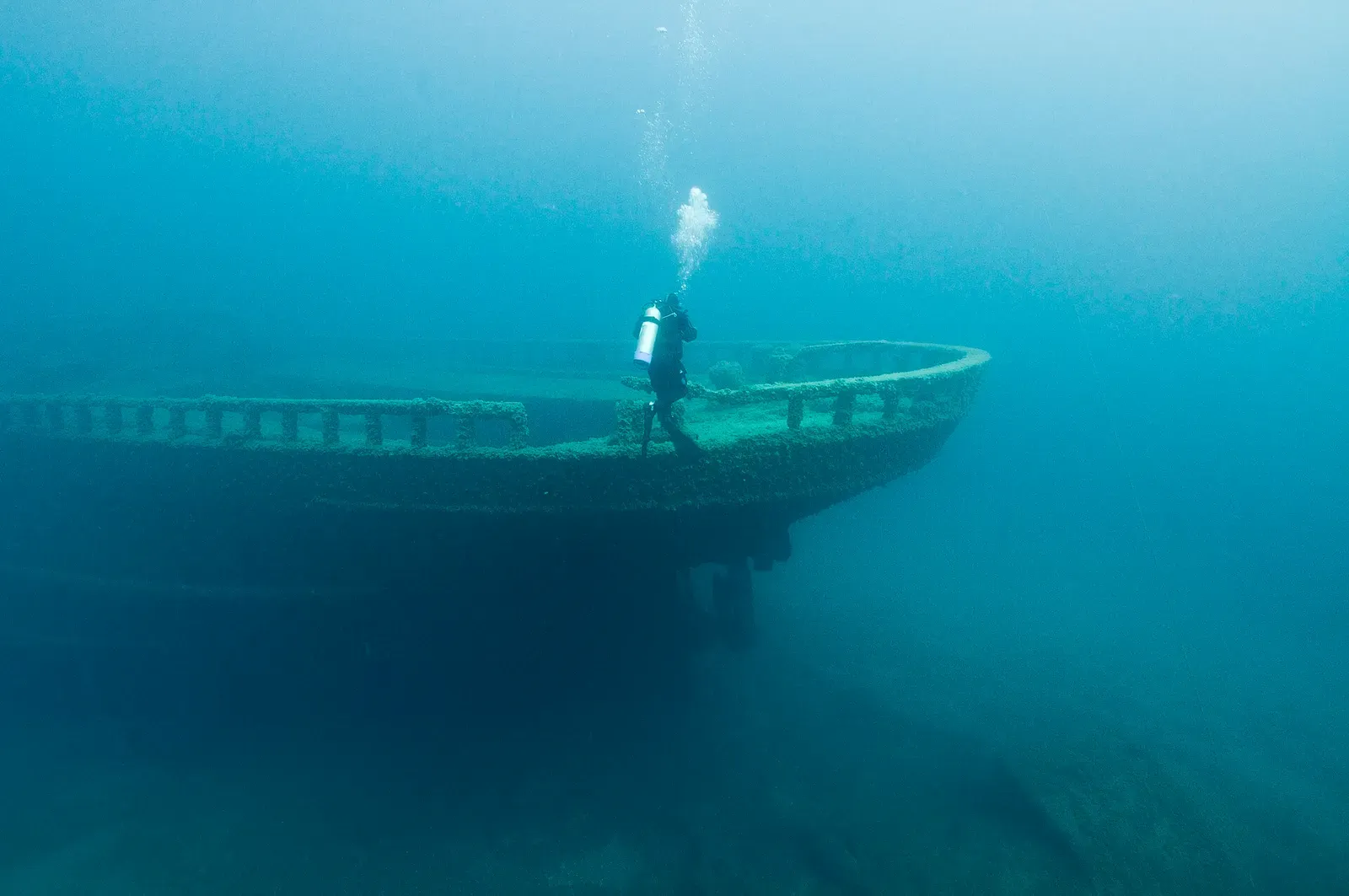
A 90-metre (296-foot) bulk freighter that sank in three minutes in 1895 when another ship put a hole in her side in fog, and one of the sanctuary's more popular technical dives. Between 52 and 61 m the cold has preserved her nearly intact, with the forward pilothouse, open cargo deck, stern cabin and engine room all still readable as parts of a ship.
Where it is and how deep
45.3116° N, 83.2789° WPublished position for this site.
The dive
The Norman lies between 170 and 200 feet (61 m), dark and cold and nearly complete, and the layout of a nineteenth-century Great Lakes freighter is set out below you in order: forward pilothouse, open deck with evenly spaced cargo holds, stern cabin, engine room aft. Working forward to aft along the deck is the natural route, and it is about as much as the bottom time allows on a single dive.
The pilothouse standing forward is the shot most divers come for, and the preservation behind it is why NOAA calls this a popular site for technical divers — the cold water of Lake Huron has held the ship together in a way the sea never does. Her yawl boat lies in the sand beside the hull, a reminder that three of her crew never got off. Nothing here is penetrated casually and nothing is removed. Deco on the way up runs far longer than the time spent on the ship.
The wreck
- Vessel
- Norman
- Type
- Bulk freighter with forward pilothouse
- Length
- 90 m (295 ft)
- Built
- 1890
- Sunk
- 1895
- Cause
- Collided with the freighter Jack in fog, which holed her side; she sank within three minutes
- Lies
- Nearly intact and preserved by cold water, pilothouse and engine room in place
The Norman was launched in 1890 by Globe Iron Works at Cleveland, Ohio, a 90 m bulk freighter (296 ft). On 30 May 1895, steaming north in fog past Presque Isle, she collided with the freighter Jack; Jack's bow punched an immense hole into Norman's side while most of her crew slept in their berths, and she went down within three minutes, taking three of them with her. The cold water of Lake Huron has left her nearly intact, still showing the distinctive Great Lakes arrangement of forward pilothouse, open cargo deck, stern cabin and engine room.
Marine life and season
The sources we used don't single out particular species here.
| Jan | Feb | Mar | Apr | May | Jun | Jul | Aug | Sep | Oct | Nov | Dec |
|---|---|---|---|---|---|---|---|---|---|---|---|
| Off-season | Off-season | Off-season | Off-season | Fair | Good | Prime | Prime | Prime | Fair | Off-season | Off-season |
Season follows Thunder Bay: The season runs late May to early October, with July and August warmest; the lake is unworkably cold and rough otherwise.
Know before you go
- An intact ship at 61 m invites penetration it does not forgive: the pilothouse, cabin and engine room are overhead environments needing their own training.
Questions divers ask
Why is the Norman popular with technical divers?+
She is nearly intact at 61 m — cold fresh water has preserved the forward pilothouse, open cargo deck, stern cabin and engine room, so the whole layout of an 1890 Great Lakes freighter is still readable.
Sources
- Norman — NOAA Thunder Bay National Marine Sanctuary
More dive sites in Thunder Bay
Wreck
Ghost schooner upright at 56 m, masts still standing
Wreck
Steering wheel and chained windlass on a broken schooner
Wreck
The sanctuary's largest wreck, 162 m and inverted
Wreck
An intact 1848 schooner on an even keel at 56 m
Wreck
Three masts still on deck at 63 m
Upright steel freighter with engine and boilers still in place
Wreck
A Great Lakes freighter lying inverted at 53 m
An 1862 schooner in 18 m on a mooring buoy
Similar dives elsewhere
Remains of the largest wooden steamer on the Great Lakes, in 5 m
Bowsprit still extending from an 1852 hull at 32 m
Wreck
Bermuda
Alger Underwater Preserve & Munising · United States
Upright 1870 schooner with open cargo hatches and schools of rock bass

.jpg)
A 1940 Lunenburg schooner scuttled for divers at 17 m