Cabo de Palos & Islas Hormigas · Spain · Wreck
Naranjito
Intact 1946 orange freighter, forecastle at 28 m, stern at 45
Photo: Diego Delso · CC BY-SA 4.0
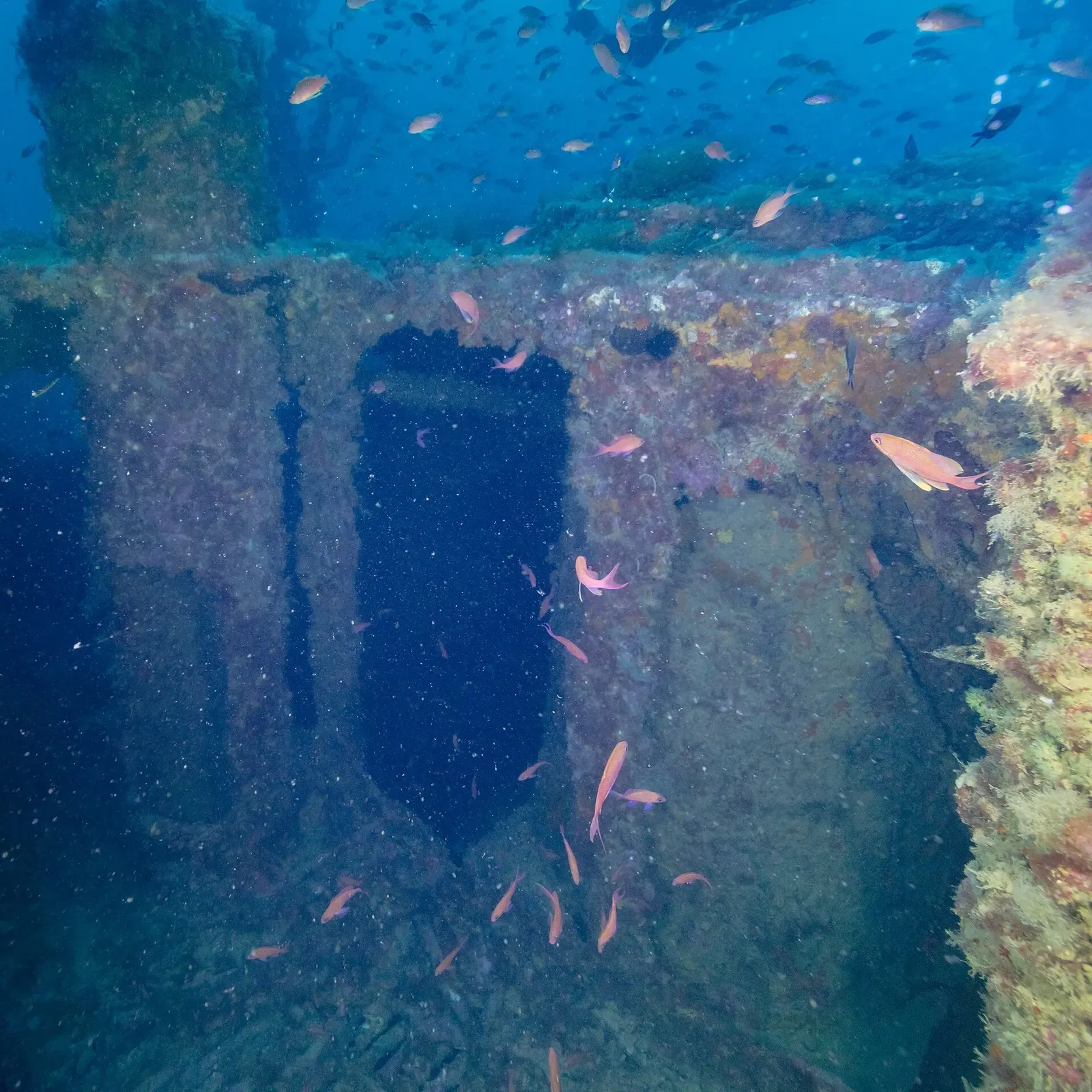
A 51-metre merchant ship that went down on her April 1946 voyage carrying a cargo of oranges, which is where the local name comes from. She lies on a sandy bottom off Cabo de Palos, heeled slightly to starboard, bow at 42 metres and the bottom of the stern at 45. PADI puts the hull in excellent condition, with the engine room and the holds open to divers trained for penetration.
Also known as El Naranjito.
Where it is and how deep
37.6299° N, 0.6770° WPublished position for this site.
The dive
The shallowest structure on the ship is the forecastle deck, at around 28 metres, and it is the natural reference point for the rest of the dive. From there the hull runs down onto a sandy bottom, the bow sitting at 42 metres and the bottom of the stern at 45, with the ship heeled slightly over to starboard rather than square on her keel. PADI quotes 42 metres as the maximum depth for the site, so the profile is planned around the deck and the bow rather than the deepest point of the stern.
The vessel is 51 metres long and, on PADI's description, in excellent condition, with the engine room and the holds open enough to serve as a first taste of wreck penetration for divers trained for it. The training PADI lists as useful here runs from Advanced Open Water, Deep, Wreck and Enriched Air through Full Face Mask and Discover Tec to Tec 40, 60 and 100 and closed-circuit rebreather courses, which is a fair measure of how much planning and gas the depth asks for.
PADI lists barracuda, groupers, amberjack, moray eels and sunfish as the common sightings here. Barracuda, amberjack and groupers work the water around the structure and morays take to the metal, which is the pattern on most Mediterranean wrecks of this size. Sunfish are the outlier on that list: an open-water animal, more likely met in the blue on the ascent than anywhere over the deck. Nothing further about the marine life on this wreck is published.
The wreck
- Vessel
- Naranjito
- Type
- Merchant cargo vessel
- Length
- 51 m (167 ft)
- Sunk
- 1946
- Cause
- Lost on her April 1946 voyage; the cause is not recorded in the available sources
- Lies
- On sand, heeled slightly to starboard, bow at 42 m and the bottom of the stern at 45 m
The ship is known locally as El Naranjito for the cargo of oranges she was carrying on the fatal voyage of April 1946. She is named with the Sirio and the Nord America among the notable wrecks of these waters, lies largely intact, and is among the most frequently dived wrecks of the area. The marine reserve declared around the Islas Hormigas in 1995 protects several historic shipwrecks along with the system of submerged seamounts and rocky reefs.
Marine life and season
- Groupers
- Barracuda
- Trevally & jacks
- Mola mola
| Jan | Feb | Mar | Apr | May | Jun | Jul | Aug | Sep | Oct | Nov | Dec |
|---|---|---|---|---|---|---|---|---|---|---|---|
| Fair | Fair | Fair | Good | Good | Prime | Prime | Prime | Prime | Prime | Good | Fair |
Season follows Cabo de Palos & Islas Hormigas: Jun–Oct has the warmest water and the calmest crossings; winter is clearest but cold, and easterly winds close the seamounts year-round.
Know before you go
- The shallowest structure sits at 28 m and the stern bottoms out at 45, so plan it as a decompression dive and carry the gas and training for the depth rather than relying on a short bottom time.
- The engine room and holds are penetration rather than swim-throughs: overhead training, a reel and a light before anyone goes inside.
Photos from Naranjito
Diego Delso · CC BY-SA 4.0
Diego Delso · CC BY-SA 4.0
Diego Delso · CC BY-SA 4.0
Dive videos
Bucear en el Naranjito - Cabo de palos · Viaja Por libre on YouTube
Inmersión en el Pecio Naranjito · Divers Cabo de Palos on YouTube
Questions divers ask
How deep is the Naranjito?+
The forecastle deck is at around 28 metres, the bow sits at 42 and the bottom of the stern at 45. PADI quotes 42 metres as the site's maximum depth, so the profile is normally planned around the deck and the bow.
What training do I need for the Naranjito?+
PADI lists Advanced Open Water, Deep, Wreck and Enriched Air as useful training for the site, along with Discover Tec, Tec 40, 60 and 100 and rebreather courses. The engine room and holds are penetration, so overhead training is needed to go inside.
Can you dive the Naranjito from shore?+
No. PADI records boat as the entry for the site. Diving inside the Cabo de Palos and Islas Hormigas reserve is permitted only through authorised dive centres and under a daily cap on the number of divers.
Sources
- Naranjito dive site — PADI
- Cape Palos — Wikipedia
Photo credits
- Sunlit wreck hull opening with small fish, seen from below in blue water by Diego Delso, CC BY-SA 4.0, via Wikimedia Commons
- Encrusted wreck deck with two dark openings and small fish overhead by Diego Delso, CC BY-SA 4.0, via Wikimedia Commons
- Conger eel peering out of an encrusted porthole on the wreck by Diego Delso, CC BY-SA 4.0, via Wikimedia Commons
- Conger eel looking out from a second porthole framed by soft corals by Diego Delso, CC BY-SA 4.0, via Wikimedia Commons
In The Logbook
- Sunfish diving: where and when to see a molaBig animals · 11 min read
- Air, nitrox or trimix: which gas, and when?Gear & kit · 15 min read
More dive sites in Cabo de Palos & Islas Hormigas
A rock needle to 3 m, with a conger cave at 22 m on its east side
Seamount
A submerged mountain from 55 m to 3 m, four hulls on its flanks
Reef
Blocks, caves and furrows in the south face that took ships' anchors
Pinnacle
A rock spine with a crest at 12 m and groupers along its length
Gorgonians on the vertical north wall of a submerged island
Pinnacle
A steep gorge to 25 m holding the remains of an old anchorage
Steps from the lighthouse car park into the cape's main shore dive
Reef
Shallow cove diving at the foot of the Cabo de Palos lighthouse
Similar dives elsewhere
A sunken fish farm hanging at an angle from 12 m to 35 m
Groupers hold in the frames of a scuttled minesweeper
A 110 m steamship with her deck at 30 m and the sand at 40


,_pecio_Naranjito,_Cabo_de_Palos,_Espa%C3%B1a,_2022-07-16,_DD_01.jpg)
,_pecio_Naranjito,_Cabo_de_Palos,_Espa%C3%B1a,_2022-07-16,_DD_12.jpg)
A 50 m ferry upright at 41 m, reached by a giant stride from the rocks