The short answer
Inside 30 metres (100 feet), air works and nitrox works better. Between 30 and 40 metres, nitrox is often the thing that makes the dive worth doing — and it is also where its own oxygen ceiling starts to close in. Past 40 metres the honest answer stops being nitrox and becomes helium. Those three cover almost every dive almost everybody does.
That is the spine of it, not the whole list. Between air and trimix sit half a dozen working mixes — enriched air in a range of blends, decompression nitrox, pure oxygen, heliair, light-helium mixes sold as Helitrox or Triox — and beyond trimix are the gases of commercial and saturation diving: heliox, hydreliox, hydrox, neox. Each one exists because somebody hit a wall the previous gas could not get past. All of them are below, along with argon, which technical divers carry and never breathe.
There are only three problems any breathing gas has to solve, and they pull against each other. Nitrogen dissolves into you and has to come back out on a schedule, and on the way it makes you slow and stupid. Oxygen, which you cannot dive without, becomes a convulsive poison above a certain partial pressure. And the whole mixture gets denser as you descend, until moving it in and out of your chest costs more than the dive is worth. Choosing a gas is choosing which of those three you would rather fight on a given dive.
What is actually in the tank
Air is 21 per cent oxygen, 78 per cent nitrogen and about 1 per cent other gases, mostly argon. What changes underwater is not the mixture but the pressure. At 30 metres you are breathing at four times atmospheric pressure, so every gas in the tank arrives at your lungs at four times the partial pressure it had on the surface: the oxygen at 0.84 bar, the nitrogen at a little over 3 bar.
Those partial pressures, not the percentages, are what your body responds to. Nitrogen at 3 bar loads your tissues roughly four times faster than it does at the surface, which is why no-stop time collapses with depth. Oxygen is benign at 0.21 bar and dangerous at 1.6, and the number that matters is the product of the fraction and the depth. And density scales the same way: air at 40 metres is five times as dense as the air in the room you are reading this in, close to the point at which carbon dioxide starts to build up faster than you can ventilate it out, whatever your fitness.
Every named gas below is an attempt to move one of those three numbers in your favour, and each one moves at least one of the others against you.
Air: still the default, and honestly fine
Air is free, universal, needs no course and needs no analysis. Every compressor on every dive boat makes it. For the enormous majority of diving — reefs at 12 to 25 metres, two or three dives a day, no decompression — it is a perfectly good gas and nothing else buys you much.
Its limits are real, though, and they arrive fast. On the NOAA air table a single no-stop dive gets 60 minutes at 18 metres, 25 minutes at 30 metres and 10 minutes at 40. Narcosis is measurable from about 30 metres in most divers and unmistakable by 40. And the recreational depth limit of 40 metres is, not coincidentally, close to where the gas itself becomes hard work to breathe.
Deep air — taking a 21 per cent mix below 40 metres — was standard practice for decades and has not entirely gone away. Our own site notes record the reality: at Punta Sur in Cozumel, where the Devil’s Throat tunnel is entered at about 30 metres and opens onto the wall at roughly 41, most divers on the site are breathing compressed air rather than trimix, at exactly the depth where narcosis is worst and there is no shallow reef to sit on while a computer clears. It is dived that way every day. That does not make it the right gas; it makes it the available one.
Nitrox: bottom time, not magic
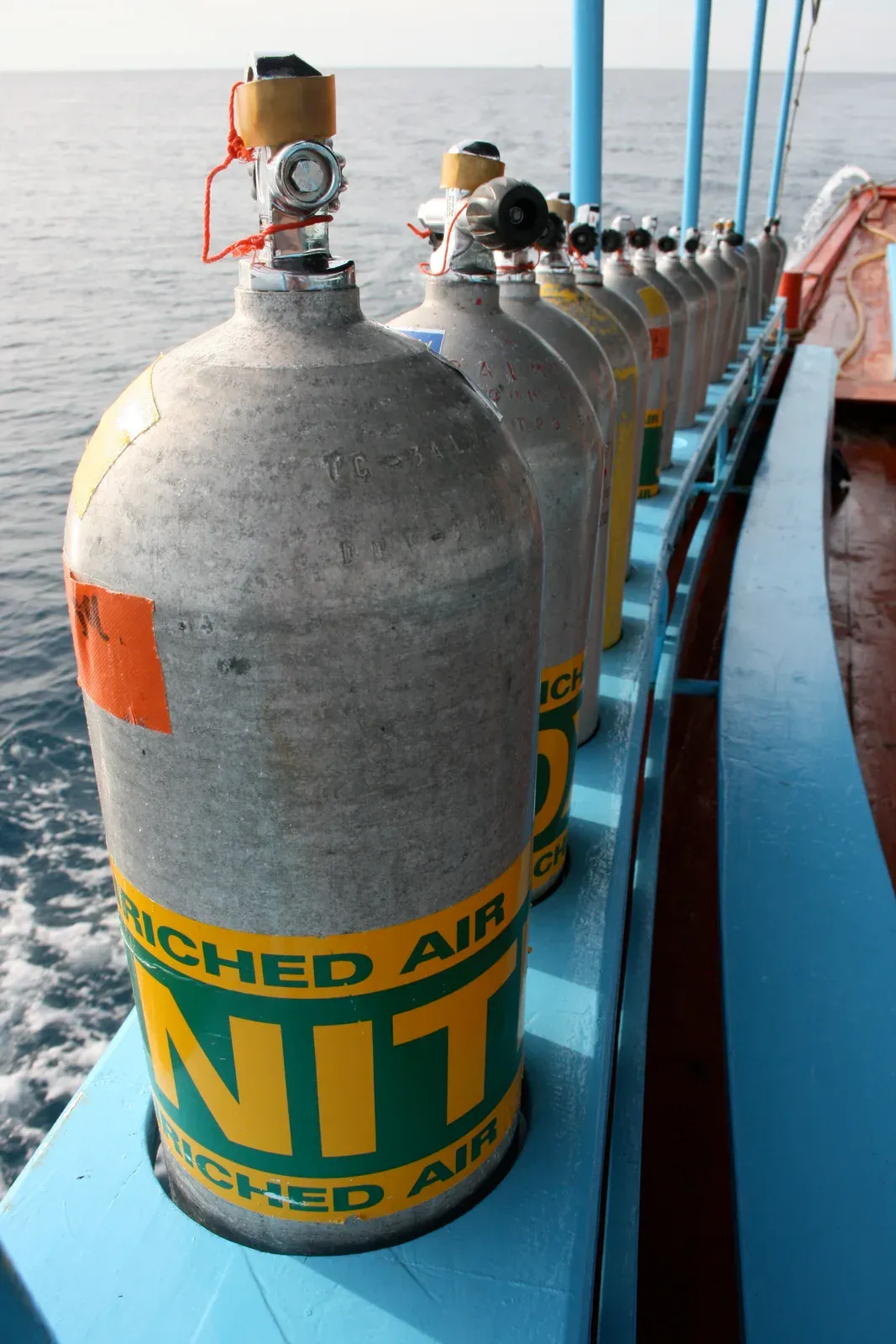
Enriched air nitrox is air with some of the nitrogen replaced by oxygen, normally 32 or 36 per cent oxygen. Less nitrogen going in means less nitrogen to come out, and the whole benefit follows from that one sentence.
The size of the benefit is worth being concrete about. At 30 metres, EAN32 loads your tissues as though you were at about 24 metres on air — the “equivalent air depth” your tables and computer work from. On the NOAA table that turns 25 minutes of no-stop time into 39. At 24 metres, EAN36 turns 39 minutes into about an hour. The gain is largest exactly where recreational diving hurts most: the 25-to-35-metre band, and the second, third and fourth dives of a day, when residual nitrogen rather than depth is what ends the dive.
That is why nitrox has become standard stock on tropical day boats and is included in the price on many liveaboards. It is worth taking on the 38-metre tanker Shinkoku Maru in Chuuk Lagoon, on Habagat at 37 metres off Panglao, on the Alma Jane at 30, and on any site where the whole dive is spent deep with no shallow section to off-gas on — Punta Maria at Cocos, where you are at 18 metres or below from start to finish, is the type case.
There is a second, quieter way to spend the same fill: dive nitrox and plan on air. Same bottom time, same profile, but a real margin against a cold, hard, hungover or dehydrated day. Divers who have had a decompression hit, or who are simply over 50 and doing four dives a day, tend to end up here.
What nitrox does not do is worth saying plainly. It does not let you go deeper — it does the opposite. It does not meaningfully clear your head at depth. And the “less tired afterwards” effect that everyone reports has never shown up reliably in controlled trials; if you feel better after a week of nitrox, the extra bottom time and the wider margins are a sufficient explanation.
The oxygen ceiling, and the discipline that comes with it
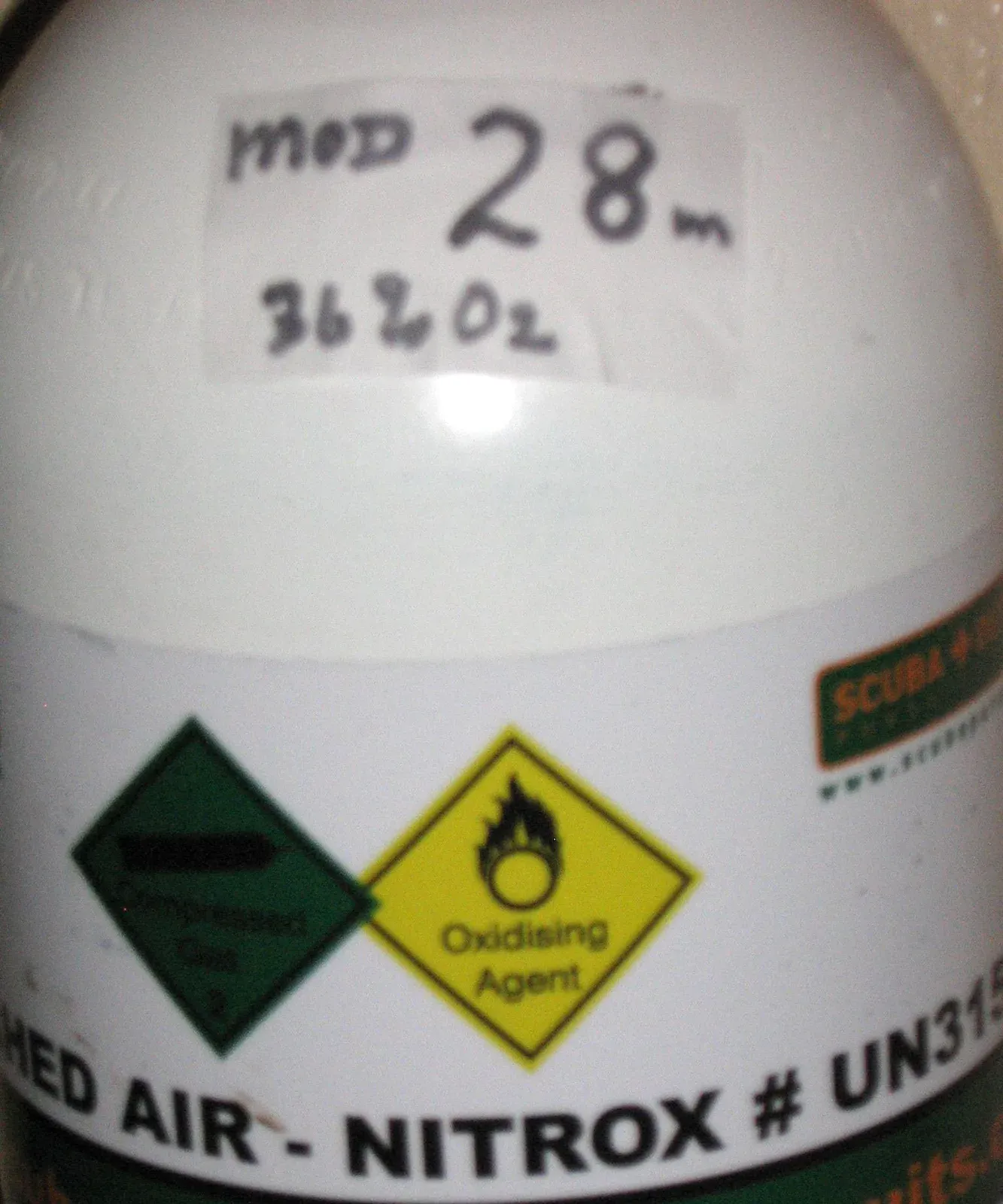
The price of enriched air is a hard depth limit. The working limit for oxygen partial pressure is 1.4 bar for the bottom phase of a dive, with 1.6 reserved for decompression stops and contingencies. Divide and you get a maximum operating depth: 33 metres on EAN32, 28 metres on EAN36. EAN36 is a 25-metre gas. EAN32 is a 30-metre gas. Take either past its MOD and you are gambling on an oxygen seizure, which underwater is not survivable in any useful sense.
Exposure time matters as well as depth. NOAA allows 150 minutes of single-exposure oxygen at 1.4 bar but only 45 minutes at 1.6, and on a week of four-dive days the cumulative load — the “CNS clock” your computer tracks — is a real constraint rather than a theoretical one.
Which leads to the part of nitrox diving that no course can make optional. You analyse every fill yourself, with an analyser, before the cylinder leaves the shop; you write the mix and the MOD on the tank; you sign the fill log. The reason is not bureaucratic. A Divers Alert Network account of a wreck charter describes an instructor picking up someone else’s 50 per cent bailout cylinder in mistake for his own 32 per cent pony bottle — the sort of error that a strip of tape and thirty seconds with an analyser is designed to catch. Above 40 per cent oxygen, cylinders and valves also need to be oxygen-clean, which is why most sport fills stop at 36.
Trimix: buying back your head
Somewhere around 40 metres the sums stop working. Air is too narcotic and too dense; nitrox would fix the nitrogen but its oxygen fraction is already over its ceiling at that depth. The only remaining lever is to put something in the tank that is neither nitrogen nor oxygen. That something is helium, and the result is trimix — oxygen, helium and nitrogen in whatever proportion the depth demands.
Helium is not narcotic in the way nitrogen is, and it is much lighter, so it solves two problems at once. Mixes are named by their oxygen and helium fractions: 21/35 is 21 per cent oxygen and 35 per cent helium, with the balance nitrogen. Anything with 18 per cent oxygen or more is “normoxic” and can be breathed from the surface; 18/45 is a classic 50-to-60-metre gas. Below that, the oxygen fraction has to come down to keep the partial pressure survivable at depth, and a 15/55 or 12/60 mix is genuinely hypoxic — you cannot breathe it at the surface at all, and the dive needs a separate travel gas for the first part of the descent.
The narcosis maths is as simple as the MOD maths. Equivalent narcotic depth is the depth multiplied by the non-helium fraction, adjusted for the surface atmosphere: on 18/45 at 60 metres your head is at about 28 metres. Most technical training aims to keep END at or under 30 metres, which is roughly the point where task loading and narcosis stop compounding each other.
Not all trimix is blended to order. Heliair is the cheap version: helium added to air, with no pure oxygen involved, so the oxygen and nitrogen stay locked in their 21-to-79 ratio and only the helium fraction is chosen. It blends in minutes on any compressor with a helium bank, and the price of that convenience is that you take whatever oxygen fraction falls out of the sum. At the other end, Helitrox or Triox is trimix with the helium turned down rather than up: a modest helium fraction added to a nitrox mix, taught as a course of its own, and aimed squarely at the 30-to-45-metre band where divers want a clear head and a little decompression rather than a full technical dive.
Helium costs you elsewhere. It is expensive and, in some parts of the world, intermittently scarce. It conducts heat several times better than nitrogen, so you get cold faster and drysuit divers often inflate with argon instead. It saturates and desaturates quickly, which changes the shape of decompression rather than shortening it, and switching between helium-rich and nitrogen-rich mixes at the wrong moment can drive gas into tissues rather than out of them. And it makes you sound ridiculous, which matters more than you would think when the whole dive runs on clear communication.
Decompression gases: oxygen on the way up
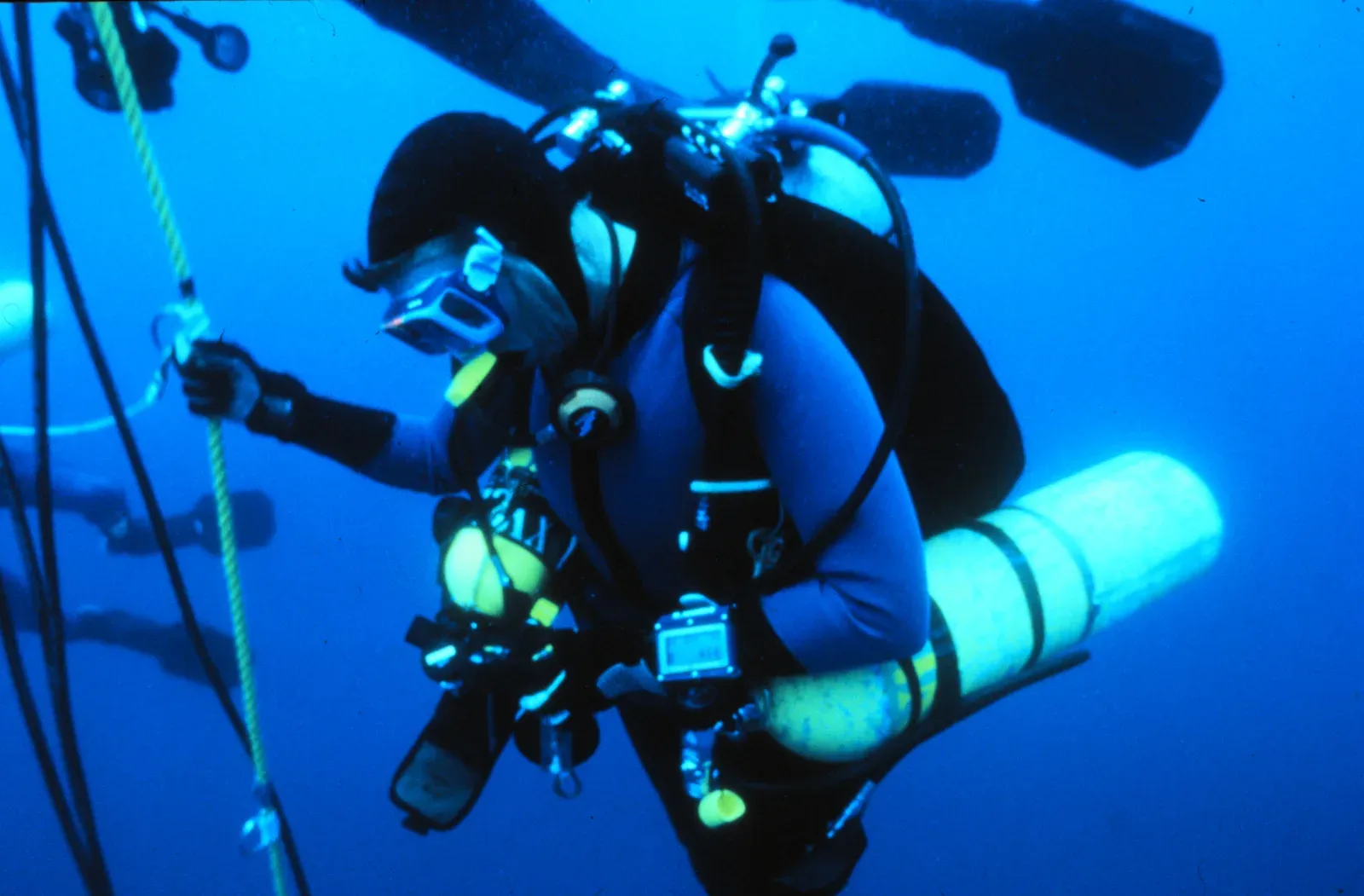
Bottom gas is only half a technical dive’s gas plan. The other half is what you breathe on the ascent, and there the goal reverses: you want the highest oxygen fraction the depth will allow, because the bigger the gradient between the inert gas in your tissues and the inert gas in your lungs, the faster you off-gas.
In practice that means EAN50 from 22 metres — its MOD at the 1.6 bar decompression limit — and pure oxygen from 6 metres. A staged 60-metre dive might therefore involve three gases: trimix on the bottom, 50 per cent through the middle stops, oxygen at the last one. Each switch is a place to die if it is done wrong: breathing 50 per cent at 40 metres is a 2.5 bar oxygen exposure. Hence the ritual — analyse, label with the MOD in figures big enough to read at arm’s length in bad visibility, and confirm the switch with your buddy, at the stop, before the regulator goes in your mouth.
Past trimix: heliox, hydrogen and neon
Below about 100 metres, and in the commercial world generally, the mixes change again.
Heliox is oxygen and helium with the nitrogen taken out entirely. No narcosis at all and a very light gas to breathe, which is why it is the standard mixture for deep offshore saturation diving, where teams live under pressure for weeks and work from a bell. It is expensive, it makes divers cold, and past roughly 150 metres it runs into high pressure nervous syndrome — tremor, dizziness and difficulty concentrating, caused by pressure itself rather than by any gas. The counter-intuitive fix is to add a little nitrogen back: a few per cent of the narcotic gas suppresses the shakes, which is one of the odder trade-offs in diving physiology.
Hydrogen is the answer at depths where even that stops working, and it has the longest and strangest history of any diving gas. The Swedish engineer Arne Zetterström dived hydrox — 96 per cent hydrogen and 4 per cent oxygen — to 160 metres in a series of sea dives in 1943 and 1944, and was killed in August 1945 when his support crew misread his signals and raised him far too fast. That 4 per cent is the whole problem: hydrogen and oxygen are explosive together in almost any other proportion, so the mix is only safe once the oxygen fraction is too low to breathe at the surface. Comex picked the thread up in the 1980s. Its divers worked at 534 metres in the Mediterranean on hydrogen-based mixes in 1988, and in 1992 Théo Mavrostomos spent two hours at a simulated 701 metres in a chamber breathing hydreliox, hydrogen with helium and oxygen. The hydrogen is there to hold down HPNS and to make an extremely dense environment breathable.
Neox or neonox, oxygen and neon, was tried in commercial diving because neon is barely narcotic and does not distort the voice the way helium does. It is rarely used now: neon is very expensive, and the decompression sickness it produces has a bad reputation among the people who have had it.
None of these will ever be in a cylinder handed to you on a dive boat. They are worth knowing about because they show where the logic of gas choice ends up when you keep following it down.
Oxygen, argon and the gases nobody plans for
Oxygen, at 100 per cent, has two homes: the final decompression stop at 6 metres, and the first aid kit. Surface oxygen is the single most useful thing anyone can do for a suspected decompression injury before a chamber, and an operator that carries a proper kit and knows how to use it is telling you something about the whole operation. Military oxygen rebreathers use it as the only gas, which is why those units are limited to a few metres.
Argon turns up in technical kit and never in the breathing loop. It is a poor conductor of heat, which makes it a good drysuit inflation gas for divers whose breathing gas is helium-based and whose suit would otherwise be filled with the most heat-stealing gas available. It is also considerably more narcotic than nitrogen. The bottle is deliberately small, deliberately labelled and deliberately not plumbed into anything you breathe.
Carbon dioxide is the gas you make rather than carry, and on a rebreather it is the one the scrubber exists to remove. Dense gas, hard work and a tired scrubber all push it up, and hypercapnia is the failure that turns a manageable problem into a fatal one because it destroys judgement first.
Badly filled air deserves a mention as the gas nobody chooses. Carbon monoxide from a compressor intake sitting downwind of an exhaust is rare but real, and its effects scale with depth like everything else. It is the one contaminant a fill station’s discipline — intake placement, filter changes, periodic air testing — actually prevents.
Rebreathers: the gas mixes itself
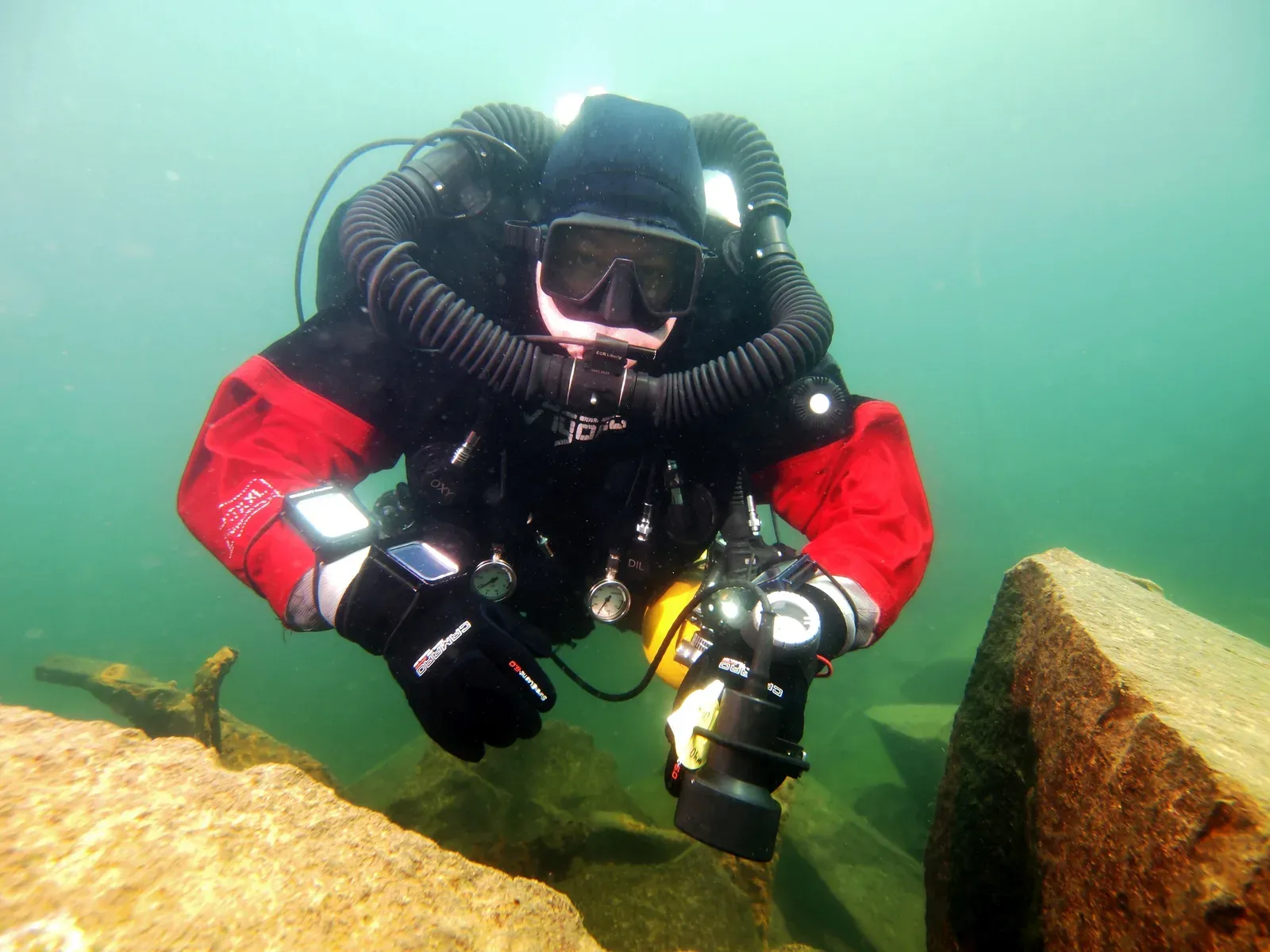
A closed-circuit rebreather sidesteps the whole question by blending continuously. It scrubs your exhaled carbon dioxide, adds oxygen to hold a fixed partial pressure — typically 1.2 or 1.3 bar — and tops up with a diluent, either air or trimix, as depth changes. The practical result is that you breathe something close to the optimal mix at every depth of the dive rather than a compromise chosen on the surface.
For deep diving that is transformative, and mostly for an unglamorous reason: you only consume the helium you actually lose, so the gas bill for a 60-metre dive falls by an order of magnitude. The gas also comes back warm and humid, the duration is measured in hours rather than minutes, and there are no bubbles, which is why so much big-animal photography is shot on a loop. Our own site notes reflect this — HMS Hermes at 53 metres in Trincomalee & Kalpitiya lists rebreather training among its recommended qualifications, and the centre that runs the Naranjito in Spain teaches closed-circuit courses alongside the trimix ones.
The cost is that all three failure modes — too little oxygen, too much oxygen, carbon dioxide breakthrough — are silent and gradual, and each one ends with an unconscious diver rather than an alarming one. That is why rebreather diving runs on written checklists, redundant oxygen cells and a bailout plan that assumes the unit stops working at the worst moment of the dive. It is not a shortcut past open-circuit training; it is a separate discipline built on top of it.
Which gas, and when
| Gas | Typical mix | Sensible working depth | What it buys | What it costs |
|---|---|---|---|---|
| Air | 21 per cent oxygen | 0 to 30 m, 40 m at a push | Nothing to plan, nothing to analyse, available everywhere | Shortest bottom time, full narcosis, densest of the common gases |
| Nitrox | EAN32 or EAN36 | 18 to 33 m | Half again the no-stop time; shorter surface intervals | A course, an analyser, a hard depth ceiling |
| Custom nitrox | EAN28 to EAN40, blended to a target depth | Wherever the MOD lands | Every per cent of oxygen the depth will allow | A blender who will make it, and oxygen-clean kit above 40 per cent |
| Decompression nitrox | EAN50, sometimes EAN80 | 22 m and shallower, ascent only | Much faster off-gassing | A gas switch to get wrong |
| Oxygen | 100 per cent | 6 m and shallower, plus the first aid kit | The fastest possible final stop | 6 m means 6 m |
| Helitrox or Triox | Nitrox with a modest helium fraction | 30 to 45 m | A clear head on a dive that is still nearly recreational | Helium prices for a small benefit |
| Heliair | Helium added to air, oxygen left at 21 per cent of the rest | 40 to 55 m | Trimix from any compressor with a helium bank | You take whatever oxygen fraction the sum gives you |
| Normoxic trimix | 21/35, 18/45 | 40 to 60 m | A clear head and a gas breathable from the surface | Helium cost, heat loss, real training |
| Hypoxic trimix | 15/55, 12/60 | 60 m and beyond | Depth that air cannot reach safely | Unbreathable at the surface: needs a travel gas |
| Heliox | Oxygen and helium, no nitrogen | Commercial and saturation work | No narcosis at all, very light to breathe | Cost, cold, and HPNS past about 150 m |
| Hydreliox and hydrox | Hydrogen with oxygen, usually plus helium | Several hundred metres, commercial and experimental | The only gases that work at extreme depth | Explosive if the oxygen fraction rises; research territory |
| Neox | Oxygen and neon | Commercial, historically | Little narcosis and an undistorted voice | Very expensive, and a bad decompression reputation |
| Rebreather diluent | Air or trimix | Whatever the dive is | Optimal mix at every depth, a fraction of the helium | Bailout, checklists, silent failure modes |
| Argon | Pure argon | Not breathed at all | A warm drysuit on a helium dive | More narcotic than nitrogen if you ever breathe it |
Where the gas decides the dive
Some sites are shaped entirely by what is in the cylinder. These are the ones where a nitrox fill changes a short dive into a proper one:
| Site | Depth | Level | Best months |
|---|---|---|---|
| Shinkoku Maru Chuuk Lagoon · Micronesia | to 38 m | Advanced | Nov–May |
| Habagat Wreck Panglao · Philippines | to 37 m | Advanced | Nov–May |
| Alma Jane Wreck Puerto Galera · Philippines | to 30 m | Advanced | Jan–Apr |
| NRP Hermenegildo Capelo Algarve · Portugal | to 30 m | Advanced | Jun–Sep |
| Hilma Hooker Bonaire · Caribbean Netherlands | to 30 m | Advanced | Dec–Apr |
| Blue Hole & Inland Sea Malta & Gozo · Malta | 10–30 m | Intermediate | Jun–Sep |
| Osezaki Bay Izu Peninsula · Japan | to 40 m | Intermediate | Sep–Nov |
| Punta Maria Cocos Island · Costa Rica | 18–25 m | Advanced | Jun–Nov |
| The Cars Dauin · Philippines | 24–28 m | Intermediate | Apr–May |
| Manta Reef Tofo · Mozambique | 21–26 m | Advanced | Jun–Oct |
| Batee Tokong Pulau Weh · Indonesia | to 24 m | Advanced | Oct–Apr |
| Punta Sur Cozumel · Mexico | 24–38 m | Advanced | Jan–Apr |
And these are the ones that do not happen at all without helium and staged decompression — the depths at which gas planning, not the wreck, sets the shape of the dive:
| Site | Depth | Level | Best months |
|---|---|---|---|
| HMS Triumph Gallipoli · Turkey | to 73 m | Advanced | Jun–Sep |
| The Stern Espiritu Santo · Vanuatu | to 73 m | Advanced | Apr–Nov |
| SS Justicia Malin Head · Ireland | to 70 m | Advanced | Jun–Aug |
| SS Empire Heritage Malin Head · Ireland | to 70 m | Advanced | Jun–Aug |
| SMS Szent István Premuda · Croatia | to 66 m | Advanced | Jun–Sep |
| San Francisco Maru Chuuk Lagoon · Micronesia | 27–64 m | Advanced | Nov–May |
| Corveta Camaquã Recife Wrecks · Brazil | to 60 m | Advanced | Sep–Feb |
| Cornelia B. Windiate Thunder Bay · United States | to 56 m | Advanced | Jul–Sep |
| USS Arkansas Bikini Atoll · Marshall Islands | to 55 m | Advanced | Apr–Nov |
| Corsair Fighter Wreck Solomon Islands · Solomon Islands | to 54 m | Advanced | Jun–Sep |
| HMS Hermes Trincomalee & Kalpitiya · Sri Lanka | to 53 m | Advanced | Apr–Aug |
| Le Donator Port-Cros & Îles d'Hyères · France | 35–51 m | Advanced | Jun–Sep |
| Rosalie Moller Abu Nuhas & Gubal Strait · Egypt | 18–50 m | Advanced | Apr–Jun |
| Sophie Rickmers Pulau Weh · Indonesia | 37–45 m | Advanced | Oct–Apr |
| SMS Markgraf Scapa Flow · United Kingdom | 25–45 m | Advanced | Jun–Aug |
| Naranjito Cabo de Palos & Islas Hormigas · Spain | 28–42 m | Advanced | Jun–Oct |


