Fakarava · French Polynesia · Channel & pass · Drift
South Pass (Tumakohua)
The highest concentration of grey reef sharks recorded anywhere
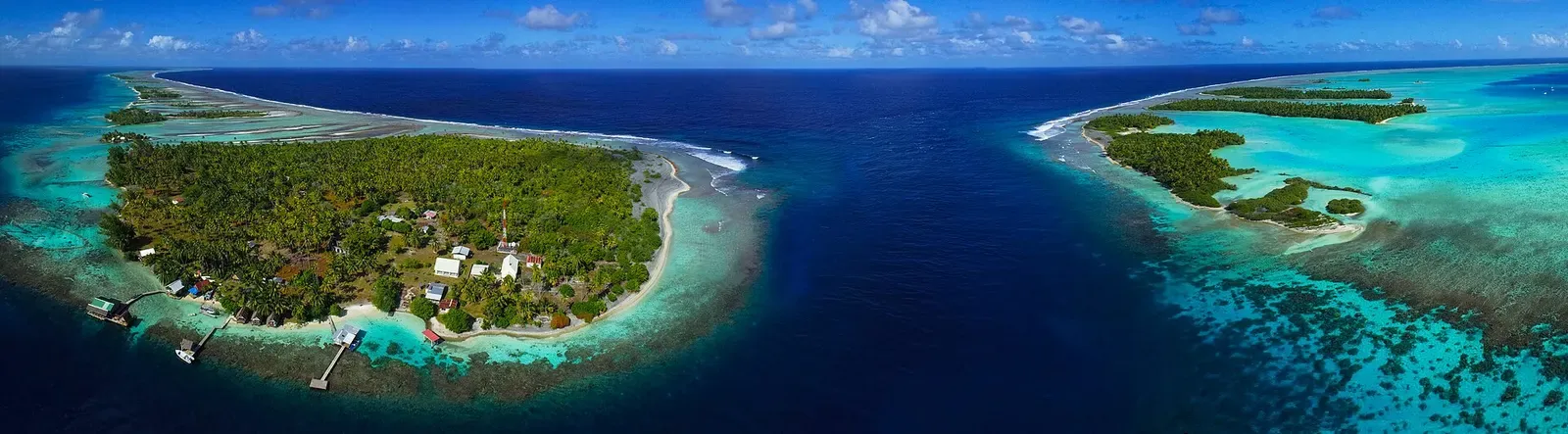
Photo: Tahitipix · CC BY-SA 4.0
Tumakohua is Fakarava's southern channel, about 200 m wide, dived on the tidal current for the single school of grey reef sharks that lives in it - an estimated 700 animals. The pass has been protected since 2008 and the atoll is part of a UNESCO Biosphere Reserve, so the sharks are found in anything like their historical numbers. Camouflage groupers spawn at the ocean end over the June and July full moons.
Also known as Tetamanu Pass, Passe Tumakohua, Passe Sud.
Where it is and how deep
16.5183° S, 145.4616° WApproximate position — the dashed circle shows where the site lies; your operator's briefing has the mooring.
The dive
The dive is a drift through the channel, and the sharks are the structure of it. Grey reef sharks hold in Tumakohua as a single school estimated at 700 animals, the highest concentration of the species recorded anywhere in the world, and hunting groups of up to 700 have been observed at the atoll. Blacktip reef sharks are in the pass alongside them.
Away from the sharks the pass carries the fish life of a Tuamotu channel - camouflage groupers, humphead wrasse (the napoleon fish, locally), titan triggerfish and spotted eagle rays, with barracuda out in the moving water. The groupers set the calendar: the species aggregates to spawn at the ocean exit of the pass over the two full moons of June and July, and that spawning is what the Gombessa 2 expedition came here to film in 2014.
Timing decides what you see. The Gombessa 4 expedition returned to Tumakohua in 2017 to study how a population of more than 700 grey reef sharks organises itself in the same June and July window, which is when the density in the pass is at its highest. Dives are timed to the slack of the incoming tide, working the pass bed into a gully at about 27 m where the sharks gather thickest, then following the channel back in. Tumakohua is the gentler of the atoll's two drift dives - the current runs calmer than in the northern pass - but it is still run to the tide.
Background
The south pass of Fakarava has been protected since 2008, and it is one of the only reefs where sharks are fully protected and can be found in anything like their historical numbers. In 2016 the atoll became part of a UNESCO Biosphere Reserve created in 1977. Tumakohua has since doubled as a working laboratory: the Gombessa 2 expedition filmed marbled grouper spawning at the pass exit in 2014, and Gombessa 4 returned in 2017 to study the shark aggregation itself.
Marine life and season
- Reef sharks
- Groupers
- Napoleon wrasse
- Eagle rays
- Barracuda
| Jan | Feb | Mar | Apr | May | Jun | Jul | Aug | Sep | Oct | Nov | Dec |
|---|---|---|---|---|---|---|---|---|---|---|---|
| Good | Good | Good | Good | Good | Prime | Prime | Good | Good | Good | Good | Good |
Season follows Fakarava: Jun-Jul brings the grouper spawning aggregation and peak shark density; conditions stay clear and diveable year-round otherwise.
Know before you go
- Tumakohua is a tidal channel, so the dive is timed to the tide and the technique is holding position off the coral rather than swimming against the flow.
Photos from South Pass (Tumakohua)
Pierre BURGALAT · CC BY-SA 4.0
Dive videos
Shark TV - Fakarava, Diving the South Pass with Sharks, tons of Fish and the Famous Napolean Wrasse · underWATERcam - Your Window to the Ocean & Nature on YouTube
Tetamanu by Night · Maddy Prout on YouTube
Questions divers ask
When is the best time to dive Fakarava's South Pass?+
June and July. Camouflage groupers aggregate to spawn at the ocean end of the pass over the two full moons of those months, and the grey reef shark density peaks with them - the concentration the Gombessa 4 expedition came to study in 2017.
How many sharks are there at Tumakohua?+
An estimated 700 grey reef sharks, described as the single school that inhabits the pass and the highest concentration of the species recorded anywhere in the world. Hunting groups of up to 700 animals have been observed at Fakarava.
Are Fakarava's sharks protected?+
Yes. The south pass has been protected since 2008 and is one of the only reefs where sharks are fully protected, and in 2016 Fakarava became part of a UNESCO Biosphere Reserve created in 1977.
How deep is the dive at Tumakohua?+
The pass bed is worked into a gully at about 27 m, where the grey reef sharks gather thickest, before the dive follows the channel back towards the lagoon. TopDive rates the south pass as suitable for all levels of experience on both the inflowing and outflowing current.
Sources
- Fakarava — Wikipedia
- Fakarava — Wikipedia (fr)
- Fakarava — Wikivoyage
- Gray reef shark — Wikipedia
- OpenStreetMap search: Passe Tumakohua — OpenStreetMap
- Scuba diving in Fakarava — TopDive
- The grey shark wall — Tumakohua pass, Fakarava south — TopDive
- Diving at Fakarava Atoll — Divezone
Photo credits
- Aerial panorama of Fakarava's South Pass with Tetamanu village and coral gardens by Tahitipix, CC BY-SA 4.0, via Wikimedia Commons
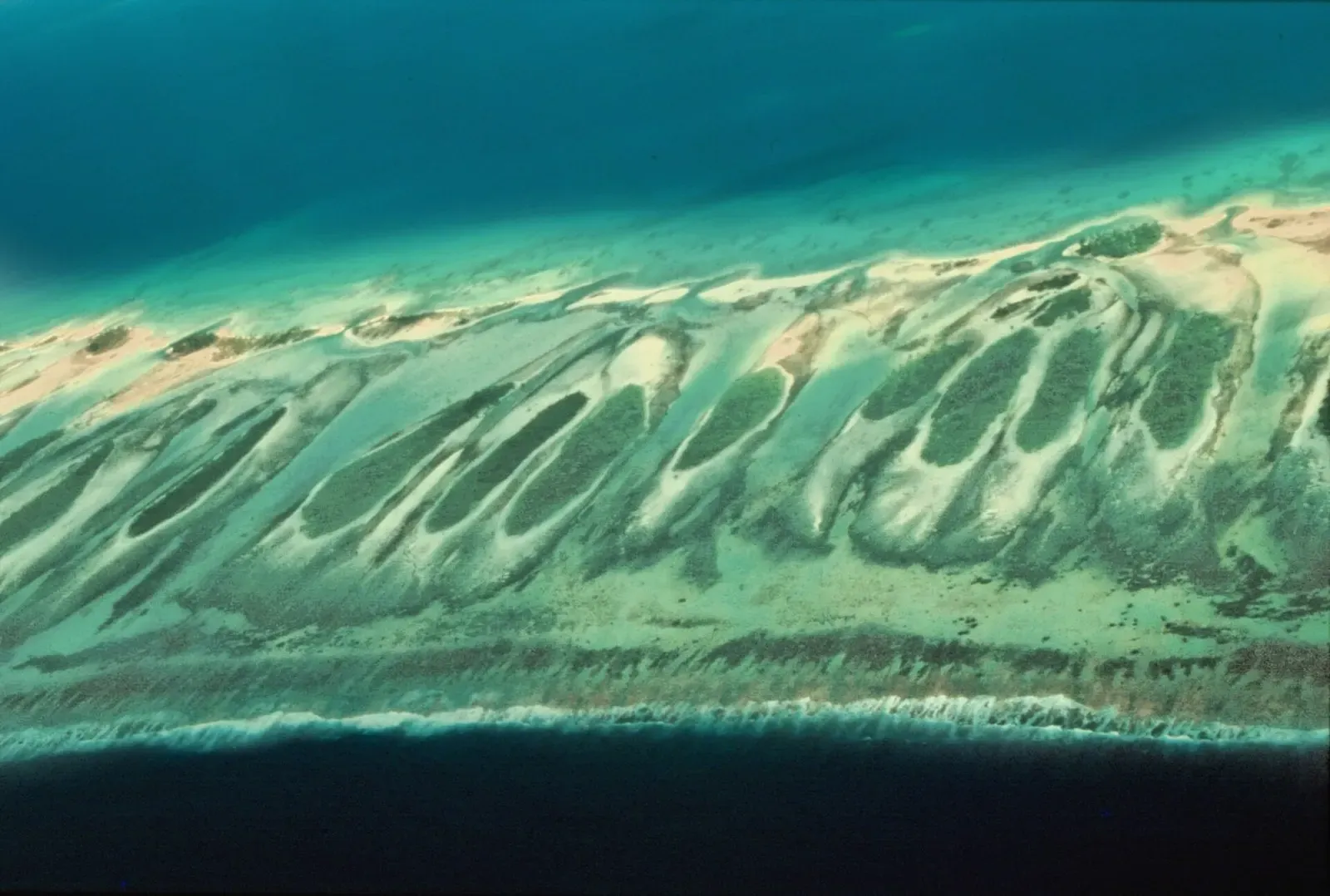
- Rippled pink sand flat facing a small palm motu near Fakarava South Pass by Pierre BURGALAT, CC BY-SA 4.0, via Wikimedia Commons
In The Logbook
- Where to see reef sharks on your first divesBig animals · 14 min read
- Where to dive in every month of the yearTrip planning · 14 min read
- When does coral spawn? The moon's calendarBig animals · 10 min read
- When is slack water? Tides for diversOcean science · 7 min read
- How long should a surface interval be?Body & health · 8 min read
- Drift diving: how to read and ride a currentDrift & current · 8 min read
More dive sites in Fakarava
Channel & pass
Hook into the reef and let the flood run sharks past you
Similar dives elsewhere

Mantas and eagle rays in the outer reaches of a tidal cut
Channel & pass
Calalin Channel
Majuro & Mili · Marshall Islands
A fast tidal drift past sharks, eagle rays and trevally
Hammerheads and tigers in a pass drifted above 10 m


Advanced channel drift with sharks between 22 and 30 m