The only clock every animal can read
Most of what lives on a reef cannot move to meet a mate. A coral colony is cemented to its rock for life; a giant clam sits where its larva landed. For all of these animals reproduction means broadcast spawning — releasing eggs and sperm into open water and trusting them to find each other — and about 75 per cent of reef-building coral species reproduce this way. The arithmetic of it is brutal. Seawater dilutes everything, currents carry everything away, and an egg drifting alone over a kilometre of reef meets nothing. Broadcast spawning only works if everyone lets go at once, which turns reproduction into a problem of timekeeping: the whole reef needs a clock that every colony can read, with no way to compare notes.
The sun is half of that clock — water temperature and day length set the season. But a season is months long, and the synchrony has to land on a night, close to a minute. The only signal precise enough that every animal on the reef receives it identically is the moon: its light, its phases, and — as the tides guide works through — the tidal rhythm it drives through every channel and over every reef flat. Our tide article called the fortnightly spring-neap cycle a planning dial for divers. This article is about the animals that read the same dial, and have been reading it for rather longer.
One week a year: the coral snowstorm
The famous version is the Great Barrier Reef’s mass spawning. Reefs on the inner Barrier spawn during the week after the full moon in October; the outer reefs follow in November and December. The reef authority’s own fact sheet puts the inshore start at one to six nights after the first full moon in October and says the mass event usually lasts about a week — which is an extraordinary thing to be able to print about wild animals, and boats out of Cairns run one-off night charters against exactly that prediction.
The mechanism is stranger than “spawn at full moon”. Moonlight itself appears to suppress spawning; the immediate cue seems to be the dark gap between sunset and moonrise. In the nights after full moon, the moon rises later and later, opening a widening window of true darkness in the early evening — and it is in that window, often within ten to thirty minutes of it, that the corals let go. What they release are buoyant bundles of eggs and sperm that break apart as they rise, so fertilisation happens at the surface and the water column fills from the bottom up, a snowstorm falling in reverse.
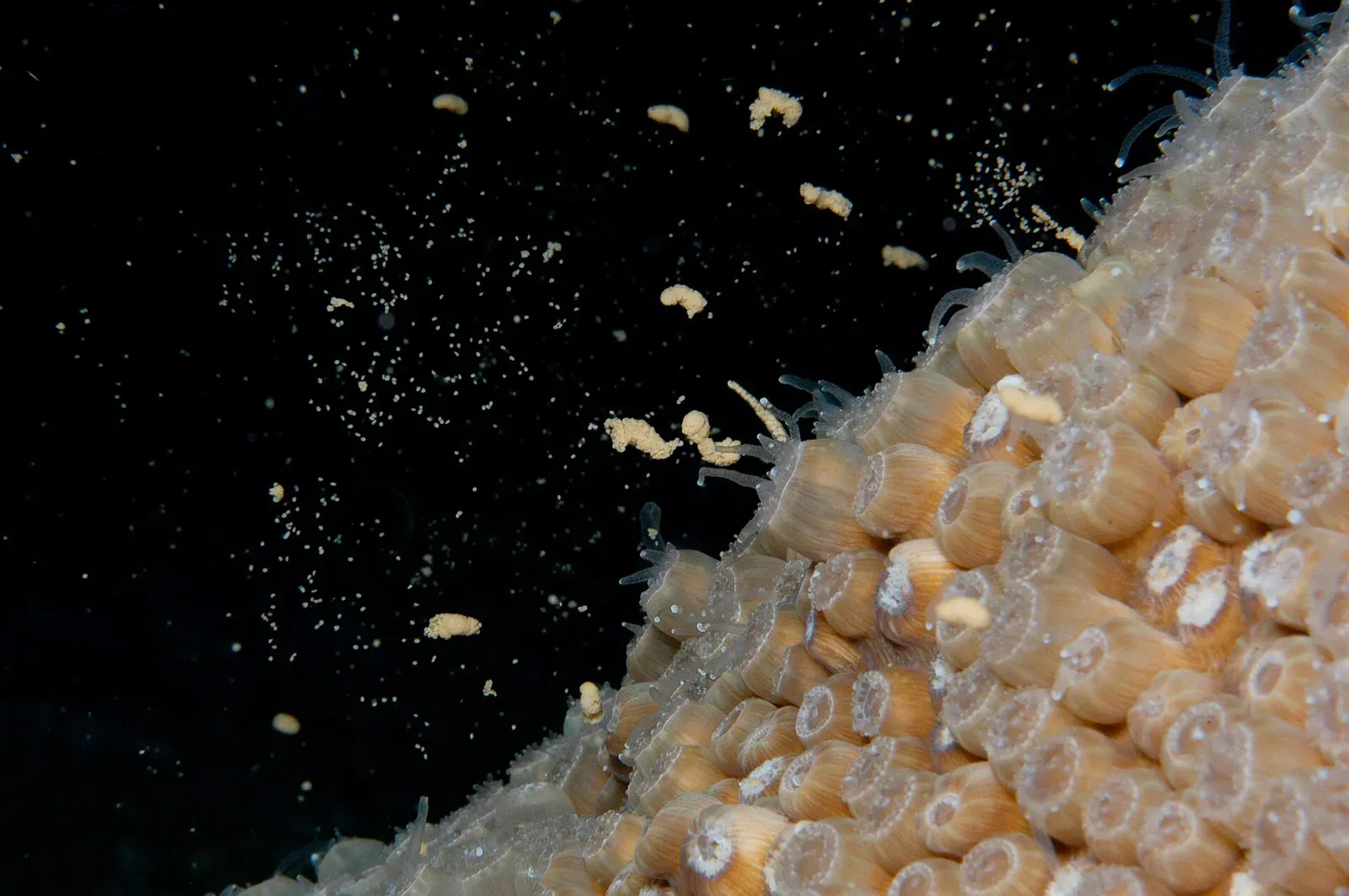
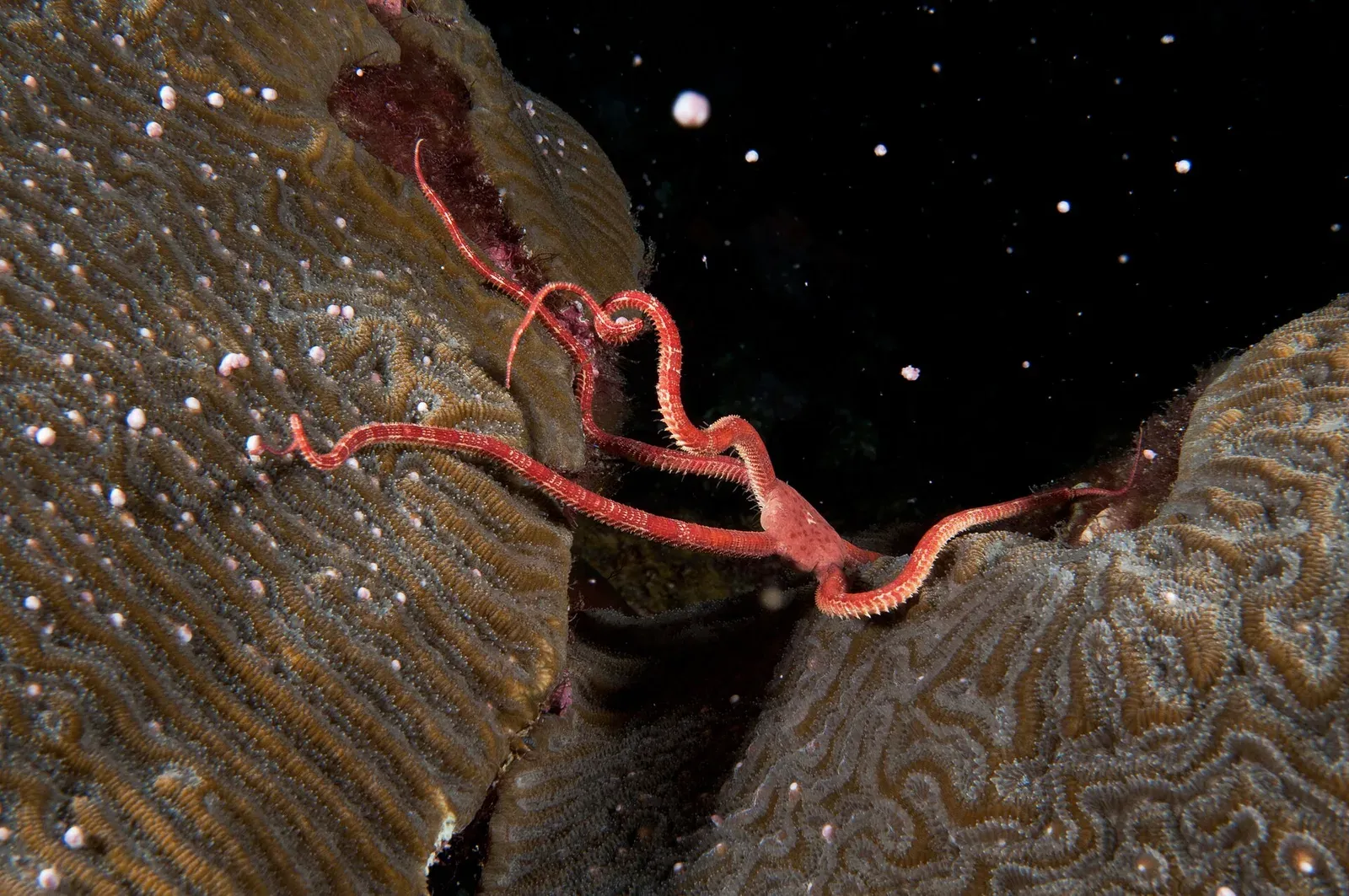
The Great Barrier Reef holds no monopoly. The brain corals of the Flower Garden Banks sanctuary in the Gulf of Mexico spawn seven to ten days after the August full moon — our hero photo is one of those nights — and reef corals from the Red Sea to the Caribbean run their own local editions of the same event. There is also a modern complication worth knowing about: studies suggest artificial light at night desynchronises spawning in some species, and in the Red Sea as many as 10 of 50 studied species may now be spawning out of step compared with thirty years ago. A reef’s entire reproductive strategy assumes darkness arrives on schedule. Our night-diving guide covers how a coral-spawning charter is actually run — booked against a lunar prediction, with a real chance the reef holds off a night or a month.
The fish that keep appointments
Fish can swim to a rendezvous, and the reef’s big predators use that freedom to take lunar timing further: entire regional populations converge on one point of reef, on one phase of the moon, and spawn together. Biologists call these transient spawning aggregations, and Wikipedia’s summary of the mutton snapper could stand for dozens of species: it spawns at the same place and at the same time relative to the lunar calendar, every year.
The best place in our dataset to see one is Fakarava’s South Pass in French Polynesia. Camouflage groupers aggregate to spawn at the ocean exit of the pass over the two full moons of June and July — the event the Gombessa 2 expedition came to film in 2014 — and the density of the pass’s resident grey reef sharks, an estimated 700 animals, peaks with them. That is the whole food web reading one calendar: the groupers time their spawning to the moon, the sharks time their hunting to the groupers, and the divers drift through the middle of it on a tide the same moon is driving.
Mandarin Valley, Mabul 4K · FishyVentures on YouTube
The pattern repeats across the Pacific. Naiqoro Passage in Fiji is a channel through the Great Astrolabe barrier whose grouper spawning aggregation was surveyed and tagged by conservation researchers in 2011; Batu Wali in the Banda Islands sits inside a marine protected area core zone declared partly because the ground is a spawning area for plectropomus grouper; Blue Corner in Palau is known for huge spawning aggregations of bohar snapper on top of everything else it is known for. And at Una Una in the Togians the appointment is kept by something smaller: near full moon, lantern tobyfish spawn in their millions, stacking so thickly around the pinnacle that they close out the light and the movement alone can bring on vertigo.
The spectators
An aggregation is not just fish — it is a concentration of food, and other animals have learned the calendar by watching it.
The clearest case we list is Gladden Spit in Belize, where mutton snapper and grouper hold a ten-day spawning aggregation along the shelf edge between March and June, and whale sharks arrive to feed on the newly laid eggs. Cubera snapper spawn on the same edge on lunar cycles from May to August and the sharks eat those eggs too. Our whale shark guide files Gladden under the aggregations you can book a date against, and the reason it is bookable at all is the fish’s punctuality: the whale sharks are second-order readers of the same lunar calendar. Down the reef at Turneffe Atoll, the Elbow works the same way on a smaller scale — the atoll’s reserve documents at least three important fish spawning aggregation sites, and the snapper congregating over the point are the reason the eagle rays work its edge.
Whale Shark Diving at Gladden Spit · George Probst on YouTube
Fakarava’s sharks belong in this section as much as the last one. So, historically, did fishermen — at Gladden Spit they were harvesting the aggregation for decades before any diver saw it, which is a thread we will pick up below.
The miniature version, every single night
Not every spawning ritual needs a calendar; some just need a sunset. Mandarinfish — a few centimetres of orange, green and electric blue, patterned like nothing else in the sea — spend the day deep in coral rubble and rise off it in the last minutes of daylight to court and spawn. Pairs press together and spiral slowly upwards, release eggs and sperm at the top of the ascent, and drop back into cover. The event is over in minutes and it happens again the next evening, and the one after: this is the spawning dive that runs on the solar day rather than the lunar month, and it is the easiest one in this article to actually book.
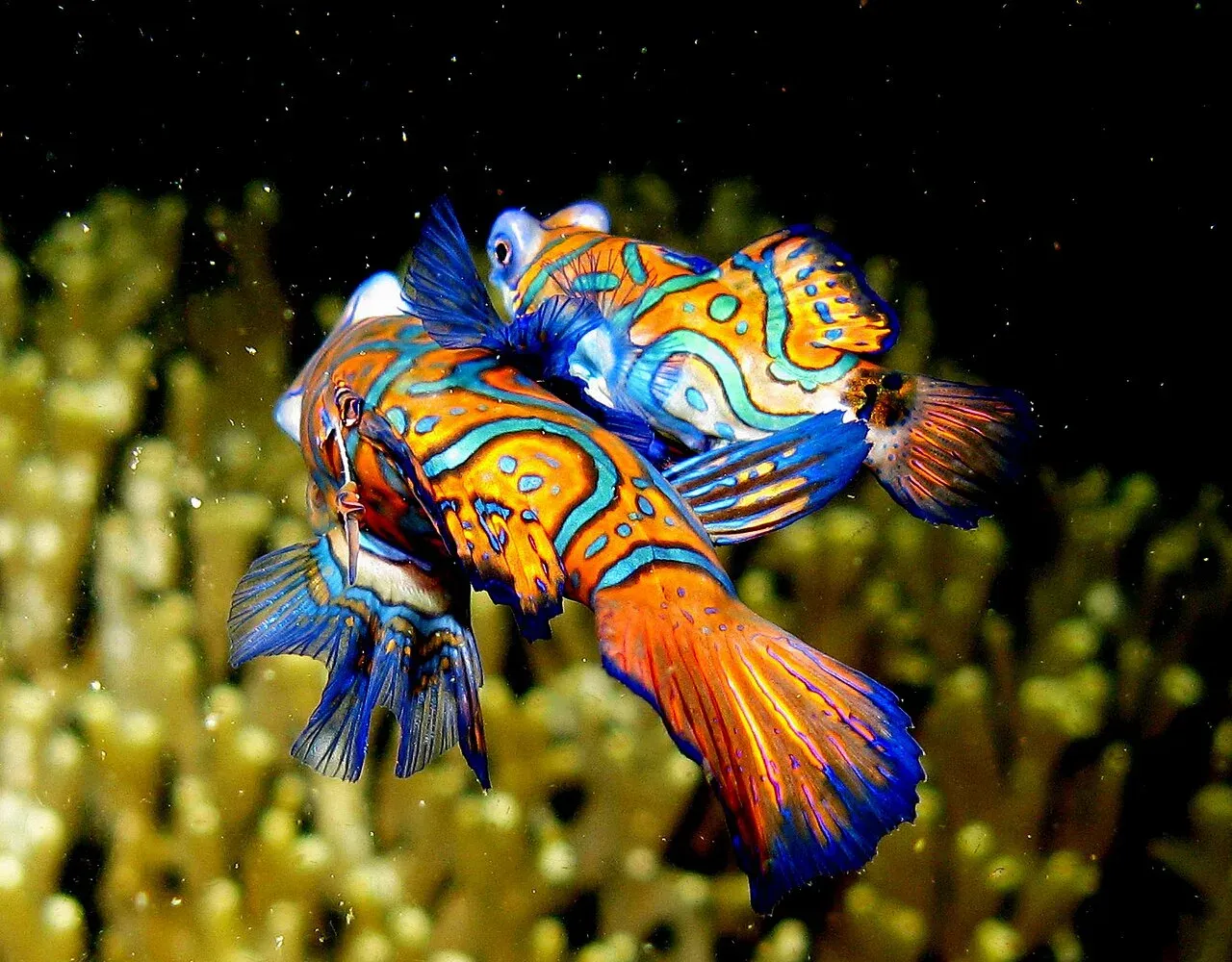
Our muck coasts are full of it. At Masaplod in Dauin the pairs spiral up out of the rubble at sunset inside a marine sanctuary; Mandarin Valley off Kapalai earns its name at dusk as the fish come out to dance among the urchin spines; Mandarin Lagoon is five metres (15 feet) of sand dived just before sunset and carried straight on into the night; and in the Philippines Talisay Pier, Wonderwall and The Hill all run the same last-hour-of-light dive. The technique is identical everywhere, and our records repeat it like a chorus: settle over one patch of rubble before the light goes, hold still, keep bright torches off the fish — red light and patience work — and mind where you put your knees, because stonefish share the ground. The night-dives guide calls it the shortest event in diving; the muck guide has the rest of what lives on these slopes.
The worm that kept the calendar first
If you want proof that the moon’s spawning calendar is real, precise and older than any tide table, the Pacific has kept the receipt. The palolo worm lives in burrows in the reef rock, and once a year, on nights of the waning moon in October and November, the rear sections of the worms’ bodies detach — the process is called schizogamy — and swim to the surface in their millions to release eggs and sperm. In Samoa the swarming is a delicacy and a festival, and the traditional prediction is exact: the hunt takes place seven days after the first full moon of the traditional lunar month falling within October, with villages out at night scooping the rising with nets and buckets. In Lombok in Indonesia the same event arrives in February. The trigger that holds the worms to those particular nights is still not completely understood — but Samoan communities were setting their calendar by it long before anyone wrote down a tide table.
Japan contributes two reminders that the moon is not the only timekeeper. At Amami Ōshima’s Mystery Circles, male white-spotted pufferfish spend seven to nine days ploughing two-metre geometric nests into the sand, spawning from spring into summer on a schedule set by nest-building rather than moon phase. And at Sumisaki the dive centre sets out egg-laying beds each April for the bigfin reef squid that spawn on the site — a reproductive calendar you can read off the noticeboard.
Catastrophically fishable
Everything that makes a spawning aggregation magnificent to dive makes it lethally easy to fish. The entire adult population of a region gathers at a known place, on a predictable date, focused on something other than danger. A fishing boat that learns the calendar can take the breeding stock of an ecosystem in a handful of nights per year — and for the Nassau grouper of the Caribbean, that is broadly what happened. The species gathers to spawn around the full moons from November through February, always in the same locations, in gatherings that historically ran to tens of thousands of fish. Those aggregations were fished as reliably as they formed. An estimated third or more of them have now disappeared outright, the population has declined by around 60 per cent over three decades, and the IUCN lists the species as Critically Endangered. Of nine spawning sites once known for the species, an assessment cited by Wikipedia found only two still viable — one of them Glover’s Reef in Belize, a short sail from the reef this article’s whale sharks feed over.
That is why so many of the sites above come wrapped in legal protection, and why the protection is usually younger than the diving. Fiji closed Naiqoro Passage to fishing in 2018 under regulations written specifically for its spawning aggregation. Fakarava’s South Pass has been protected since 2008 and sits inside a UNESCO biosphere reserve. Gladden Spit’s aggregation lives inside a dedicated whale shark and reef-fish spawning conservation zone; Turneffe became a marine reserve in 2012; Batu Wali’s grouper ground anchors the core zone of the Banda MPA. A spawning aggregation is the reef’s annual general meeting of breeding adults. Protect that one place for those few nights, and you protect the next generation of an area far larger than any line on the map.
Reading the calendar like a diver
Be honest about what the calendar can and cannot give you. The moon phase is knowable years ahead; the exact nights are not. Corals can hold off a night or a month, aggregations build and disperse on their own schedule, and every one of these events is timed locally — by operators, researchers and communities who watch their own reef year after year. Book the moon window, then trust the people on the ground for the night. And remember what else the full moon brings: spring tides, the strongest streams and the shortest slacks of the fortnight — the tides guide explains why the very weeks that concentrate the spawning also squeeze the diving, which is one more reason these pass dives run on the guide’s clock, not yours.
| Site | Depth | Current | Level | Best months |
|---|---|---|---|---|
| South Pass (Tumakohua) Fakarava · French Polynesia | to 27 m | Moderate | Intermediate | Jun–Jul |
| Naiqoro Passage Kadavu & the Great Astrolabe Reef · Fiji | to 36 m | Strong | Advanced | Apr–Oct |
| Gladden Spit Belize Barrier Reef · Belize | to 40 m | Moderate | Advanced | Mar–Jun |
| The Elbow (Turneffe) Belize Barrier Reef · Belize | to 18 m | Moderate | Advanced | Mar–Jun |
| Batu Wali Banda Islands · Indonesia | 5–30 m | Strong | Advanced | Oct–Nov |
| Blue Corner Palau · Palau | 8–30 m | Strong | Advanced | Dec–Mar |
| Una Una Togian Islands · Indonesia | 21–45 m | Mild | Advanced | Apr–Aug |
| Masaplod Muck Dauin · Philippines | to 15 m | Mild | Beginner | Apr–May |
| Mandarin Valley Mabul & Kapalai · Malaysia | to 10 m | Mild | Beginner | Mar–Oct |
| Mandarin Lagoon Derawan & Sangalaki · Indonesia | 5–6 m | Mild | Beginner | Apr–Jul |
| Talisay Pier Cabilao · Philippines | 3–40 m | Mild | Intermediate | Nov–May |
| Wonderwall Anda · Philippines | 3–26 m | Mild | Intermediate | Nov–May |
| Giant Clams / The Hill Puerto Galera · Philippines | 5–18 m | Moderate | Intermediate | Jan–Apr |
| Sumisaki Kushimoto · Japan | 10–25 m | None | Beginner | Jul–Oct |
| Mystery Circles Amami Ōshima · Japan | 10–27 m | Moderate | Intermediate | Apr–Jun |
None of this diving requires anything technical. It requires the older skills: arriving in the right fortnight, sitting still while something ancient happens on schedule, and leaving the calendar running for the animals that were reading it first.