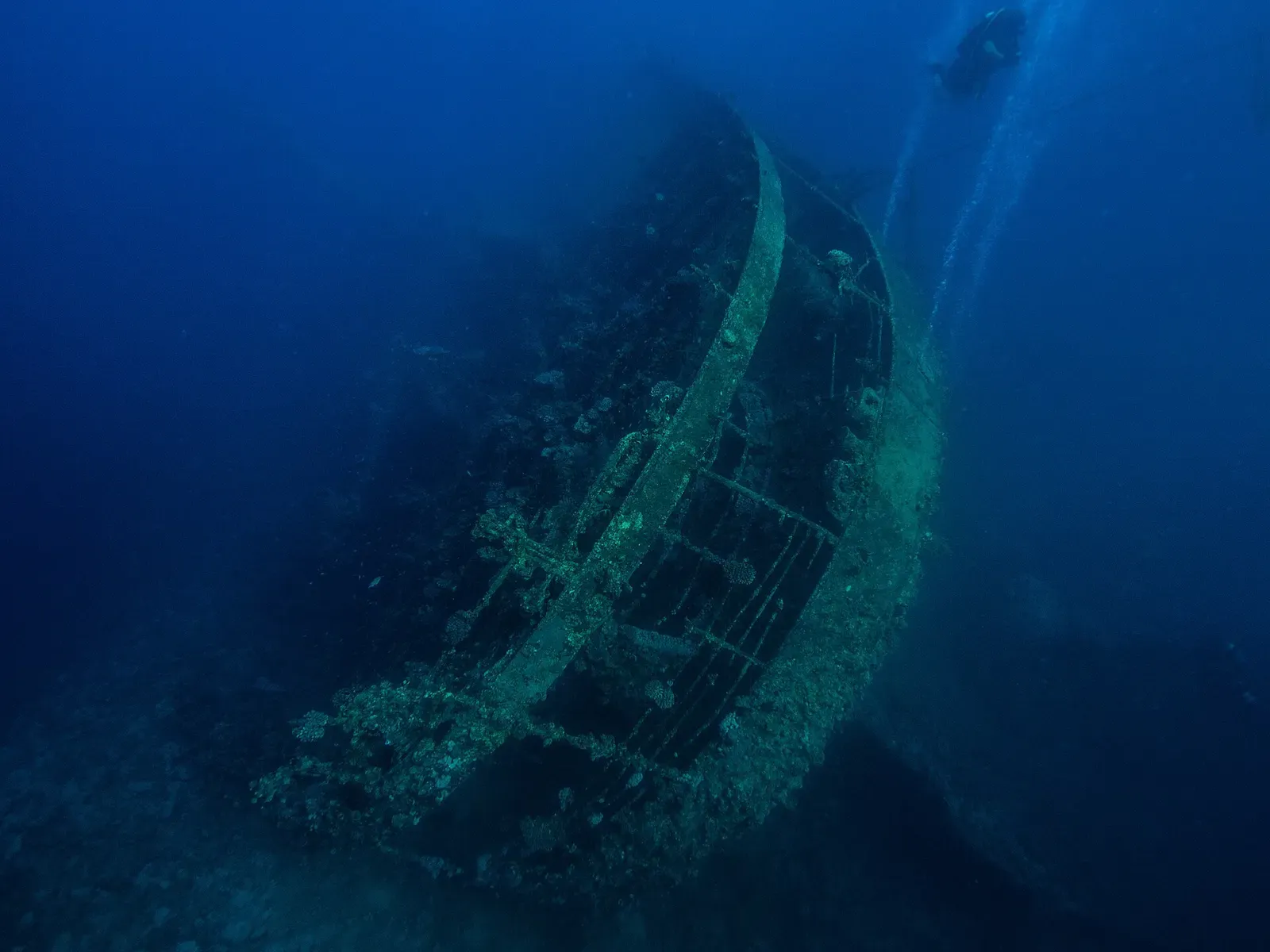
What the ladder does not reset
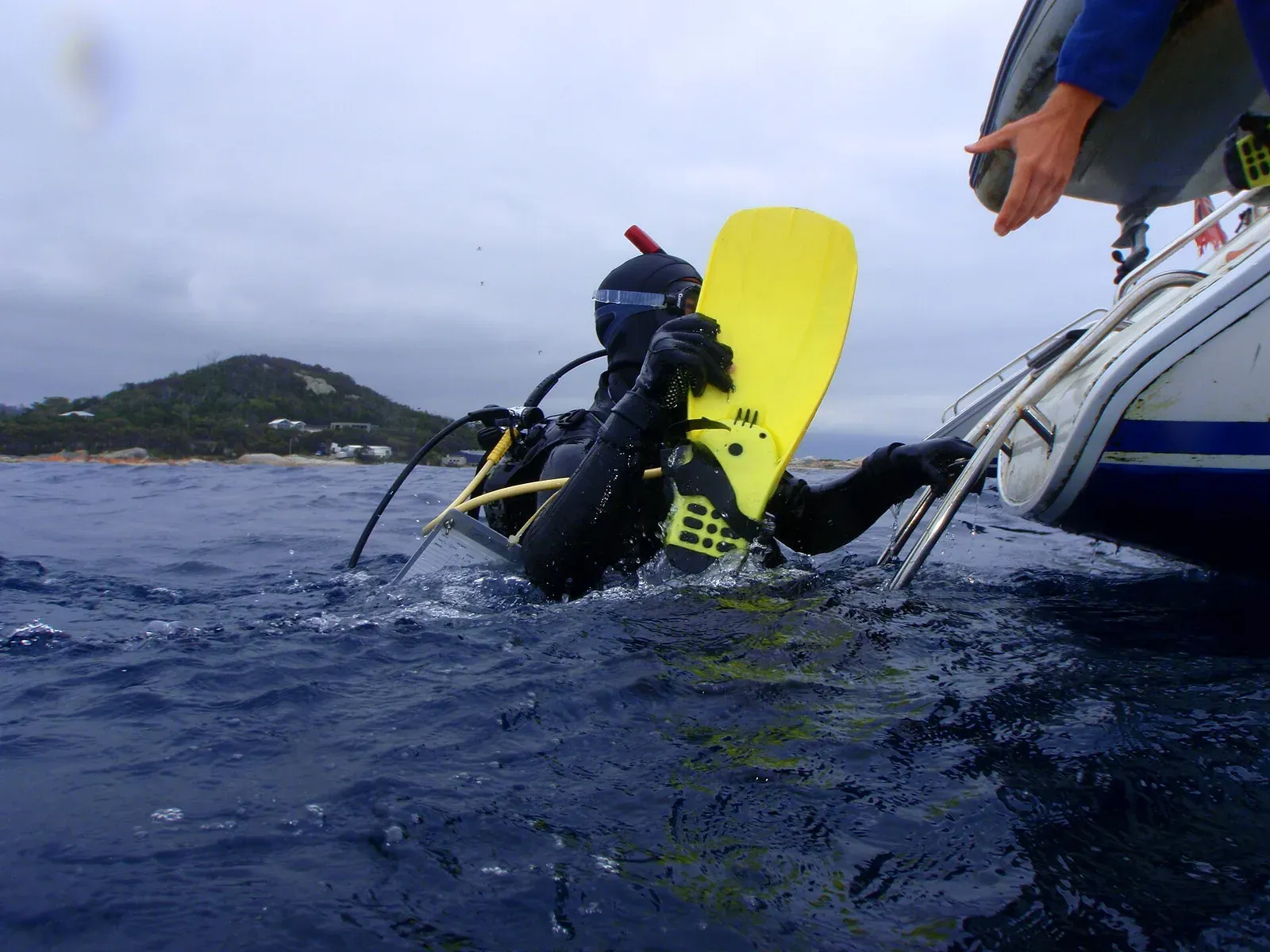
The first dive of the morning went to 30 metres (100 feet) for 20 minutes — the no-stop limit, almost to the second, that the Bühlmann ZH-L16C model behind every diagram on this site allows at that depth. You climb the ladder, hand up your fins, and for the next hour you are, as far as the boat is concerned, off duty. As far as your tissues are concerned, you are mid-dive.
At the moment you break the surface, the fastest of the model’s sixteen theoretical compartments — the one with the 5-minute half-time — is carrying 1.33 bar of nitrogen above its surface equilibrium. An hour later it is carrying, to three decimal places, nothing: twelve half-times is as good as forever. The 77-minute compartment tells a different story. It surfaces with 0.39 bar of excess and an hour later still holds 0.23 — it has barely started. Every surface interval is both of these at once: a sprint finishing and a queue barely moving.
That split — minutes for the fast tissues, hours for the slow — is the entire physiology of the surface interval. What makes it worth an article is what it does to the next dive, because the interval is not rest. It is the first half of dive two.
What an hour on deck actually buys
Ask the model directly. After that 30-metre morning dive, how much no-stop time does the second dive have, as a function of how long you sit on deck first?
Straight back into the water, a second dive to 30 metres is worth four and a half minutes. After half an hour, a second dive to 18 metres has 43.5 of its fresh 62 minutes. After the canonical hour it has 52, and the 30-metre option has 19 of its fresh 20. From there the curves crawl: the 18-metre line does not recover its full fresh limit until the interval is nearly four hours long, while the 30-metre line got everything back inside two.
Read that again, because it is the opposite of what most divers would guess: the deeper the second dive, the faster the interval pays you back. The reason is which tissue polices which depth. A fresh dive to 30 metres is ended by the 8-minute compartment, which fills fast, empties fast, and has completely forgotten the first dive within the hour. A fresh dive to 18 metres is ended by the 27-minute compartment — and after a morning dive, the second 18-metre dive is ended by the 38-minute one, still carrying residual gas your hour on deck barely touched. Deep dives answer to sprinters, which forgive; shallow, long dives answer to the middle distance, which remembers.
The honest caveat is that the no-stop clock is not the whole ledger. Two 30-metre dives 90 minutes apart are legal by the model, but the slow compartments do not care what was legal — they are the ratchet in the diagram above, climbing all day, and they are what the 12- and 18-hour flying rules exist to drain. The interval buys back the clock long before it buys back the diver.
Letters for nitrogen
None of this arithmetic was visible to the divers who invented the conventions. What they had was a table, and a bookkeeping problem: how do you carry one dive’s leftover nitrogen into the sums for the next?
The 1956 US Navy tables answered with letters. Surface with a repetitive group; wait, and the surface interval credit table moves you down the alphabet; your letter then buys a residual nitrogen time to add to the next dive. The machinery under the letters was a single choice: the credit ran on the model’s 120-minute compartment, the slowest thing the Navy tracked. Any interval under 10 minutes did not count as an interval at all, and only after 12 hours were you clean off the books. For working Navy divers making one or two serious dives, pinning the bookkeeping to the worst case was prudent and cheap. For a holiday diver making four dives a day, it was ruinously stingy — the alphabet simply refused to move fast enough.
That gap is what the Recreational Dive Planner was built to close. Raymond Rogers, analysing the Navy tables for recreational use from 1983, concluded that short no-stop dives were governed by much faster tissues, and that a 60-minute compartment was the right one to hang the repetitive bookkeeping on. PADI funded the development in 1987 through Diving Science and Technology, with no-stop limits cut systematically below the Navy’s — Doppler monitoring had shown silent bubbles to be common at and near the old limits — and released the RDP in 1988 as a table and the rotating Wheel. The testing was done with Doppler bubble monitoring rather than bent-or-not-bent counting, including multi-day trials of four dives a day for six days, with no symptomatic decompression sickness. The practical difference was dramatic and entirely intentional: surface-interval credit that used to take hours now arrived in one.
The two systems even agree on what “clean” means — they just start different clocks. The RDP stops calling a dive repetitive after 6 hours; the old Navy tables after 12. Each threshold is six half-times of its own credit compartment, the point where less than 2 per cent of the excess remains. The rules look like different philosophies; they are the same sentence about different tissues.
And the one-hour rule of thumb? It has a traceable birthplace. The RDP’s printed rules for a day of three or more dives say that a diver whose pressure group reaches W or X must take at least an hour between dives, and Y or Z at least three. That specific, conditional clause — a floor, for the most loaded divers, on the most crowded days — is what four decades of dive briefings have rounded into “always leave an hour”. As folklore goes it aged well: the payback chart shows an hour returning most of what a second dive can use. But it is a floor that became a folk law, and the model, not the letter W, is what your computer actually runs.
Deepest first, and the workshop that checked
The other rule every diver inherits is dive order: deepest first, always. It feels like physiology. It is table arithmetic. Doing the deep dive first yields more total no-stop time on paper — an agency manual first printed the recommendation in 1974 on exactly that basis — and somewhere in the retelling a scheduling convenience hardened into a safety rule with a prohibition attached: never dive deeper than the dive before.
In October 1999, the American Academy of Underwater Sciences and the Smithsonian Institution convened a workshop in Washington to ask what evidence sat under the prohibition. The answer was: none that anyone could produce. Neither the US Navy nor commercial diving had ever banned reverse profiles, and the recreational ban “cannot be traced to any definite diving experience that indicates an increased risk of DCS”. The finding, published with the proceedings in 2000, is one of the more carefully fenced sentences in diving: “We find no reason for the diving communities to prohibit reverse dive profiles for no-decompression dive profiles less than 40 m/130fsw and depth differentials less than 12 m/40fsw.”
Our payback curve is quietly on the workshop’s side. The model has no opinion about order as such — only about what each dive starts loaded with. It will hand a 30-metre second dive most of its clock back in 90 minutes precisely because the tissues that end that dive are fast ones. Deepest-first survives as good default scheduling: do the demanding dive while you are freshest, spend the day getting shallower and warmer, and the arithmetic of every table you might fall back on works in your favour. It is a habit worth keeping — held for the right reason, and inside the workshop’s 40-metre, 12-metre fence.
The interval as the product
There is a class of trip where none of this is background theory: the liveaboard, where the entire day is dive, interval, dive, interval. Red Sea operators describe their itineraries as three to four dives a day; Aggressor’s northern Red Sea boat advertises up to 21 dives on a seven-night charter. At that cadence the intervals are not gaps in the schedule — they are the schedule, and the slow-tissue ratchet is why day five feels different from day one and why the last interval of the trip, the one before the flight, is measured in multiples of the others.
Where the interval is part of the plan
These are dives from our data where the surface interval is written into how the trip runs — liveaboard reefs and passes dived three and four times a day, where the boat’s rhythm is the model’s rhythm.
| Site | Depth | Level | Best months |
|---|---|---|---|
| Elephant Head Rock Similan Islands · Thailand | 25–40 m | Advanced | Dec–Mar |
| The Pinnacle Richelieu Rock · Thailand | 2–33 m | Advanced | Feb–Apr |
| Habili Ali St John's Reefs · Egypt | 10–40 m | Advanced | Apr–Jun |
| Shaab Rumi Sudanese Red Sea · Sudan | 5–30 m | Advanced | Apr–May |
| Farallón Jardines de la Reina · Cuba | 15–30 m | Advanced | Dec–Apr |
| Cape Kri Raja Ampat · Indonesia | to 40 m | Advanced | Nov–Mar |
| Castle Rock Komodo · Indonesia | 10–25 m | Advanced | Jun–Oct |
| Shark Point Addu Atoll · Maldives | 5–35 m | Advanced | Jan–Apr |
| North Horn Osprey Reef · Australia | 10–25 m | Advanced | Sep–Nov |
| South Pass (Tumakohua) Fakarava · French Polynesia | to 27 m | Intermediate | Jun–Jul |
There is one place in the world where divers decided the whole idea was beneath them. At Shaab Rumi in 1963, Jacques Cousteau’s Conshelf II team put six oceanauts in a starfish-shaped house at 10 metres and left them there for thirty days — no ascents, no intervals, tissues saturated and the clock abolished. Saturation diving is what resenting the surface interval looks like when it is taken to its logical conclusion, and what is left of the village still sits on the sand at 13 metres, on a reef liveaboards now dive on a three-interval day.
"Jacques' shack" - diving Shaab Rumi, Sudan 2008 · Martin Johnston on YouTube
The model doing this article’s sums is unpacked in how your dive computer decides; what the last three minutes of each dive do to the fast compartments is in what a safety stop actually does; and the interval’s two long-clock cousins — the wait before the flight home, and what happens to all of this arithmetic when the surface itself is thinner — are in flying after diving and diving at altitude.