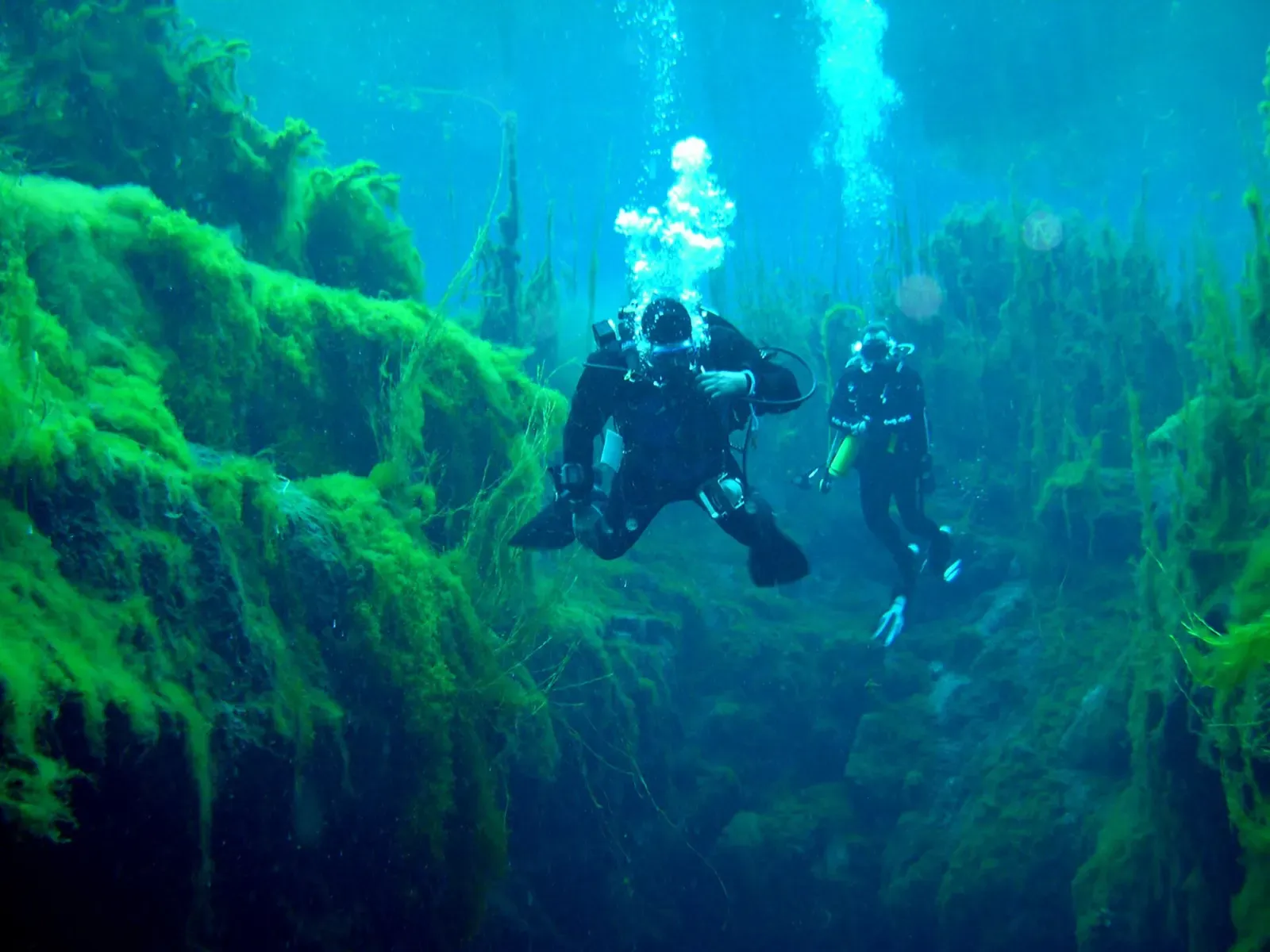
Mount Gambier · Australia · Freshwater · Cave & cavern
The Shaft
A metre-wide hole in a paddock over a 140 m chamber
Area photo: Mark Whatmough · CC BY 2.0
The Shaft, site 5L158, is a flooded sinkhole in a paddock near Allendale East, a few kilometres south of Mount Gambier, entered through a hole in the ground about a metre across. Below it opens into a chamber roughly 140 metres long and 80 metres wide, with tunnels running to 124 metres deep. Four divers died here in 1973.
Where it is and how deep
38.0044° S, 140.7098° EApproximate position — the dashed circle shows where the site lies; your operator's briefing has the mooring.
The dive
Nothing about the entrance suggests what is under it. The opening in the paddock was originally about a foot across and has since been enlarged to roughly a metre for diving access, and the water surface sits about 7 metres below ground level. You go down through that hole to the water, then drop into open space: the main chamber below is about 140 metres long and 80 metres wide, far wider than any light you carry.
Directly beneath the surface opening is a central rock formation known as the rock pile, rising to a minimum depth of about 36 metres. That mound is the shallowest thing in the chamber and the reference point for everything else. In a space 140 metres long and 80 metres wide the walls sit well beyond a dive light, so the dive is flown in open water inside rock rather than swum along a wall.
Two tunnels lead off the chamber. The north-western one runs to roughly 80 metres, and the eastern one reaches a maximum depth of 124 metres before turning horizontal and closing out against rock formations. Those depths put the far ends of the site firmly in technical territory, on mixed gas and staged decompression; the shallower rock pile at 36 metres is where a dive within the CDAA Basic Cave rating stays.
Background
On 28 May 1973, four divers — Stephen and Christine Millott, Gordon Roberts and John Bockerman — died at The Shaft in what became known as the 1973 Mount Gambier cave diving accident. The sinkhole had been discovered in 1938 in Thompson's Paddock on a private farm in the region. The deaths led directly to the founding of the Cave Divers Association of Australia later that year, and the rating system the CDAA built after the accident is what still governs access to the district's sinkholes, including this one, which the association lists at Basic Cave grade.
Marine life and season
The sources we used don't single out particular species here.
| Jan | Feb | Mar | Apr | May | Jun | Jul | Aug | Sep | Oct | Nov | Dec |
|---|---|---|---|---|---|---|---|---|---|---|---|
| Good | Good | Good | Good | Prime | Prime | Prime | Prime | Fair | Fair | Fair | Good |
Season follows Mount Gambier: Every site is spring- or aquifer-fed, so temperature holds steady all year; the one fixed closure is Ewens Ponds from 1 September to 30 November, and winter is reported as Kilsby's clearest water.
Know before you go
- The only way out is the metre-wide surface opening, so entry, exit and any emergency ascent all funnel through one small hole.
- Depth: the tunnels reach 80 and 124 metres, deep enough that narcosis and decompression obligations, not the cave itself, become the limiting factor.
- Disorientation in a chamber 140 m long and 80 m wide, where the walls are beyond your light and there is no contour to follow back to the single exit.
Questions divers ask
How deep is The Shaft at Mount Gambier?+
The eastern tunnel reaches a maximum depth of 124 metres before becoming horizontal and blocked by rock formations. The north-western tunnel runs to roughly 80 metres, and the central rock pile beneath the entrance rises to about 36 metres.
What happened at The Shaft in 1973?+
On 28 May 1973 four divers — Stephen and Christine Millott, Gordon Roberts and John Bockerman — died there. The accident led to the founding of the Cave Divers Association of Australia later the same year.
Sources
- 1973 Mount Gambier cave diving accident — Wikipedia
- Cave Dive Sites by Region — Cave Divers Association of Australia
- Allendale East, South Australia — OpenStreetMap
In The Logbook
- How a rebreather works, and what it buys youGear & kit · 6 min read
More dive sites in Mount Gambier
Cave & cavern
A flooded cave running under the streets of Mount Gambier
Freshwater
Drift through three linked limestone ponds on an Open Water certificate alone
Freshwater
A roadside sinkhole in 30-million-year-old limestone
Freshwater
The area's cave-training sinkhole, CDAA-rated Basic Cave
Freshwater
Farmland sinkhole diving to 40 m in water that runs 30 to 60 m of visibility
Freshwater
A 50 m cenote starting at 25 m, with a 1966 car resting on its silty floor
Freshwater
A limestone chasm over 100 m deep, reached through a Ramsar wetland pond
Similar dives elsewhere

A 72 m rope descent onto a lake 80 m deep
A sulphide cloud you can put a hand through, at 27 m

Submerged trees, some 6,400 years old, at 4 to 6 m

Fresh water over salt, and 38 degrees below the thermocline