Mount Gambier · Australia · Freshwater · Blue hole
Little Blue Lake
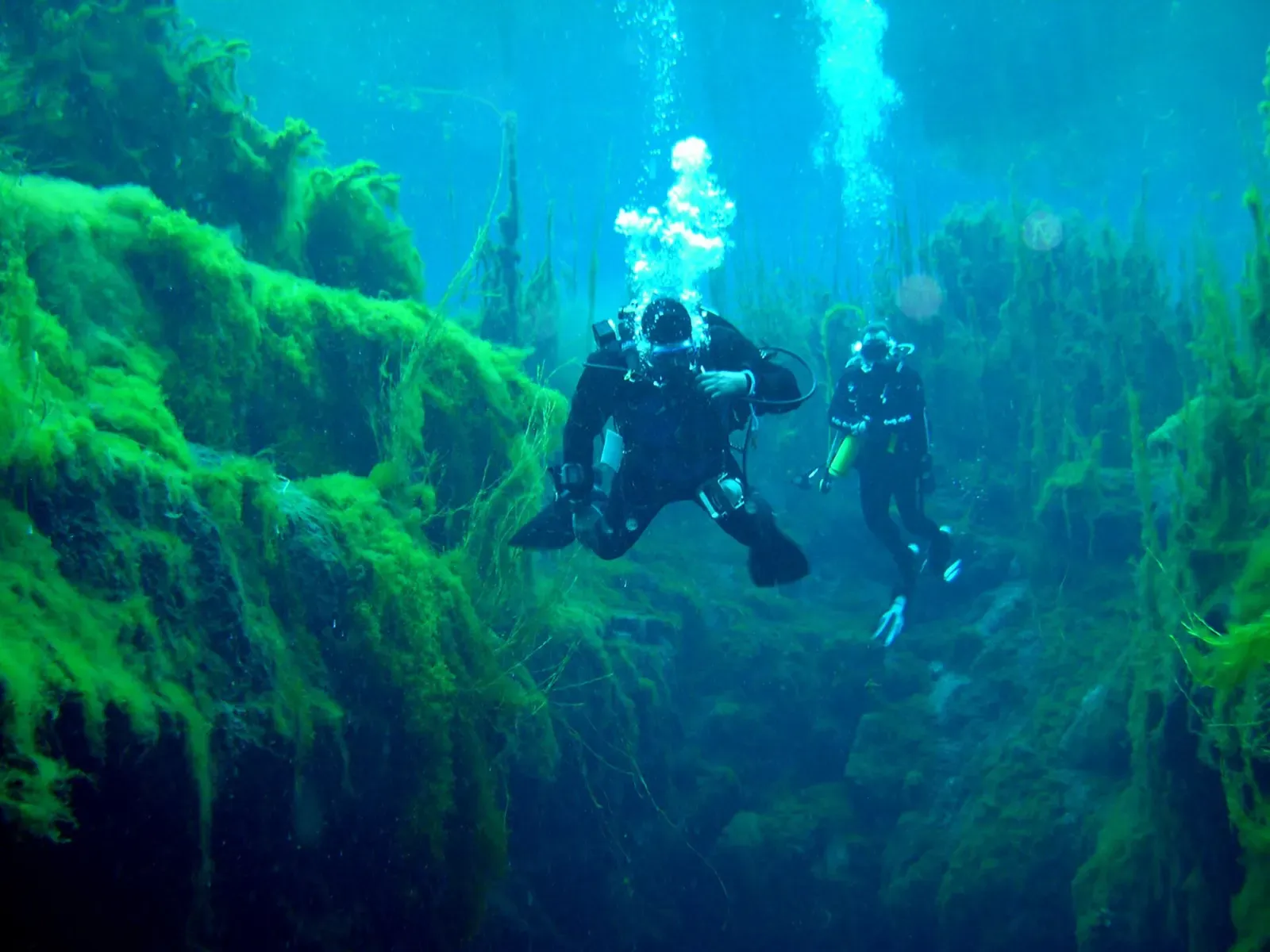
A 50 m cenote starting at 25 m, with a 1966 car resting on its silty floor
Area photo: Mark Whatmough · CC BY 2.0
A near-circular cenote about 50 m across near Mount Schank, ringed by undercut cliffs 8 m high and reached down a metal stairway to a floating pontoon. The silty floor sits at an average 36 m, shallowest at 25 m below the entry ramp and reaching just over 42 m at its deepest, with visibility that Wikipedia describes as normally poor but able to improve at depth. Diving is restricted to CDAA members; swimming above the surface needs no permit at all.
Also known as Baby Blue.
Where it is and how deep
37.9292° S, 140.6783° EPublished position for this site.
The dive
The stairway and pontoon put you straight over the shallowest part of the lake, a rubble pile at about 25 m that is the highest point of a large cone of collapsed rock filling the centre of the hole. From there the flat, silty floor spreads out to the south and west, dropping gradually to an average of about 36 m and reaching just over 42 m at its deepest recorded point, though the water table itself moves by around 4 m between seasons.
Visibility is the trade-off for the depth: Wikipedia describes it as normally poor, though it can improve lower in the water column away from surface disturbance. What the silt has preserved is an odd catalogue of dumped rubbish rather than wildlife — a 1966 Morris 1100, an old petrol bowser, road signs and traffic cones lie scattered across the bottom, more industrial debris than the underwater garden divers find at Ewens Ponds nearby.
Little Blue Lake belongs to the same family of cenotes as Piccaninnie Ponds and Kilsby: a chamber dissolved by CO2-acidified groundwater rising from below during volcanic activity at nearby Mount Schank, which then collapsed and filled as sea levels rose roughly 8,000 years ago. The lake was first explored underwater in the 1950s and surveyed properly by the Cave Divers Association of Australia in the 1990s, and it remains open only to CDAA divers holding the site's required rating.
Background
The lake's name comes from its resemblance to Mount Gambier's larger Blue Lake, and its water once turned a similar blue each summer; in recent decades it has stayed green year-round, likely from nutrient run-off raising algae levels. Explored underwater from the 1950s and surveyed by Lewis and Stace in 1980 and the CDAA in the 1990s, the land was dedicated a public reserve in 1986, and a stairway and floating pontoon were added in 2002 after a review of public safety.
Marine life and season
The sources we used don't single out particular species here.
| Jan | Feb | Mar | Apr | May | Jun | Jul | Aug | Sep | Oct | Nov | Dec |
|---|---|---|---|---|---|---|---|---|---|---|---|
| Good | Good | Good | Good | Prime | Prime | Prime | Prime | Fair | Fair | Fair | Good |
Season follows Mount Gambier: Every site is spring- or aquifer-fed, so temperature holds steady all year; the one fixed closure is Ewens Ponds from 1 September to 30 November, and winter is reported as Kilsby's clearest water.
Know before you go
- The shallowest point of the dive is already 25 m, so this is not a site to learn deep diving on; every entry starts at depth.
- Visibility is normally poor and the floor is heavily silted; a careless fin kick can end the dive for everyone in the water.
- Dumped debris including a car body and scrap metal litters the floor and is an entanglement risk if visibility drops further.
Questions divers ask
How deep is Little Blue Lake?+
The shallowest point, a rubble cone below the entry ramp, sits at about 25 m. The floor averages around 36 m and reaches just over 42 m at its deepest, though the water table shifts the exact figures by a few metres between seasons.
Can I swim at Little Blue Lake without diving?+
Yes, above-water swimming is free, unfenced and open 24 hours via the stairway and pontoon. Diving below the surface is restricted to CDAA members holding the site's required rating.
Why is the visibility poor?+
Wikipedia describes it as normally poor, though able to improve lower in the water column away from surface disturbance; no source gives a specific cause, and the lake is not spring-fed with moving water the way Ewens Ponds is.
Sources
- Little Blue Lake — Wikipedia
- Dive Sites — Cave Divers Association of Australia
- Sinkhole and Swimming Hotspots of the Limestone Coast — Visit Limestone Coast
In The Logbook
- Blue holes: what's actually down thereCaves & caverns · 13 min read
- Freshwater diving: lakes, springs and quarriesFreshwater · 15 min read
More dive sites in Mount Gambier
Cave & cavern
A flooded cave running under the streets of Mount Gambier
Freshwater
Drift through three linked limestone ponds on an Open Water certificate alone
Freshwater
A roadside sinkhole in 30-million-year-old limestone
Freshwater
The area's cave-training sinkhole, CDAA-rated Basic Cave
Freshwater
Farmland sinkhole diving to 40 m in water that runs 30 to 60 m of visibility
Freshwater
A limestone chasm over 100 m deep, reached through a Ramsar wetland pond
Freshwater
A metre-wide hole in a paddock over a 140 m chamber
Similar dives elsewhere

Submerged trees, some 6,400 years old, at 4 to 6 m
Flat granite pitted with round craters, in 6 m of water
The lake's most popular summer night dive, free and shallow
An artificial reef under the red marker buoy at 9 m