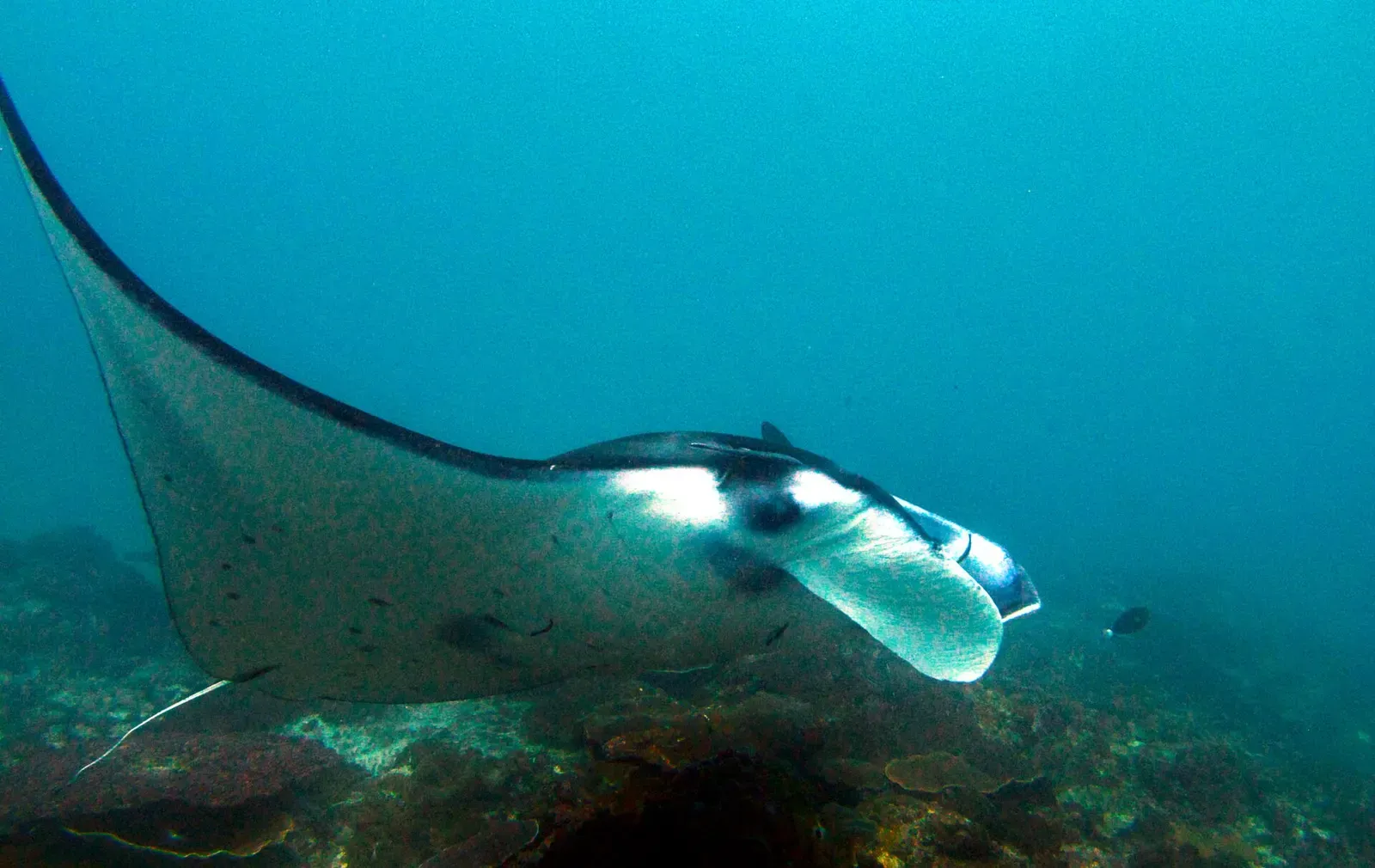
Manta Point, also known as Batu Lumbung, is a bay on the southern side of Nusa Penida ringed by limestone cliffs, with a coral slope and a maximum depth of 15 metres. Manta rays use a cleaning station here and can be seen year round, with the best chances from March to June, which makes it the shallow, easy dive of the Nusa Penida day.
Also known as Batu Lumbung.
Where it is and how deep
8.7985° S, 115.5295° EPublished position for this site.
The dive
The site is a shallow bay with limestone cliffs all around it and a slope of good coral below, and the whole dive fits inside 15 metres. There is no current to speak of, which is what makes it an easy dive site, and the shallow profile means air lasts and you can hold one position rather than covering ground. Boats reach it in a few minutes from the dive centres on Nusa Lembongan, which is why the early slots go first.
The manta rays are the point, and they come to a cleaning station rather than passing through, so the approach is to settle low over the coral, stay still, and let them work the station on their own terms. Sightings are not guaranteed on any given day, and without the mantas there is not a great deal else here. Keep half an eye on the surface as the dive runs on: later in the day the sea can become choppy and the visibility drops off.
Marine life and season
- Manta rays
| Jan | Feb | Mar | Apr | May | Jun | Jul | Aug | Sep | Oct | Nov | Dec |
|---|---|---|---|---|---|---|---|---|---|---|---|
| Good | Good | Prime | Prime | Prime | Prime | Good | Good | Good | Good | Good | Good |
Manta rays can be seen year round; the best chances are from March to June, unlike the rest of Nusa Penida where August to October is the draw.
Know before you go
- The site is very popular and often crowded, which puts several boats and their divers over one shallow cleaning station. Go early and keep track of your own group.
- Conditions deteriorate through the day: the sea can become choppy and visibility gets worse, so morning slots are the ones worth taking.
Photos from Manta Point
Tilonaut · CC BY 3.0
ito1117 · CC BY-SA 3.0
Dive videos
Manta Point - Nusa Penida Bali Diving (HD) · Bali Diving on YouTube
Questions divers ask
What time of year should I dive Manta Point?+
Manta rays can be seen year round, and the best chances are from March to June. That is the opposite of the rest of Nusa Penida, where August to October brings the mola mola, so the two headline animals fall in different halves of the year.
How deep is Manta Point?+
Maximum depth is 15 metres, over a coral slope inside a bay ringed by limestone cliffs. The shallow profile keeps bottom time long, which is part of why the site works for watching mantas at a cleaning station rather than chasing them.
Is Manta Point suitable for new divers?+
The site itself is shallow and has essentially no current, which makes it an easy dive. Nusa Penida as a whole is a different matter: currents around the islands are strong and unpredictable, and the area is not recommended for inexperienced divers.
Sources
- Nusa Penida / Nusa Lembongan diving — Divezone
- Manta Point dive site — Divezone
- Nusa Penida travel guide — Wikivoyage
- Nusa Penida — Wikipedia
- OpenStreetMap: Manta Point — OpenStreetMap
Photo credits
- A reef manta ray gliding close overhead in blue water at Manta Point by Tilonaut, CC BY 3.0, via Wikimedia Commons
- A manta ray approaching low over the coral slope at Manta Point by Tilonaut, CC BY 3.0, via Wikimedia Commons
- Two manta rays cruising side by side over the shallow reef by ito1117, CC BY-SA 3.0, via Wikimedia Commons
In The Logbook
- Sunfish diving: where and when to see a molaBig animals · 11 min read
- Where to dive with manta rays, month by monthBig animals · 8 min read
More dive sites in Nusa Penida
Cave & cavern
A 200-metre cave ending in an air space full of bats
Wall
Shallow reef structure, infrequent hammerheads
Drift
Bali's other mola mola plateau, deeper and rougher than Crystal Bay
The mola mola site, in cold and sometimes downward current
Reef
West-coast slope where mola mola come up in season
Reef
Bommie-topped plateau above a fan-covered wall
Artificial reef
Planted restoration structures at 6 metres, shore entry
Reef
North-coast slope from 5 metres to past 40
Similar dives elsewhere

Four hectares of shallow cleaning station in the pass

.jpeg)
.jpeg)

Hook into the ridge and let the mantas come to you
Reef mantas queue over the sand in 8-15 m of water
Rock cover that puts you close to passing mantas