Raja Ampat · Indonesia · Reef · Coral garden
Cape Kri
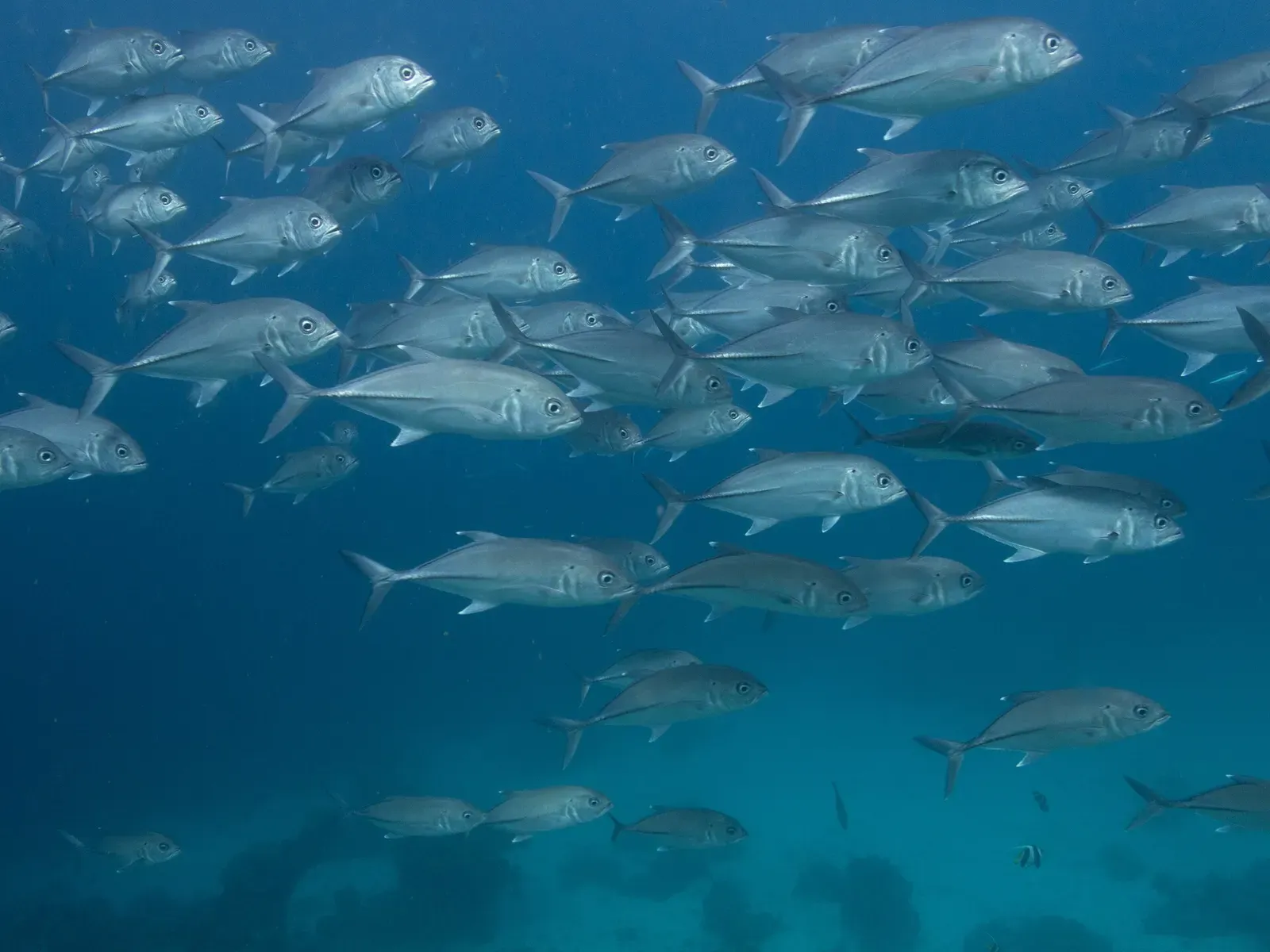
Fish fill the water before your BCD is finished deflating
Photo: Justin Philbois · CC0
Cape Kri is dived for fish biomass rather than for any single feature. The top of the reef is a shallow coral garden broken by sandy patches, and past the drop-off it settles into a steady slope of mixed coral running to a maximum of 40 m. Dogtooth tuna, giant trevally and chevron barracuda dominate the water column above it.
Where it is and how deep
0.5563° S, 130.6907° EPublished position for this site.
The dive
Entry is from a boat and the fish are there immediately: the usual account of a dive here is that the spectacle starts before you have finished deflating your BCD. The first minutes are spent over the reef top, a shallow coral garden interrupted by sandy patches, with fusiliers and snappers moving across it in numbers that already make the site feel busy.
The drop-off sits a little further out and gives way to a steady sloping reef of assorted corals and reef fish, and this is where the biomass concentrates. Dogtooth tuna, giant trevally and chevron barracuda dominate the water column; large napoleon wrasse, whitetip reef sharks and giant groupers work the slope itself. The site runs to a maximum of 40 m, so the deep portion of the profile is short and the shallow coral garden takes the end of the dive.
Marine life and season
- Tuna
- Trevally & jacks
- Barracuda
- Napoleon wrasse
- Reef sharks
- Groupers
- Reef fish swarms
| Jan | Feb | Mar | Apr | May | Jun | Jul | Aug | Sep | Oct | Nov | Dec |
|---|---|---|---|---|---|---|---|---|---|---|---|
| Prime | Prime | Prime | Prime | Good | Good | Fair | Fair | Fair | Good | Prime | Prime |
Season follows Raja Ampat: October to April is the drier stretch and November to April the manta season at Manta Ridge; July to mid-September can bring strong winds and rough seas.
Photos from Cape Kri
Justin Philbois · CC0
Justin Philbois · CC0
Dive videos
Diving Cape Kri, Raja ampat · Underwater Traveler on YouTube
Escape with me 10 minutes to Cape Kri · scuba-tube Dietrich (scuba-tube) on YouTube
Questions divers ask
How deep is Cape Kri?+
The maximum depth on the site is 40 m, down the sloping reef beyond the drop-off. The reef top is a shallow coral garden, and most of the schooling fish sit well above the deep end, so the profile is set by how deep you choose to go rather than by the site.
Do you need to be experienced to dive Cape Kri?+
It is a boat dive on a reef that runs to 40 m and the site carries current, so Advanced Open Water and some experience of moving water is the sensible level. Divers who stay shallow still see most of the fish.
Sources
- Cape Kri Dive Site | PADI — PADI
- Diving Sites Indonesia - Raja Ampat — Dive The World
Photo credits
- A dense school of bigeye trevally streaming over the reef at Cape Kri. by Justin Philbois, CC0, via Wikimedia Commons
- A hawksbill turtle swimming low over hard coral at Cape Kri. by Justin Philbois, CC0, via Wikimedia Commons
- A goldsaddle goatfish swimming close to the reef at Cape Kri. by Justin Philbois, CC0, via Wikimedia Commons
In The Logbook
- Where to dive in every month of the yearTrip planning · 14 min read
- Why do you pee when diving, and tire after?Body & health · 12 min read
- How long should a surface interval be?Body & health · 8 min read
- Drift diving: how to read and ride a currentDrift & current · 8 min read
More dive sites in Raja Ampat
Reef
Reef hook dive at 10-12 m in very strong current
Schooling jacks hunting silversides under the village jetty
Overhang at 28-35 m with the wall dropping past 50
Reef
Five Rocks: a repeat-request reef to around 24 m
House reef from the jetty at 2 m down to 20 m
Pinnacle
Cleaning stations on the summit, mantas on the flanks in season
Wall
A drift from schooling fish on the point to macro on the slope
Pinnacle
Fish clouds swirling through a boulder corridor
Similar dives elsewhere

Hard coral grown over lava that reached the sea in 1988.

A jukung-only reef of bommies and soft coral away from the crowds
Five hefty giant clams lying in a row on the sand


Current-swept corner with a pinnacle at 21 m for watching pelagics