Water sorts itself
Leave any body of water alone and it files itself by weight: the densest water settles to the bottom, the lightest floats, and between them form seams sharp enough to see. Only two dials set the density that matters to a diver — temperature and salt — and the salt dial is by far the stronger. Ordinary ocean water at 35 grams of salt per kilogram runs 26 to 28 kg/m³ denser than fresh water at the same temperature, while thirty degrees of warming buys back only about 6. That lopsidedness is the key to every strange layer in this article, and none of it needs hand-waving: oceanographers fitted the density of seawater to a polynomial decades ago — the international one-atmosphere equation of state — and every number and chart below is computed from those published coefficients.
Once water has layered, the arrangement is stable — lifting dense water costs energy, so the layers resist mixing the way oil and vinegar do. Wind stirs the top into a mixed layer; below it, the stack just sits there. A stratified water column is the ocean’s default condition, and the boundaries have names divers keep meeting in briefings: a thermocline where the temperature steps, a halocline where the salt does.
The four-degree kink
Fresh water hides an anomaly that shapes every lake you will ever dive: it is densest not at its coldest but at 3.98 °C. Chill it past four degrees and it expands again, floating up — which is why lakes freeze from the top down while the deep water sits all winter at four degrees, and why they hold their summer layers so firmly: a warm, sunlit epilimnion over a thermocline (the metalimnion), over a cold hypolimnion that summer never touches. Twice a year the trick reverses. When the surface cools — or warms — through four degrees, the whole column briefly reaches one density and the wind can finally stir it top to bottom: the spring and autumn turnover of the classic dimictic lake, recirculating nutrients and, for divers, briefly wrecking the visibility. That deep, changeless cold is also fresh water’s great gift to wreck divers: the hypolimnion of Lake Huron keeps the Isaac M. Scott in cold storage at 53 m, where our record’s warning is simply that cold and narcosis bite early.
Seawater never learned the trick. Dissolve ocean salt in water and the density maximum is pushed down to the freezing point — the seawater curve in the chart has no kink at all, just a steady climb toward the densest water at about −2 °C. Cold seawater always sinks, all the way down; that is the engine of the global deep circulation, and it is why “the deep is cold” is true of every ocean on Earth.
Thermoclines: the seasonal ceiling
In the sea, the thermocline is the floor of the weather. Sun and wind work the top few tens of metres into a warm mixed layer; below it the temperature steps down toward the calm dark. The boundary is semi-permanent in the tropics, seasonal in temperate seas — building through summer, breaking down in the autumn and winter mixing — and barely exists at the poles, where the column is cold top to bottom. Divers meet it two ways. Gently: a band of shimmer, which Wikipedia’s thermocline article describes with the best simile in the business — water like the wrinkled glass of a bathroom window, light bending through the refractive-index change between warm and cold. Or brutally: on upwelling walls like Punta Vicente Roca, where our record notes the temperature can drop sharply mid-dive as the thermocline shifts and the exposure advice is a 7 mm suit or a drysuit — the heat guide’s arithmetic, applied at a single fin-kick. At Batu Wali the record calls the chilly thermoclines on the deep half of the dive a distraction; that is the usual truth of them, cold rather than mechanics. The layer even has a military career: the density step reflects sonar, which is why submarines like to sit under it.
One more thing lives on the thermocline: waves. A density interface inside the ocean supports internal waves exactly as the surface supports swell — but because the density contrast is tiny compared with water-against-air, they run slower and far larger, with wavelengths from centimetres to kilometres. The slow, deep breathing you sometimes feel on a wall as the cold band rises and falls around you is the waves-and-surge story replayed on an interior surface of the sea.
Haloclines: where fresh sits on salt
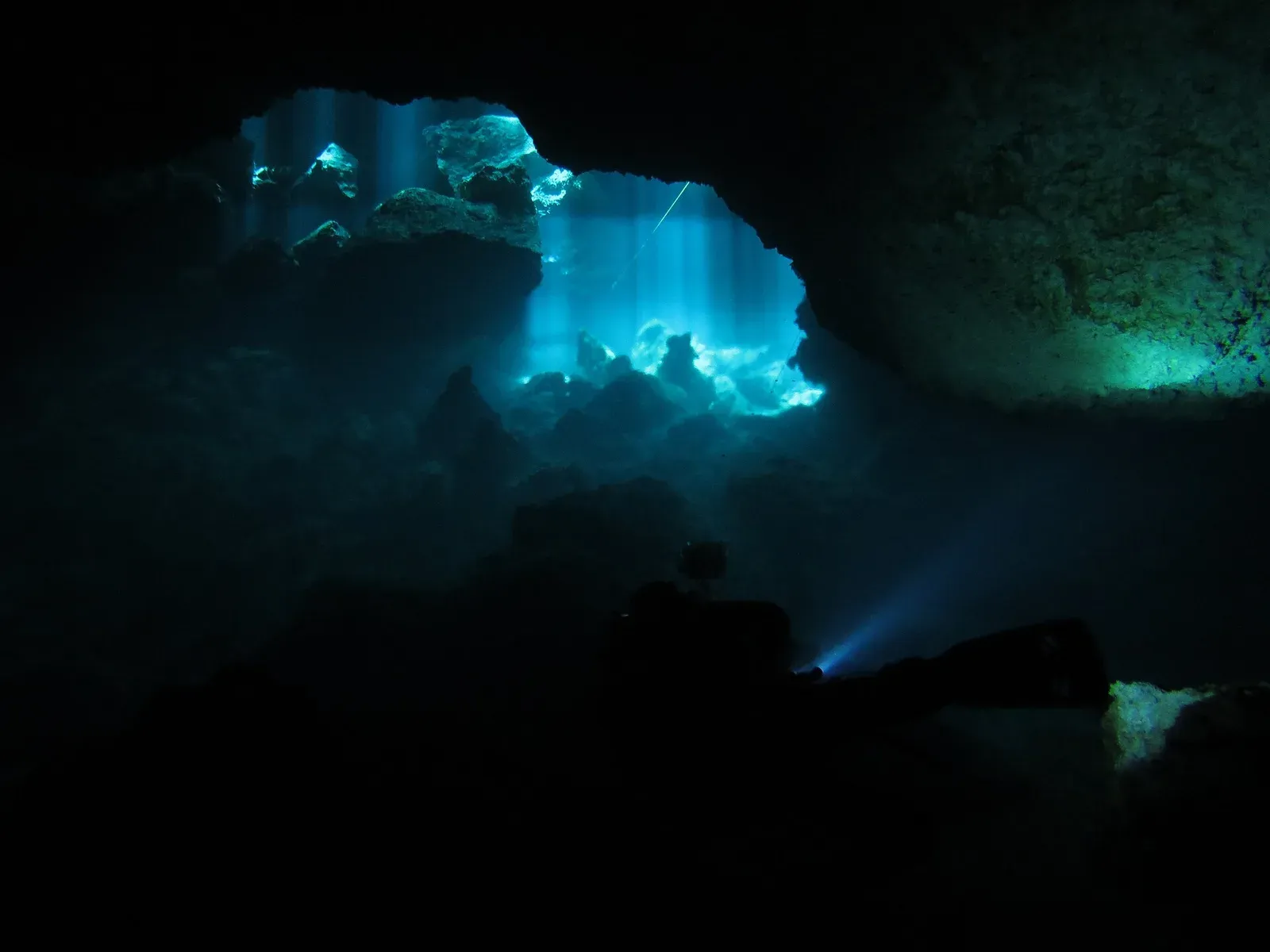
Salt makes sharper seams than heat, because the salt dial is stronger. The textbook case is the one cave divers cross every week in the Yucatán: rain soaks through the limestone and floats as a fresh lens on seawater that has intruded beneath the whole peninsula — about 10 to 20 m down near the coast, 50 to 100 m inland. The interface is a halocline, and where a diver’s fins have stirred the two waters together the mixture bends light chaotically — a swirling, blurry band, described in our Cathedral and Pokemon Cave records with the same practical advice: hold the line and your buddy, because the diver in front is easiest to lose exactly where the water blurs. In still passages an untouched interface can be so optically clean that cave explorers report the illusion of an air surface deep underground; in systems like Dan’s Cave, our record notes the halocline can cloud the visibility mid-dive. The blur is pure physics — refractive index rises with salinity, so a salinity gradient is a lens with a tremor — and it resets itself once you are through into homogeneous water.
Whole seas run on the same plan. The brackish Baltic is permanently layered, fresher river water over saltier inflow, with a halocline at roughly 60 to 80 m that acts as a lid on oxygen exchange — one reason its deep wrecks sit in such still, dark preservation. Milford Sound floats a tannin-stained freshwater lid up to 10 m thick on the fiord, and our record’s briefing is the halocline briefing everywhere: descend slowly and expect the picture to settle only underneath. And at Toriike’s collapsed sinkholes, connected to the open sea by a cave, you watch the water itself change colour from ocean blue to pond green on one swim.
The two-kilogram step
Here is the part your BCD notices. Buoyancy is displacement times density, so crossing into denser water hands a diver lift — and the chart shows why thermoclines and haloclines feel so different. A hefty 5 °C ocean thermocline changes an 80-litre diver’s buoyancy by 0.12 kg, a 10 °C quarry thermocline by 0.14: real, but smaller than a breath. What you feel at a thermocline is the cold. A halocline is another animal: fresh-to-salt at cenote strength is worth 2.1 kg of lift — cross it descending and the water shoulders you up like a dropped weight belt, which is why divers bounce on the seam, and why weighting checked in a fresh upper layer is wrong in the salt below it.
The showpiece is Barracuda Lake, where the layers do something that sounds impossible: about 4 m of warm fresh water sits over salt water, the blur band is stacked at 14 m, and below it the water gets hotter — 38 °C at depth, per our record. Hot water under cool should overturn instantly; run the equation of state — modelling the warm fresh cap at a typical 30 °C — and the trick is exposed. Warming fresh water from 30 to 38 degrees lightens it by less than 3 kg/m³, while ocean-strength salt adds about 26 at these temperatures — the salt wins by 23, and the bathwater stays politely on the bottom of the stack. It is the article’s whole argument in one lake: heat writes the small print, salt writes the headlines.
When the layers trap things
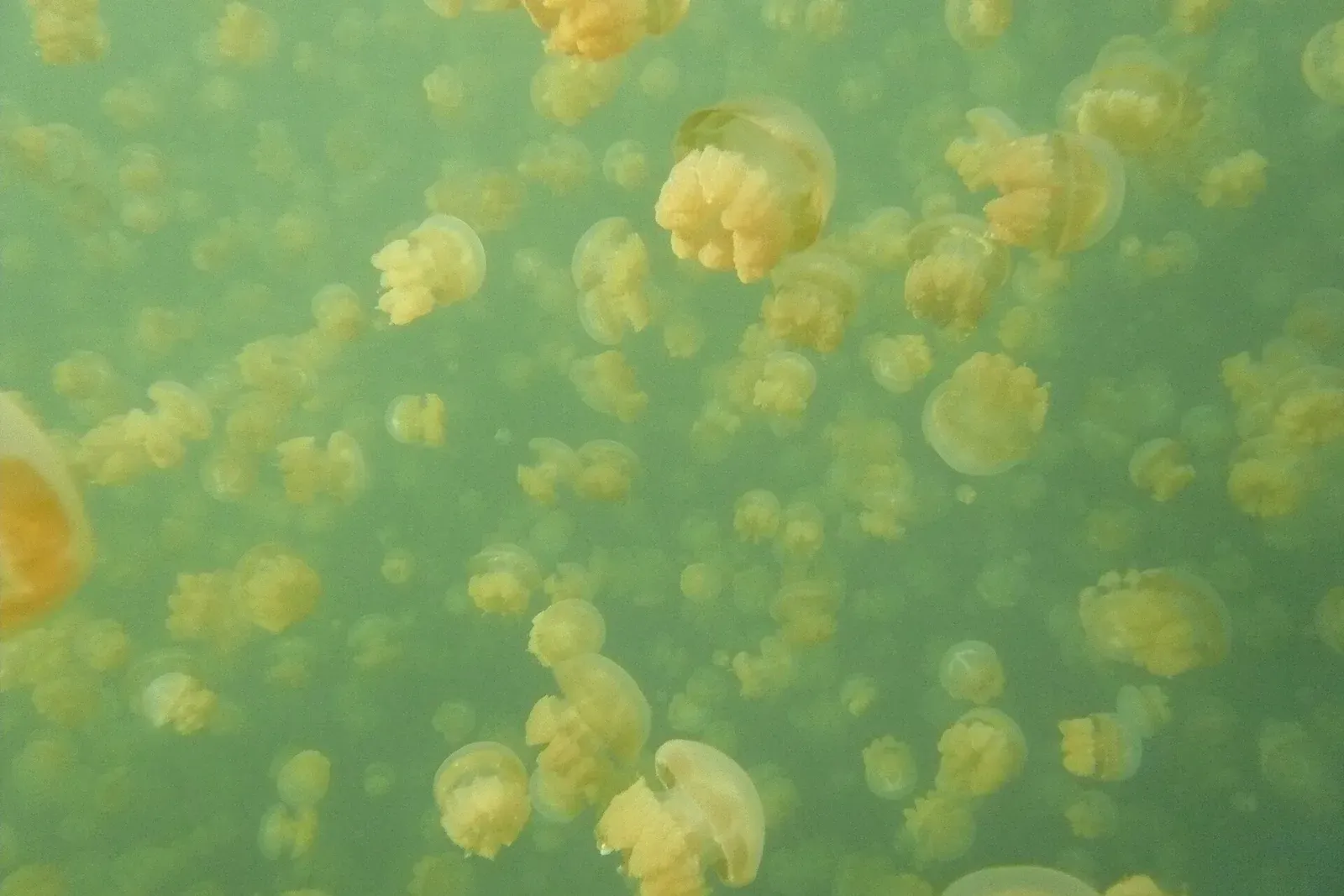
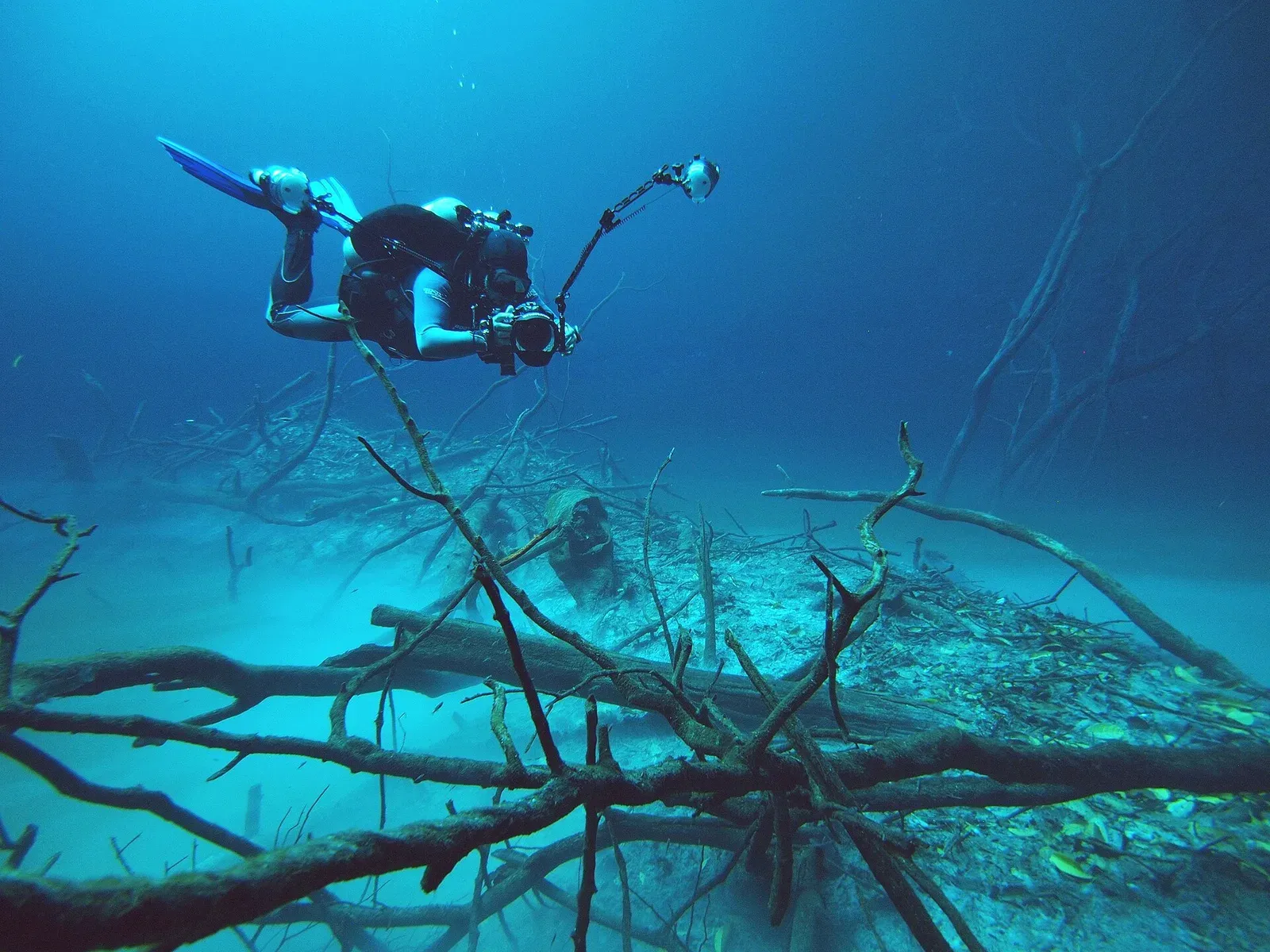
Seal a basin off from wind and tide and stratification goes from scenery to chemistry. A lake that never fully mixes strands its deep water without oxygen, and what accumulates instead is hydrogen sulfide. Jellyfish Lake is the gentle face of it — millions of golden jellyfish circulating in the oxygenated top layer, scuba banned outright because below about 15 m (50 ft) the water is anoxic, with sulfide our record puts at over 80 mg per litre at the bottom, enough to poison a diver through the skin. The Great Blue Hole keeps its dead zone politely out of recreational reach, below roughly 91 m. And at Angelita the chemistry becomes theatre: a sulfide cloud pooled on the density interface — our record, following PADI’s write-up, puts it around 27 m in a 55 m shaft — so convincingly river-like, with bare branches breaking its surface, that the dive is sold as swimming above an underwater river. It is the same seam as every halocline in this article, made visible by what it traps.
Where the sea shows its seams
| Site | Depth | Level | Best months |
|---|---|---|---|
| Angelita Riviera Maya Cenotes · Mexico | to 27 m | Advanced | Nov–Apr |
| Barracuda Lake Coron · Philippines | to 30 m | Advanced | Year-round |
| Jellyfish Lake Palau · Palau | to 15 m | Beginner | Dec–Mar |
| Dan's Cave South Abaco Blue Holes · Bahamas | 23–46 m | Advanced | Jan–Apr |
| The Cathedral Crete · Greece | 14–21 m | Intermediate | Jun–Oct |
| Pokemon Cave Vis · Croatia | to 18 m | Advanced | Jun–Sep |
| Toriike Miyako-jima · Japan | 20–35 m | Advanced | Apr–Jun |
| Milford Sound (Piopiotahi) Fiordland · New Zealand | to 40 m | Advanced | Dec–Feb |
| Punta Vicente Roca Galápagos West (Isabela & Fernandina) · Ecuador | 12–27 m | Advanced | Jan–Apr |
| Batu Wali Banda Islands · Indonesia | 5–30 m | Advanced | Oct–Nov |
| Great Blue Hole Belize Barrier Reef · Belize | 5–40 m | Advanced | Mar–Jun |
| Cenote Yax-Chen Riviera Maya Cenotes · Mexico | 5–7 m | Intermediate | Nov–Apr |
| Isaac M. Scott Thunder Bay · United States | to 53 m | Advanced | Jul–Sep |
Cenote Angelita: "Underwater River" · AB TV on YouTube
The cave country where haloclines live is covered in cenotes and caverns; the four-degree lakes are in freshwater diving; what the cold below the thermocline does to you is in the heat guide and cold-water diving; the buoyancy craft is in buoyancy and weighting; and the reason the fresh lid at Milford is dark as well as fresh belongs to why some seas are green.


