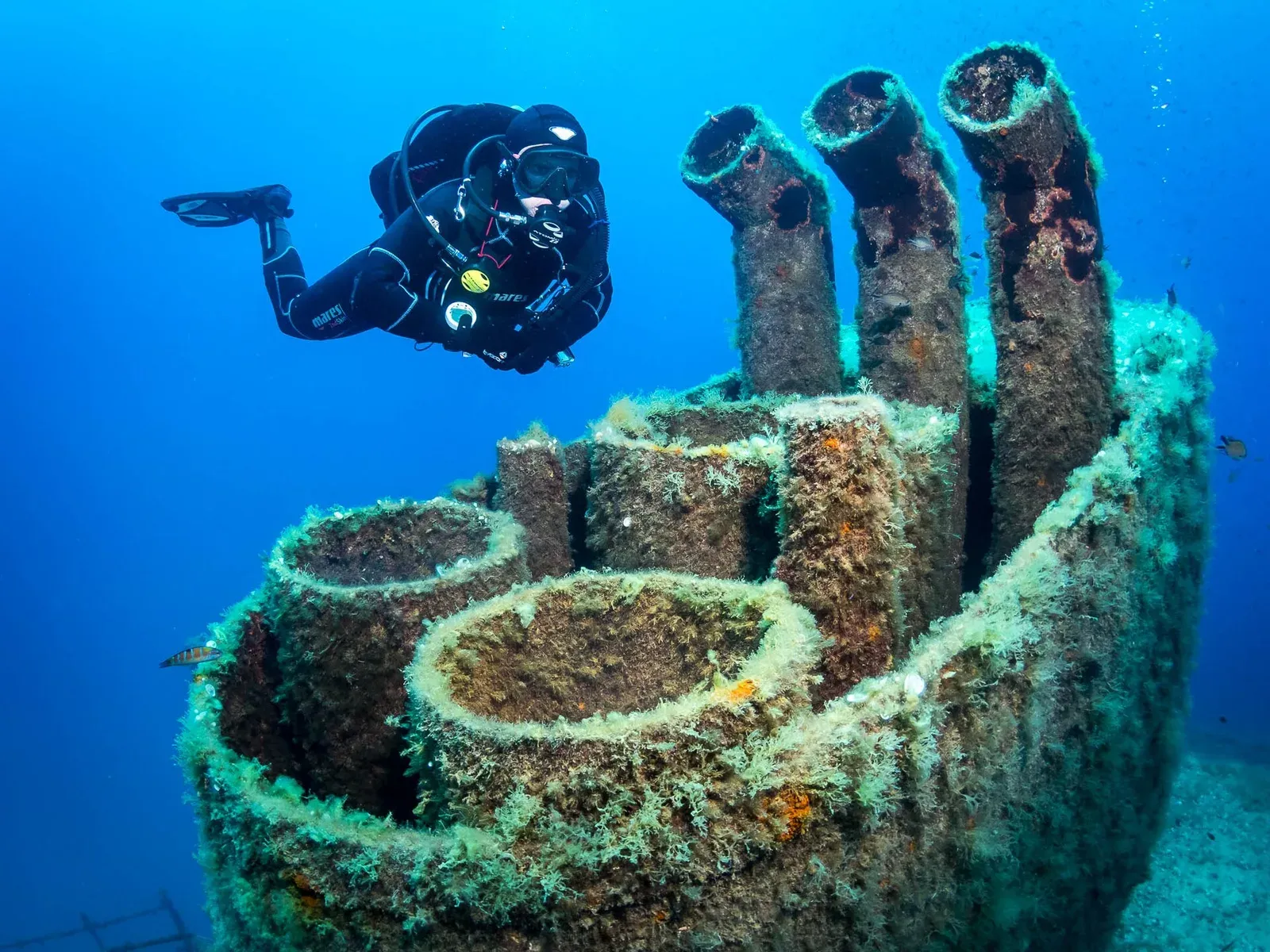
You do not need a boat for the biggest ship in this guide. The Um El Faroud, a 115 m tanker, lies about 150 m off a shore entry on Malta’s south coast, and she is the pattern for the whole archipelago. Most diving days on Malta and Gozo start in a car park rather than on a deck: centres drive out to a handful of proven entries, divers kit up on the rocks and walk in, and two or three dives a day stay cheap and unhurried.
What they walk in to is, more often than not, a ship somebody sank on purpose. This guide covers four scuttled ships, the P29, the Um El Faroud, the Karwela and the Hephaestus, plus the Blue Hole as the day off between them. It is about where they are and when to go. Why anyone sinks a ship, and what gets stripped out first, is in ships sunk on purpose.
Why the wrecks are the diving here
Malta and Gozo are limestone, and the coast carries on underwater as arches, chimneys, tunnels and cavern mouths. There is no hard-coral reef. Colour comes from sponge and algae on the rock, and the interest is architecture and light, which is exactly what a steel hull on white sand supplies. The ships are the reef.
Put the four of them on one depth scale, with the Blue Hole beside them, and the finding is plain.

Embed this diagram
<figure>
  <img src="https://reefwander.com/og/diagrams/malta-wreck-ladder.svg" alt="Malta and Gozo’s scuttled ships and the Blue Hole, by the depths in each site’s record. The ships span 12 to 46 m: two start inside Open Water range, the Karwela begins where Advanced ends, and the Hephaestus lies wholly past the 40 m line." loading="lazy">
  <figcaption>Diagram by Reefwander, licensed under CC BY 4.0.</figcaption>
</figure>
The four ships sit in a 34 m band, from the top of the P29 at 12 m to the Hephaestus on the sand at about 46 m. Two of them, the P29 and the Um El Faroud, start inside the 18 m an Open Water card is written for. The Karwela begins at 30 m, exactly where an Advanced card ends. The Hephaestus lies wholly below the 40 m recreational line, and she is the only one that does. And every site on the chart has a shore entry. That is what separates Malta from the wreck destinations dived from a boat: no boat schedule, no liveaboard, and often one entry that serves a shallow dive and a deep one.
| Site | Depth | Current | Level | Best months |
|---|---|---|---|---|
| P29 Patrol Boat Malta & Gozo · Malta | 12–35 m | Mild | Advanced | Jun–Sep |
| Um El Faroud Malta & Gozo · Malta | 28–35 m | Mild | Advanced | Jun–Sep |
| MV Karwela Malta & Gozo · Malta | 30–41 m | Mild | Advanced | Jun–Sep |
| MT Hephaestus Malta & Gozo · Malta | to 46 m | Mild | Advanced | Jun–Sep |
| Blue Hole & Inland Sea Malta & Gozo · Malta | 10–30 m | Mild | Intermediate | Jun–Sep |
The P29 wreck at Ċirkewwa
The P29 is the wreck most people type into a search bar, and she is also the shallowest to start. She was launched in East Germany in 1970 as the Kondor I-class minesweeper Boltenhagen, patrolled the inner-German border, and was bought by Malta in 1997 to work against smugglers as patrol boat P29. She was decommissioned in 2004, bought by the Malta Tourism Authority, cleaned, and scuttled off Ċirkewwa on 14 August 2007.
She sits upright on her keel about 150 m off Ċirkewwa at Malta’s northern tip, just under 52 m long, stern towards the shore. Her highest point is 12 m down, the sand around her is at 34 m and a dip in the seabed under the bow reaches 37 m, so the record gives the dive as 12 to 35 m. The swim out passes a memorial stone on the sand and an old anchor in the seagrass, and the machine gun left on her bow is the most visited spot on the wreck. What that means for you: an Open Water diver on a guided dive can see her mast and superstructure, while the bow and the sand beside her are Advanced depth with a short no-stop time.
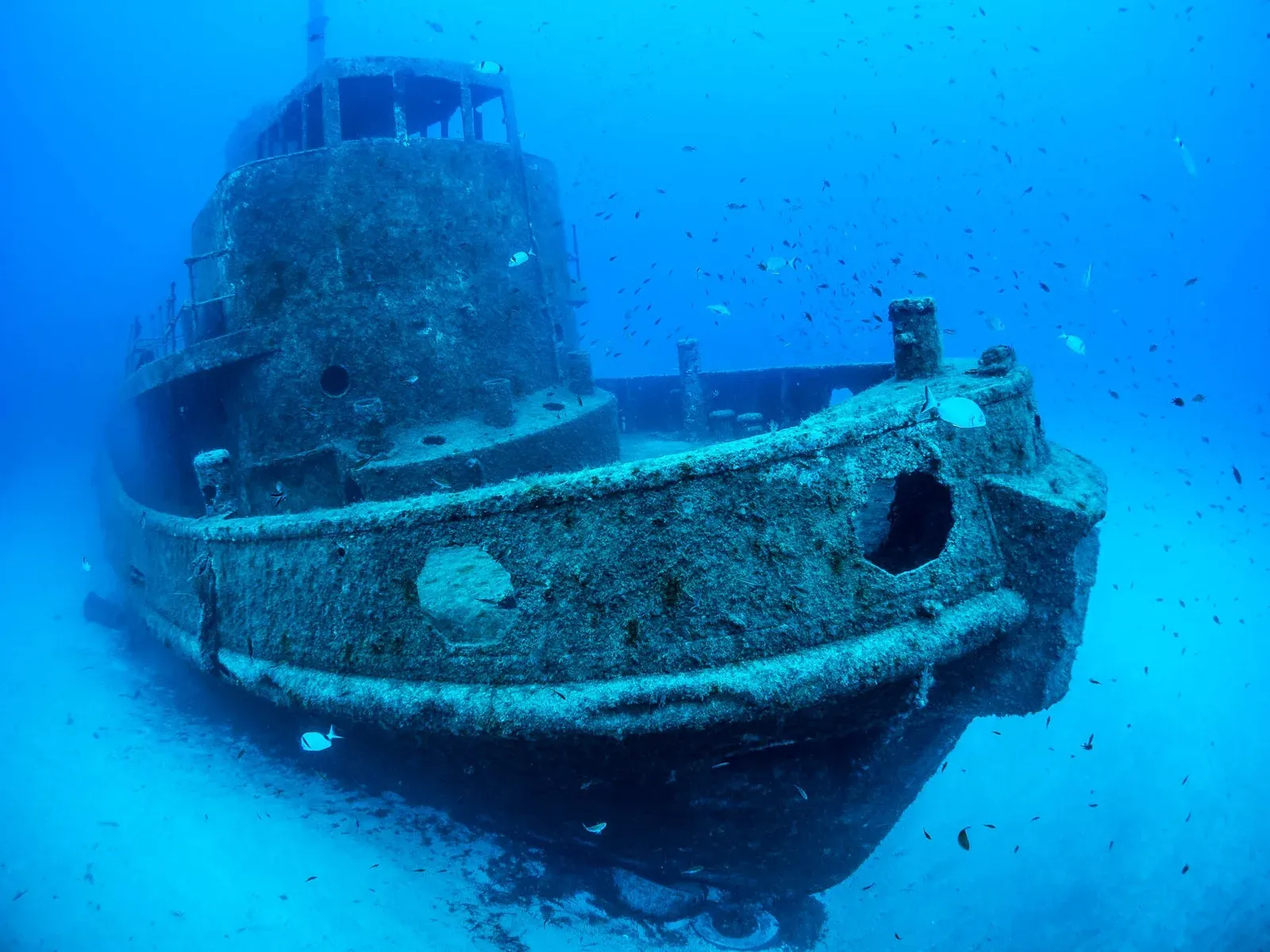
The same entry holds more. The tug Rozi, built in Bristol in 1958, was scuttled nearby in 1992 and lies upright on sand at 36 m, and the Ċirkewwa reef has cliffs, caves and an arch that reaches the seabed at 27 m. A second dive rarely needs a change of car park. It is also one of the busiest dive areas in the islands, so expect other groups on the same superstructure. The Gozo ferry leaves from the same headland.
The Um El Faroud at Wied iż-Żurrieq
The Um El Faroud is the big one: a 115 m Libyan-owned motor tanker, built in Middlesbrough in 1969. On 3 February 1995, during maintenance in a Malta dry dock, an explosion in her No. 3 centre tank killed nine shipyard workers. She stayed in the yard for three years and was scuttled off Wied iż-Żurrieq in 1998. The full story of why a wrecked hulk becomes a reef is in ships sunk on purpose; here it is enough to know that she is also a memorial.
She sits upright on clean sand. The bridge is between 15 and 18 m, the main deck at 25 m, and the seabed at 36 m by the record, with other published figures from 32 m. A storm in the winter of 2005/6 broke her in two, and the break is now part of the tour. Operators publish her as a 28 to 35 m dive: start on the bridge, run deeper along the ship to the bow, turn and work back along the outer hull, and finish shallow on the superstructure. Her inner tanks are completely open, which is why so many divers make her their first real wreck, but the rest of the hull is for divers trained and equipped for penetration.
Current can run over her, and a buoy line is placed close to the wreck through the summer for the ascent. From Malta she is a shore dive. From Gozo she is a full hour’s boat ride, more than 20 nautical miles, so base yourself on Malta for the days you want her.
The Karwela and the Hephaestus at Xatt l-Aħmar
Gozo’s south coast has its own cluster. At Xatt l-Aħmar, near the ferry port at Mġarr, several ships were sunk off one stretch of rock as diving attractions, and two of them are covered here.
The Karwela was launched in West Germany in 1957 as the ferry Frisia II, came to Malta in 1986, carried tourists round the Grand Harbour until 2002, and was scuttled here on 12 August 2006 beside the Xlendi and the Cominoland. She is just over 50 m long and sits upright on the sand: her top deck from 30 m, her bow at 39 m and her stern at 41 m. The entry is a giant stride off the rocks and a swim south down the reef to a drop-off; the bow lies about 80 m from where you went in, and the exit is up two ladders fixed to the shore rocks. Most dives hold an average of about 35 m. The feature everyone comes for is a staircase in the middle of the ship running down to the lower deck, lit by the portholes, and seeing it from inside needs Wreck Diver certification.
Her shallowest point is where an Advanced card stops, and her record asks for certification to 40 m, which in practice means a deep specialty on top of Advanced. Plan the gas for the swim back to the ladders after the safety stop, not just for the wreck.
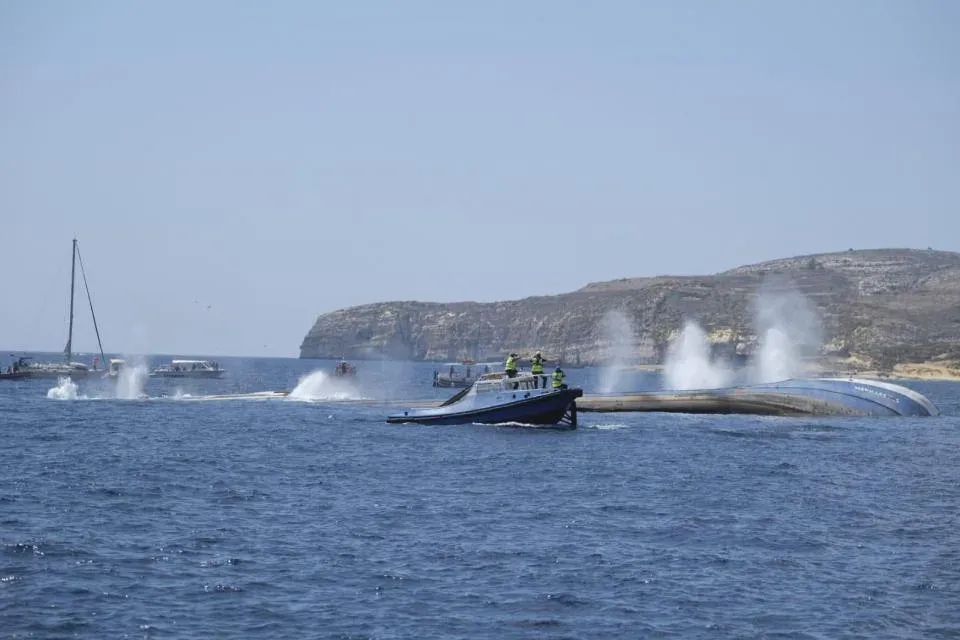
The Hephaestus is the newest. A 61 m steel tanker built in Sweden in 1965, she ran aground off Qawra in a storm on 10 February 2018, was towed off that August, and was scuttled at Xatt l-Aħmar on 29 August 2022. She rests upright on sand at about 46 m, roughly 30 m off the coast, so the descent starts almost at once and the whole dive is below 40 m.
Say it plainly: an Advanced Open Water card does not cover the Hephaestus. “Advanced” in the table above is the top of our level scale, not the name of the card; the dive itself is a decompression dive that needs technical training, suitable gas and a planned ascent, and no dive route, current or visibility figures have been published for her yet, so take the briefing from an operator who dives her. Where she sits among the world’s deeper wrecks, and what the step past 40 m involves, is in deep wrecks and the recreational limit.
The Blue Hole in Gozo, for the day between wrecks
Four days of wrecks at 25 to 40 m is a lot of nitrogen. The standard day off is at Dwejra on Gozo’s west coast, where the Blue Hole and the Inland Sea sit side by side.
The Blue Hole is a collapsed sea cave, a five-minute walk from the car park over an old quarry and down carved steps. An archway in its seaward wall opens between about 6 and 15 m, and outside it lies the rubble of the Azure Window, the rock arch that collapsed on 8 March 2017, now stacked into overhangs between 5 and 16 m. The Inland Sea is a lagoon where the vans park at the water’s edge, and it drains to open sea through an 80 m tunnel in the cliff. The record gives both as 10 to 30 m and rates them intermediate; the wall outside keeps falling well past that, so agree a turn depth before you go through the arch.
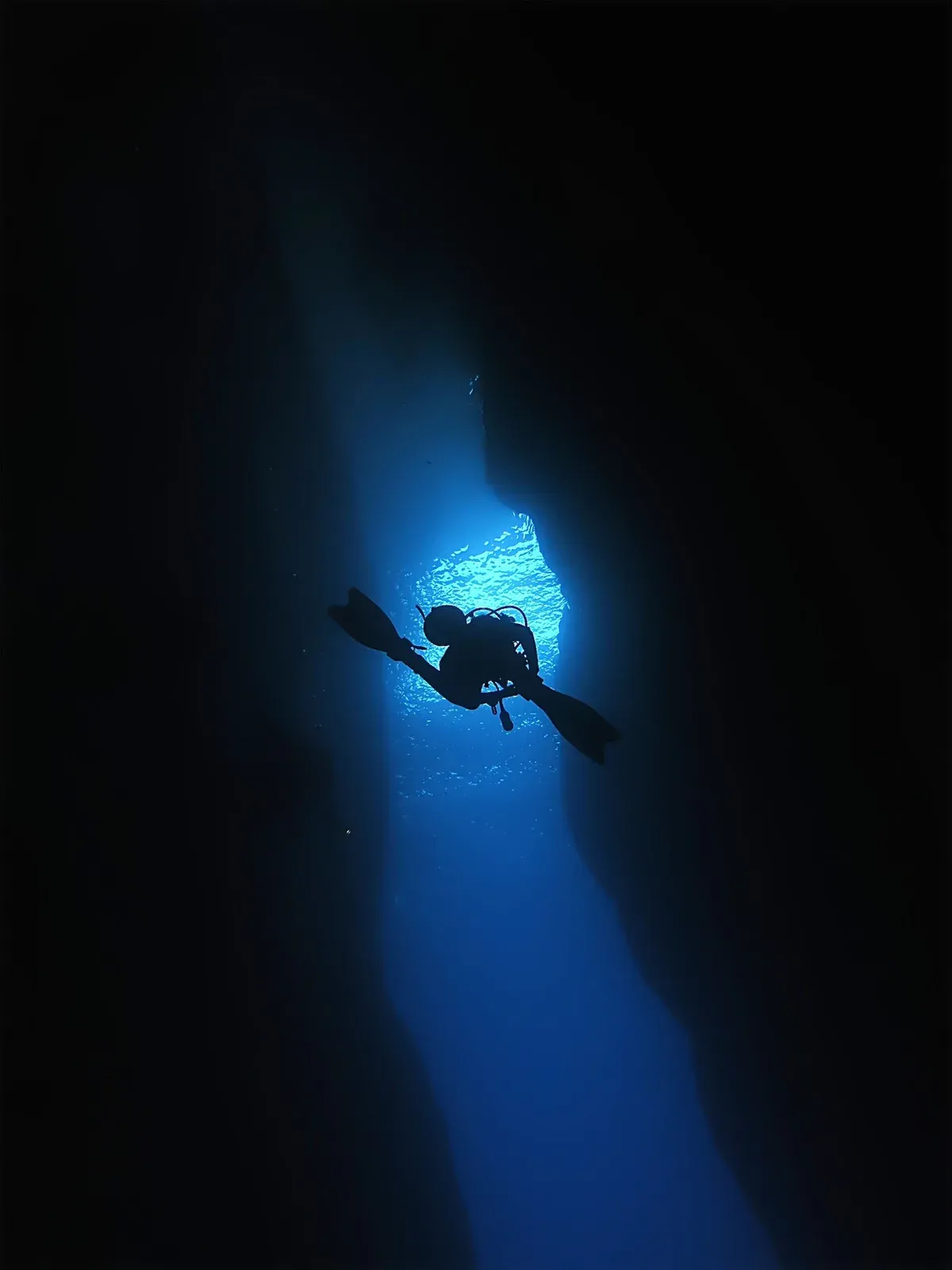
It is the one site on this list with Open Water as the stated minimum, and it works as the shallow, light-filled half of a week spent mostly on steel. The wider world of blue holes is in our blue holes guide.
When to dive Malta and Gozo’s wrecks
Here is the area’s diving calendar. Every row is the same, because none of these sites carries a season of its own: they all inherit the Malta and Gozo rating, and it describes diving conditions, not what you will see.
| Site | Jan | Feb | Mar | Apr | May | Jun | Jul | Aug | Sep | Oct | Nov | Dec |
|---|---|---|---|---|---|---|---|---|---|---|---|---|
| P29 Patrol BoatMalta & Gozo | Fair | Fair | Fair | Good | Good | Prime | Prime | Prime | Prime | Good | Good | Fair |
| Um El FaroudMalta & Gozo | Fair | Fair | Fair | Good | Good | Prime | Prime | Prime | Prime | Good | Good | Fair |
| MV KarwelaMalta & Gozo | Fair | Fair | Fair | Good | Good | Prime | Prime | Prime | Prime | Good | Good | Fair |
| MT HephaestusMalta & Gozo | Fair | Fair | Fair | Good | Good | Prime | Prime | Prime | Prime | Good | Good | Fair |
| Blue Hole & Inland SeaMalta & Gozo | Fair | Fair | Fair | Good | Good | Prime | Prime | Prime | Prime | Good | Good | Fair |
The ratings say June to September is prime, and the numbers behind them say something more useful: there is no closed season. The sea averages 21 °C in June and peaks near 26 °C in August, with conditions at their most settled and the popular entries at their busiest. October and November stay above 20 °C on the monthly average and the sites are quieter, which makes autumn the best-value window. April and May are cooler, around 16 to 18 °C, and warming. December to March brings the coldest water, about 15 to 17 °C, and it never drops below 14 °C.
So the wrecks are dived all year. What changes is the suit and the coast. In winter the cold is a matter of neoprene, and our wetsuit thickness guide gives the temperature bands. What actually cancels a dive is weather. With almost no tide to work round, wind picks the coast: when a storm hits one side, centres move to whichever shore is in the lee, and on an island as small as Gozo that is minutes away. A winter trip needs slack in the schedule for the day the wreck you wanted is on the wrong side of the wind.
The area’s general wildlife note puts barracuda and the densest clouds of small fish in the summer months, and nudibranchs on the shallow rock in winter. Our site records do not carry an animal calendar for any of these wrecks, so treat that as a tendency, not a timetable.
How a week of wreck diving runs
Nearly everyone flies into Malta International and bases around Sliema, St Paul’s Bay or Bugibba, then drives or rides the centre’s van out to the entries. The P29 and the Rozi are at Ċirkewwa, and the Gozo car ferry leaves from the same place for Mġarr, a crossing of about 25 minutes. On Gozo, Marsalforn and Xlendi are the usual bases, a short drive from the Dwejra sites. Comino, between the two, is dived by boat, and adds the P31, a sister ship of the P29 scuttled as a dive site, which reaches only 20 m.
A sensible week follows the depth chart. An Open Water diver with a guide can dive the upper works of the P29 and the Um El Faroud, the P31 and the Blue Hole. The decks at 25 m and the sand beside the hulls want an Advanced card, and the Karwela, from 30 m down, wants certification to 40 m. Going inside any of them, beyond the Um El Faroud’s open tanks, wants Wreck Diver training; our first wreck dive guide covers what that first dive feels like. The Hephaestus is for technical divers.
Diving without a guide is allowed, with conditions: a buddy, Advanced Open Water or an equivalent such as CMAS Two Star or BSAC Sport Diver, and a signed medical statement. Guided dives are open to Open Water divers.
