The shark that comes to you
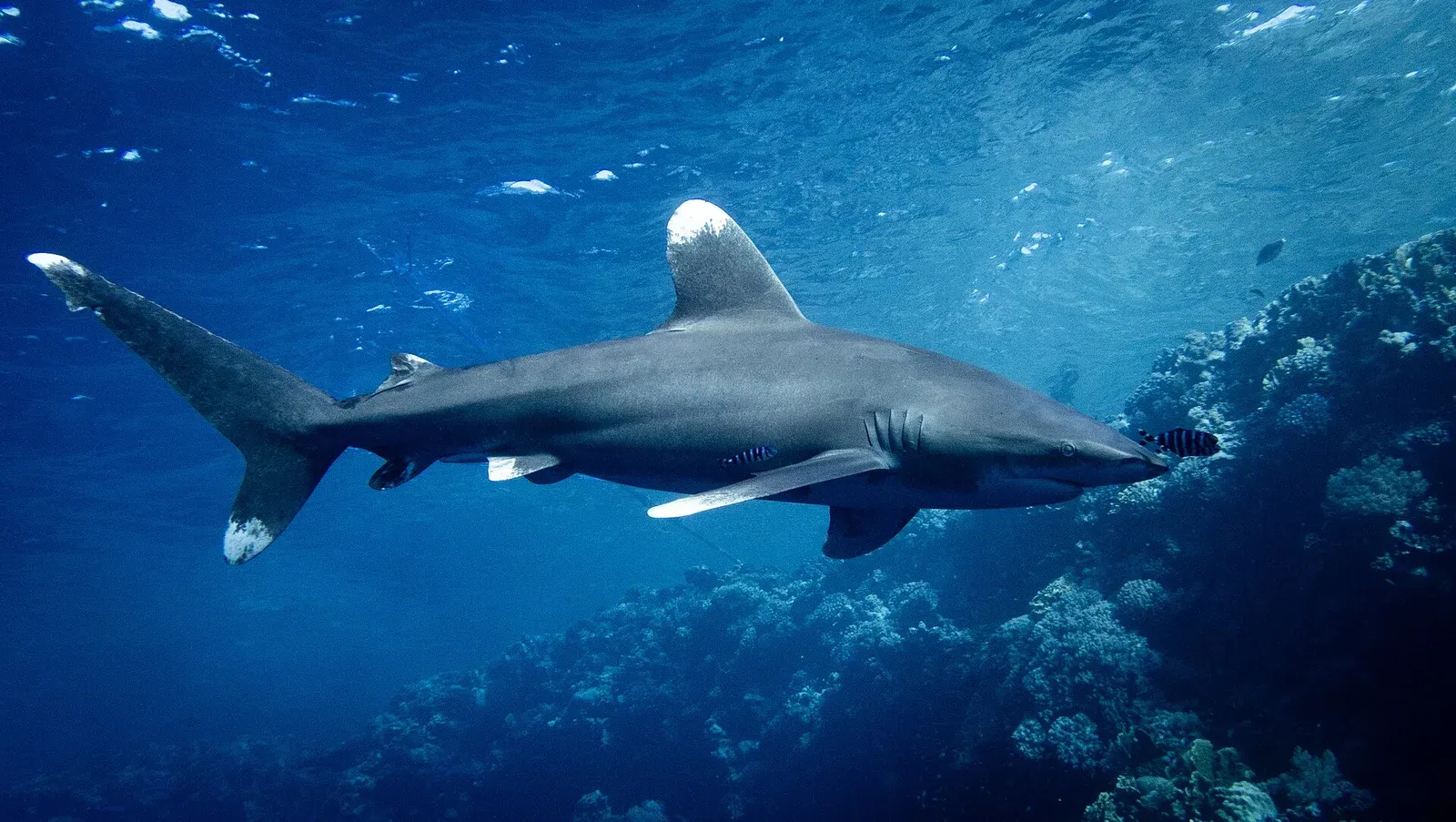
Most sharks a diver meets are reef animals with a home address. The oceanic whitetip is not one of them. It lives in the open sea, in the warm surface layer above 20 °C, generally in the top 200 m of water over a bottom that may be a kilometre down; NOAA describes it as a surface-dwelling species, and tagged animals have been recorded at over 1,000 m but spend almost all their time near the top. It is stocky, usually two to three metres long with the largest recorded past four, and its field marks are unmistakable once you have seen them: a broad rounded dorsal fin and long paddle-shaped pectorals, both mottled white at the tips. It rarely travels alone. Pilot fish ride at the snout and under the pectorals, and remoras and dolphinfish trail behind.
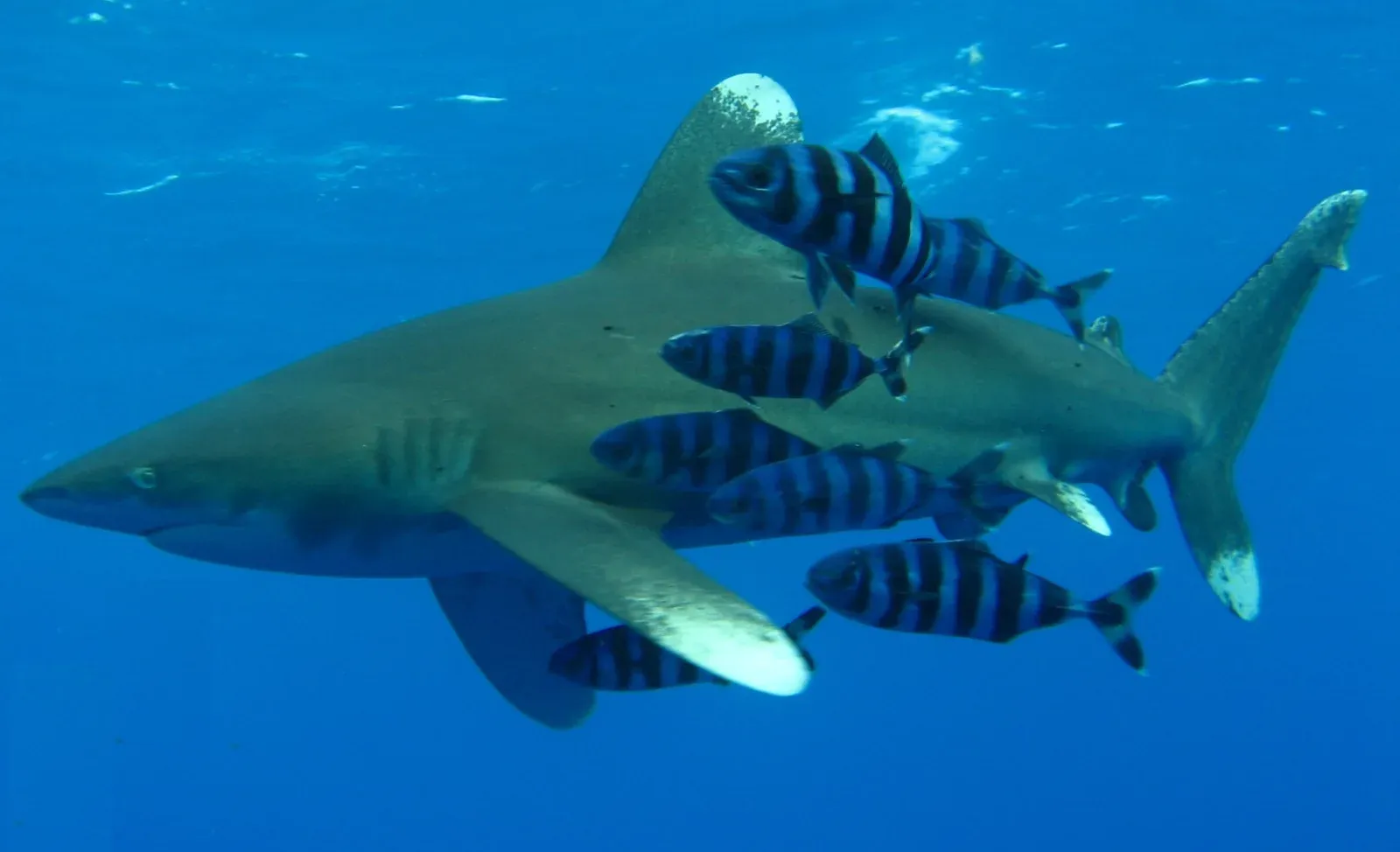
What makes it different underwater is not the shape, it is the approach. Reef sharks pass. Whitetips arrive. They swim slowly and directly at a diver, hold, turn, and come back — repeatedly, at close range, sometimes bumping. This is investigative rather than predatory behaviour, and it is also the whole reason Red Sea shark briefings sound nothing like Caribbean ones. On a Caribbean reef the briefing is about what you will see. On an Egyptian offshore boat it is about what you will do when a two-and-a-half-metre animal takes an interest in you for the third time in five minutes.
The other thing to know before you plan a trip is how few places this is possible at all. Across our whole dataset only twelve dive sites carry oceanic whitetips, and ten of them are in Egyptian or Sudanese water — nine in Egypt alone. That is not a gap in the research; it reflects a genuinely oceanic animal that only comes within reach of a recreational diver where deep water runs up against something worth patrolling.
The Red Sea season, and why it is autumn
The Red Sea’s offshore reefs are the exception that makes this article possible, because there the deep water arrives at the reef rather than the other way around. Big and Little Brother and Daedalus are isolated rock rising out of open sea, sixty to a hundred kilometres offshore, and oceanic whitetips are the animal most trips there see — cruising the walls right through the March-to-November liveaboard season, and closest in on autumn boats. Daedalus is the extreme version: a lighthouse on a seamount that climbs out of 450 m of water about 100 km off Marsa Alam, wall on every side, current strong and unpredictable enough that groups drop where the water allows and drift a single face.
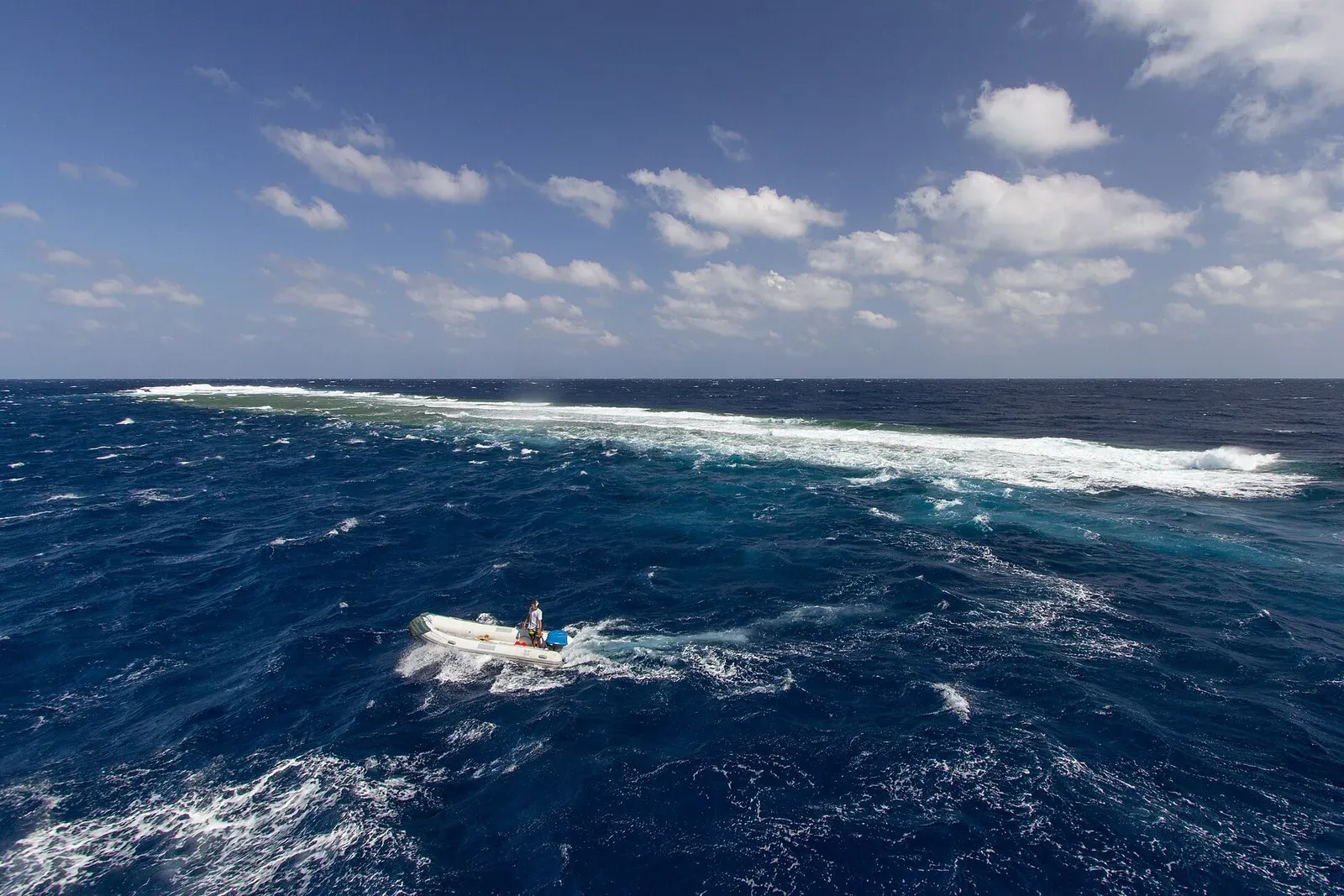
Everywhere else in the Red Sea, autumn is not just the best window — it is close to the only one. Elphinstone Reef, a standalone wall about 30 km north of Marsa Alam with a plateau at each end, has its best chances between October and December, and one Red Sea operator calls it the most reliable oceanic whitetip site on the planet. At St John’s, far south near the Sudanese border, the animal is rated a possibility in the settled autumn window rather than a fixture: Habili Ali is an exposed pinnacle rising to within five or six metres and dropping past 60, and Gota Kebir is the 840-metre reef block next door. Up north at Sharm, hammerheads are the June-to-September hope and whitetips are the autumn one, both luck rather than bookable, on the wall at Shark & Yolanda Reef. Fury Shoals is the outlier of the Egyptian group: shallow, mild, diveable all year, and the one site on this list where a whitetip is a bonus rather than the point.
That autumn concentration is the single most useful planning fact in this article. If you book a Brothers–Daedalus–Elphinstone itinerary for September, October or November, you are buying the best odds this species offers anywhere on earth. Book the same boat in May and you are buying a very good week of wall diving on which a whitetip may or may not turn up.
| Site | Jan | Feb | Mar | Apr | May | Jun | Jul | Aug | Sep | Oct | Nov | Dec |
|---|---|---|---|---|---|---|---|---|---|---|---|---|
| Big Brother IslandBrothers & Daedalus | Off-season | Off-season | Fair | Good | Prime | Prime | Good | Fair | Prime | Prime | Good | Off-season |
| Little Brother IslandBrothers & Daedalus | Off-season | Off-season | Fair | Good | Prime | Prime | Good | Fair | Prime | Prime | Good | Off-season |
| Daedalus ReefBrothers & Daedalus | Off-season | Off-season | Fair | Good | Prime | Prime | Good | Fair | Prime | Prime | Good | Off-season |
| Elphinstone ReefMarsa Alam & Port Ghalib | Good | Good | Prime | Prime | Prime | Good | Good | Good | Prime | Prime | Prime | Good |
| Fury ShoalsHamata & Wadi Lahami | Fair | Fair | Good | Good | Prime | Prime | Prime | Prime | Prime | Prime | Good | Fair |
| Habili AliSt John's Reefs | Fair | Fair | Good | Prime | Prime | Prime | Good | Good | Prime | Prime | Good | Fair |
| Gota KebirSt John's Reefs | Fair | Fair | Good | Prime | Prime | Prime | Good | Good | Prime | Prime | Good | Fair |
| Shark & Yolanda ReefSharm El Sheikh | Fair | Fair | Good | Good | Prime | Prime | Prime | Prime | Prime | Prime | Good | Fair |
| Sanganeb AtollSudanese Red Sea | Fair | Fair | Good | Prime | Prime | Good | Fair | Fair | Good | Prime | Prime | Fair |
| Columbus PointCat Island | Fair | Fair | Good | Prime | Prime | Prime | Fair | Fair | Off-season | Off-season | Fair | Fair |
| Roca PartidaRevillagigedo (Socorro) | Prime | Prime | Prime | Good | Fair | Off-season | Off-season | Off-season | Off-season | Off-season | Fair | Good |
Sudan belongs on the list and carries a caveat. Sanganeb, the Red Sea’s only atoll and Sudan’s first marine national park, sits 30 km northeast of Port Sudan on a ring reef rising from around 800 m, and whitetips patrol the blue off it through the April-to-June and October-to-November windows. But the 2023 conflict has disrupted Port Sudan liveaboard departures, Port Sudan flight routings change at short notice, and operators have to be verified individually. Treat any Sudanese itinerary as unconfirmed until the boat gives you written confirmation that it is actually sailing, and check that your insurance still covers the country.
The two outliers
Two sites on the list are nowhere near the Red Sea, and they are opposites of each other.
Columbus Point off Cat Island in the Bahamas is the purest version of this dive that exists. The boat runs about twenty minutes out from Greenwood Beach Resort, stops over open ocean with nothing below in reach, and divers get in and stay there. There is no reef, no bottom, and no cage — the boat, the line and the other divers are the only structure. Because the sharks hold near the surface the profile stays shallow, around 18 m (60 ft) at most, so bottom time is generous and several entries fit into a day. Unlike the Red Sea dives this one is baited: a crate of it is kept at the boat so the animals have a reason to circle, and divers are shown how to redirect a close pass with a camera housing rather than a hand. The season is hard and short: whitetips gather off the island’s southern end from winter into spring, and the operator running the trips lists May and June. Outside roughly April to June the animals disperse and the blue-water trips do not run at all.
Roca Partida in Mexico’s Revillagigedo archipelago is the opposite: whitetips are one name on a long list. The rock is small enough to swim around in a single dive, walls dropping vertically past 40 m from a base below 50, and every direction you look off the wall is open ocean. Oceanic whitetips, scalloped hammerheads, Galápagos sharks, whale sharks and giant Pacific mantas all work the same water, with dolphins and humpbacks recorded there too. Access needs a liveaboard berth out of Cabo San Lucas and permits from the Mexican Armed Forces, and the season inverts the Red Sea’s — boats sail roughly mid-November to May, because June to October is too rough for the crossing.
| Site | Depth | Current | Level | Best months |
|---|---|---|---|---|
| Big Brother Island Brothers & Daedalus · Egypt | 10–35 m | Strong | Advanced | May–Jun |
| Little Brother Island Brothers & Daedalus · Egypt | 10–40 m | Strong | Advanced | May–Jun |
| Daedalus Reef Brothers & Daedalus · Egypt | 10–40 m | Strong | Advanced | May–Jun |
| Numidia Wreck Brothers & Daedalus · Egypt | 8–40 m | Strong | Advanced | May–Jun |
| Elphinstone Reef Marsa Alam & Port Ghalib · Egypt | 18–40 m | Strong | Advanced | Mar–May |
| Fury Shoals Hamata & Wadi Lahami · Egypt | 10–25 m | Mild | Intermediate | May–Oct |
| Habili Ali St John's Reefs · Egypt | 10–40 m | Strong | Advanced | Apr–Jun |
| Gota Kebir St John's Reefs · Egypt | 15–30 m | Moderate | Intermediate | Apr–Jun |
| Shark & Yolanda Reef Sharm El Sheikh · Egypt | 15–30 m | Strong | Advanced | May–Oct |
| Sanganeb Atoll Sudanese Red Sea · Sudan | 5–40 m | Moderate | Advanced | Apr–May |
| Columbus Point Cat Island · Bahamas | to 18 m | Mild | Advanced | Apr–Jun |
| Roca Partida Revillagigedo (Socorro) · Mexico | to 40 m | Moderate | Advanced | Jan–Mar |
How the dive is actually run
Almost none of these sites are dived the way a reef is dived, and the reason is that whitetips are not on the reef. They are off it, in mid-water, which puts the encounter in the part of the dive most divers treat as an afterthought.
How NOT to dive with longimanus Sharks Elphinstone Reef 2022 · Tomáš Vránek (gmail) on YouTube
The safety stop is the dive. At the Brothers and Daedalus, sharks tend to show away from the rock — in mid-water on the crossing, or circling the boat while the group hangs. That is why guides there insist on a tight group and a controlled ascent on a line rather than a loose drift up. If you have spent your diving life treating five metres for three minutes as the boring bit, this is the trip that changes your mind.
Stay vertical, in a group, facing the animal. After a diver was bitten on the arm at Elphinstone in December 2020, the operator involved published its own guidance, and it is as clear a summary as you will find: don’t flap your arms, maintain good buoyancy, remain calm, stay in a vertical position within a group, always face the shark and keep your eye on it, do not turn your back on it, and follow the guide at all times. Guides at Elphinstone commonly put a group with its back to the wall and cameras facing out — whitetips prefer an isolated target, and four divers presenting outward is not one.
Do not linger at the surface, and do not dangle. The surface interval and the moment of climbing out are the highest-risk parts of the day, which is why the same guidance says not to separate from the group or hang around on top, and why groups are expected to ascend and get out together rather than trickling up alone. The vertical posture that helps in mid-water is a posture inside a group; a lone diver hanging off the line at the top with fins trailing below is exactly the isolated target the briefing is trying to avoid.
And do not dive it early. Every Egyptian offshore site on this list is graded advanced, and the Brothers operators set a minimum of around 50 logged dives with strong-current and deep experience. That is not about the sharks; it is about current that has carried divers out into open sea, downwellings reported at Little Brother, and pickups in open water well off the reef.
The bite history, stated plainly
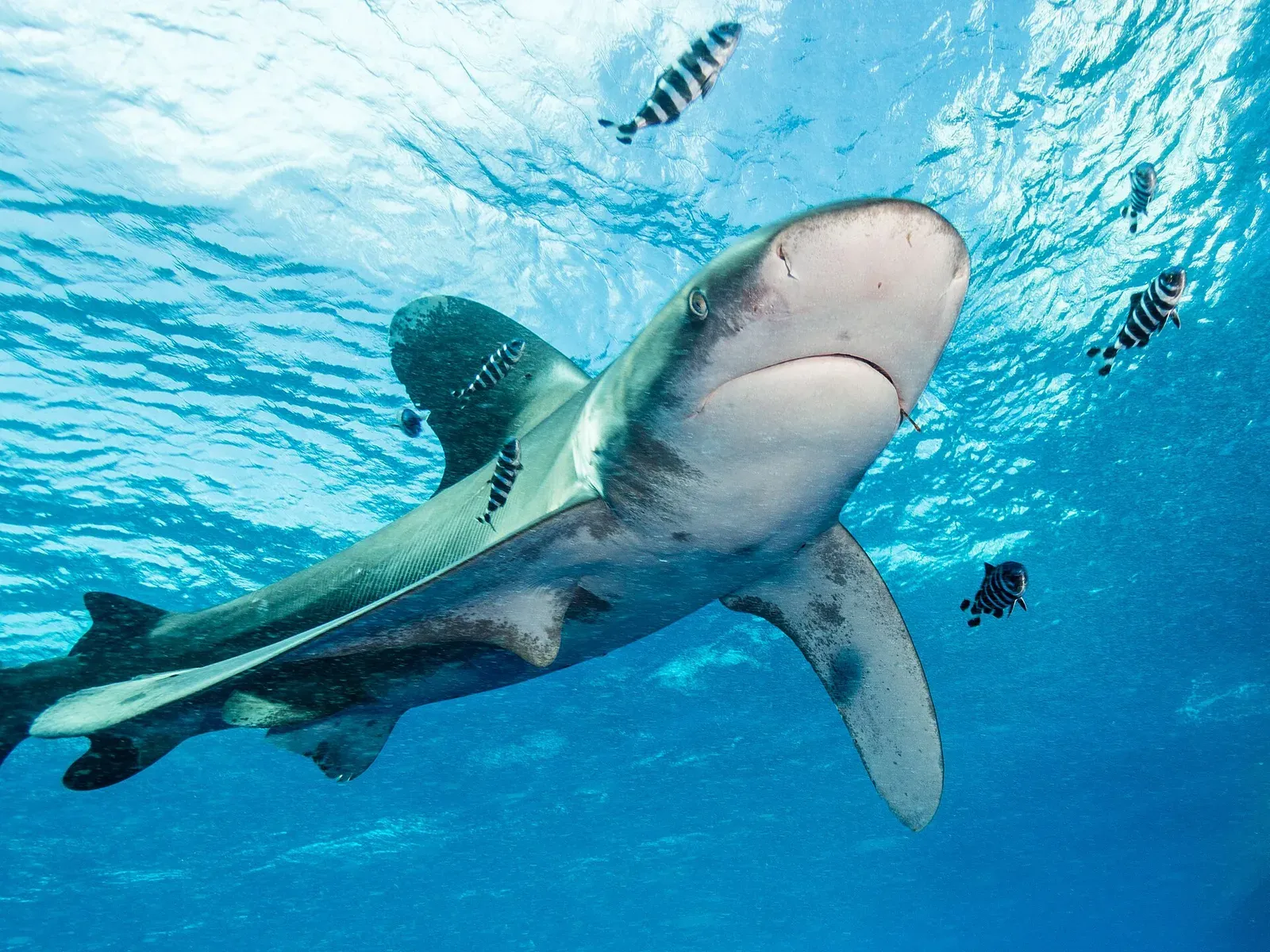
Oceanic whitetips have a reputation, and pretending otherwise would be worse than useless. Cousteau called the species “the most dangerous of all sharks”, and its historical notoriety comes from wartime sinkings — the Nova Scotia in 1942 and the Indianapolis in 1945 — where survivors were in open water for hours or days.
The modern record is much smaller and much more specific. The species is recorded as having attacked 21 people between 1955 and 2020: nine divers, eight swimmers, two fishermen, one shipwreck survivor and one downed pilot. Five of those were fatal. Against the number of dives run on Elphinstone and the Brothers every autumn, that is a very small number — and it is not zero.
The best-known cluster is the 2010 Sharm El Sheikh incidents. On 1 December 2010 four swimmers were seriously injured within minutes of each other in the shallows near Ra’s Nasrani, and on 5 December a German woman was killed while wading and snorkelling close to shore. An oceanic whitetip was implicated, though divers and conservationists disputed whether the animal caught afterwards was the one photographed at the site. What matters for anyone planning a trip is where and why it happened: these were shore-water incidents at hotel beaches, not encounters on the offshore dives, and the accumulating evidence pointed to a shark that had been conditioned to being hand fed. Egypt’s response included closing the beaches and banning shark feeding.
That is the through-line. The two documented Red Sea events with an identified cause — Sharm in 2010 and Sanganeb’s history of operator feeding — both come back to food and people in the same water. It is also why the Red Sea briefings ban bait and loose hands outright, why the baited Bahamian trips keep theirs in a crate at the boat rather than loose in the water, and why the divers who work these sites treat the safety stop as a formation rather than a pause.
Critically endangered, and what it costs
The animal you are queuing up to see is one of the most heavily depleted large fish in the ocean. The IUCN Red List assessed Carcharhinus longimanus as Critically Endangered in 2019, with numbers down in every ocean region it inhabits and a decline estimated at roughly 98 per cent, with the highest probability of a reduction over 80 per cent across three generations — a span of about 61 years. NOAA, which listed it as Threatened under the US Endangered Species Act in 2018, puts the Pacific decline at 80 to 95 per cent since the mid-1990s and the Gulf of Mexico decline at 88 per cent.
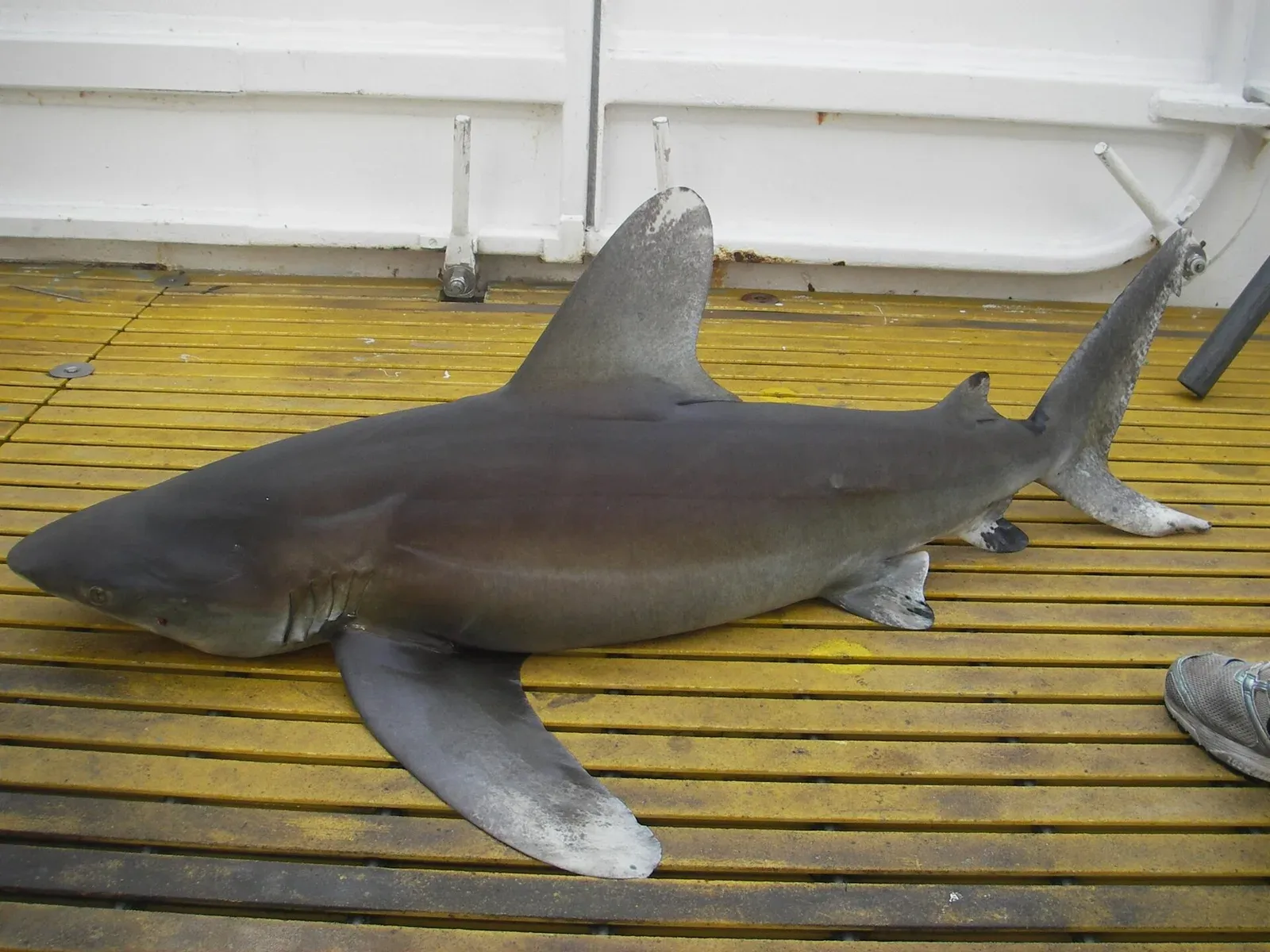
The cause is not mysterious. Whitetips live in the warm surface layer of the open ocean, which is precisely where pelagic longlines, purse seines and gillnets work, so encounter and mortality rates are high wherever those fisheries operate; the large, distinctive fins are then valuable in the fin trade. The species is also slow to recover by design — females mature at six to nine years, gestation runs ten to twelve months, and litters average about six pups on what is thought to be a two-year cycle.
There is one recent piece of good news. On 27 November 2025, CITES CoP20 voted with 83 per cent in favour to move oceanic whitetips from Appendix II to Appendix I, the first time a shark has been given CITES’ highest protection and a general prohibition on international commercial trade. Whether that translates into sharks in the water depends on enforcement in fisheries a long way from any dive boat.
For a diver the practical conclusion is small but real: a live whitetip on an autumn Red Sea boat is worth more to the local economy than a dead one on a longline, and the operators who run those trips properly — briefing hard, banning bait, keeping groups tight — are the ones making that argument credible.
Where this overlaps with the rest of the Logbook
Three of these sites turn up in our month-by-month hammerhead guide — Little Brother, Habili Ali and Sanganeb — and Jackson Reef, the hammerhead site in the Straits of Tiran, sits on the same Sharm day-boat circuit as Shark & Yolanda. The same current that brings one species brings the other. If your trip is aimed at whitetips in autumn, that guide is where to check what else the same week might produce.
Oceanic whitetip shark - Shark & Yolanda reef · Adel M. El Beialy on YouTube
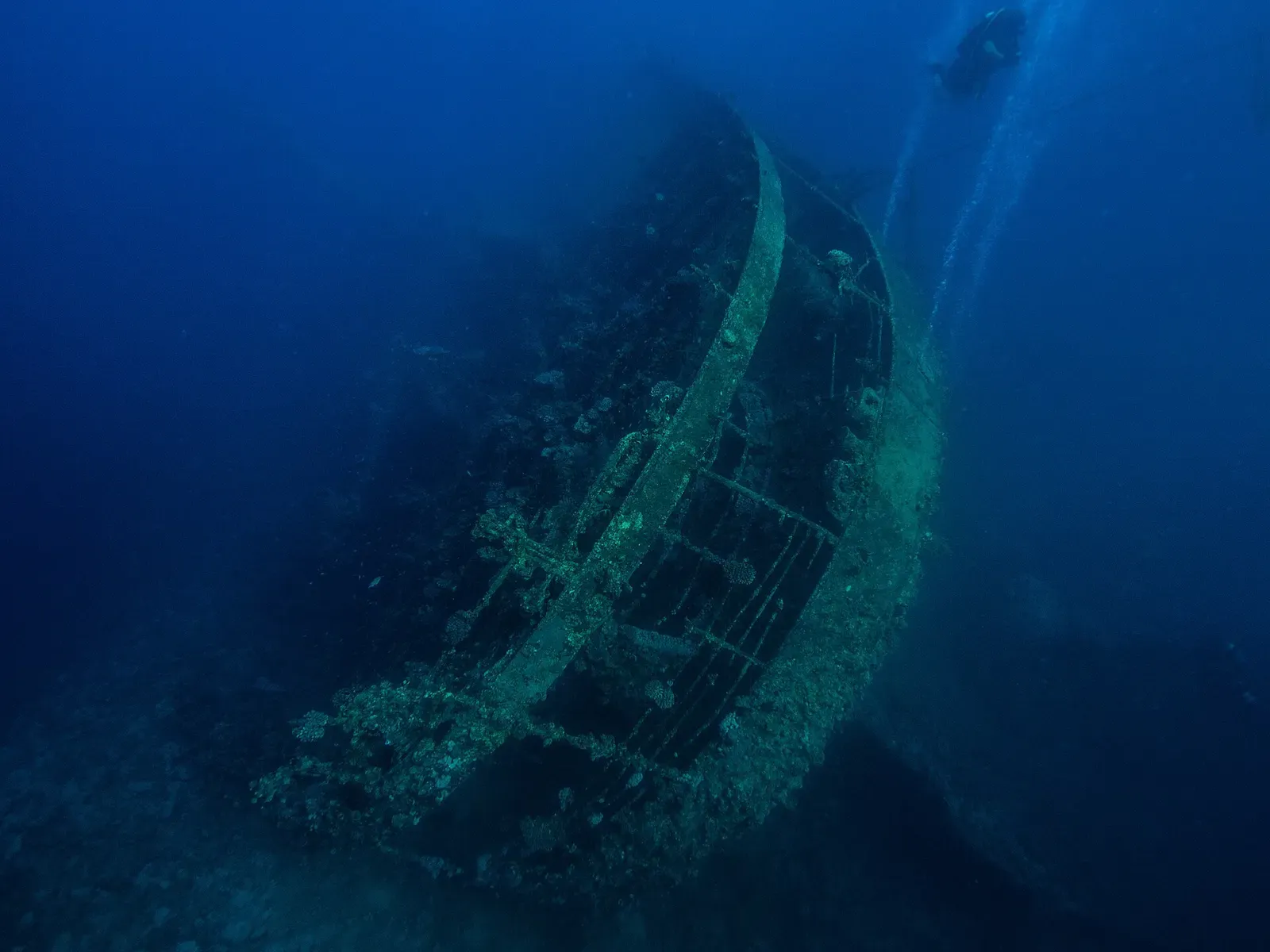
And one site does double duty in a way worth knowing before you book. Big Brother’s north wall carries the Numidia, an 1901 cargo steamer hanging down the rock with her railway wheels at 8 m and her stern at 80. It is the same mooring, the same current and often the same shark traffic, but the deep end of that hull is technical ground and the decision to follow it down is the subject of our guide to deep wrecks and where recreational diving stops. On a whitetip trip, the Numidia is a shallow wall dive with an interesting hull on it. Keep it that way.